
describe basal dose and bolus dose of insulin
basal bolus insulin regimen diagram
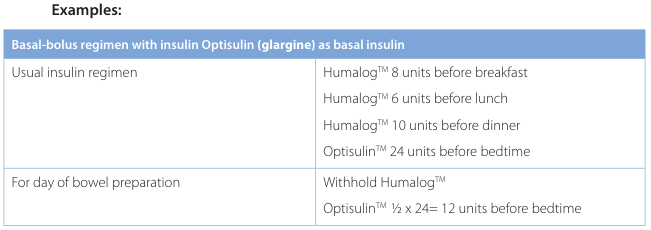
Examples: <table><thead><tr><th colspan="2">Basal-bolus regimen with insulin Optisulin (glargine) as basal insulin</th></tr></thead><tbody><tr><td>Usual insulin regimen</td><td>Humalog™ 8 units before breakfast<br>Humalog™ 6 units before lunch<br>Humalog™ 10 units before dinner<br>Optisulin™ 24 units before bedtime</td></tr><tr><td>For day of bowel preparation</td><td>Withhold Humalog™<br>Optisulin™ ½ x 24= 12 units before bedtime</td></tr></tbody></table>
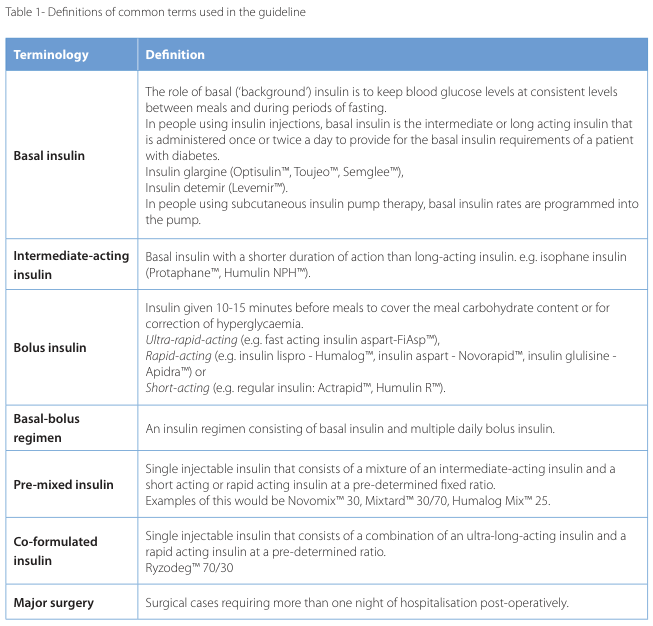
Table 1- Definitions of common terms used in the guideline <table><thead><tr><th>Terminology</th><th>Definition</th></tr></thead><tbody><tr><td>Basal insulin</td><td>The role of basal ('background') insulin is to keep blood glucose levels at consistent levels between meals and during periods of fasting.<br>In people using insulin injections, basal insulin is the intermediate or long acting insulin that is administered once or twice a day to provide for the basal insulin requirements of a patient with diabetes.<br>Insulin glargine (Optisulim™, Toujeo™, Semglee™),<br>Insulin detemir (Levemir™).<br>In people using subcutaneous insulin pump therapy, basal insulin rates are programmed into the pump.</td></tr><tr><td>Intermediate-acting insulin</td><td>Basal insulin with a shorter duration of action than long-acting insulin, e.g. isophane insulin (Protaphane™, Humulin NPH™).</td></tr><tr><td>Bolus insulin</td><td>Insulin given 10-15 minutes before meals to cover the meal carbohydrate content or for correction of hyperglycaemia.<br>Ultra-rapid-acting (e.g. fast acting insulin aspart-FiAsp™),<br>Rapid-acting (e.g. insulin lispro - Humalog™, insulin aspart - Novorapid™, insulin glulisine - Apidra™) or<br>Short-acting (e.g. regular insulin: Actrapid™, Humulin R™).</td></tr><tr><td>Basal-bolus regimen</td><td>An insulin regimen consisting of basal insulin and multiple daily bolus insulin.</td></tr><tr><td>Pre-mixed insulin</td><td>Single injectable insulin that consists of a mixture of an intermediate-acting insulin and a short acting or rapid acting insulin at a pre-determined fixed ratio.<br>Examples of this would be Novomix™ 30, Mixtard™ 30/70, Humalog Mix™ 25.</td></tr><tr><td>Co-formulated insulin</td><td>Single injectable insulin that consists of a combination of an ultra-long-acting insulin and a rapid acting insulin at a pre-determined ratio.<br>Ryzodeg™ 70/30</td></tr><tr><td>Major surgery</td><td>Surgical cases requiring more than one night of hospitalisation post-operatively.</td></tr></tbody></table>
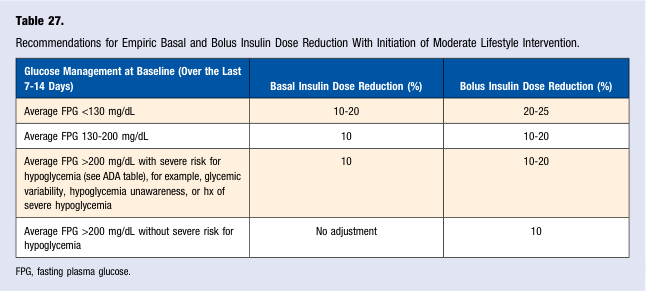
Table 27. Recommendations for Empiric Basal and Bolus Insulin Dose Reduction With Initiation of Moderate Lifestyle Intervention. <table><thead><tr><th>Glucose Management at Baseline (Over the Last 7-14 Days)</th><th>Basal Insulin Dose Reduction (%)</th><th>Bolus Insulin Dose Reduction (%)</th></tr></thead><tbody><tr><td>Average FPG <130 mg/dL</td><td>10-20</td><td>20-25</td></tr><tr><td>Average FPG 130-200 mg/dL</td><td>10</td><td>10-20</td></tr><tr><td>Average FPG >200 mg/dL with severe risk for hypoglycemia (see ADA table), for example, glycemic variability, hypoglycemia unawareness, or hx of severe hypoglycemia</td><td>10</td><td>10-20</td></tr><tr><td>Average FPG >200 mg/dL without severe risk for hypoglycemia</td><td>No adjustment</td><td>10</td></tr></tbody></table> FPG, fasting plasma glucose.
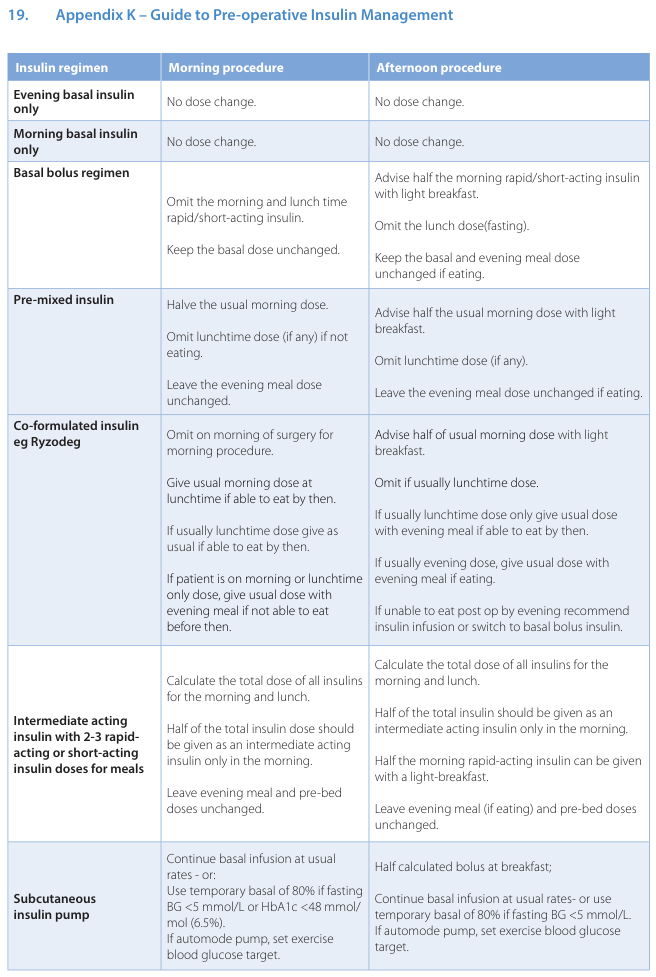
19. Appendix K – Guide to Pre-operative Insulin Management <table><thead><tr><th>Insulin regimen</th><th>Morning procedure</th><th>Afternoon procedure</th></tr></thead><tbody><tr><td>Evening basal insulin only</td><td>No dose change.</td><td>No dose change.</td></tr><tr><td>Morning basal insulin only</td><td>No dose change.</td><td>No dose change.</td></tr><tr><td>Basal bolus regimen</td><td>Omit the morning and lunch time rapid/short-acting insulin. Keep the basal dose unchanged.</td><td>Advise half the morning rapid/short-acting insulin with light breakfast. Omit the lunch dose(fasting). Keep the basal and evening meal dose unchanged if eating.</td></tr><tr><td>Pre-mixed insulin</td><td>Halve the usual morning dose. Omit lunchtime dose (if any) if not eating. Leave the evening meal dose unchanged.</td><td>Advise half the usual morning dose with light breakfast. Omit lunchtime dose (if any). Leave the evening meal dose unchanged if eating.</td></tr><tr><td>Co-formulated insulin eg Ryzodeg</td><td>Omit on morning of surgery for morning procedure. Give usual morning dose at lunchtime if able to eat by then. If usually lunchtime dose give as usual if able to eat by then. If patient is on morning or lunchtime only dose, give usual dose with evening meal if not able to eat before then.</td><td>Advise half of usual morning dose with light breakfast. Omit if usually lunchtime dose. If usually lunchtime dose only give usual dose with evening meal if able to eat by then. If usually evening dose, give usual dose with evening meal if eating. If unable to eat post op by evening recommend insulin infusion or switch to basal bolus insulin.</td></tr><tr><td>Intermediate acting insulin with 2-3 rapid-acting or short-acting insulin doses for meals</td><td>Calculate the total dose of all insulins for the morning and lunch. Half of the total insulin dose should be given as an intermediate acting insulin only in the morning. Leave evening meal and pre-bed doses unchanged.</td><td>Calculate the total dose of all insulins for the morning and lunch. Half of the total insulin should be given as an intermediate acting insulin only in the morning. Half the morning rapid-acting insulin can be given with a light-breakfast. Leave evening meal (if eating) and pre-bed doses unchanged.</td></tr><tr><td>Subcutaneous insulin pump</td><td>Continue basal infusion at usual rates - or: Use temporary basal of 80% if fasting BG <5 mmol/L or HbA1c <48 mmol/mol (6.5%). If automode pump, set exercise blood glucose target.</td><td>Half calculated bolus at breakfast; Continue basal infusion at usual rates- or use temporary basal of 80% if fasting BG <5 mmol/L. If automode pump, set exercise blood glucose target.</td></tr></tbody></table>
Basal Dose and Bolus Dose of Insulin
Physiological Background
- Continuous low-level (basal) secretion - suppresses hepatic glucose output between meals and overnight
- Sharp meal-stimulated (bolus) secretion - covers postprandial glucose rise
Basal Insulin
Definition
Agents Used
| Type | Examples | Onset | Duration |
|---|---|---|---|
| Long-acting | Insulin glargine (Toujeo, Semglee), Insulin degludec | 1-4 hrs | ~24 hrs (glargine), >42 hrs (degludec) |
| Intermediate-acting | NPH (Protaphane, Humulin NPH) | 2-4 hrs | 12-18 hrs |
- Glargine and detemir both have a relatively flat time-action profile (minimal peak), making them ideal basal insulins
- Degludec has minimal peak activity and ultra-long duration
Dosing
- Basal insulin = 50% of the Total Daily Dose (TDD)
- TDD is calculated as: weight (kg) × 0.7 units
- Example: 70 kg patient → TDD = 49 units → basal dose ≈ 25 units/day
- Titration: increase by 1 unit/day until fasting blood glucose is < 100 mg/dL
- Injected at a consistent time each day (usually evening/bedtime)
Key Purpose
Bolus (Prandial) Insulin
Definition
Agents Used
| Type | Examples | Onset | Peak | Duration |
|---|---|---|---|---|
| Rapid-acting | Insulin lispro (Humalog), Aspart (Novorapid), Glulisine (Apidra) | 10-15 min | ~1 hr | 3-4 hrs |
| Ultra-rapid-acting | Fast-acting insulin aspart (FiAsp) | ~5 min | Faster | Shorter |
| Short-acting (regular) | Actrapid, Humulin R | 30-45 min | 2-3 hrs | 6-8 hrs |
- Regular insulin must be injected 30-45 minutes before meals
- Rapid-acting analogues are injected <10 minutes before meals (or just after)
Dosing
- Bolus insulin = 50% of TDD (split across meals)
- Baseline prandial dose: 0.1 units/kg/meal
- Example: 70 kg patient → 7 units of rapid-acting insulin per meal
Components of Bolus Dose
-
Meal (nutritional) component - based on carbohydrate content
- Insulin-to-carbohydrate ratio (ICR): commonly 1 unit per 10-15 g of carbohydrate (must be individualized)
-
Correction (supplemental) component - corrects high pre-meal glucose
- Formula: 1 unit for every 30-60 mg/dL above the pre-meal glucose target
- Correction factor can be estimated as: 1500 ÷ total daily insulin dose
- Harrison's Principles of Internal Medicine 22E, p. 3254
Basal-Bolus Regimen (Multiple Daily Injections - MDI)
- Typically involves 1 injection of long-acting insulin (basal) + 3 injections of rapid-acting insulin (one before each meal)
- Alternatively delivered via continuous subcutaneous insulin infusion (CSII) - insulin pump therapy
- The dose of long-acting insulin is adjusted based on fasting glucose
- The rapid-acting dose is adjusted based on pre-meal glucose + anticipated carbohydrate intake
Starting a Basal-Bolus Regimen (Summary)
| Step | Action |
|---|---|
| 1 | Calculate TDD = weight (kg) × 0.7 |
| 2 | Basal = 50% of TDD; Bolus = 50% of TDD |
| 3 | Prandial dose = 0.1 units/kg/meal |
| 4 | Inject rapid-acting insulin 15 min before meals |
| 5 | Adjust basal by +1 unit/day until fasting glucose < 100 mg/dL |
| 6 | Adjust bolus using ICR and correction factor |
Visual Reference
Key Differences at a Glance
| Feature | Basal Insulin | Bolus Insulin |
|---|---|---|
| Purpose | Fasting glucose control | Postprandial glucose control |
| Timing | Once daily (consistent time) | Before each meal |
| Agents | Glargine, Degludec, NPH | Lispro, Aspart, Glulisine, Regular |
| % of TDD | ~50% | ~50% |
| Action profile | Flat, peakless | Sharp peak, short duration |
| Adjusted by | Fasting glucose | Pre-meal glucose + carb intake |
| Hypoglycemia risk | Nocturnal/fasting | Postprandial |