
Give me a flow chart regarding pathophysiology of fresh and salt water drowning according to narayan reddy
A detailed medical flowchart titled "Pathophysiology of Drowning - Fresh Water vs Salt Water (Narayan Reddy)" split into two parallel columns. LEFT COLUMN - FRESH WATER DROWNING: Start box: "Aspiration of FRESH WATER (hypotonic, 0.05% NaCl) into alveoli" Arrow down: "Osmotic gradient: water moves FROM alveoli INTO bloodstream (hypotonic fluid absorbed)" Arrow down: "HYPERVOLEMIA - Blood volume increases by up to 50%" Arrow down to three branches: Branch 1: "HEMODILUTION → Hemolysis of RBCs → Hemoglobinemia → Hemoglobinuria → Relative anemia" Branch 2: "Electrolyte disturbance → Hyponatremia ↓Na+ → Hyperkalemia ↑K+ → ↓Ca2+ (to 2 mEq/L)" Branch 3: "Surfactant DENATURED/destroyed → Alveolar collapse → ↓ Lung compliance → V/Q mismatch" These branches converge to: "Cardiac overload: Heart subjected to hypoxia + overfilling + Na deficit + K excess" Arrow down: "Ventricular arrhythmia → Ventricular tachycardia → VENTRICULAR FIBRILLATION" Arrow down: "DEATH in 3-5 minutes from anoxia + disturbed Na/K ratio" RIGHT COLUMN - SALT WATER DROWNING: Start box: "Aspiration of SALT WATER (hypertonic, >3% NaCl) into alveoli" Arrow down: "Osmotic gradient: water moves FROM bloodstream INTO alveoli (plasma drawn into lung)" Arrow down: "HEMOCONCENTRATION - ↑blood viscosity, ↑plasma osmolarity" Arrow down to two branches: Branch 1: "Electrolyte disturbance → Hypernatremia ↑Na+ → Salts pass from lungs into bloodstream → ↑K/Na ratio → RBCs CRENATED" Branch 2: "Severe pulmonary edema → Frothy fluid in alveoli → Airway obstruction → Asphyxia" These branches converge to: "Marked bradycardia (due to raised plasma Na+) → Myocardial anoxia + increased blood viscosity" Arrow down: "Heart failure from myocardial anoxia" Arrow down: "SLOW DEATH from ASPHYXIA in 8-10 minutes" At bottom center a comparison box: "Key Difference: Fresh water - HEMODILUTION (more dangerous) | Salt water - HEMOCONCENTRATION. Fresh water RBCs: LYSED | Salt water RBCs: CRENATED. Both cause: Pulmonary edema, V/Q mismatch, Metabolic acidosis, ARDS (if survived)" Use clean clinical diagram style with light blue for fresh water side and orange/tan for salt water side, clear arrows, white background, professional medical textbook appearance.
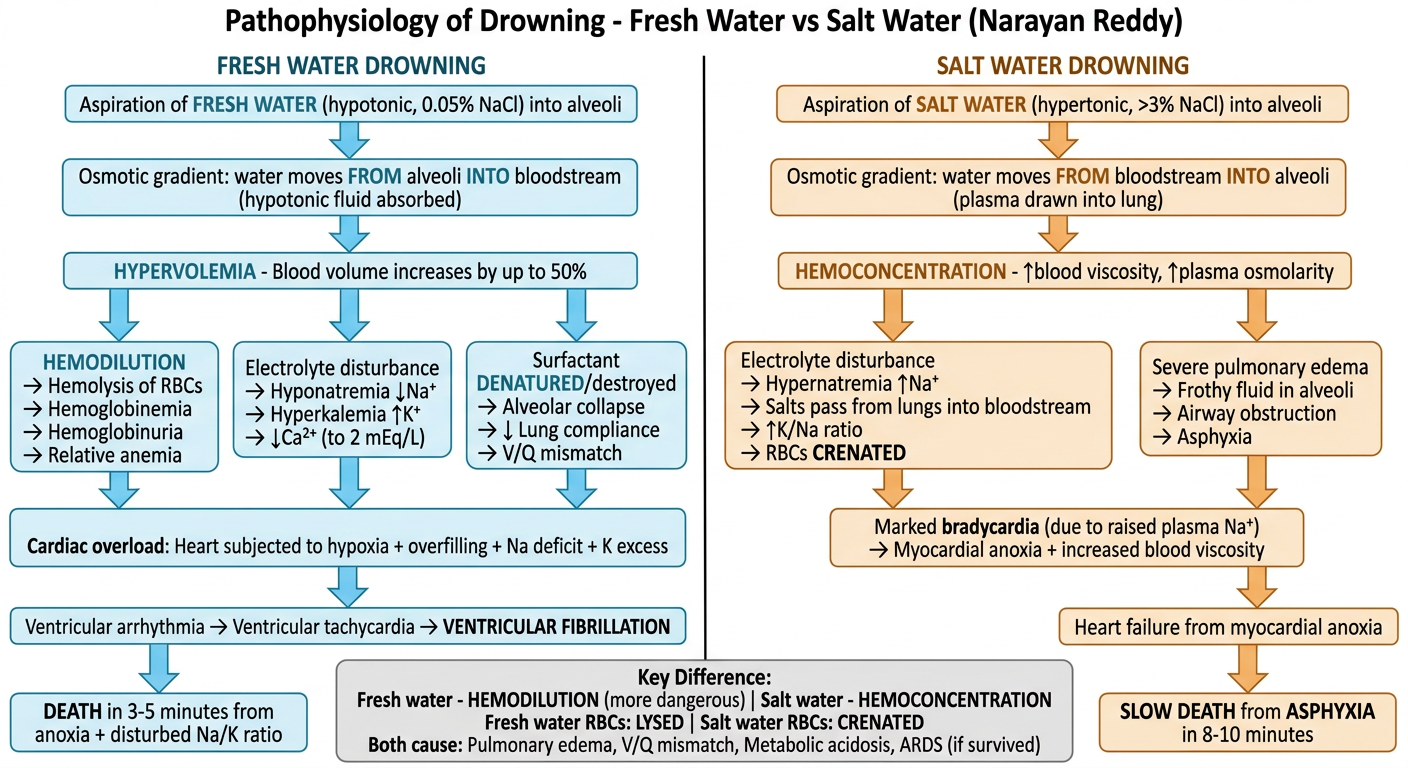
Summary of the Pathophysiology (Narayan Reddy)
Fresh Water Drowning
- Hypervolemia - Blood volume may rise by 50%, straining the heart
- Hemodilution - Leads to hemolysis of RBCs, hemoglobinemia, hemoglobinuria, relative anaemia
- Electrolytes - Marked hyponatremia (↓Na+), hyperkalemia (↑K+), calcium falls to ~2 mEq/L
- Surfactant denatured - Alveolar collapse, ↓lung compliance, V/Q mismatch (up to 75% blood perfusing non-ventilated areas)
- Result - Pulmonary oedema, cardiac arrhythmias → ventricular tachycardia → ventricular fibrillation
- Fatal period - Death in 3-5 minutes
Salt Water Drowning
- Hemoconcentration - Increased blood viscosity, raised plasma sodium
- Severe pulmonary oedema - From plasma drawn into alveoli
- Hypernatremia - Salts also pass from alveoli back into blood
- RBCs crenated (not lysed, unlike fresh water)
- Marked bradycardia - Due to raised plasma Na+; heart failure from myocardial anoxia
- Result - Slow asphyxia
- Fatal period - Death in 8-10 minutes
Key Comparison (Narayan Reddy)
| Feature | Fresh Water | Salt Water |
|---|---|---|
| Water movement | Alveoli → Blood | Blood → Alveoli |
| Blood volume | Hypervolemia (+50%) | Hemoconcentration |
| Sodium | Hyponatremia ↓ | Hypernatremia ↑ |
| Potassium | Hyperkalemia ↑ | ↑ K/Na ratio |
| RBC change | Lysed (haemolysis) | Crenated |
| Surfactant | Denatured | Diluted/washed away |
| Cause of death | Ventricular fibrillation | Asphyxia / Heart failure |
| Fatal period | 3-5 minutes | 8-10 minutes |
| Relative danger | More dangerous (hemodilution) | Less dangerous |
"Hemodilution is far more dangerous than hemoconcentration." - Narayan Reddy, Essentials of Forensic Medicine & Toxicology, 36th ed., p. 361