
Predictive markers of liver function.
Reading File
Predictive markers of liver function include serum enzymes (ALT, AST, ALP, GGT), synthetic markers (albumin, prothrombin time/INR, fibrinogen), excretory markers (bilirubin), and newer fibrosis markers (FIB-4, APRI, ELF score). These help assess hepatocyte integrity, synthetic capacity, biliary function, and fibrotic change.
Searching sources...
Finding Sources
Finding Sources
Searching PubMed
"liver function" AND "predictive markers" AND biomarkers
Finding Sources
Finding Sources
Searching PubMed
"liver function tests" AND biomarkers AND hepatic
Good - I have useful leads. Let me read the key sections from Harrison's and Henry's (the most authoritative sources for this topic).
Reading File
Reading File
Excellent - rich content. Now let me read more of Harrison's evaluation of liver function section and also the Sleisenger section on tests.
Reading File
Reading File
Reading File
I have very rich content now. Let me read a little more of the Harrison's section to capture the synthetic markers and MELD score information.
Reading File
I now have comprehensive content from Harrison's and Henry's. Let me also fetch the diagnostic algorithm image from Harrison's.
Loading Image
I now have all the information needed for a comprehensive, well-structured answer. Let me compile it.
Predictive Markers of Liver Function
Liver function testing involves multiple categories of markers, each reflecting a different aspect of hepatic physiology - cell integrity, synthetic capacity, excretory function, and biliary flow. No single test captures the liver's total functional capacity; a battery of tests is required for meaningful clinical prediction.
1. Markers of Hepatocellular Integrity (Cell Damage Markers)
These detect liver cell injury rather than function per se, but are critical predictors of the degree of hepatic damage.
Aminotransferases (Transaminases)
| Enzyme | Full Name | Primary Source | Specificity |
|---|---|---|---|
| ALT | Alanine aminotransferase | Primarily liver | More specific for liver injury |
| AST | Aspartate aminotransferase | Liver, cardiac/skeletal muscle, kidneys, brain, RBCs | Less specific |
- Both enzymes are released into the blood when hepatocyte membrane permeability increases - cell necrosis is not required.
- They are the most sensitive indicators of acute hepatocellular disease (hepatitis, toxic injury, ischaemia).
- Normal serum levels are low (ALT: ~7-56 U/L; AST: ~10-40 U/L).
- ALT/AST ratio: an AST:ALT ratio >2:1 suggests alcoholic liver disease (due to pyridoxine B6 deficiency impairing ALT synthesis). A ratio >3:1 is strongly suggestive.
- Massive elevations (>1000 U/L) point to acute viral hepatitis, drug/toxin-induced hepatitis, or ischaemic hepatitis.
- Lactate dehydrogenase (LDH) also rises with hepatocyte injury but is non-specific.
"ALT is found primarily in the liver and is therefore a more specific indicator of liver injury." - Harrison's Principles of Internal Medicine 22E
2. Markers of Cholestasis (Biliary Obstruction)
Alkaline Phosphatase (ALP)
- Located on the canalicular surface of hepatocytes.
- Elevated in intrahepatic or extrahepatic cholestasis, infiltrative liver disease, and space-occupying lesions.
- Non-specific: also elevated in bone disease, pregnancy, growth. Fractionation (or GGT/5'-NT confirmation) identifies hepatic origin.
- Normal range: ~44-147 U/L (adult). Elevated in children due to bone growth.
Gamma-Glutamyl Transferase (GGT)
- Located on the hepatic surface of canalicular membranes.
- Elevated in cholestasis, alcoholic liver disease, and drug-induced liver disease.
- Not elevated in bone disease - so if ALP is elevated with a normal GGT, bone disease is more likely.
- Highly sensitive but not very specific (elevated by alcohol, many drugs, fatty liver).
5'-Nucleotidase (5'-NT)
- Like GGT, confirms that an elevated ALP is of hepatic rather than bone origin.
- Elevated specifically in biliary/cholestatic disease.
Serum Bilirubin
- Total bilirubin = conjugated (direct) + unconjugated (indirect).
- Normal total bilirubin: 0.2-0.9 mg/dL (95th percentile); upper limit ~1-1.5 mg/dL.
- Conjugated hyperbilirubinemia almost always indicates liver or biliary tract disease (rate-limiting step = transport into bile canaliculi, not conjugation).
- Unconjugated hyperbilirubinemia without conjugated fraction suggests haemolysis or Gilbert's syndrome.
- Predictive value: Total bilirubin has strong prognostic significance -
- Higher bilirubin = greater hepatocellular damage in viral hepatitis
- Correlates with mortality in alcoholic hepatitis
- Key component of MELD 3.0 score (organ allocation, transplant survival prediction)
- Prognostic marker in primary biliary cholangitis
- Indicates severity in drug-induced liver injury
3. Markers of Hepatic Synthetic Function
These are the true functional markers - they fall only when >80% of liver tissue is destroyed.
Serum Albumin
- Synthesized exclusively by hepatocytes; comprises nearly all plasma albumin.
- Normal: 3.5-5.0 g/dL.
- Half-life: ~3 weeks - therefore not a reliable marker of acute liver injury. Useful in chronic disease (cirrhosis, chronic hepatitis).
- Falls in advanced cirrhosis, fulminant hepatic failure, and protein-losing states.
- Hypoalbuminaemia indicates reduced synthetic capacity, but is also influenced by nutritional state, protein loss (nephrotic syndrome, protein-losing enteropathy), and distribution volume.
Prothrombin Time (PT) / INR
- The single best acute measure of hepatic synthetic function.
- All clotting factors except factor VIII are made exclusively in hepatocytes.
- Half-lives range from 6 hours (factor VII) to 5 days (fibrinogen) - much shorter than albumin.
- PT collectively reflects factors II, V, VII, and X.
- Predictive value:
- PT prolongation >5 seconds above control, not corrected by parenteral vitamin K, is a poor prognostic sign in acute viral hepatitis and other acute liver diseases.
- Must distinguish vitamin K deficiency (obstructive jaundice, fat malabsorption) - responsive to IV vitamin K - from true synthetic failure (not responsive).
- INR is a component of the MELD 3.0 score.
Serum Ammonia
- Liver is the only organ that can metabolise ammonia (via the Krebs-Henseleit urea cycle).
- Elevated ammonia occurs only when >80% of liver tissue is destroyed or in portal-systemic shunting.
- Limitations: poor correlation with the presence or severity of hepatic encephalopathy.
- Elevated arterial ammonia does correlate with outcome in fulminant hepatic failure.
- Useful for identifying occult liver disease in patients with altered mental status.
Other Synthetic Markers
| Marker | Comment |
|---|---|
| Serum cholesterol | Falls in severe hepatocellular failure (liver synthesises cholesterol); elevated in cholestasis |
| Plasma pseudocholinesterase | Synthesised by liver; falls in hepatocellular disease |
| Serum total protein | Decreases when >80% of liver is destroyed |
| Blood glucose | Hypoglycaemia in acute liver failure (impaired gluconeogenesis/glycogenolysis) |
| Fibrinogen | Short half-life; falls in acute synthetic failure |
4. Non-Invasive Fibrosis Markers (Newer Predictive Tools)
Used to detect hepatic fibrosis without biopsy - important for staging chronic liver disease.
| Score/Test | Components | Use |
|---|---|---|
| MELD 3.0 | Bilirubin + INR + creatinine + albumin + sodium (+ sex) | Predicts 90-day mortality; organ allocation |
| FIB-4 | Age + AST + ALT + platelet count | Non-invasive fibrosis staging (NAFLD, NASH, viral hepatitis) |
| APRI | AST + platelet count | Hepatic fibrosis and cirrhosis (hepatitis C) |
| Enhanced Liver Fibrosis (ELF) score | TIMP-1 + PIIINP + hyaluronic acid | Serum-based fibrosis score |
| Transient elastography (FibroScan) | Liver stiffness (kPa) | Gold standard non-invasive fibrosis assessment |
| Child-Pugh score | Bilirubin + albumin + PT + ascites + encephalopathy | Cirrhosis severity and surgical risk |
5. Diagnostic Pattern Recognition
Combining markers into patterns helps localise the type of liver disease:
| Pattern | Predominant Abnormality | Likely Disease |
|---|---|---|
| Hepatocellular | AST/ALT markedly elevated; mild ALP | Acute hepatitis, toxic injury, ischaemia |
| Cholestatic | ALP/GGT markedly elevated; mild AST/ALT; elevated conjugated bilirubin | Biliary obstruction, PBC, PSC, drug-induced cholestasis |
| Synthetic failure | Low albumin, prolonged PT/INR | Cirrhosis, fulminant hepatic failure |
| Mixed | ALP + aminotransferase elevation | Infiltrative disease, drug injury, alcoholic hepatitis |
| Isolated bilirubin rise (unconjugated) | No enzyme elevation | Haemolysis, Gilbert's syndrome |
The diagnostic algorithm for abnormal liver tests is shown below:
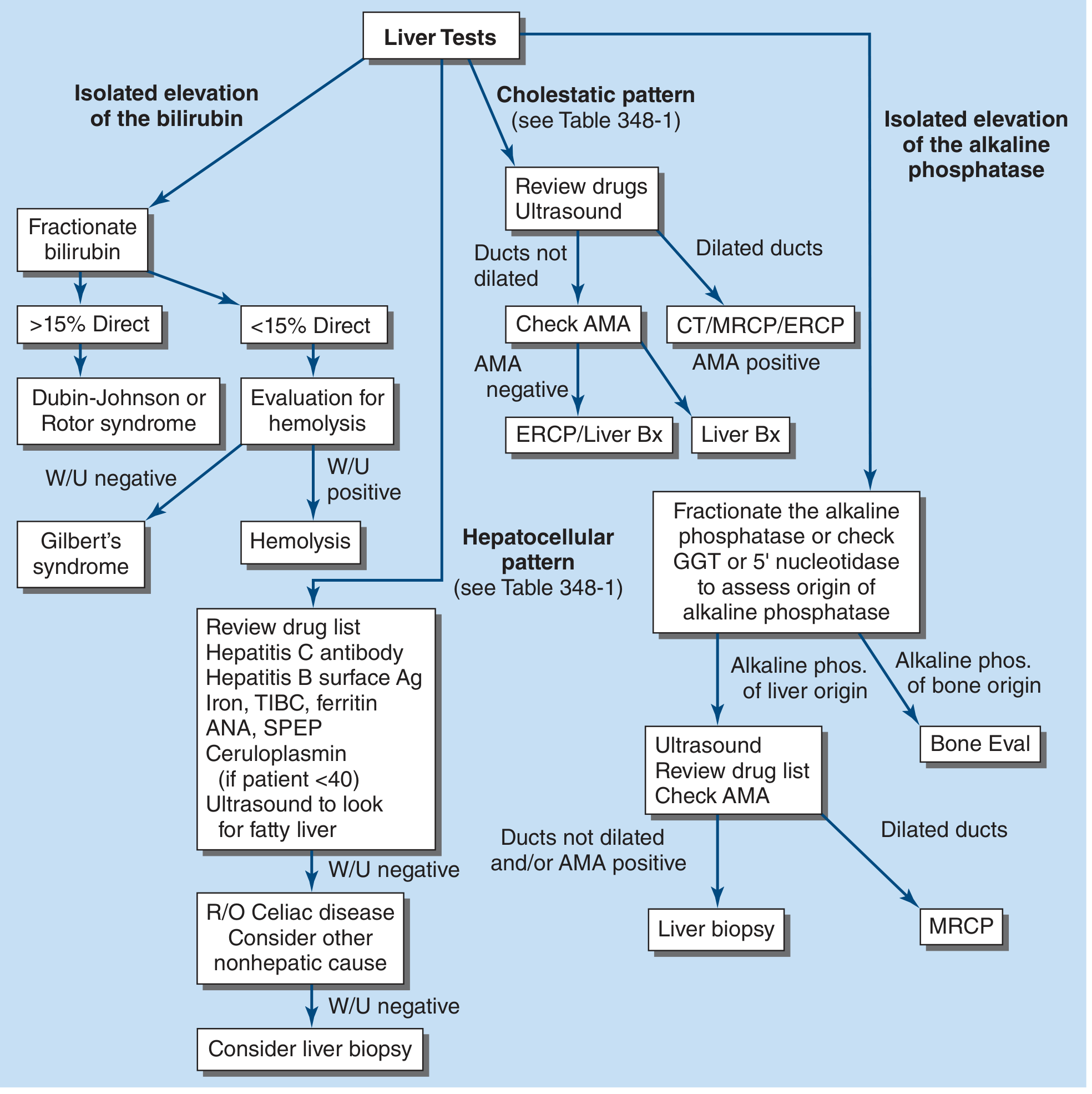
FIGURE: Algorithm for evaluation of chronically abnormal liver tests (Harrison's Principles of Internal Medicine 22E, Chapter 348)
Summary Table: Predictive Markers at a Glance
| Marker | What It Measures | Best Use |
|---|---|---|
| ALT | Hepatocyte injury | Detecting active liver cell damage |
| AST | Hepatocyte injury (less specific) | Alcoholic hepatitis when AST:ALT >2 |
| ALP | Biliary/cholestatic disease | Cholestasis, infiltrative disease |
| GGT | Biliary disease; alcohol; drugs | Confirming hepatic origin of ALP |
| Total bilirubin | Excretory function | Prognosis in hepatitis, cholestasis; MELD |
| Albumin | Chronic synthetic function | Staging cirrhosis; chronic disease |
| PT/INR | Acute synthetic function | Prognosis in acute hepatic failure; MELD |
| Ammonia | Urea cycle function | Encephalopathy workup; fulminant failure |
| FIB-4/APRI | Fibrosis stage | Non-invasive staging of chronic liver disease |
| MELD 3.0 | Overall decompensation | Transplant allocation; mortality prediction |
Sources:
- Harrison's Principles of Internal Medicine 22E, Chapter 348: Evaluation of Liver Function (Emily D. Bethea, Daniel S. Pratt)
- Henry's Clinical Diagnosis and Management by Laboratory Methods, Chapter: Liver Function Tests
- Sleisenger and Fordtran's Gastrointestinal and Liver Disease
- Morgan and Mikhail's Clinical Anesthesiology, 7e
Create a reference guide PDF on liver function tests for clinical use
Reading File
Reading File
Running Command
mkdir -p /tmp/workspace/lft-reference && ls /tmp/workspace/
Writing File
~/lft-reference/build_lft_pdf.py
"""
Clinical Reference Guide: Liver Function Tests
Builds a professional multi-page PDF using ReportLab.
"""
from reportlab.platypus import (
SimpleDocTemplate, Paragraph, Spacer, Table, TableStyle,
HRFlowable, PageBreak, KeepTogether
)
from reportlab.lib.styles import getSampleStyleSheet, ParagraphStyle
from reportlab.lib import colors
from reportlab.lib.units import cm
from reportlab.lib.pagesizes import A4
from reportlab.lib.enums import TA_CENTER, TA_LEFT, TA_RIGHT
from reportlab.platypus import Flowable
OUTPUT = "/tmp/workspace/lft-reference/LFT_Clinical_Reference_Guide.pdf"
# ─── Colour palette ───────────────────────────────────────────────────────────
NAVY = colors.HexColor("#1B3A6B")
TEAL = colors.HexColor("#0F7173")
LIGHT_TEAL = colors.HexColor("#D6EFEF")
AMBER = colors.HexColor("#E87722")
LIGHT_AMBER= colors.HexColor("#FFF3E0")
GREY_LIGHT = colors.HexColor("#F4F6F9")
GREY_MID = colors.HexColor("#CDD5E0")
WHITE = colors.white
RED_LIGHT = colors.HexColor("#FDECEA")
RED = colors.HexColor("#C0392B")
GREEN_LIGHT= colors.HexColor("#E8F5E9")
GREEN = colors.HexColor("#1B6B2F")
# ─── Document setup ───────────────────────────────────────────────────────────
doc = SimpleDocTemplate(
OUTPUT,
pagesize=A4,
leftMargin=1.8*cm, rightMargin=1.8*cm,
topMargin=2.0*cm, bottomMargin=2.0*cm,
title="Liver Function Tests – Clinical Reference Guide",
author="Orris Clinical Reference",
subject="Hepatology / Biochemistry",
)
PAGE_W = A4[0] - 3.6*cm # usable width
# ─── Styles ───────────────────────────────────────────────────────────────────
base = getSampleStyleSheet()
def ps(name, parent="Normal", **kw):
return ParagraphStyle(name, parent=base[parent], **kw)
sTitle = ps("sTitle", "Title",
fontSize=26, textColor=WHITE, leading=32,
spaceAfter=4, alignment=TA_CENTER, fontName="Helvetica-Bold")
sSubtitle = ps("sSubtitle",
fontSize=12, textColor=WHITE, leading=16,
spaceAfter=2, alignment=TA_CENTER, fontName="Helvetica")
sH1 = ps("sH1",
fontSize=13, textColor=WHITE, leading=18,
spaceBefore=8, spaceAfter=4,
fontName="Helvetica-Bold", alignment=TA_LEFT)
sH2 = ps("sH2",
fontSize=11, textColor=NAVY, leading=15,
spaceBefore=10, spaceAfter=3,
fontName="Helvetica-Bold")
sH3 = ps("sH3",
fontSize=10, textColor=TEAL, leading=14,
spaceBefore=6, spaceAfter=2,
fontName="Helvetica-Bold")
sBody = ps("sBody",
fontSize=9, leading=13, spaceAfter=4,
fontName="Helvetica", textColor=colors.HexColor("#1A1A2E"))
sBullet = ps("sBullet",
fontSize=9, leading=13, spaceAfter=2,
leftIndent=14, firstLineIndent=-10,
fontName="Helvetica", textColor=colors.HexColor("#1A1A2E"))
sSmall = ps("sSmall",
fontSize=7.5, leading=11, spaceAfter=2,
fontName="Helvetica", textColor=colors.HexColor("#555555"))
sNote = ps("sNote",
fontSize=8.5, leading=12, spaceAfter=2,
fontName="Helvetica-Oblique", textColor=colors.HexColor("#444444"))
sFooter = ps("sFooter",
fontSize=7, leading=10,
fontName="Helvetica", textColor=colors.HexColor("#888888"),
alignment=TA_CENTER)
sTH = ps("sTH",
fontSize=8.5, leading=12, fontName="Helvetica-Bold",
textColor=WHITE, alignment=TA_CENTER)
sTD = ps("sTD",
fontSize=8.5, leading=12, fontName="Helvetica",
textColor=colors.HexColor("#1A1A2E"), alignment=TA_LEFT)
sTDc = ps("sTDc",
fontSize=8.5, leading=12, fontName="Helvetica",
textColor=colors.HexColor("#1A1A2E"), alignment=TA_CENTER)
sTDbold = ps("sTDbold",
fontSize=8.5, leading=12, fontName="Helvetica-Bold",
textColor=NAVY, alignment=TA_LEFT)
sAlert = ps("sAlert",
fontSize=8.5, leading=12, fontName="Helvetica-Bold",
textColor=RED, alignment=TA_LEFT)
# ─── Helper: coloured section header band ────────────────────────────────────
class SectionBand(Flowable):
def __init__(self, text, bg=NAVY, width=None, height=24):
super().__init__()
self.text = text
self.bg = bg
self._width = width
self.height = height
def wrap(self, availW, availH):
self._width = self._width or availW
return self._width, self.height
def draw(self):
c = self.canv
c.setFillColor(self.bg)
c.roundRect(0, 0, self._width, self.height, 4, fill=1, stroke=0)
c.setFillColor(WHITE)
c.setFont("Helvetica-Bold", 11)
c.drawString(10, 7, self.text)
class TitleBanner(Flowable):
"""Full-width decorative title banner."""
def __init__(self, title, subtitle, width=None):
super().__init__()
self.title = title
self.subtitle = subtitle
self._width = width
self.height = 90
def wrap(self, availW, availH):
self._width = self._width or availW
return self._width, self.height
def draw(self):
c = self.canv
w, h = self._width, self.height
# Gradient-like block
c.setFillColor(NAVY)
c.roundRect(0, 0, w, h, 6, fill=1, stroke=0)
# Accent stripe
c.setFillColor(TEAL)
c.rect(0, 0, 6, h, fill=1, stroke=0)
# Amber accent line at top
c.setFillColor(AMBER)
c.rect(0, h-4, w, 4, fill=1, stroke=0)
# Title text
c.setFillColor(WHITE)
c.setFont("Helvetica-Bold", 22)
c.drawCentredString(w/2, h-36, self.title)
# Subtitle
c.setFont("Helvetica", 10)
c.setFillColor(LIGHT_TEAL)
c.drawCentredString(w/2, h-52, self.subtitle)
# Footer line in banner
c.setFillColor(colors.HexColor("#AACCCC"))
c.setFont("Helvetica-Oblique", 8)
c.drawCentredString(w/2, 8, "Sources: Harrison's Principles of Internal Medicine 22E · Henry's Clinical Diagnosis · Sleisenger & Fordtran")
def make_table(data, col_widths, header_bg=NAVY, stripe=True, font_size=8.5):
"""Build a styled table. data[0] is header row."""
cell_data = []
for i, row in enumerate(data):
cell_row = []
for j, cell in enumerate(row):
if i == 0:
cell_row.append(Paragraph(str(cell), sTH))
else:
p = sTDbold if j == 0 else sTD
cell_row.append(Paragraph(str(cell), p))
cell_data.append(cell_row)
cmds = [
("BACKGROUND", (0,0), (-1,0), header_bg),
("ROWBACKGROUNDS", (0,1), (-1,-1), [WHITE, GREY_LIGHT]),
("GRID", (0,0), (-1,-1), 0.4, GREY_MID),
("LINEBELOW", (0,0), (-1,0), 1.0, header_bg),
("VALIGN", (0,0), (-1,-1), "MIDDLE"),
("TOPPADDING", (0,0), (-1,-1), 4),
("BOTTOMPADDING",(0,0), (-1,-1), 4),
("LEFTPADDING", (0,0), (-1,-1), 6),
("RIGHTPADDING", (0,0), (-1,-1), 6),
]
t = Table(cell_data, colWidths=col_widths, repeatRows=1)
t.setStyle(TableStyle(cmds))
return t
def make_alert_box(text, bg=LIGHT_AMBER, border=AMBER):
"""Coloured alert/tip box."""
inner = Table(
[[Paragraph(text, sBody)]],
colWidths=[PAGE_W - 1.2*cm]
)
inner.setStyle(TableStyle([
("BACKGROUND", (0,0), (-1,-1), bg),
("LINEAFTER", (0,0), (0,-1), 3, border),
("LINEBEFORE", (0,0), (0,-1), 3, border),
("TOPPADDING", (0,0), (-1,-1), 6),
("BOTTOMPADDING", (0,0), (-1,-1), 6),
("LEFTPADDING", (0,0), (-1,-1), 10),
("RIGHTPADDING", (0,0), (-1,-1), 10),
]))
return inner
# ═══════════════════════════════════════════════════════════════════════════════
# BUILD CONTENT
# ═══════════════════════════════════════════════════════════════════════════════
story = []
S = Spacer
def add_section(title, color=NAVY):
story.append(S(1, 10))
story.append(SectionBand(title, bg=color, width=PAGE_W))
story.append(S(1, 6))
# ─── PAGE 1 : COVER / OVERVIEW ───────────────────────────────────────────────
story.append(TitleBanner(
"Liver Function Tests",
"Clinical Reference Guide • Orris Medical • 2026",
width=PAGE_W
))
story.append(S(1, 10))
story.append(Paragraph(
"This guide provides a rapid-access reference for interpreting liver biochemistry panels in clinical practice. "
"Tests are grouped by the hepatic system they reflect: <b>cell integrity</b>, <b>cholestasis</b>, "
"<b>synthetic function</b>, and <b>non-invasive fibrosis staging</b>. "
"No single test captures total liver function — a panel approach is required.",
sBody
))
story.append(S(1, 8))
# KEY POINT BOX
story.append(make_alert_box(
"<b>Key principle:</b> Use LFTs as a battery, not in isolation. "
"Persistent or multi-test abnormalities increase specificity. "
"Aminotransferases detect <i>cell damage</i>; albumin and PT/INR assess true <i>synthetic function</i>.",
bg=LIGHT_TEAL, border=TEAL
))
story.append(S(1, 12))
# OVERVIEW TABLE
add_section("▸ Overview: Categories of Liver Function Tests", NAVY)
overview_data = [
["Category", "Tests", "What It Measures", "Rises / Falls"],
["Hepatocyte integrity", "ALT, AST, LDH", "Cell membrane damage / necrosis", "Rises with injury"],
["Cholestatic / biliary", "ALP, GGT, 5'-NT, Bilirubin (conjugated)", "Bile flow obstruction", "Rises with obstruction"],
["Synthetic function", "Albumin, PT/INR, Fibrinogen, Cholesterol", "Protein & factor production", "Falls with failure"],
["Excretory function", "Total & fractionated Bilirubin", "Conjugation & excretion of bilirubin", "Rises with impairment"],
["Detoxification", "Serum Ammonia", "Urea cycle capacity", "Rises when >80% liver lost"],
["Fibrosis staging", "FIB-4, APRI, ELF score, FibroScan", "Hepatic fibrosis extent", "Rises with fibrosis"],
["Prognostic scores", "MELD 3.0, Child-Pugh", "Decompensation / mortality", "Higher = worse prognosis"],
]
overview_cw = [3.5*cm, 4.5*cm, 5.0*cm, 3.5*cm]
story.append(make_table(overview_data, overview_cw, header_bg=NAVY))
story.append(S(1, 10))
# ─── PAGE 2 : HEPATOCYTE INTEGRITY ───────────────────────────────────────────
story.append(PageBreak())
story.append(TitleBanner(
"Section 1: Hepatocellular Integrity Markers",
"Aminotransferases — Detect cell injury before necrosis occurs",
width=PAGE_W
))
story.append(S(1, 10))
add_section("▸ Aminotransferases (Transaminases)", TEAL)
aminotransferase_data = [
["Enzyme", "Full Name", "Primary Source", "Normal Range", "Specificity"],
["ALT", "Alanine aminotransferase", "Primarily liver", "7–56 U/L", "High for liver injury"],
["AST", "Aspartate aminotransferase", "Liver, cardiac & skeletal muscle,\nkidneys, brain, RBCs", "10–40 U/L", "Lower (multi-organ)"],
["LDH", "Lactate dehydrogenase", "Liver, heart, muscle, RBCs", "140–280 U/L", "Non-specific"],
]
aminotransferase_cw = [2.0*cm, 4.5*cm, 5.0*cm, 2.5*cm, 2.5*cm]
story.append(make_table(aminotransferase_data, aminotransferase_cw, header_bg=TEAL))
story.append(S(1, 8))
story.append(Paragraph("<b>Interpretation rules:</b>", sH3))
bullets_alt = [
"Both ALT and AST are released into blood when hepatocyte membrane permeability increases — <b>cell necrosis is not required</b>.",
"ALT is more liver-specific; AST elevations can originate from muscle, heart, or haemolysis.",
"<b>Massive elevation (>1000 U/L):</b> Acute viral hepatitis, ischaemic hepatitis ('shock liver'), or drug/toxin-induced injury.",
"<b>Moderate elevation (5–15× ULN):</b> Chronic hepatitis B/C, alcoholic hepatitis, autoimmune hepatitis.",
"<b>Mild elevation (<5× ULN):</b> Non-alcoholic fatty liver disease (NAFLD), medications, thyroid disease, coeliac disease.",
]
for b in bullets_alt:
story.append(Paragraph(f"• {b}", sBullet))
story.append(S(1, 8))
add_section("▸ AST:ALT Ratio — Diagnostic Clues", TEAL)
ratio_data = [
["AST:ALT Ratio", "Interpretation", "Classic Cause"],
[">2:1", "Strongly suggests alcoholic aetiology", "Alcoholic liver disease (ALD)"],
[">3:1", "Highly specific for ALD", "Alcoholic hepatitis"],
["~1:1", "Equal elevation", "Viral hepatitis, NAFLD"],
["ALT > AST", "ALT dominates", "Chronic viral hepatitis (HBV, HCV)"],
["Both >1000 U/L", "Massive hepatocellular necrosis", "Ischaemia, acetaminophen toxicity, acute viral hepatitis"],
]
ratio_cw = [3.0*cm, 6.0*cm, 7.0*cm]
story.append(make_table(ratio_data, ratio_cw, header_bg=TEAL))
story.append(S(1, 8))
story.append(make_alert_box(
"<b>Pitfall:</b> AST:ALT ratio >2 in ALD is partly because pyridoxine (vitamin B6) deficiency impairs ALT synthesis more than AST. "
"Elevated AST from myocardial infarction, myopathy, or haemolysis can mimic liver disease — always consider non-hepatic sources.",
bg=RED_LIGHT, border=RED
))
# ─── PAGE 3 : CHOLESTASIS MARKERS ────────────────────────────────────────────
story.append(PageBreak())
story.append(TitleBanner(
"Section 2: Cholestatic & Biliary Markers",
"ALP · GGT · 5'-NT · Bilirubin",
width=PAGE_W
))
story.append(S(1, 10))
add_section("▸ Alkaline Phosphatase (ALP)", NAVY)
story.append(Paragraph(
"ALP is located on the <b>canalicular surface</b> of hepatocytes. Elevated in biliary obstruction, cholestasis, and infiltrative liver disease. "
"Also elevated in bone disease, pregnancy, and normal childhood growth (non-hepatic isoforms). "
"If ALP is elevated in isolation, fractionation or GGT/5'-NT measurement confirms hepatic origin.",
sBody
))
story.append(S(1,4))
alp_data = [
["ALP Level", "Likely Significance"],
["1–3× ULN", "May be non-specific; check GGT/5'-NT"],
["3–10× ULN", "Suggestive of cholestasis or infiltrative disease"],
[">10× ULN", "High likelihood of biliary obstruction or primary biliary cholangitis (PBC)"],
["Elevated + normal GGT", "Likely bone origin (Paget's, growth, fracture, bone mets)"],
["Elevated + elevated GGT", "Confirms hepatic origin"],
]
alp_cw = [3.5*cm, 13.0*cm]
story.append(make_table(alp_data, alp_cw, header_bg=NAVY))
story.append(S(1, 10))
add_section("▸ Gamma-Glutamyl Transferase (GGT)", NAVY)
story.append(Paragraph(
"GGT is on the <b>hepatic (sinusoidal) surface</b> of canalicular membranes. Highly sensitive but not specific. "
"Elevated by cholestasis, alcohol, many drugs (phenytoin, barbiturates, warfarin), and fatty liver disease. "
"<b>Not elevated in bone disease</b> — useful to differentiate hepatic vs. bone ALP.",
sBody
))
story.append(S(1, 10))
add_section("▸ 5'-Nucleotidase (5'-NT)", NAVY)
story.append(Paragraph(
"Like GGT, 5'-NT confirms the hepatic origin of an elevated ALP. Elevated specifically in biliary/cholestatic conditions. "
"Not influenced by alcohol, drugs, or pregnancy to the same degree as GGT.",
sBody
))
story.append(S(1, 10))
add_section("▸ Serum Bilirubin", NAVY)
bili_data = [
["Fraction", "Solubility", "Normal", "Elevated When", "Key Point"],
["Total bilirubin", "—", "0.2–0.9 mg/dL\n(ULN ~1–1.5)", "Any liver/biliary disease,\nhaemolysis", "Used in MELD 3.0"],
["Unconjugated\n(indirect)", "Water-insoluble\n(albumin-bound)", "<85% of total", "Haemolysis, Gilbert's,\nCrigler-Najjar", "Not filtered by kidney;\nno bilirubinuria"],
["Conjugated\n(direct)", "Water-soluble", "<0.3 mg/dL\n(<15% of total)", "Liver disease,\nbiliary obstruction", "Almost always\nimplies hepatobiliary disease"],
]
bili_cw = [2.8*cm, 3.0*cm, 2.8*cm, 4.2*cm, 3.7*cm]
story.append(make_table(bili_data, bili_cw, header_bg=NAVY))
story.append(S(1, 8))
story.append(Paragraph("<b>Prognostic value of total bilirubin:</b>", sH3))
bili_prog = [
"Higher bilirubin = greater hepatocellular damage in acute viral hepatitis.",
"Strongly correlates with mortality in <b>alcoholic hepatitis</b>.",
"Key component of <b>MELD 3.0</b> (predicts 90-day mortality, guides transplant allocation).",
"Prognostic marker in <b>primary biliary cholangitis (PBC)</b>.",
"Elevation in drug-induced liver injury signals more severe injury.",
"<b>Bilirubinuria</b> (dipstick) = conjugated bilirubin in urine → implies hepatobiliary disease (nearly 100% accurate).",
]
for b in bili_prog:
story.append(Paragraph(f"• {b}", sBullet))
# ─── PAGE 4 : SYNTHETIC FUNCTION ─────────────────────────────────────────────
story.append(PageBreak())
story.append(TitleBanner(
"Section 3: Hepatic Synthetic Function",
"Albumin · PT/INR · Coagulation Factors · Ammonia",
width=PAGE_W
))
story.append(S(1, 10))
story.append(Paragraph(
"True synthetic markers fall <b>only when >80% of functional liver tissue is destroyed</b>. "
"They are the most reliable indicators of overall hepatic reserve.",
sBody
))
story.append(S(1, 6))
add_section("▸ Serum Albumin", TEAL)
alb_rows = [
["Parameter", "Detail"],
["Synthesis", "Exclusively by hepatocytes; accounts for >50% of plasma protein synthesis"],
["Normal range", "3.5–5.0 g/dL"],
["Half-life", "~21 days (3 weeks) — NOT useful for acute injury assessment"],
["Best use", "Chronic liver disease staging (cirrhosis, chronic hepatitis)"],
["Falls with", ">80% hepatocyte destruction, malnutrition, protein-losing states (nephrotic syndrome, protein-losing enteropathy)"],
["Limitations", "Long half-life means slow response; also falls in systemic inflammation (negative acute-phase reactant)"],
]
alb_cw = [4.0*cm, 12.5*cm]
story.append(make_table(alb_rows, alb_cw, header_bg=TEAL))
story.append(S(1, 10))
add_section("▸ Prothrombin Time (PT) / INR", TEAL)
story.append(Paragraph(
"The <b>single best acute measure</b> of hepatic synthetic function. All clotting factors except Factor VIII are made exclusively in hepatocytes.",
sBody
))
story.append(S(1, 4))
factors_data = [
["Coagulation Factor", "Half-life", "Measured by PT?", "Vitamin K-dependent?"],
["Factor I (Fibrinogen)", "~5 days", "Indirectly", "No"],
["Factor II (Prothrombin)", "~3 days", "Yes", "Yes"],
["Factor V", "~1 day", "Yes", "No"],
["Factor VII", "~6 hours", "Yes", "Yes"],
["Factor X", "~2 days", "Yes", "Yes"],
["Factor VIII", "~12 hours", "No", "No (produced by endothelium)"],
]
factors_cw = [5.0*cm, 2.5*cm, 3.0*cm, 3.5*cm]
story.append(make_table(factors_data, factors_cw, header_bg=TEAL))
story.append(S(1, 8))
story.append(Paragraph("<b>Interpreting PT/INR in liver disease:</b>", sH3))
pt_points = [
"<b>Factor VII</b> has the shortest half-life (6 h) → PT/INR is the most rapidly responsive test for acute synthetic failure.",
"PT prolonged >5 s above control, <b>not corrected by parenteral vitamin K</b>, is a poor prognostic sign in acute hepatitis.",
"<b>Vitamin K deficiency</b> (cholestasis, fat malabsorption) also prolongs PT — responds to IV vitamin K. True synthetic failure does NOT respond.",
"INR is a core component of <b>MELD 3.0</b>.",
"Administer IV vitamin K (10 mg) before attributing PT prolongation to synthetic failure.",
]
for b in pt_points:
story.append(Paragraph(f"• {b}", sBullet))
story.append(S(1, 8))
add_section("▸ Other Synthetic Markers", TEAL)
other_syn_data = [
["Marker", "Direction in Failure", "Key Use / Notes"],
["Fibrinogen", "Decreases", "Short half-life; sensitive in acute failure; also consumed in DIC"],
["Serum Cholesterol", "Decreases", "Falls in severe hepatocellular failure (liver makes cholesterol). Rises in cholestasis"],
["Plasma Pseudocholinesterase", "Decreases", "Liver-synthesised; reduced in cirrhosis; relevant in anaesthesia (suxamethonium sensitivity)"],
["Blood Glucose", "Decreases (hypoglycaemia)", "Impaired gluconeogenesis/glycogenolysis in acute fulminant failure"],
["Total Protein", "Decreases", "Falls when >80% liver is destroyed; less sensitive than albumin alone"],
]
other_syn_cw = [4.5*cm, 3.5*cm, 8.5*cm]
story.append(make_table(other_syn_data, other_syn_cw, header_bg=TEAL))
story.append(S(1, 10))
add_section("▸ Serum Ammonia", TEAL)
ammonia_points = [
"The liver is the <b>only organ</b> that metabolises ammonia to urea (Krebs-Henseleit cycle).",
"Ammonia rises when >80% of hepatic tissue is destroyed or in significant <b>portosystemic shunting</b>.",
"<b>Poor correlation</b> with the presence or severity of hepatic encephalopathy (HE) — do not use alone for HE diagnosis.",
"<b>Elevated arterial ammonia</b> does correlate with outcome in <b>fulminant hepatic failure</b>.",
"Useful to identify occult liver disease in patients with unexplained mental status changes.",
"Muscle wasting in cirrhosis worsens hyperammonaemia (muscle also detoxifies ammonia → glutamine).",
]
for b in ammonia_points:
story.append(Paragraph(f"• {b}", sBullet))
# ─── PAGE 5 : FIBROSIS + SCORES ──────────────────────────────────────────────
story.append(PageBreak())
story.append(TitleBanner(
"Section 4: Non-Invasive Fibrosis Staging & Prognostic Scores",
"FIB-4 · APRI · ELF · Child-Pugh · MELD 3.0",
width=PAGE_W
))
story.append(S(1, 10))
add_section("▸ Non-Invasive Fibrosis Scores", NAVY)
fib_data = [
["Score / Test", "Formula / Components", "Threshold", "Use"],
["FIB-4", "Age × AST / (Platelets × √ALT)", "<1.30 = low fibrosis\n>2.67 = high fibrosis", "NAFLD, HCV, HBV staging"],
["APRI", "(AST/ULN) / Platelets × 100", "<0.5 = low\n>1.0 = significant fibrosis", "HCV fibrosis, cirrhosis"],
["ELF Score", "TIMP-1 + PIIINP + Hyaluronic acid", ">9.8 = advanced fibrosis", "Chronic liver disease"],
["FibroScan\n(Transient Elastography)", "Liver stiffness (kPa) via ultrasound probe", "<7 kPa = F0–F1\n>12–14 kPa = cirrhosis", "Gold-standard non-invasive; most validated"],
["NFS (NAFLD Fibrosis Score)", "Age, BMI, IFG/DM, AST:ALT ratio,\nplatelets, albumin", "<-1.455 = low risk\n>0.676 = high risk", "Specifically validated in NAFLD/MASLD"],
]
fib_cw = [3.0*cm, 5.5*cm, 4.0*cm, 4.0*cm]
story.append(make_table(fib_data, fib_cw, header_bg=NAVY))
story.append(S(1, 10))
add_section("▸ Prognostic Scoring Systems", AMBER)
score_data = [
["Score", "Components", "Score Range", "Clinical Use"],
["MELD 3.0", "Bilirubin + INR + Creatinine +\nAlbumin + Sodium (+ 1.33 if female)", "6–40 (higher = worse)", "90-day mortality; transplant organ allocation; surgical risk in cirrhosis"],
["Child-Pugh", "Bilirubin + Albumin + PT +\nAscites + Encephalopathy", "A (5–6): mild\nB (7–9): moderate\nC (10–15): severe", "Cirrhosis staging; surgical risk; prognosis in chronic liver disease"],
["Maddrey's DF", "(PT – control × 4.6) + Bilirubin", "≥32 = severe alcoholic hepatitis", "Steroid treatment decision in alcoholic hepatitis"],
["Glasgow AH Score", "Age + WBC + Urea + PT ratio + Bilirubin", "≥9 = poor prognosis", "Alcoholic hepatitis 28-day survival"],
]
score_cw = [2.5*cm, 5.0*cm, 4.0*cm, 5.0*cm]
story.append(make_table(score_data, score_cw, header_bg=AMBER))
story.append(S(1, 10))
story.append(make_alert_box(
"<b>MELD 3.0 Formula:</b> "
"4.56 × ln(bilirubin) + 9.09 × ln(INR) + 11.14 × ln(creatinine) + 1.85 × (138 – sodium) – 0.24 × (138 – sodium) × ln(creatinine) – 7 × albumin + 1.33 (if female) + 9.09 "
"| Score ≥15: benefit from transplantation. Score ≥40: ~100% 3-month mortality without transplant.",
bg=LIGHT_AMBER, border=AMBER
))
# ─── PAGE 6 : DIAGNOSTIC PATTERNS ────────────────────────────────────────────
story.append(PageBreak())
story.append(TitleBanner(
"Section 5: Diagnostic Pattern Recognition",
"Interpreting the test battery — pattern approach to liver disease",
width=PAGE_W
))
story.append(S(1, 10))
add_section("▸ Classic Biochemical Patterns", NAVY)
pattern_data = [
["Pattern", "ALT / AST", "ALP / GGT", "Bilirubin", "Albumin / PT", "Classic Aetiology"],
["Acute hepatocellular\ninjury", "Markedly elevated\n(>10× ULN)", "Mildly elevated\n(1–3×)", "Moderately raised\n(conjugated+unconj.)", "PT may prolong\nacutely", "Viral hepatitis, drug toxicity,\nischaemic hepatitis"],
["Chronic hepatocellular\ndisease", "Mildly–moderately\nelevated (1–10×)", "Mildly elevated", "Normal or\nmildly raised", "Albumin low;\nPT prolonged", "Cirrhosis, chronic HCV/HBV,\nNAFLD"],
["Cholestatic\n(obstructive)", "Mildly elevated\n(<3×)", "Markedly elevated\n(>4×)", "Conjugated bili-\nrubin dominates", "Normal unless\nprolonged cholestasis", "Gallstones, cholangiocarcinoma,\nPSC, PBC, drug-induced"],
["Alcoholic hepatitis", "AST:ALT >2:1\n(rarely >300 U/L)", "GGT markedly elevated;\nALP variable", "Elevated", "Albumin low;\nPT prolonged", "Alcohol use disorder"],
["Infiltrative disease\n(e.g. malignancy,\ngranuloma)", "Normal or mildly\nelevated", "ALP markedly\nelevated", "Mildly elevated\nor normal", "Normal (early)", "Hepatic metastases, sarcoidosis,\ntuberculosis, amyloid"],
["Isolated unconjugated\nhyperbilirubinaemia", "Normal", "Normal", "Unconjugated\nfraction only", "Normal", "Gilbert's syndrome,\nhaemolysis"],
["Fulminant hepatic\nfailure", "Very high\n(>1000 U/L)", "Elevated", "Very high", "Albumin falls;\nPT/INR markedly\nprolonged", "Acute viral hepatitis,\nacetaminophen, Wilson's disease"],
]
pattern_cw = [2.8*cm, 2.8*cm, 2.8*cm, 2.8*cm, 2.8*cm, 3.5*cm]
story.append(make_table(pattern_data, pattern_cw, header_bg=NAVY))
story.append(S(1, 10))
add_section("▸ Differential by Degree of ALT/AST Elevation", TEAL)
elevation_data = [
["Elevation Level", "ALT/AST Range", "Typical Causes"],
["Mild", "<3× ULN", "NAFLD, medications (statins, antibiotics), thyroid disease, coeliac disease, early cirrhosis"],
["Moderate", "3–10× ULN", "Chronic viral hepatitis (HBV/HCV), autoimmune hepatitis, alcoholic liver disease, haemochromatosis"],
["Marked", "10–40× ULN", "Acute viral hepatitis, drug-induced liver injury (DILI), acute biliary obstruction"],
["Massive (>1000 U/L)", ">40× ULN", "Ischaemic/shock hepatitis, acetaminophen toxicity, severe acute viral hepatitis, Budd-Chiari (acute)"],
]
elevation_cw = [2.5*cm, 3.0*cm, 11.0*cm]
story.append(make_table(elevation_data, elevation_cw, header_bg=TEAL))
# ─── PAGE 7 : QUICK REFERENCE CARD ──────────────────────────────────────────
story.append(PageBreak())
story.append(TitleBanner(
"Section 6: Quick Reference Card",
"Normal ranges · clinical red flags · follow-up thresholds",
width=PAGE_W
))
story.append(S(1, 10))
add_section("▸ Normal Reference Ranges (Adult)", NAVY)
normal_data = [
["Test", "Conventional Units", "SI Units", "Notes"],
["ALT", "7–56 U/L", "0.12–0.93 µkat/L", "Female ULN slightly lower in many labs"],
["AST", "10–40 U/L", "0.17–0.67 µkat/L", "Higher in neonates"],
["ALP", "44–147 U/L", "0.73–2.45 µkat/L", "Elevated in children, pregnancy (placental isoform)"],
["GGT", "9–48 U/L (M)\n7–25 U/L (F)", "—", "Age/sex-dependent; rises with alcohol, drugs"],
["Total Bilirubin", "0.2–1.2 mg/dL", "3.4–20.5 µmol/L", "95th percentile: 0.2–0.9 mg/dL"],
["Direct (Conj.) Bilirubin", "<0.3 mg/dL", "<5.1 µmol/L", ">15% of total = conjugated hyperbilirubinaemia"],
["Albumin", "3.5–5.0 g/dL", "35–50 g/L", "Nutritional status also affects levels"],
["Prothrombin Time", "11–13.5 sec", "INR: 0.9–1.1", "Reagent-dependent; INR standardises comparison"],
["Ammonia (venous)", "15–45 µg/dL", "9–33 µmol/L", "Arterial sample preferred for critical illness"],
["Fibrinogen", "200–400 mg/dL", "2.0–4.0 g/L", "Acute-phase reactant; may initially rise in inflammation"],
]
normal_cw = [3.5*cm, 3.5*cm, 3.0*cm, 6.5*cm]
story.append(make_table(normal_data, normal_cw, header_bg=NAVY))
story.append(S(1, 10))
add_section("▸ Clinical Red Flags Requiring Urgent Action", RED)
redflag_data = [
["Finding", "Clinical Significance", "Action"],
["PT/INR >1.5 + jaundice\n(not corrected by vitamin K)", "Acute liver failure (ALF) or\nsevere synthetic failure", "Admit, liver transplant centre referral, N-acetylcysteine if acetaminophen"],
["Bilirubin rising + PT\nprolonging in viral hepatitis", "Pending acute liver failure", "Urgent hepatology review"],
["ALT/AST falling but PT rising\nin acute hepatitis", "\"Burned-out\" necrosis —\nparadoxical sign of deterioration", "Urgent review; mass necrosis"],
["Ammonia >150 µmol/L\n+ encephalopathy", "Severe hyperammonaemia in\nfultminant failure", "ICU level care; transplant evaluation"],
["Maddrey DF ≥32", "Severe alcoholic hepatitis:\n~50% 30-day mortality", "Consider corticosteroids (Prednisolone 40 mg/day) if no contraindication"],
["Child-Pugh C\n(score 10–15)", "Advanced cirrhosis; high\noperative mortality", "Avoid elective surgery; transplant assessment"],
]
redflag_cw = [4.0*cm, 5.5*cm, 7.0*cm]
story.append(make_table(redflag_data, redflag_cw, header_bg=RED))
story.append(S(1, 10))
# ─── PAGE 8 : APPROACH & SOURCES ─────────────────────────────────────────────
story.append(PageBreak())
story.append(TitleBanner(
"Section 7: Stepwise Clinical Approach",
"When you receive an abnormal LFT panel",
width=PAGE_W
))
story.append(S(1, 10))
add_section("▸ Step-by-Step Evaluation Algorithm", TEAL)
steps = [
("<b>Step 1 — Identify the dominant pattern</b>",
"Is it hepatocellular (ALT/AST ↑↑), cholestatic (ALP/GGT ↑↑), or mixed? Look at the ratio of transaminases to ALP."),
("<b>Step 2 — Assess severity</b>",
"Check synthetic markers (albumin, PT/INR) and bilirubin. Prolonged PT not corrected by vitamin K = true synthetic failure."),
("<b>Step 3 — Acute vs. chronic?</b>",
"Albumin falls over weeks; PT/INR changes within hours–days. Low albumin + normal PT suggests chronic disease. Very high AST/ALT (>500) suggests acute injury."),
("<b>Step 4 — Confirm hepatic origin of ALP</b>",
"If ALP is elevated, check GGT or 5'-NT. If both elevated = hepatic origin. If GGT normal = likely bone or pregnancy."),
("<b>Step 5 — Fractionate bilirubin if needed</b>",
"Unconjugated dominant → haemolysis or Gilbert's. Conjugated dominant → hepatobiliary disease. Mixed elevation = most liver diseases."),
("<b>Step 6 — Directed aetiological workup</b>",
"Hepatocellular pattern → Hepatitis B/C serology, autoimmune panel (ANA, ASMA, anti-LKM), iron studies, ceruloplasmin (age <40), ferritin, alcohol history, drug review. "
"Cholestatic pattern → Ultrasound first; if ducts not dilated → AMA (PBC); if dilated → CT/MRCP/ERCP."),
("<b>Step 7 — Stage fibrosis in chronic disease</b>",
"Use FIB-4, APRI, or FibroScan to assess fibrosis non-invasively before considering biopsy."),
("<b>Step 8 — Calculate a prognostic score</b>",
"MELD 3.0 for transplant/mortality risk. Child-Pugh for surgical planning. Maddrey DF for alcoholic hepatitis treatment decision."),
]
for i, (heading, body) in enumerate(steps):
story.append(Paragraph(heading, sH3))
story.append(Paragraph(body, sBody))
story.append(S(1, 4))
story.append(S(1, 10))
add_section("▸ Sources & References", GREY_MID if False else colors.HexColor("#3D3D5C"))
refs = [
"Harrison's Principles of Internal Medicine, 22nd Edition (2025, McGraw Hill) — Chapter 348: Evaluation of Liver Function (Bethea ED, Pratt DS)",
"Henry's Clinical Diagnosis and Management by Laboratory Methods — Chapter: Liver Function Tests",
"Sleisenger and Fordtran's Gastrointestinal and Liver Disease — Tests to Establish the Presence and Severity of Liver Disease",
"Morgan & Mikhail's Clinical Anesthesiology, 7th Edition — Liver Function Testing",
"Barash, Cullen & Stoelting's Clinical Anesthesia, 9th Edition — Assessment of Hepatic Function",
"MELD 3.0: Kim WR et al. MELD 3.0: The Model for End-Stage Liver Disease Updated for the 21st Century. Hepatology. 2021;74(4):1instance68–1177.",
"European Association for the Study of the Liver (EASL) Clinical Practice Guidelines — Non-invasive tests for evaluation of liver disease",
]
for r in refs:
story.append(Paragraph(f"• {r}", sSmall))
story.append(S(1, 14))
story.append(HRFlowable(width=PAGE_W, thickness=0.5, color=GREY_MID))
story.append(S(1, 6))
story.append(Paragraph(
"This reference guide is intended for qualified healthcare professionals. Clinical decisions must integrate patient-specific context, "
"institutional guidelines, and current evidence. Always verify reference ranges against your local laboratory's validated intervals.",
sNote
))
story.append(S(1, 4))
story.append(Paragraph("Orris Clinical Reference • Liver Function Tests Guide • July 2026", sFooter))
# ─── BUILD ────────────────────────────────────────────────────────────────────
doc.build(story)
print(f"PDF written to: {OUTPUT}")
Running Command
cd /tmp/workspace/lft-reference && python build_lft_pdf.py 2>&1
Running Command
ls -lh /tmp/workspace/lft-reference/LFT_Clinical_Reference_Guide.pdf
Your clinical reference PDF is ready:
LFT Clinical Reference Guide
PDF Document · PDF
What's inside (8 pages, A4, print-ready):
| Section | Content |
|---|---|
| Cover / Overview | Introductory panel, key principle box, master categories table |
| Section 1 - Hepatocellular Integrity | ALT & AST normal ranges, specificity, interpretation rules, AST:ALT ratio table with classic aetiologies, pitfall alert box |
| Section 2 - Cholestatic & Biliary | ALP (with degree-of-elevation table), GGT, 5'-NT, full bilirubin fractionation table, prognostic value of bilirubin |
| Section 3 - Synthetic Function | Albumin (half-life caveats), PT/INR with coagulation factor table (half-lives, vitamin K dependence), other synthetic markers, ammonia |
| Section 4 - Fibrosis & Prognostic Scores | FIB-4, APRI, ELF, FibroScan, NFS; MELD 3.0 formula + thresholds, Child-Pugh, Maddrey DF, Glasgow AH score |
| Section 5 - Diagnostic Patterns | Pattern recognition table (8 clinical scenarios), differential by degree of ALT/AST elevation |
| Section 6 - Quick Reference Card | Normal reference ranges (conventional + SI units), red flag findings with action thresholds |
| Section 7 - Stepwise Approach & References | 8-step clinical algorithm, primary sources (Harrison's 22E, Henry's, Sleisenger & Fordtran) |
This is a shared conversation. Sign in to Orris to start your own chat.