
Subject:Pharmacology Topic:pharmacokinetics Subtopic:Distribution Target exam: NEET-PG /
Reading File
Finding Sources
Finding Sources
Finding Sources
Finding Sources
Searching PubMed
"drug distribution" AND pharmacokinetics
Reading File
Reading File
Pharmacokinetics: Distribution (NEET-PG High-Yield Notes)
1. Definition
Distribution is the reversible transfer of drug from the blood/plasma into the interstitial fluid and tissues after it enters systemic circulation. Unlike absorption, IV-administered drugs skip absorption entirely and their concentration-time curve immediately begins with a distribution phase followed by an elimination phase - Lippincott Illustrated Reviews: Pharmacology, p. 44.
2. Factors Governing Distribution
| Factor | Effect |
|---|---|
| Organ blood flow | Vessel-rich organs (brain, liver, kidney, heart) receive drug early; muscle, skin, fat receive it later. Explains why IV propofol/thiopental act fast (high CNS blood flow + high lipophilicity) then wear off by redistribution into muscle/fat, not metabolism |
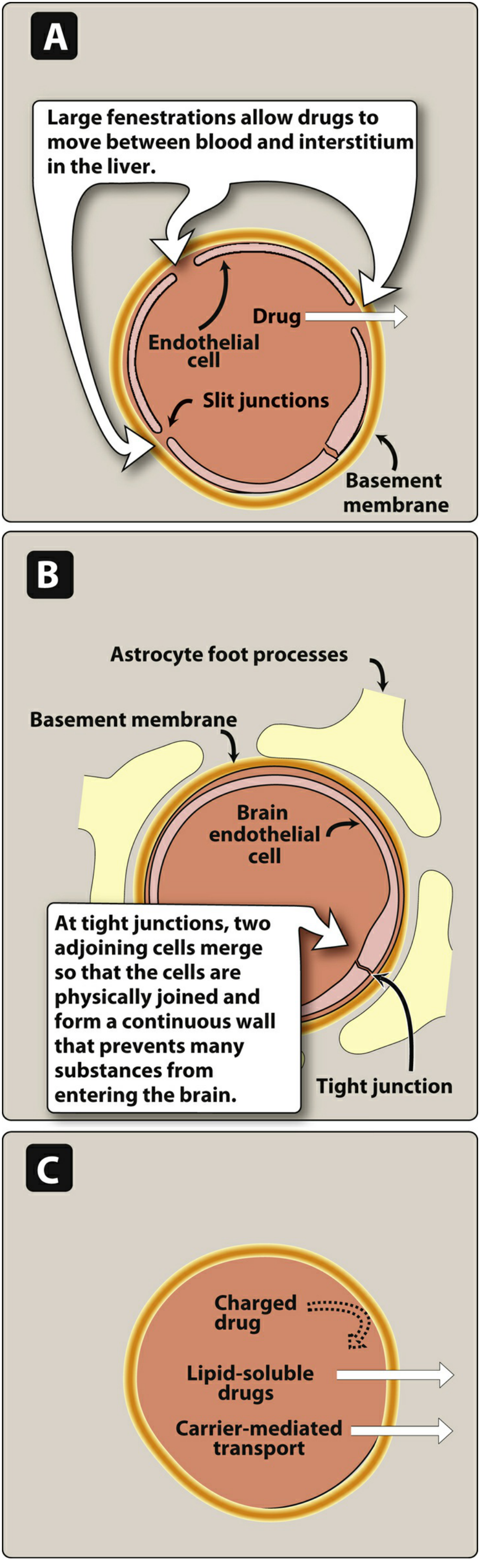
| Capillary permeability | Liver/spleen capillaries are discontinuous with large fenestrations - even large plasma proteins cross. Brain capillaries are continuous, tight-junctioned (no slit junctions) - this is the anatomic basis of the blood-brain barrier (BBB). Only lipid-soluble or actively transported drugs (e.g., levodopa via a carrier) cross into CNS |
| Plasma protein binding | Acidic drugs bind mainly albumin; basic drugs bind alpha-1 acid glycoprotein. Only the unbound (free) fraction is pharmacologically active and available for distribution, metabolism, and elimination |
| Tissue binding/lipophilicity | Highly lipophilic drugs (diazepam, thiopental) accumulate in fat; drugs like tetracyclines/lead deposit in bone |
| Physiological barriers | BBB, placental barrier, blood-testis barrier restrict distribution of polar/ionized drugs |
(Barash, Cullen and Stoelting's Clinical Anesthesia, p. distribution section; Lippincott Pharmacology, p. 45-46)
3. Volume of Distribution (Vd) - The Key NEET-PG Concept
Formula:
$$V_d = \frac{\text{Total amount of drug in body}}{\text{Plasma drug concentration}}$$
- Vd is an apparent volume - a proportionality constant, not a real anatomical space. It tells you how a dose relates to the resulting plasma concentration, not where the drug physically sits - Katzung's Basic and Clinical Pharmacology, 16th ed., p. 77.
- If Vd exceeds total body water (0.6 L/kg), the drug is extensively bound to tissues/lipid and plasma concentration is deceptively low.
Physical body compartments for reference (Katzung, Table 3-2)
| Compartment | Volume (L/kg) | Example drugs |
|---|---|---|
| Plasma | 0.04 | Large protein molecules, heparin, warfarin (highly protein-bound) |
| Extracellular water | 0.2 | Gentamicin, other aminoglycosides |
| Total body water | 0.6 | Ethanol, small water-soluble molecules |
| Fat | 0.2-0.35 | Diazepam, other highly lipophilic drugs |
| Bone | 0.07 | Lead, fluoride, tetracyclines |
High-yield interpretation rules
- Low Vd (~0.04-0.2 L/kg): drug stays largely in plasma/ECF - highly polar, protein-bound, or high molecular weight (e.g., warfarin, heparin).
- High Vd (>1 L/kg, can exceed total body weight): drug is sequestered in tissues (fat, muscle) - lipophilic drugs like digoxin (~500 L), chloroquine (very high Vd), amiodarone, chlorpromazine.
- Classic NEET-PG teaching point: a drug with Vd far greater than total body water indicates extensive extravascular tissue binding, not "more space" in the body.
Clinical application - Loading Dose
$$\text{Loading dose} = V_d \times \text{Target plasma concentration}$$
This is tested repeatedly - e.g., calculating a digoxin or aminoglycoside loading dose from a given Vd and desired plasma level.
4. Redistribution (frequently asked, especially with anesthetics)
Highly lipophilic IV anesthetics (thiopental, propofol) show a short duration of action after a single bolus not because of rapid metabolism, but because they redistribute from the highly perfused brain to less perfused compartments (muscle, then fat) as plasma levels fall, terminating the CNS effect. Repeated dosing saturates these peripheral compartments, so the drug then accumulates and duration of action prolongs.
5. Special Barriers
- Blood-brain barrier (BBB): continuous capillary endothelium, tight junctions, astrocytic foot processes; inflamed meninges (meningitis) increase permeability, aiding antibiotic penetration.
- Placental barrier: lipophilic, non-ionized, low-molecular-weight drugs cross readily (diazepam, most anesthetics); this underlies teratogenicity risk.
- Blood-testis barrier and blood-ocular barrier are similarly restrictive.
6. Factors That Alter Vd/Distribution Clinically (exam favorites)
- Renal/hepatic disease: decreased plasma protein synthesis (hypoalbuminemia) or accumulation of endogenous inhibitors -> decreased protein binding -> increased free fraction -> increased Vd for highly protein-bound drugs (e.g., phenytoin, drugs discussed in the Brenner and Rector's Kidney board question: decreased plasma protein binding increases Vd in CKD).
- Obesity: increased Vd for lipophilic drugs (e.g., benzodiazepines), unchanged/decreased Vd for hydrophilic drugs relative to total body weight - important for dosing.
- Age: neonates have higher total body water and immature BBB (increased sensitivity to CNS-acting drugs), higher Vd for water-soluble drugs; elderly have increased fat and decreased lean mass, raising Vd for lipophilic drugs.
- Edema/ascites/CHF: increases Vd for hydrophilic drugs (e.g., aminoglycosides) due to expanded ECF space.
- Drug displacement interactions: e.g., warfarin displaced from albumin by another highly protein-bound drug transiently increases free warfarin (though Katzung notes this is rarely of major clinical consequence in isolation).
7. Quick Table - Vd of Commonly Tested Drugs
| Drug | Approx Vd | Significance |
|---|---|---|
| Warfarin | ~0.14 L/kg | Highly protein bound, low Vd |
| Gentamicin | ~0.25 L/kg | Confined to ECF |
| Diazepam | ~1-1.5 L/kg | Lipophilic, high Vd |
| Digoxin | ~5-7 L/kg (~500 L) | Extensive tissue binding (muscle) |
| Chloroquine | >100 L/kg | Massive tissue sequestration |
| Amiodarone | Very high | Extensive tissue accumulation, long half-life |
NEET-PG Exam Pearls
- Vd = Dose / C (single compartment estimate); loading dose = Vd x target Cp - do the math both ways.
- High Vd does NOT mean "more drug" - it means drug has left plasma for tissues, so plasma concentration is low relative to total body burden.
- Redistribution (not metabolism) explains short action of thiopental/propofol after a single bolus - repeated doses -> saturation -> prolonged action.
- Only free (unbound) drug distributes, acts, and is filtered/metabolized - protein binding changes matter most for drugs that are highly bound (>90%) and have a narrow therapeutic index.
- BBB and placenta favor passage of lipid-soluble, non-ionized, low-MW drugs.
A note on evolving evidence
A recent 2024 systematic review (PMID: 38716900, Clinical and Translational Science) re-examines how much plasma protein binding changes in hepatic/renal impairment actually matter for dose decisions - it argues these effects are more clinically significant and should be considered more carefully in drug labeling than classical teaching (which often downplays protein-binding changes as "rarely clinically relevant," per Katzung) suggests. This is a nuance beyond the standard textbook framing worth knowing if the exam probes special populations, but does not change the core Vd/distribution concepts above.
This is a shared conversation. Sign in to Orris to start your own chat.