
Pbc vs psc vs igg4 related sclerosi g cholangitis
Reading File
Now let me run parallel searches across all three conditions:
Finding Sources
Finding Sources
Finding Sources
Searching PubMed
"IgG4 related cholangitis" AND "primary sclerosing cholangitis" AND "primary biliary cholangitis"
Now let me read the key sections in parallel:
Reading File
Reading File
Reading File
Reading File
Now let me get the PSC content and the Tietz/Goldman sections for additional detail:
Reading File
Reading File
Finding Sources
Finding Sources
Let me get the Goldman-Cecil PBC and the PSC management/treatment data, plus fetch the key histology images:
Reading File
Reading File
Loading Image
Let me get the PSC treatment/management and PBC treatment sections, plus get the comparison table from Sleisenger:
Finding Sources
Finding Sources
Finding Sources
Now let me get the Harrison's IgG4 section and the PSC treatment section from Goldman-Cecil:
Reading File
Reading File
Loading Image
I now have comprehensive data. Let me compile the full comparison:
PBC vs PSC vs IgG4-Related Sclerosing Cholangitis
Overview / Quick Comparison
| Feature | PBC | PSC | IgG4-SC |
|---|---|---|---|
| Full name | Primary biliary cholangitis | Primary sclerosing cholangitis | IgG4-related sclerosing cholangitis |
| Sex predominance | Female (9:1 F:M) | Male (2:1 M:F) | Male (strongly, >80%) |
| Age at presentation | 40–60 yrs | 25–45 yrs (median 36–39) | >60 yrs |
| Ducts involved | Small/medium intrahepatic only | Intra- and extrahepatic | Intra- and extrahepatic (mimics PSC) |
| Associated IBD | No | Yes (60–80%, usually UC) | No |
| Other organ involvement | Sicca syndrome, CREST, thyroiditis, celiac | None specific | Autoimmune pancreatitis, sialadenitis, retroperitoneal fibrosis |
| Cancer risk | Minimal (HCC only in cirrhosis) | Cholangiocarcinoma (10–15%) | Rare (CCA/cirrhosis uncommon) |
| Prognosis | Progressive → cirrhosis (now slowed by UDCA) | Variable; mean transplant-free survival ~12–20 yrs | Excellent with steroids |
Primary Biliary Cholangitis (PBC)
Pathogenesis
T lymphocyte–mediated destruction of small and medium intrahepatic bile ducts. Antimitochondrial antibodies (AMA) are present in 90–95% of patients — highly characteristic but their exact pathogenic role is unclear. Genome-wide studies implicate IL-12A and IL-12RB2 variants (IL-12 signaling pathway). Retained bile salts cause secondary hepatocellular injury.
Clinical Features
- Predominant symptoms: fatigue (50%) and pruritus (30%); ~50% asymptomatic at diagnosis
- Hypercholesterolemia, xanthelasmas, steatorrhea, metabolic bone disease (osteomalacia/osteoporosis)
- Extrahepatic autoimmunity: Sjögren syndrome, systemic sclerosis/CREST, thyroiditis, Raynaud phenomenon, celiac disease, rheumatoid arthritis
Diagnosis
- ↑ Alkaline phosphatase + ↑ GGT (first clue)
- AMA (anti-M2): sensitivity and specificity >95% at titer >1:40
- ↑ IgM (characteristic)
- Bilirubin often normal until late disease
- Liver biopsy: "florid duct lesion" — lymphoplasmacytic inflammation ± granulomas destroying interlobular ducts; portal-portal septal fibrosis
Treatment
- Ursodeoxycholic acid (UDCA) 13–15 mg/kg/day — dramatically improves outcomes and slows progression
- Obeticholic acid (farnesoid X receptor agonist) — approved for inadequate response to UDCA
- Pruritus: cholestyramine, rifampicin, naltrexone, ondansetron
- Liver transplantation for advanced disease (can recur in allograft)
Primary Sclerosing Cholangitis (PSC)
Pathogenesis
Immune-mediated injury to both intrahepatic and extrahepatic bile ducts. Key features:
- T-cell and autoantibody-mediated periductal inflammation
- Association with HLA-B8, HLA-A01, B08, DRB1*03
- "Gut-liver axis" hypothesis: T cells activated in damaged UC mucosa migrate to liver, cross-react with bile duct antigens
- Microbiome and toxic bile theories also implicated
Clinical Features
- Often asymptomatic at presentation — identified by ↑ ALP
- When symptomatic: fatigue, pruritus, upper abdominal pain, fever (cholangitis)
- ~60–80% have concurrent IBD (typically pan-UC with rectal sparing and ileitis — a "PSC-IBD" phenotype distinct from classic UC)
- Cholangiocarcinoma (10–15% lifetime risk) — major cause of death
- Also increased risk of colorectal cancer (in PSC-IBD)
Subtypes
- Large-duct PSC (classic): cholangiographic disease — intrahepatic ± extrahepatic ducts
- Small-duct PSC (5–20%): clinical/biochemical/histologic PSC without cholangiographic findings; better prognosis, no CCA risk
- PSC-AIH overlap (~7.5%): more responsive to immunosuppression, more common in children
Diagnosis
- ↑ ALP (90% of patients), ± ↑ AST/ALT
- pANCA positive in ~80% (non-specific; also positive in UC)
- ANA/ASMA in 25%; AMA is negative (if positive → think PBC)
- MRCP (gold standard imaging): "beaded" appearance — multifocal short strictures with intervening dilation
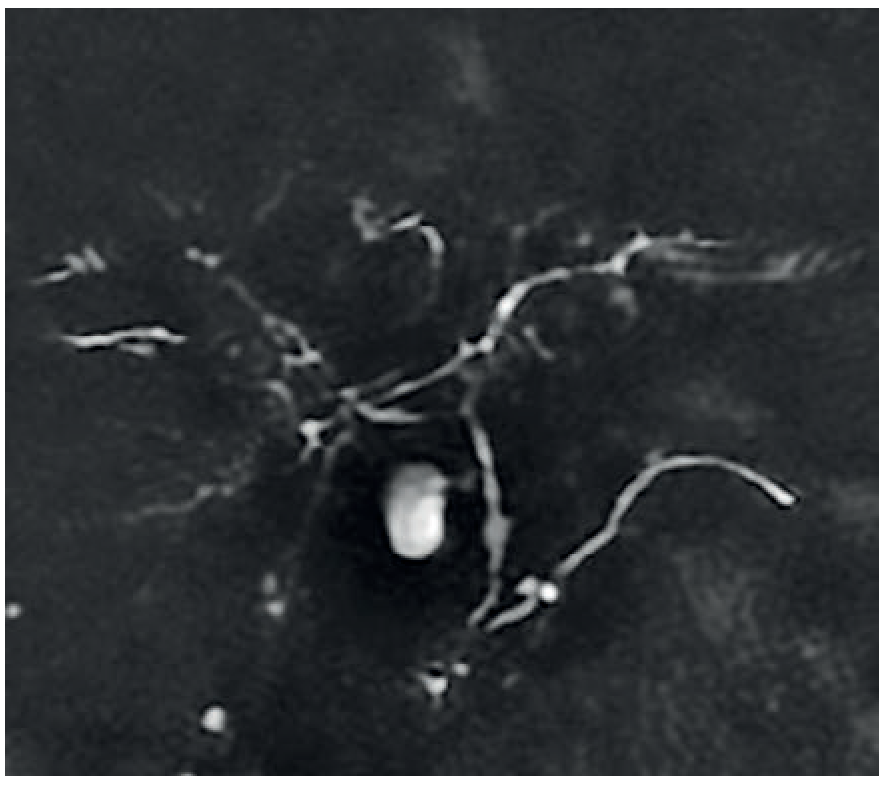
- Liver biopsy: "onion-skin" periductal fibrosis around atrophic ducts → eventual obliteration leaving "tombstone" scar → biliary cirrhosis
Treatment
- No proven effective pharmacologic therapy (UDCA has not shown mortality benefit in PSC)
- Endoscopic biliary dilatation/stenting for dominant strictures
- Surveillance: annual CA 19-9 + MRCP for cholangiocarcinoma; colonoscopy q1–2 years for colorectal cancer
- Liver transplantation is definitive treatment; PSC can recur post-transplant (~25%)
- Children: more responsive to medical therapy; high overlap with AIH
IgG4-Related Sclerosing Cholangitis (IgG4-SC)
Pathogenesis
A biliary phenotype of IgG4-related disease (IgG4-RD). Characterized histologically by:
- Dense lymphoplasmacytic infiltrate of IgG4+ plasma cells and eosinophils
- Obliterative phlebitis
- Storiform (whorled) fibrosis
Mechanism: antigen-driven immune response (possibly environmental — solvents, industrial gases) → B cells produce IgG4 → activated T cells secrete profibrotic cytokines (TGF-β, IL-10, IL-4, IL-13 — Th2 profile). RANKL from plasma cells activates myeloid-derived suppressor cells → suppress T-cell proliferation → induce Th2 differentiation.
Clinical Features
- Men >60 years — most distinctive demographic
- Often presents as obstructive jaundice ± pruritus
- Frequent concurrent autoimmune pancreatitis (type 1 AIP) — look for "sausage pancreas" on CT, "capsule sign"
- Other organ involvement: salivary gland swelling (sialadenitis/Mikulicz disease), retroperitoneal fibrosis, aortitis, tubulointerstitial nephritis
- No IBD association
Diagnosis — HISORt Criteria (Mayo Clinic)
- Histology: >10–20 IgG4+ plasma cells/HPF; obliterative phlebitis, storiform fibrosis
- Imaging: pancreatic/biliary ductal strictures; biliary stricture pattern mimicking PSC or CCA
- Serology: serum IgG4 elevated (in ~70% of cases; up to 30% are seronegative)
- IgG4 > 4× ULN is 100% specific for IgG4-SC (PSC patients may have mild IgG4 elevation but rarely exceed 2× ULN)
- Note: ~10% of PSC patients have elevated IgG4 (linked to specific HLA alleles)
- Other organ involvement
- Response to glucocorticoid therapy
IgG4-SC can be diagnosed if >20 IgG4+ plasma cells/HPF are seen on major papilla or bile duct pinch biopsy.
Cholangiographic Appearance
Can be identical to PSC (intrahepatic strictures) or mimic cholangiocarcinoma (dominant stricture) — this is the most clinically dangerous pitfall.
Treatment
- Glucocorticoids: >95% respond (prednisone 40 mg/day × 4 weeks → taper)
- Relapse frequent (31% of type 1 AIP/IgG4-SC) → maintenance with azathioprine or other immunosuppressants
- Refractory/relapsing disease: rituximab (B-cell depletion)
- Cirrhosis and cholangiocarcinoma are rare — long-term prognosis is excellent
Key Diagnostic Discriminators
| Clue | Think |
|---|---|
| Middle-aged woman + pruritus + ↑ ALP + positive AMA | PBC |
| Young/middle-aged man + UC + ↑ ALP + beading on MRCP | PSC |
| Older man + obstructive jaundice + no IBD + ↑ IgG4 + pancreatic enlargement + steroid-responsive | IgG4-SC |
| Positive pANCA | PSC (also UC, AIH) |
| ↑ IgM | PBC |
| Florid duct lesion + granulomas on biopsy | PBC |
| Onion-skin periductal fibrosis on biopsy | PSC |
| Obliterative phlebitis + storiform fibrosis on biopsy | IgG4-SC |
| IgG4 >4× ULN | IgG4-SC (100% specific) |
| AMA positive in suspected PSC | Exclude PBC overlap |
Treatment Summary
| Condition | First-line | Second-line | Definitive |
|---|---|---|---|
| PBC | UDCA 13–15 mg/kg/day | Obeticholic acid; fibrates | Liver transplant |
| PSC | No proven disease-modifying therapy | Endoscopic dilatation of dominant strictures | Liver transplant |
| IgG4-SC | Prednisone 40 mg/day | Azathioprine; rituximab | Usually not needed |
Sources: Robbins & Kumar Basic Pathology; Sleisenger and Fordtran's GI & Liver Disease; Goldman-Cecil Medicine; Harrison's Principles of Internal Medicine 22e
Autoimmune hepatitis
Finding Sources
Reading File
Reading File
Finding Sources
Reading File
Reading File
Finding Sources
Finding Sources
Reading File
Reading File
Loading Image
Reading File
Reading File
Reading File
Reading File
Now let me get the Sleisenger section on treatment protocols and the treatment endpoints:
Reading File
You've run out of free credits. Sign up for a free account to continue using Orris.
This is a shared conversation. Sign in to Orris to start your own chat.