
Q1 Nosocomial infection in ICU. Q2 ROLE of Nmethyl N Aspartate receptor in pain and gate control theory of pain. Answer these question for 10 marks each for dnb final anesthesia exam from standard source
Reading File
Now let me search both topics in parallel from the medical library.
Finding Sources
Finding Sources
Finding Sources
Finding Sources
Good results found. Now let me read the relevant sections in parallel.
Reading File
Reading File
Excellent content. Now let me search for NMDA receptor role in pain specifically, and more ICU nosocomial infection details.
Finding Sources
Reading File
Excellent - found Barash Clinical Anesthesia content on NMDA. Let me read those sections and get more nosocomial ICU content in parallel.
Reading File
Reading File
Now let me get NMDA receptor pain details from Barash preventive analgesia section and get more nosocomial ICU prevention/microbiology details in parallel.
Reading File
Reading File
Now let me get the ICU prevention/bundle strategies and search specifically for NMDA receptor physiology in pain from a dedicated pain/anesthesia source.
Reading File
Finding Sources
Reading File
Finding Sources
Now let me get the VAP prevention bundle data and also the ICU prevention section.
Reading File
Finding Sources
Reading File
I now have comprehensive content for both questions. Let me also fetch the gate control theory diagram to include visually.---
Q1 - Nosocomial Infections in the ICU (10 Marks)
Sources: Fishman's Pulmonary Diseases & Disorders; Schwartz's Principles of Surgery; Barash's Clinical Anesthesia 9e
Definition
A nosocomial (hospital-acquired) infection is any infection acquired after 48 hours of hospital admission that was not present or incubating at the time of admission. In the ICU, the most clinically important categories are:
| Type | Definition |
|---|---|
| HAP (Hospital-Acquired Pneumonia) | Pneumonia developing ≥48 h after hospital admission |
| VAP (Ventilator-Associated Pneumonia) | Pneumonia developing ≥48 h after endotracheal intubation |
| CLABSI | Central line-associated bloodstream infection |
| CAUTI | Catheter-associated urinary tract infection |
| SSI | Surgical site infection |
Epidemiology
- HAP and VAP together account for approximately 28% of all HAIs and are the most frequent nosocomial infections overall.
- Respiratory tract infections are the most common infection in the ICU, accounting for 60.1% of infections in a 1-day point prevalence study across 88 countries.
- Mechanical ventilation increases pneumonia risk up to 20-fold; approximately 10% of mechanically ventilated patients develop VAP.
- VAP rate is approximately 14.8 cases per 1000 ventilator days with peak risk around day 5.
- ICU mortality from respiratory nosocomial infections: 24.8%; in-hospital mortality: 31.9%.
- Mean added hospital cost: >$40,000 per case; attributable ICU LOS increase: 4-13 days.
(Fishman's Pulmonary Diseases, p. 2763)
Microbiology
Common pathogens, especially multidrug-resistant (MDR) organisms:
| Organism | Notes |
|---|---|
| Pseudomonas aeruginosa | Most frequent GNB; multi-drug resistant |
| Staphylococcus aureus / MRSA | 36.9% of S. aureus are methicillin-resistant (NHSN 2015-17) |
| Klebsiella pneumoniae | Common in HAP |
| Acinetobacter baumannii | Important in trauma ICUs |
| Enterobacteriaceae | E. coli, Enterobacter spp. |
| Anaerobes | Uncommon in VAP except in lung abscess/empyema |
| Legionella | Associated with contaminated water systems |
| Viral (influenza, rhinovirus) | Underappreciated; can require mechanical ventilation |
MDR infections carry increased mortality, largely due to delayed appropriate antimicrobial therapy.
(Fishman's Pulmonary Diseases, p. 2875-2879)
Pathophysiology
The primary mechanism is aspiration of microorganisms colonizing the oropharynx/aerodigestive tract in a host with altered immunity. Secondary mechanisms:
- Altered gastric pH - stress ulcer prophylaxis (H2-blockers, PPIs) promotes gastric bacterial overgrowth and oropharyngeal colonization.
- Endotracheal tube (ETT) - serves as a reservoir; bacteria from the upper airway leak around the cuff into the lower respiratory tract (LRT). Biofilm forms inside the ETT.
- Contaminated respiratory equipment - humidifiers, nebulizers, ventilator circuits.
- Disrupted microbiome - critically ill patients have reduced respiratory microbiota diversity; antibiotic use promotes pathogenic colonization.
- Post-inflammatory immunosuppression - patients surviving the initial cytokine storm of sepsis develop an immunodeficient state that promotes viral reactivation and secondary nosocomial infection.
- Direct inhalation and hematogenous spread are less frequent.
(Fishman's Pulmonary Diseases, p. 2884-2912)
Risk Factors
Host factors:
- Severity of illness (APACHE II ≥16)
- Immunosuppression, malnutrition
- COPD, cystic fibrosis, bronchiectasis
- Burns, trauma, post-surgical state
Device/iatrogenic factors:
- Mechanical ventilation (single most important risk factor)
- Reintubation (further doubles VAP risk)
- Indwelling vascular / urinary catheters
- Nasogastric tube (promotes aspiration)
- Prior antibiotic use (promotes MDR organisms)
- Prolonged ICU stay (>5 days)
- H2-blockers/PPIs use
(Fishman's Pulmonary Diseases, p. 2915-2920)
Diagnosis
Clinical strategy (CPIS - Clinical Pulmonary Infection Score): Uses fever, WBC, purulent secretions, PaO2/FiO2 ratio, chest X-ray infiltrate. More sensitive but less specific.
Bacteriologic strategy (Quantitative cultures):
- Endotracheal aspirate: ≥10^5 CFU/mL
- Bronchoalveolar lavage (BAL): ≥10^4 CFU/mL
- Protected specimen brush: ≥10^3 CFU/mL
An unstable patient with high pre-test probability should receive empiric antibiotics immediately without waiting for culture results, as delay in appropriate antibiotics is an independent predictor of in-hospital mortality.
Treatment
- Assess MDR risk factors before choosing empiric regimen.
- Initiate antibiotics early - failure to give appropriate antibiotics promptly increases mortality.
- De-escalate based on culture/sensitivity results (antibiotic stewardship).
- Duration: 7 days is standard; extend to >7 days for P. aeruginosa, immunocompromise, cavitation, lung abscess, or empyema.
- Knowledge of local antibiogram is essential.
- β-lactams act in a time-dependent manner; aminoglycosides act in a concentration-dependent manner - dosing implications differ.
(Fishman's Pulmonary Diseases, p. 3051-3080)
Prevention - VAP Bundle (Evidence Level 1 Strategies)
| Strategy | Rationale |
|---|---|
| Shorten mechanical ventilation duration | Removes the primary risk factor |
| Noninvasive ventilation when possible | Avoids intubation entirely |
| Orotracheal (not nasotracheal) intubation | Reduces sinusitis, aspiration |
| Semirecumbent positioning (30-45°) | Reduces aspiration |
| Subglottic secretion drainage | Removes pooled secretions above cuff |
| Oral chlorhexidine decontamination | Reduces oropharyngeal flora |
| Polyurethane ETT cuff | Better sealing reduces microaspiration |
| Silver-coated ETT | Antimicrobial surface inhibits biofilm |
| Heat-moisture exchanger (HME) | Replaces heated humidifier |
| Closed endotracheal suctioning | Avoids circuit breaks |
| Avoid reintubation | Each reintubation multiplies VAP risk |
| Protocols/bundles | Evidence Level 2 - most effective when combined |
| Adequate ICU staffing | Nurse-to-patient ratio impacts compliance |
Not recommended: Routine ventilator circuit changes, chest physiotherapy, early tracheostomy, routine antibiotic cycling.
(Fishman's Pulmonary Diseases, Table 129-6, p. 3001-3006)
Q2 - Role of NMDA Receptor in Pain and Gate Control Theory of Pain (10 Marks)
Sources: Barash's Clinical Anesthesia 9e; Neuroscience: Exploring the Brain, 5e; Eric Kandel's Principles of Neural Science 6e
PART A: Gate Control Theory of Pain
Historical Background
In 1965, Ronald Melzack and Patrick Wall (at MIT) proposed the Gate Control Theory of Pain, published in Science (150:971, 1965). This was the first mechanistic neural model to explain the modulation of pain by non-nociceptive input and superseded the older specificity and pattern theories.
(Adams & Victor's Neurology 12e, p. 1039-1045)
The Neural Circuit
The theory proposes that the transmission of nociceptive signals from the periphery to the brain is not fixed but is regulated (gated) at the dorsal horn of the spinal cord (substantia gelatinosa, laminae I and II).
Key components:
| Component | Role |
|---|---|
| C fibers (unmyelinated) | Carry nociceptive signals; slow conduction (~0.5-2 m/s) |
| Aδ fibers (thin myelinated) | Carry sharp/fast pain; intermediate |
| Aβ fibers (large myelinated) | Carry touch/pressure (non-nociceptive); fast conduction |
| Dorsal horn projection neurons (T cells) | Transmit signals up the anterolateral spinothalamic tract |
| Inhibitory interneurons (SG cells) | Gate-keepers in the substantia gelatinosa |
Mechanism of the Gate
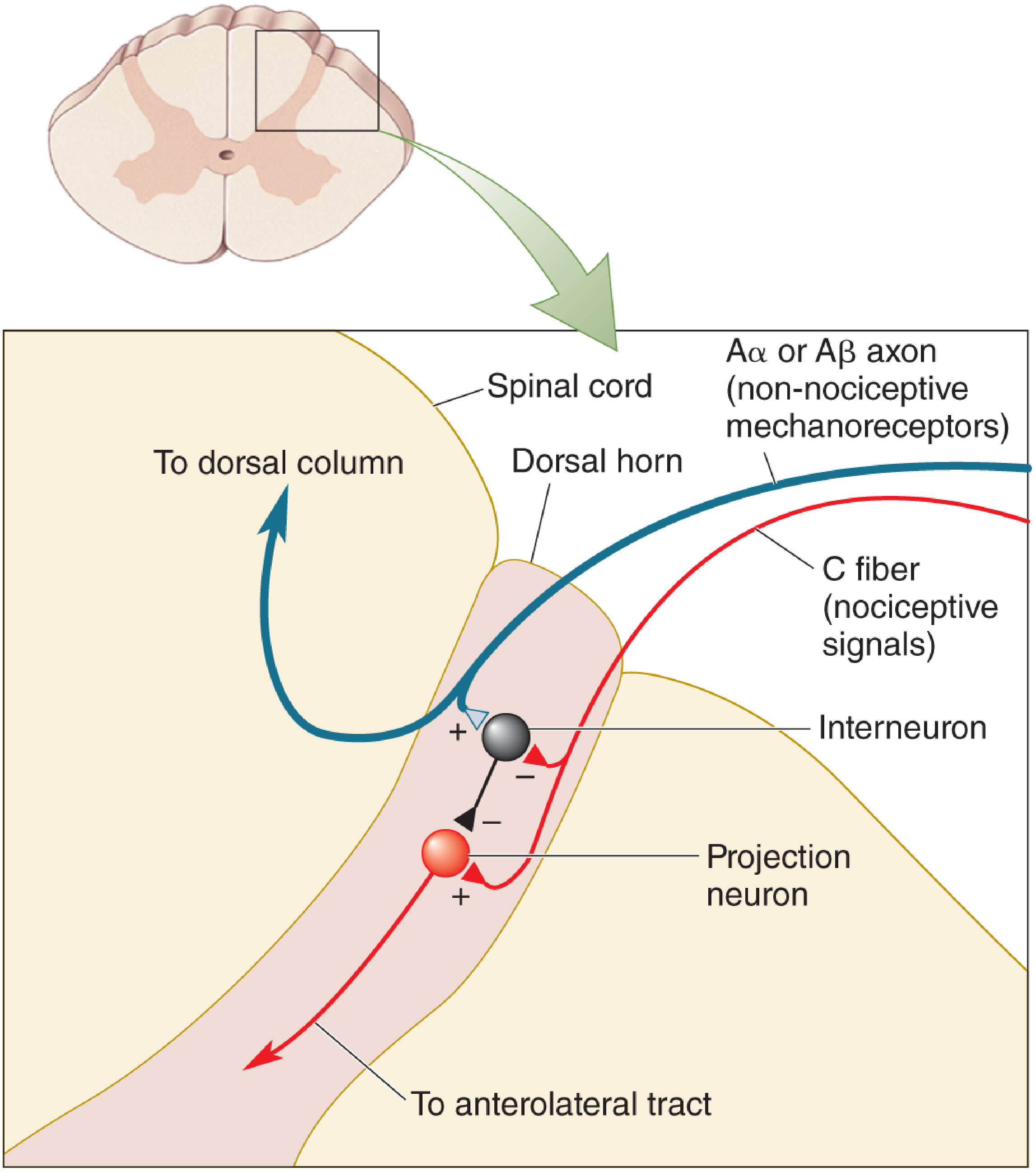
Figure: Melzack & Wall's gate control theory. Nociceptive C fiber signals reach the dorsal horn projection neurons. Inhibitory interneurons can block this signal when activated by Aβ fibers (gate closed) or are themselves inhibited by C fibers (gate open).
Gate CLOSED (Pain reduced):
- Large Aβ fiber activity (touch, rubbing, vibration, TENS) activates inhibitory interneurons in the substantia gelatinosa.
- These interneurons inhibit the projection neurons, blocking nociceptive transmission.
- Clinical example: rubbing around a bruised shin reduces pain; TENS therapy for chronic pain.
Gate OPEN (Pain enhanced):
- High C fiber nociceptive activity inhibits the inhibitory interneurons.
- Projection neurons fire freely, transmitting pain signals centrally.
- This can also occur with reduced Aβ input (e.g., large fiber loss in neuropathy).
(Neuroscience: Exploring the Brain 5e, p. 4270-4289)
Descending Modulation (Later addition to theory)
Melzack and Wall later incorporated descending control from supraspinal centers:
- The periaqueductal grey (PAG), rostroventromedial medulla (RVM), and locus coeruleus send descending pathways via the dorsolateral funiculus.
- They release serotonin, norepinephrine, and endogenous opioids (enkephalins) which activate descending inhibitory pathways to close the gate.
- Explains why soldiers/athletes sustain injuries without pain during intense activity (endogenous opioid release).
Clinical Relevance of Gate Control Theory
| Application | Mechanism |
|---|---|
| TENS (Transcutaneous Electrical Nerve Stimulation) | Activates large Aβ fibers to close the gate; used in arthritis, chronic pain |
| Spinal Cord Stimulation (SCS) | Antidromic Aβ activation at dorsal columns |
| Acupuncture | Proposed to activate endogenous inhibitory systems |
| Regional nerve blocks | Block C fiber input, close gate |
| Opioids | Enhance descending inhibition via PAG |
| Physical therapy / massage | Aβ activation + central modulation |
(Kandel's Principles of Neural Science 6e, p. 1923-1930; Neuroscience Exploring the Brain 5e, p. 4274)
PART B: Role of the NMDA Receptor in Pain
Structure and Location
The N-Methyl-D-Aspartate (NMDA) receptor is an ionotropic glutamate receptor with the following properties:
- Ligand-gated ion channel permeable to Ca²⁺, Na⁺, K⁺
- Requires dual activation: glutamate binding AND membrane depolarization (to remove the Mg²⁺ block)
- Contains a PCP (phencyclidine) binding site - the channel-blocking site where ketamine acts
- Found throughout the CNS, but especially on primary afferent nociceptors and projection neurons in the spinal dorsal horn
- Subunit composition: NR1 (obligatory) + NR2 (A-D) subunits
(Barash's Clinical Anesthesia 9e, p. 3253-3266)
NMDA Receptor in Acute Pain
Under normal conditions, low-frequency C fiber stimulation releases glutamate and substance P in the dorsal horn:
- Glutamate acts primarily on AMPA/kainate receptors for fast synaptic transmission.
- The NMDA receptor remains blocked by Mg²⁺ at resting membrane potential.
With sustained or intense nociceptive input:
- Repeated dorsal horn depolarization removes the Mg²⁺ block.
- NMDA receptors become fully active.
- Ca²⁺ influx triggers intracellular signaling cascades.
NMDA Receptor and Central Sensitization / Wind-Up
This is the central role of the NMDA receptor in chronic and pathological pain:
Wind-Up: Progressive increase in action potential discharge of dorsal horn neurons with repeated low-frequency (≤3Hz) C fiber stimulation. Each stimulus produces a greater response than the last. This is an elementary form of CNS sensitization and is NMDA receptor-dependent.
Central Sensitization: Prolonged NMDA activation leads to:
- Expansion of receptive fields - neurons respond to stimuli from wider body areas
- Decreased pain threshold (hyperalgesia) - exaggerated response to normally painful stimuli
- Allodynia - pain from normally non-painful stimuli
- Long-term potentiation (LTP) - persistent strengthening of synaptic connections
- These changes outlast the initial stimulus and can become self-sustaining.
(Barash's Clinical Anesthesia 9e - Preventive Analgesia section, p. 1451)
NMDA Receptor in Chronic Pain States
- In neuropathic pain, central sensitization via NMDA receptor activation is a primary driver.
- In complex regional pain syndrome (CRPS), wind-up and central sensitization are prominent.
- In phantom limb pain, aberrant NMDA-mediated plasticity underlies persistence of pain.
- Cancer pain with breakthrough: supraspinal NMDA activation contributes.
Pharmacological Relevance: Ketamine as NMDA Antagonist
Ketamine (phencyclidine derivative) is the prototypic clinical NMDA receptor antagonist in anesthesia:
| Property | Detail |
|---|---|
| Binding site | PCP site within the NMDA channel (open-channel blocker) |
| Mechanism | Binds after channel opens (glutamate-dependent); decreases channel opening time |
| Effect | Decreases wind-up, prevents central sensitization |
| Analgesic dose | Subanesthetic (0.1-0.5 mg/kg IV) |
| Clinical use | Acute postoperative pain, burn dressings, opioid-sparing, CRPS |
| Added effects | Blocks spinoreticular pathway; depresses medial thalamic nuclei and medial reticular formation (key relays in nociceptive transmission) |
"Antagonism of the channel is more profound if the NMDA channel has been previously opened by glutamate." (Barash 9e, p. 3266)
Preventive Analgesia and NMDA Receptors
Preventive analgesia targets NMDA-mediated sensitization across the perioperative period to prevent chronic post-surgical pain:
Three critical principles (Barash 9e):
- Depth - adequate to block all nociceptive input during surgery
- Extent - must cover the entire surgical field
- Duration - must span surgical AND post-surgical periods
By blocking NMDA receptors perioperatively, the clinician prevents:
- Wind-up in the dorsal horn
- Facilitation of nociceptive pathways
- Central sensitization
- Expansion of receptive fields
- Long-term potentiation → chronic pain state
(Barash's Clinical Anesthesia 9e, p. 1451)
Relationship Between Gate Control Theory and NMDA Receptors
| Aspect | Gate Control Theory | NMDA Receptor Mechanism |
|---|---|---|
| Location | Dorsal horn, substantia gelatinosa | Dorsal horn projection neurons, afferents |
| Modulation type | Segmental (Aβ vs C fiber balance) | Molecular (glutamate-Ca²⁺ signaling) |
| Directionality | Both peripheral (afferent) and descending | Ascending (peripheral → central) |
| Clinical target | TENS, SCS, nerve blocks | Ketamine, memantine, methadone |
| Chronic pain | Gate stays open (loss of Aβ inhibition) | Wind-up and central sensitization via NMDA |
| Unifying concept | Pain is a regulated output, not a direct transmission | Both theories support multimodal analgesia |
Summary Points for DNB Exam
Q1 - Nosocomial Infection in ICU:
- HAP/VAP = 28% of all HAIs; most common ICU infection (60.1%)
- Mechanical ventilation is the single most important risk factor (20-fold increase)
- Common organisms: P. aeruginosa, MRSA, Klebsiella, Acinetobacter
- Pathophysiology: aspiration + colonization + impaired host immunity
- Diagnosis: quantitative cultures (BAL ≥10^4, PSB ≥10^3, ETA ≥10^5 CFU/mL)
- VAP bundle: 30-45° head-up, subglottic drainage, chlorhexidine, minimize ventilator days
- Treatment duration: 7 days standard; extend for Pseudomonas, immunocompromise
Q2 - NMDA Receptor and Gate Control Theory:
- Gate control (Melzack & Wall, 1965): Aβ fibers activate inhibitory interneurons to close the gate; C fibers keep it open
- NMDA receptor: voltage + ligand gated; blocked by Mg²⁺ at rest; opens with sustained nociception
- NMDA activation → wind-up → central sensitization → hyperalgesia + allodynia + LTP
- Ketamine blocks PCP site of NMDA (open-channel blocker), reduces wind-up, prevents hyperalgesia
- Preventive analgesia: perioperative NMDA blockade to prevent chronic post-surgical pain
- Both theories form the scientific basis for multimodal analgesia in modern anesthetic practice
Sources: Fishman's Pulmonary Diseases & Disorders 2e; Barash's Clinical Anesthesia 9e; Neuroscience: Exploring the Brain 5e; Kandel's Principles of Neural Science 6eBoth questions are answered in full exam format. Here is a quick overview of what each answer covers:
What's Covered
Q1 - Nosocomial Infections in ICU (10 Marks)
The answer follows a structured approach suitable for DNB finals:
- Definition - HAP, VAP, CLABSI, CAUTI with the 48-hour rule
- Epidemiology - exact prevalence figures (60.1% of ICU infections, 14.8/1000 ventilator days, mortality data)
- Microbiology - P. aeruginosa, MRSA (36.9%), Klebsiella, Acinetobacter, viral causes
- Pathophysiology - aspiration, altered pH, ETT biofilm, disrupted microbiome, post-sepsis immunosuppression
- Risk factors - host + device/iatrogenic
- Diagnosis - CPIS vs. quantitative culture thresholds (BAL ≥10^4, PSB ≥10^3, ETA ≥10^5 CFU/mL)
- Treatment - MDR risk stratification, early antibiotics, de-escalation, 7-day duration rule
- Prevention (VAP bundle) - complete evidence Level 1 table with clinical rationale
Q2 - NMDA Receptor in Pain + Gate Control Theory (10 Marks)
- Gate Control Theory - Melzack & Wall 1965; Aβ vs C fiber balance; inhibitory interneurons; gate open/closed mechanism; descending modulation via PAG; clinical applications (TENS, SCS, opioids)
- NMDA receptor - structure, Mg²⁺ block, PCP binding site; role in wind-up and central sensitization; hyperalgesia, allodynia, LTP
- Ketamine - clinical NMDA antagonist; subanesthetic analgesia; blocks dorsal horn sensitization
- Preventive analgesia - perioperative NMDA blockade; 3 critical principles
- Integrated comparison table linking both theories to multimodal analgesia
This is a shared conversation. Sign in to Orris to start your own chat.