
Define Case control study Refer k park
Reading File
Now let me search K Park's textbook for the case control study definition.
Finding Sources
Finding Sources
Park's textbook is in the library. Let me read the relevant section.
Reading File
Reading File
I now have enough from K Park to give a thorough answer. Let me also fetch the design diagram image.
Loading Image
Here is the complete definition and description of Case Control Study as given in Park's Textbook of Preventive and Social Medicine:
Case Control Study
(Park's Textbook of Preventive and Social Medicine, p. 83)
Definition / Introduction
Case control studies, often called "retrospective studies," are a common first approach to test a causal hypothesis. In recent years, the case control approach has emerged as a permanent method of epidemiological investigation.
Three Distinct Features (K Park)
The case control method has three distinct features:
- Both exposure and outcome (disease) have already occurred before the start of the study.
- The study proceeds backwards - from effect to cause (retrospective direction).
- It uses a control or comparison group to support or refute an inference.
Design Diagram (Fig. 8, K Park)
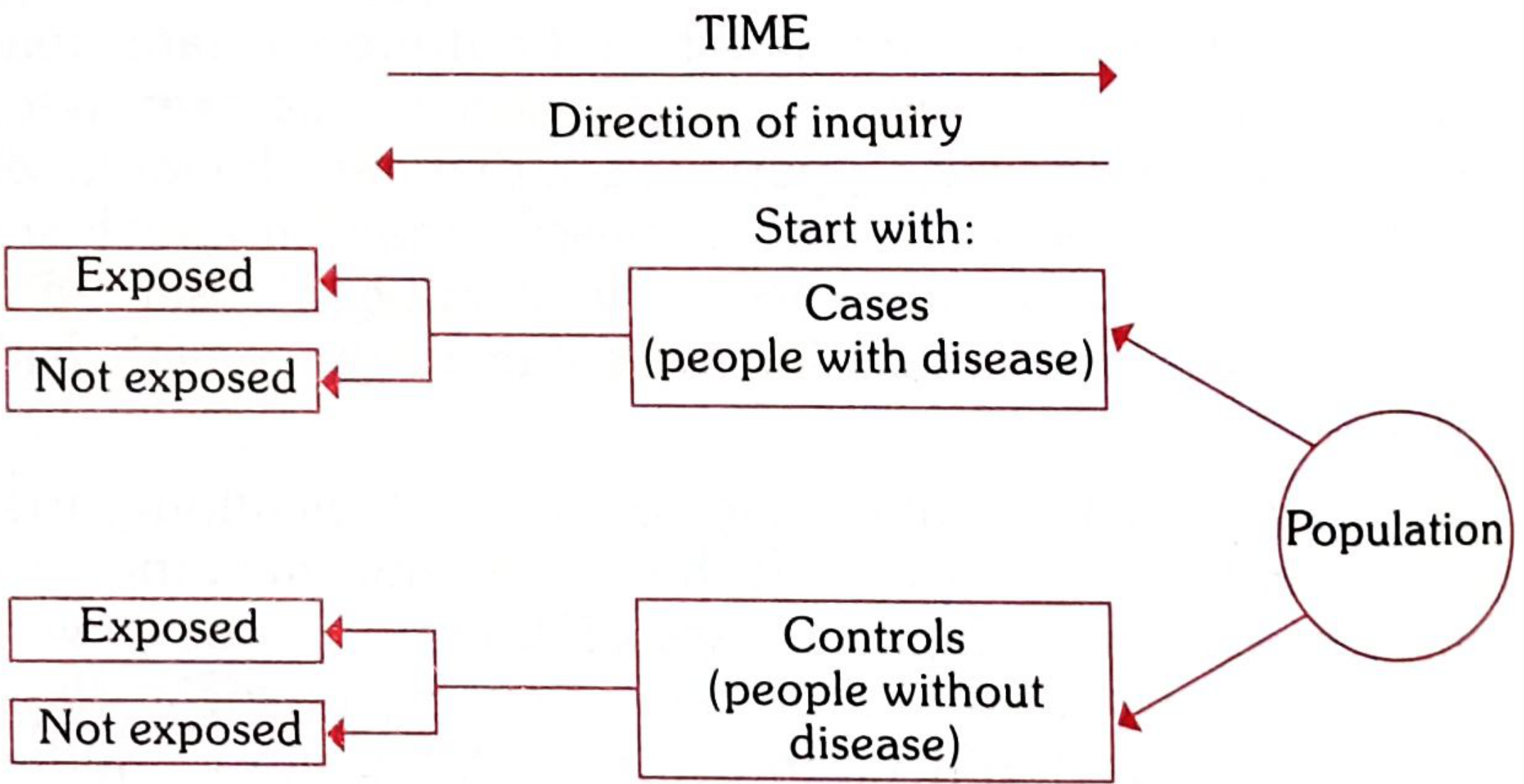
The inquiry moves backwards in time - starting with Cases (people with disease) and Controls (people without disease), and looking back to determine past exposure status.
Populations Involved
A case control study involves two populations:
- Cases - individuals who have developed the disease or health problem under study
- Controls - comparable individuals who have NOT developed the disease
The unit of study is the individual, not the group. The focus is on a disease or health problem that has already developed.
Nature of the Study
Case control studies are essentially comparison studies. Cases and controls must be comparable with respect to known confounding factors such as age, sex, occupation, and social status.
The questions asked relate to:
- Personal characteristics
- Antecedent exposures which may be responsible for the condition studied
Classic example: Cases = lung cancer patients; Controls = matched non-cancer individuals. Both groups are asked about their past history of cigarette smoking. If the frequency of smoking is higher in cases than in controls, an association is said to exist between smoking and lung cancer.
The 2 x 2 Contingency Table (Framework)
| Suspected Risk Factor | Cases (Disease Present) | Controls (Disease Absent) |
|---|---|---|
| Present | a | b |
| Absent | c | d |
| Total | a + c | b + d |
- Exposure frequency in cases = a / (a+c)
- Exposure frequency in controls = b / (b+d)
- If a/(a+c) > b/(b+d), an association exists between the exposure and the disease.
Main Use
Case control studies are most useful for studying chronic diseases where the causal pathway may span many decades (e.g., cancers, cirrhosis of the liver, lupus erythematosus, congestive heart failure).
Basic Steps in Conducting a Case Control Study
There are four basic steps:
-
Selection of cases and controls
- Cases: Requires prior definition of diagnostic criteria (e.g., histological confirmation) and eligibility criteria - preferably newly diagnosed (incident) cases, not prevalent cases.
- Controls: Must be comparable to cases on confounding variables.
-
Matching - Pairing cases and controls on confounding variables to ensure comparability.
-
Measurement of exposure - Exploring the past history of both groups for the presence or absence of the suspected risk factor.
-
Analysis and interpretation - Typically expressed as the Odds Ratio (OR), which estimates the relative risk.
Source: Park's Textbook of Preventive and Social Medicine, Chapter on Epidemiology, p. 83
This is a shared conversation. Sign in to Orris to start your own chat.