
Recent management of necrotising fasciitis
Reading File
Now let me search the medical library and PubMed in parallel for comprehensive coverage.
Finding Sources
Searching PubMed
"necrotizing fasciitis" AND management
Searching the Web
necrotising fasciitis management guidelines 2024 2025
Now let me read the key textbook sections and the 2025 consensus guidelines in parallel.
Reading File
Reading File
Reading Web Page
https://pmc.ncbi.nlm.nih.gov/articles/PMC12225674
Reading Article
PMID: 38250213
Now let me read the remaining Bailey & Love section and the 2025 consensus content more thoroughly, plus fetch the key clinical images.
Reading File
Reading Web Page
https://pmc.ncbi.nlm.nih.gov/articles/PMC12225674
Reading Article
PMID: 38037890
Now let me fetch the key clinical images from Bailey & Love and get the JAMA Surgery 2024 review abstract.
Loading Image
Loading Image
Reading Article
PMID: 39259555
I now have comprehensive data from textbooks, the 2025 consensus, and multiple recent reviews. Here is the full answer:
Necrotising Fasciitis: Recent Management
Necrotising fasciitis (NF) is a rapidly progressive, life-threatening soft-tissue infection characterised by necrosis of the subcutaneous tissues and deep fascia. Untreated, mortality approaches 70%; even with aggressive management it remains 30-50%. It is one of the true surgical emergencies in medicine.
Classification
| Type | Microbiology | Key Features |
|---|---|---|
| Type I | Polymicrobial (aerobes + anaerobes) | Most common; diabetics, immunocompromised, perineum (Fournier's) |
| Type II | Monomicrobial | Group A Streptococcus (S. pyogenes) or MRSA; any site |
| Type III | Gram-negative (Vibrio, Aeromonas) | Water-associated trauma |
| Type IV | Fungal | Immunocompromised, post-disaster |
Clinical Presentation
Classical signs (per Bailey & Love's Short Practice of Surgery, 28th Ed.):
- Oedema extending beyond visible skin erythema
- Woody-hard texture of subcutaneous tissue
- Inability to distinguish fascial planes on palpation
- Disproportionate pain relative to skin changes
- Skin vesicles/bullae, soft-tissue crepitus
- Absence of lymphangitis
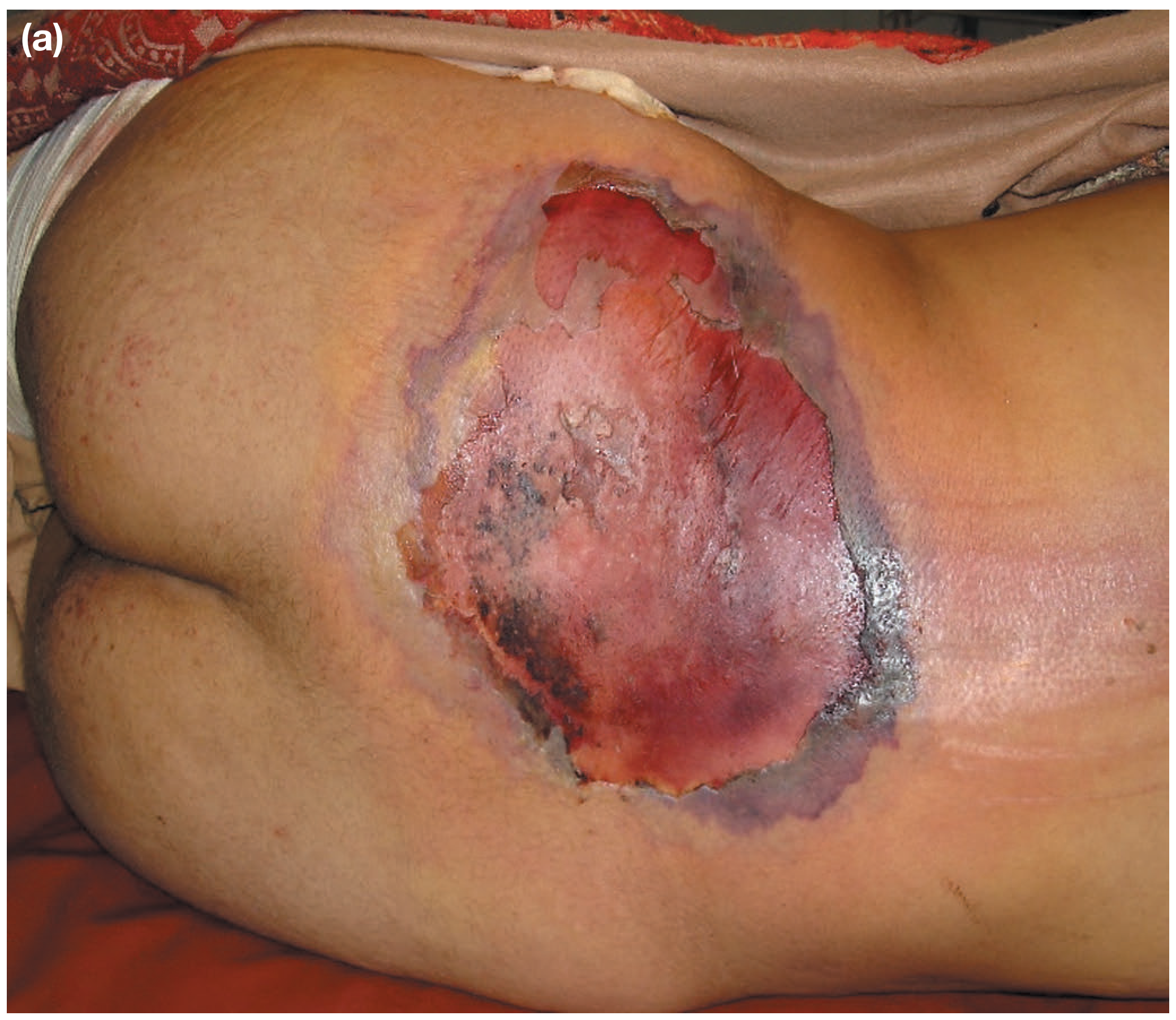
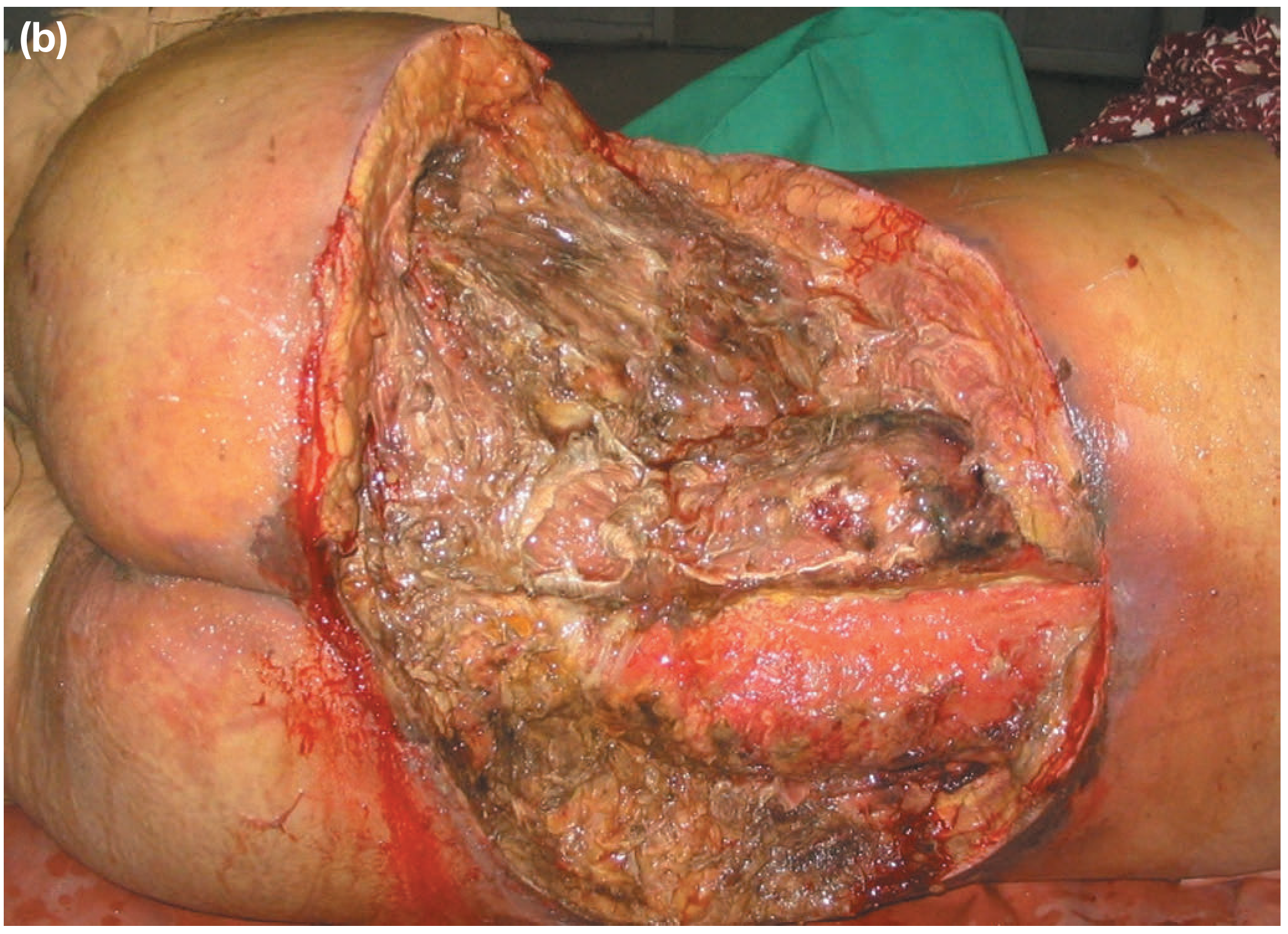
Late signs: skin blistering, frank gangrene, crepitus, and rapid progression to septic shock with renal failure. The rate of spread is dramatic - Bailey & Love emphasises this occurs within hours.
Diagnosis
Clinical - Gold Standard
Definitive diagnosis is by surgical exploration. When NF is strongly suspected, surgical exploration should not be delayed to await investigations. It is acceptable to have a rate of negative explorations (JAMA Surgery, 2024 - PMID 39259555).
Intraoperative findings: grey, necrotic fascia with "dishwater" fluid, loss of resistance on finger dissection, absence of bleeding from fascia, thrombosed vessels.
LRINEC Score
The Laboratory Risk Indicator for Necrotising Fasciitis score (Wong et al. 2004) uses 6 laboratory variables:
| Variable | Points |
|---|---|
| CRP >150 mg/L | 4 |
| WBC 15-25 x10⁹/L | 1; >25 = 2 |
| Haemoglobin 11-13.5 g/dL | 1; <11 = 2 |
| Sodium <135 mmol/L | 2 |
| Creatinine >141 µmol/L | 2 |
| Glucose >10 mmol/L | 1 |
- Score ≥6: PPV 92%, NPV 96% for NF
- Score >8: significantly higher mortality and amputation risk
- Limitations: influenced by infection site, bacterial type, renal function, and peripheral vascular disease
The 2025 Chinese Expert Consensus designates LRINEC as a valuable tool for both early diagnosis and prognostic prediction.
Imaging
- Plain X-ray: may show gas in soft tissues (sensitive but non-specific)
- CT scan: modality of choice - shows fascial plane thickening, gas tracking along fascia, fluid collections. Do NOT delay surgery for CT if clinical suspicion is high.
- MRI: most sensitive but impractical in the emergency setting
- Radiology (Grainger & Allison's) documents NF as a recognised imaging entity requiring urgent communication
Microbiology
Intraoperative tissue samples (not swabs) should be sent at each debridement to guide antibiotic tailoring. Intraoperative cultures are the gold standard.
Management: The Five Pillars
The 2025 Chinese Expert Consensus and recent reviews (JAMA Surg 2024, Curr Opin Infect Dis 2024) converge on five key management domains:
1. Resuscitation and ICU Care
- Immediate IV access, aggressive fluid resuscitation
- Haemodynamic monitoring - arterial line, consider CVP/invasive monitoring
- Oxygen supplementation; endotracheal intubation if airway compromised
- Treat septic shock per Sepsis-3 bundle: broad-spectrum antibiotics, rapid fluid resuscitation, vasopressors to maintain MAP ≥65 mmHg
- DVT prophylaxis (tiered strategy - 2025 Consensus, Recommendation 13)
- Nutritional support: early enteral nutrition given the massive metabolic demand
2. Early Surgical Debridement (Cornerstone of Treatment)
The 2025 Expert Consensus (Recommendation 4, highly recommended) states:
"In cases where NF is highly suspected, surgical exploration should be conducted without delay."
Key surgical principles:
- Timing: ideally within 6 hours of presentation (JAMA Surg 2024)
- Remove all devitalised tissue generously, going beyond the area of induration to clearly viable, bleeding tissue
- Wound is lightly packed with gauze after debridement
- Repeat debridements every 12-24 hours (some centres go daily) until no necrotic tissue remains and the patient shows clinical improvement
- Intraoperative cultures at every debridement
- Amputation is reserved for limbs with extensive muscle necrosis where function cannot be restored; it may be life-saving when fasciitis continues to spread despite debridement
From Bailey & Love: "This process is repeated daily as the necrosis is prone to spread... the role of surgical excision is radical."
3. Antimicrobial Therapy
Empirical broad-spectrum therapy should start immediately - do not wait for culture results.
Recommended empirical regimen (per 2025 Consensus and standard guidelines):
| Drug | Coverage |
|---|---|
| Penicillin G (high-dose) | Group A Streptococcus |
| Third-generation cephalosporin (e.g. ceftriaxone) | Gram-negative aerobes |
| Metronidazole | Anaerobes |
| Add vancomycin or linezolid | If MRSA suspected |
| Add piperacillin-tazobactam | Polymicrobial/immunocompromised |
- Antibiotics should be tailored based on intraoperative tissue culture results
- Duration: minimum 48-72 hours of initial therapy; extend to 2 weeks for severe disease
- For septic shock/organ dysfunction: highest-efficacy, broad-spectrum agents chosen rapidly
- Antibiotics should continue at minimum until debridement is complete and clinical improvement is evident
4. Wound Management and Reconstruction
- Vacuum-assisted closure (VAC) therapy after debridement accelerates wound healing and reduces the need for repeated theatre visits
- Early split-skin grafting in selected cases minimises protein and fluid losses (Bailey & Love)
- Reconstruction may require skin grafting, flap closure, or other techniques analogous to burn surgery
- Diverting colostomy may be needed to keep perineal wounds clean (Fournier's gangrene)
5. Adjunct Therapies
Hyperbaric Oxygen Therapy (HBOT)
- 2025 Expert Consensus (Recommendation 14, weakly recommended): "For patients with NF who have stable systemic conditions and can be safely transported, HBOT is recommended (evidence level: high)"
- Bailey & Love: mortality reduced to 9-20% with HBO vs 30-50% without
- Mechanism: enhances oxidative killing of anaerobes, promotes angiogenesis, boosts neutrophil function
- Not all centres have access; patient must be haemodynamically stable for transfer
- JAMA Surgery 2024 notes insufficient data to support routine use, but it remains a reasonable adjunct where available
Intravenous Immunoglobulin (IVIG)
- Proposed especially for Type II (GAS) NF - neutralises streptococcal superantigens (toxins responsible for the cytokine storm)
- Current evidence is insufficient to recommend routine use (JAMA Surg 2024; Curr Opin Infect Dis 2024)
- Some guidelines suggest consideration in severe GAS-associated toxic shock syndrome
- Ongoing trials are needed
Scoring and Prognosis
Factors associated with significantly higher mortality/amputation:
- Haemorrhagic bullae at presentation
- Peripheral vascular disease
- LRINEC score >8
- Bacteraemia
- Late amputation vs early amputation
- Septic shock on presentation
- Delayed time-to-surgery (>12-24 hours)
Overall mortality: 30-50% (lower end in specialist centres with early aggressive management).
Special Variants
| Variant | Location | Notes |
|---|---|---|
| Fournier's gangrene | Perineum/genitalia | Type I polymicrobial; diverting colostomy often needed |
| Meleney's gangrene | Abdominal wall | Post-operative; synergistic with microaerophilic Streptococcus |
| Periocular NF | Periorbital tissues | Rare but devastating; ophthalmology involvement essential |
Summary Algorithm
High clinical suspicion of NF
↓
Immediate resuscitation + broad-spectrum IV antibiotics
↓
Surgical exploration (do not delay for imaging)
↓
Radical debridement → intraoperative cultures → wound pack
↓
ICU: haemodynamic support, nutritional support, DVT prophylaxis
↓
Return to theatre in 12-24 hours → repeat debridement
↓
Once clean wound: VAC therapy → skin grafting/flap reconstruction
↓
HBOT (if available + patient stable); consider IVIG for GAS-NF
Key Recent References
- 2025 Chinese Expert Consensus on Diagnosis and Treatment of Adult NF - most recent consensus document
- McDermott J et al. Necrotizing Soft Tissue Infections: A Review. JAMA Surgery, 2024 - PMID 39259555
- Allaw F et al. Necrotizing fasciitis: an update on epidemiology, diagnostic methods, and treatment. Curr Opin Infect Dis, 2024 - PMID 38037890
- Guliyeva G et al. Practical Review of Necrotizing Fasciitis: Principles and Evidence-based Management. Plast Reconstr Surg Glob Open, 2024 - PMID 38250213
- Bailey and Love's Short Practice of Surgery, 28th Ed. - Chapter 33 & 45
This is a shared conversation. Sign in to Orris to start your own chat.