
Perianal hematoma
Reading File
Finding Sources
Finding Sources
Searching the Web
perianal hematoma clinical features management treatment
Finding Sources
Finding Sources
Reading File
Reading File
Reading File
Loading Image
Now I have solid textbook content. Let me also get the procedure details for thrombosed external hemorrhoid excision.
Reading File
I now have comprehensive content. Let me compile the full answer.
Perianal Hematoma (Thrombosed External Hemorrhoid)
Terminology note: The term "perianal hematoma" is often used interchangeably with "thrombosed external hemorrhoid," though strictly speaking a perianal hematoma is a blood collection within the perianal skin, while a thrombosed external hemorrhoid involves clot formation within the external hemorrhoidal venous plexus. Clinically the distinction is minor - both present and are managed identically. The "thrombosed external pile" label is a misnomer.
Anatomy
External hemorrhoids arise from the external hemorrhoidal venous plexus below the dentate (pectinate) line, covered by perianal skin (somatic innervation - hence painful). This is why thrombosis of external hemorrhoids causes severe pain, unlike thrombosis of internal hemorrhoids (above the dentate line, visceral innervation).
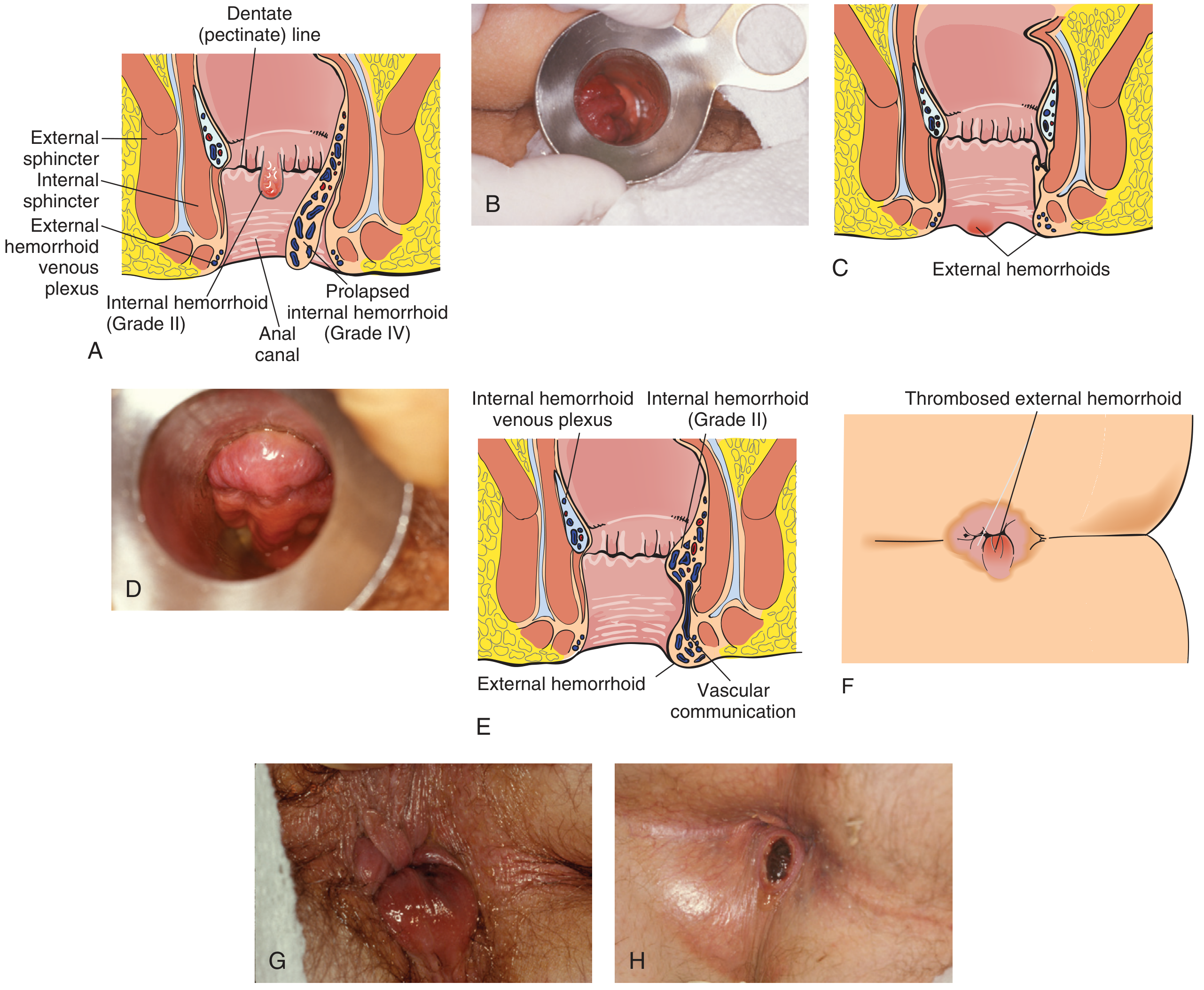
Pathophysiology
- Thrombosis occurs within the external hemorrhoidal plexus, forming a blood clot beneath the perianal skin
- Distention of the overlying perianal skin plus inflammation from the thrombotic process drives the pain
- Bleeding can occur if the overlying skin ulcerates and the liquefied, resolving hematoma extravasates
- After ~48-72 hours, the hematoma begins to liquefy and organise
Clinical Features
| Feature | Detail |
|---|---|
| Onset | Sudden, often after straining, heavy lifting, or prolonged sitting |
| Pain | Severe, constant perianal pain (unlike internal hemorrhoids) |
| Lump | Tense, tender, bluish-purple mass at the anal verge |
| Cannot be reduced | Cannot be pushed back inside (unlike prolapsed internal hemorrhoid) |
| Bleeding | May occur if skin overlying the hematoma ulcerates |
Differential diagnoses to exclude:
- Prolapsed/strangulated internal hemorrhoid (larger, more circumferential, covers the entire anus)
- Perianal abscess (fluctuant, fever, systemic signs)
- Anal melanoma - can mimic a thrombosed external hemorrhoid, but up to 25% are amelanotic; these metastasize early with 5-year survival of only 15-20%
Management
Conservative (if > 72 hours or mild symptoms)
Most thrombosed external hemorrhoids resolve within 48-72 hours on their own. Conservative treatment is appropriate if the patient presents late or has mild discomfort:
- Warm sitz baths 2-3 times daily
- Stool softeners (psyllium, docusate sodium/calcium) - to minimise straining and prevent aggravation
- Topical anesthetic ointments (e.g., lidocaine)
- Witch hazel-impregnated pads
- Oral analgesics (NSAIDs)
Conservative measures do resolve symptoms, but clinical improvement must be attributed with caution - most resolve spontaneously regardless.
Surgical (within 48-72 hours of onset, severe pain)
If the patient presents within 48-72 hours with severe pain, surgical evacuation or excision is indicated and offers:
- Immediate symptom relief
- Lower recurrence rate
- Longer remission intervals vs. conservative therapy
Excision is preferred over simple incision and drainage - excising the thrombus with overlying skin (leaving a wide-open wound) has a lower recurrence rate than I&D alone, because simple drainage allows the wound to seal over and the clot to reaccumulate.
Technique (office procedure under local anaesthesia):
- Position: left lateral decubitus; perform digital and anoscopic exam
- Wipe the area with antiseptic
- Inject 2% lidocaine with epinephrine as a field block (avoid over-infiltrating, which tents up tissue excessively)
- Using a no. 15 scalpel blade, excise the thrombosed hemorrhoid with a small elliptical wedge of overlying skin
- Spread the incision to expose the base and remove all thrombi (multiple clots are common)
- Leave wound open or close with fine absorbable suture; control bleeding with Monsel's solution or cautery
- Apply antibiotic ointment mixed with 5% lidocaine ointment
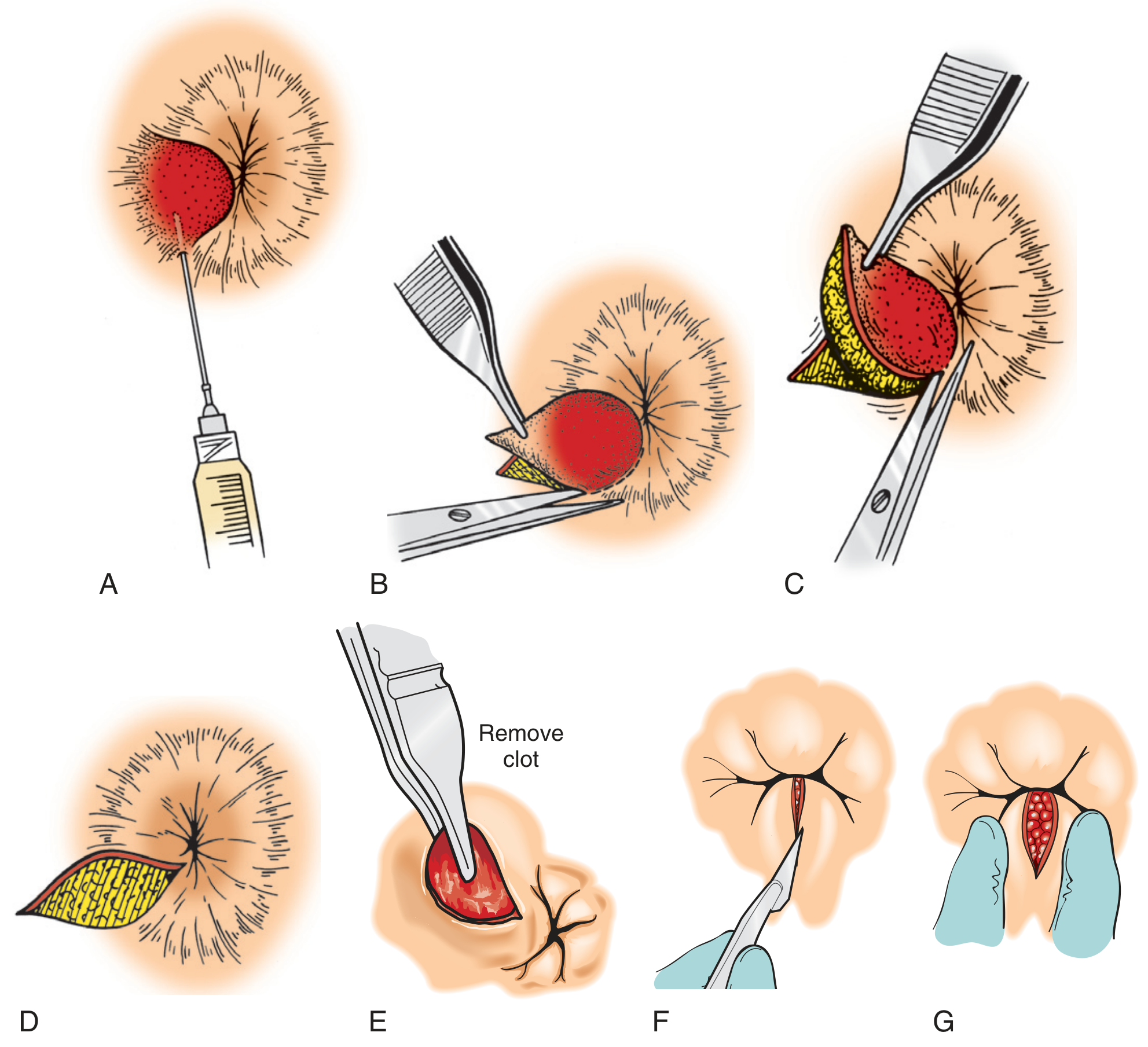
After 72 hours - do NOT evacuate. The hematoma has begun to liquefy, and surgical intervention at this stage is associated with a high rate of bleeding. Continue conservative therapy.
Complications of the Procedure
- Pain (expected)
- Bleeding
- Infection / perianal abscess (< 1%)
- Chronic fissure
Post-Resolution: Skin Tags
After the clot resolves, the overlying skin may become redundant, leaving a perianal skin tag. These are generally asymptomatic but can cause hygiene difficulties and pruritus ani. Treatment is conservative; surgical excision only for persistent hygiene problems or significant patient distress.
Key Clinical Pearls
- Excision beats simple I&D - removes the clot chamber, preventing reaccumulation (Textbook of Family Medicine 9e; Greenspon et al., 2004, SOR: B)
- 72-hour window is critical - surgery before this point gives immediate relief; after this, conservative management is safer
- Don't confuse with internal hemorrhoid prolapse - external hemorrhoids cannot be reduced; prolapsed internal hemorrhoids can (sometimes)
- Melanoma mimicry - always consider anal melanoma in atypical or non-resolving "thrombosed hemorrhoids"
Sources: Yamada's Textbook of Gastroenterology 7e; Pfenninger and Fowler's Procedures for Primary Care 3e; Textbook of Family Medicine 9e; Current Surgical Therapy 14e
This is a shared conversation. Sign in to Orris to start your own chat.