
Mechanism of respiration
Reading File
Finding Sources
Finding Sources
Good. Now let me read from the best sources — Costanzo Physiology (classic physiology text) and the Color Atlas for visual content, in parallel.
Reading File
Reading File
There's a relevant anatomy diagram. Let me fetch it and also read more Costanzo content on pressures and airflow.
Loading Image
Reading File
Excellent — I have rich content. Let me read more of the Costanzo block covering the pressure changes, airflow, and neural control.
Reading File
I now have comprehensive content. Let me compile the full answer.
Mechanism of Respiration
Respiration involves the movement of air between the atmosphere and the alveoli through cyclical changes in thoracic volume and pressure. It has two phases — inspiration (active) and expiration (passive at rest).
1. Structural Framework
The thoracic cage (ribs, sternum, thoracic vertebrae) and its muscles form the mechanical pump. The pleural cavity — a thin, fluid-filled space between the visceral and parietal pleura — transmits pressure changes from the chest wall to the lungs.
Key anatomical point: The lungs adhere to the thoracic wall through capillary forces of the pleural fluid and negative intrapleural pressure. They passively follow every thoracic movement. If the pleural cavity is breached (pneumothorax), negative pressure is lost, and the elastic lungs collapse to ~⅓ their original volume. — Color Atlas of Human Anatomy Vol. 2
2. Pressure Relationships
Three pressures govern breathing (all referenced to atmospheric pressure = 0):
| Pressure | At Rest | During Inspiration | During Expiration |
|---|---|---|---|
| Alveolar (P_alv) | 0 cm H₂O | −1 cm H₂O | +1 cm H₂O |
| Intrapleural (P_ip) | −5 cm H₂O | −8 cm H₂O | −4 cm H₂O |
| Transmural (P_alv − P_ip) | +5 cm H₂O | +7 cm H₂O | +5 cm H₂O |
The transmural pressure (also called transpulmonary pressure) is always positive throughout the breathing cycle, keeping the lungs open. — Costanzo Physiology 7th Ed.
The negative intrapleural pressure at rest exists because two opposing elastic forces pull on the intrapleural space:
- The lungs (elastic tissue + surface tension) tend to collapse inward
- The chest wall tends to spring outward This creates a "vacuum" between them.
3. Muscles of Breathing
Inspiration (Active)
- Diaphragm — the primary muscle; on contraction, it descends, pushing abdominal contents down and expanding the thorax caudally
- External intercostals — elevate the ribs, increasing transverse and sagittal diameters
- Scalene muscles — accessory muscles that elevate the upper ribs
- Sternocleidomastoid — used during forced inspiration
Expiration (Passive at rest)
- Driven by elastic recoil of lungs and chest wall — no muscle contraction required at rest
- Internal intercostals — pull ribs down and inward during forced expiration
- Abdominal muscles (rectus abdominis, transverse abdominis) — compress abdomen, push diaphragm up; active during exercise, coughing, sneezing
— Costanzo Physiology 7th Ed.; Color Atlas of Human Anatomy Vol. 2
4. The Breathing Cycle
At Rest (FRC — Functional Residual Capacity)
- No air movement; alveolar pressure = atmospheric pressure (0 cm H₂O)
- Intrapleural pressure = −5 cm H₂O
- Volume in lungs = FRC (~2.5 L in adults)
Inspiration
- The diaphragm contracts → thoracic volume increases
- By Boyle's Law (P × V = constant), as volume ↑, pressure ↓
- Alveolar pressure drops to −1 cm H₂O (below atmospheric)
- Pressure gradient (atmosphere → alveoli) drives air into the lungs
- Air flows in until alveolar pressure returns to 0 — flow stops
- Volume added = tidal volume (~500 mL); total volume now = FRC + VT
- Intrapleural pressure becomes more negative (−8 cm H₂O) due to increased elastic recoil and negative airway pressure
Expiration (quiet)
- Diaphragm relaxes → thoracic volume decreases
- Elastic recoil of lungs generates positive alveolar pressure (+1 cm H₂O)
- Air flows out of lungs (alveoli → atmosphere) down the pressure gradient
- Flow stops when alveolar pressure returns to 0; system returns to FRC
- Intrapleural pressure returns to −5 cm H₂O
— Costanzo Physiology 7th Ed.
5. Illustration: Thoracic Cage and Diaphragm Movement
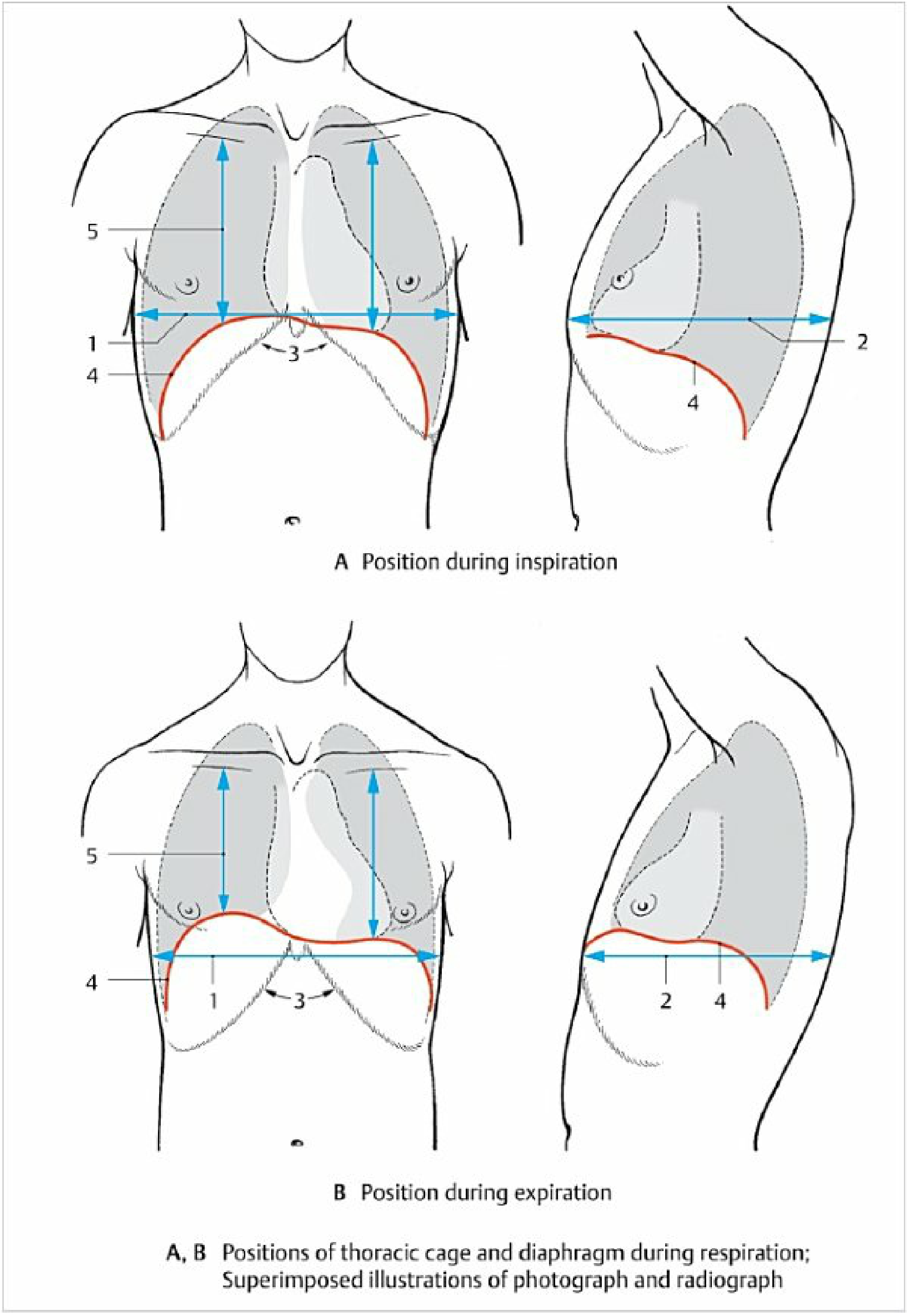
Fig. 3.21 — Positions of the thoracic cage and diaphragm during respiration. During inspiration (A), the ribs rise, increasing transverse (1) and sagittal (2) diameters; the epigastric angle widens (3); the diaphragm descends (4); and the inferior thorax expands (5). Opposite changes occur during expiration (B). — Color Atlas of Human Anatomy Vol. 2
6. Compliance and Resistance
Compliance
- Compliance = ΔVolume / ΔPressure — describes how easily the lungs stretch
- High compliance (emphysema) → lungs over-distend
- Low compliance (fibrosis, pulmonary edema) → stiff lungs, harder to inflate
- The chest wall itself also has compliance; the two compliances act in series
Surface Tension & Surfactant
- The alveolar air-liquid interface creates surface tension (by Laplace's Law: P = 2T/r), which tends to collapse alveoli
- Surfactant (secreted by type II pneumocytes) reduces surface tension, especially in small alveoli, preventing alveolar collapse (atelectasis) and reducing the work of breathing
Airway Resistance
- Governed by Poiseuille's Law: Resistance ∝ 1/r⁴ (radius has the greatest effect)
- Main site of resistance: medium-sized bronchi (not alveoli, which have too large a combined cross-section)
- Increased in asthma and COPD → expiratory muscles must assist passive expiration
7. Types of Breathing
- Thoracic (costal) breathing — predominant in adults; relies on rib cage movement
- Diaphragmatic (abdominal) breathing — predominant in infants and elderly
- Infants use abdominal breathing due to horizontal rib orientation; the elderly due to reduced thoracic elasticity
Summary Table
| Phase | Muscle Activity | Thoracic Volume | Alveolar Pressure | Air Flow |
|---|---|---|---|---|
| Rest | None | Stable (FRC) | 0 cm H₂O | None |
| Inspiration | Diaphragm contracts | Increases | −1 cm H₂O | Into lungs |
| End of inspiration | Diaphragm plateaus | Max | 0 cm H₂O | Stops |
| Expiration (quiet) | Elastic recoil only | Decreases | +1 cm H₂O | Out of lungs |
| End of expiration | Muscles relax | FRC | 0 cm H₂O | Stops |
The entire mechanism rests on Boyle's Law (pressure-volume relationship) operating within a compliant thoracopulmonary system, powered by the diaphragm and accessory muscles, and modulated by the elastic properties of lung tissue and surfactant.
With diagram
The diagram was already included in my previous response — let me fetch a few more relevant diagrams from the textbooks to give you a more complete visual picture.
Loading Image
Loading Image
Reading File
Loading Image
Here is the complete, diagram-supported explanation of the mechanism of respiration:
Mechanism of Respiration — With Diagrams
Diagram 1 — Lung & Chest Wall System
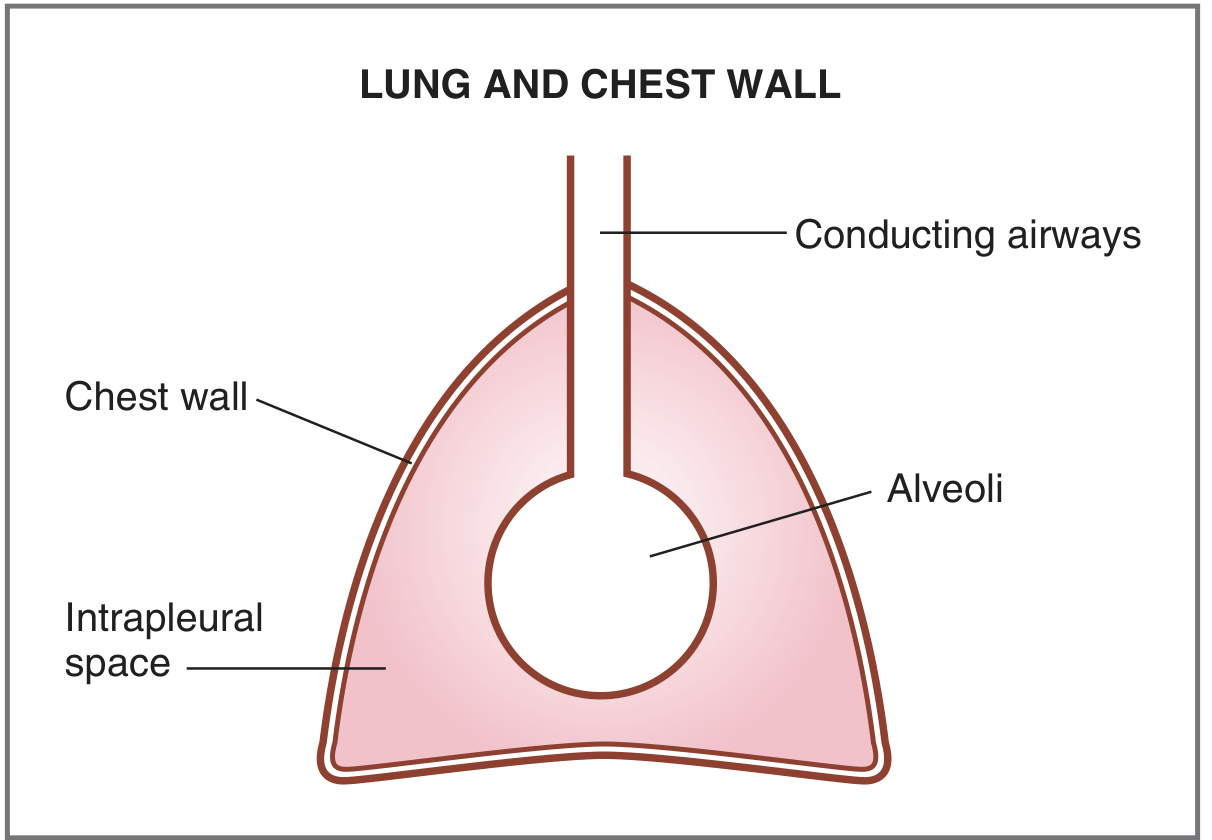
The lungs (alveoli) sit inside the chest wall, separated by the intrapleural space. Air enters via the conducting airways. The intrapleural space transmits pressure changes from the thorax to the lung surface. — Costanzo Physiology 7th Ed., Fig. 5.8
Diagram 2 — Thoracic Cage & Diaphragm Movement
During Inspiration (A): Ribs rise → transverse (1) and sagittal (2) diameters of the thorax increase → epigastric angle widens (3) → diaphragm descends (4) → thorax expands caudally (5). Lung volume increases.
During Expiration (B): All movements reverse. Ribs descend, diaphragm domes rise, thoracic volume decreases. — Color Atlas of Human Anatomy Vol. 2, Fig. 3.21
Diagram 3 — Pressures Throughout the Breathing Cycle
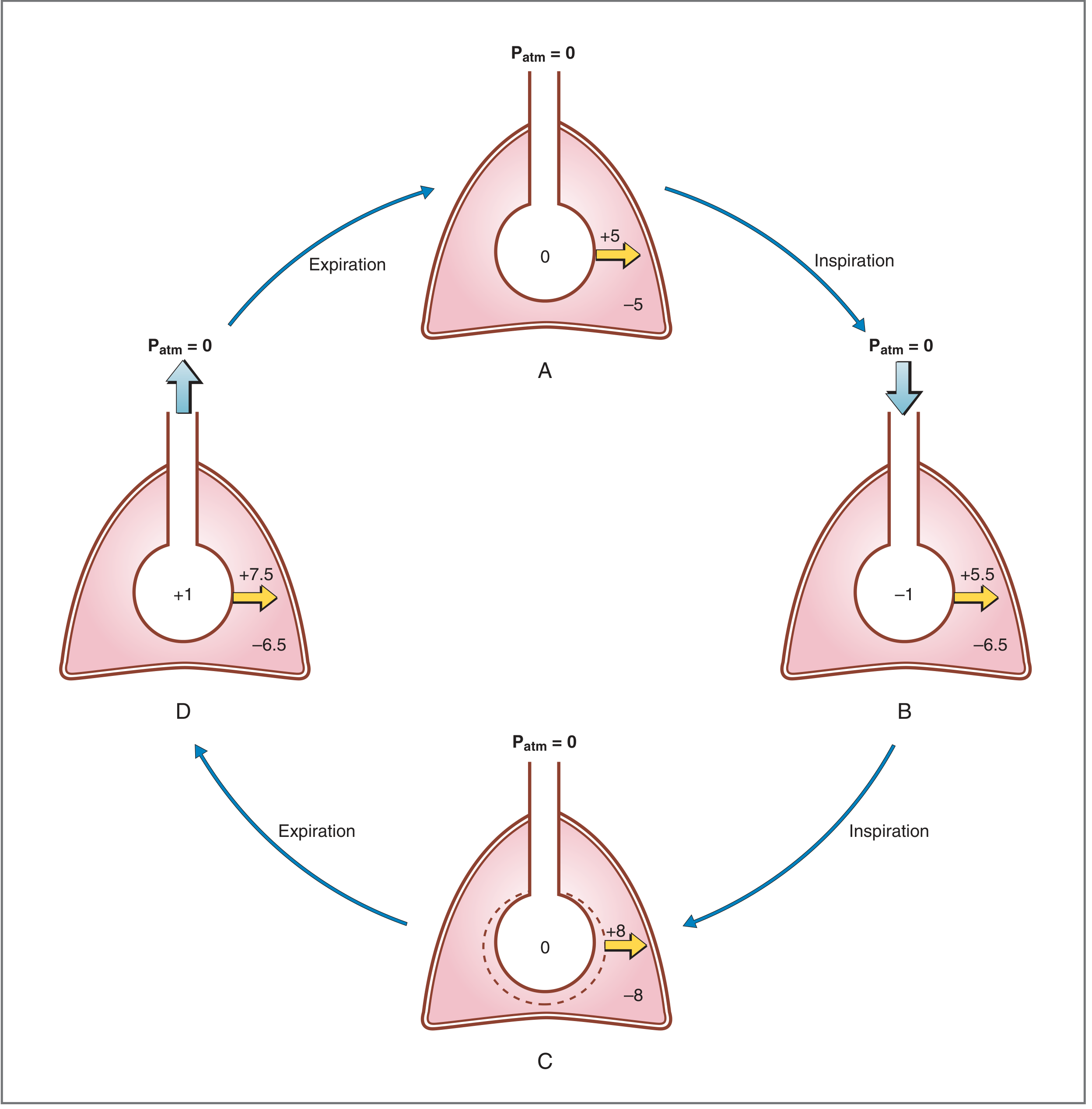
This is the key diagram. All pressures are in cm H₂O relative to atmospheric (= 0). Yellow arrows = transmural (expanding) pressure. Blue arrows = direction of airflow.
| Phase | Alveolar P | Intrapleural P | Transmural P | Airflow |
|---|---|---|---|---|
| A — Rest | 0 | −5 | +5 | None |
| B — Mid-Inspiration | −1 | −6.5 | +5.5 | Into lungs ↓ |
| C — End-Inspiration | 0 | −8 | +8 | Stops |
| D — Mid-Expiration | +1 | −6.5 | +7.5 | Out of lungs ↑ |
Key principle (Boyle's Law): As thoracic volume ↑ → alveolar pressure ↓ → air flows in. As volume ↓ → pressure ↑ → air flows out. Transmural pressure remains positive throughout, keeping airways open. — Costanzo Physiology 7th Ed., Fig. 5.14
Diagram 4 — Intrapleural Pressure: Normal vs. Pneumothorax
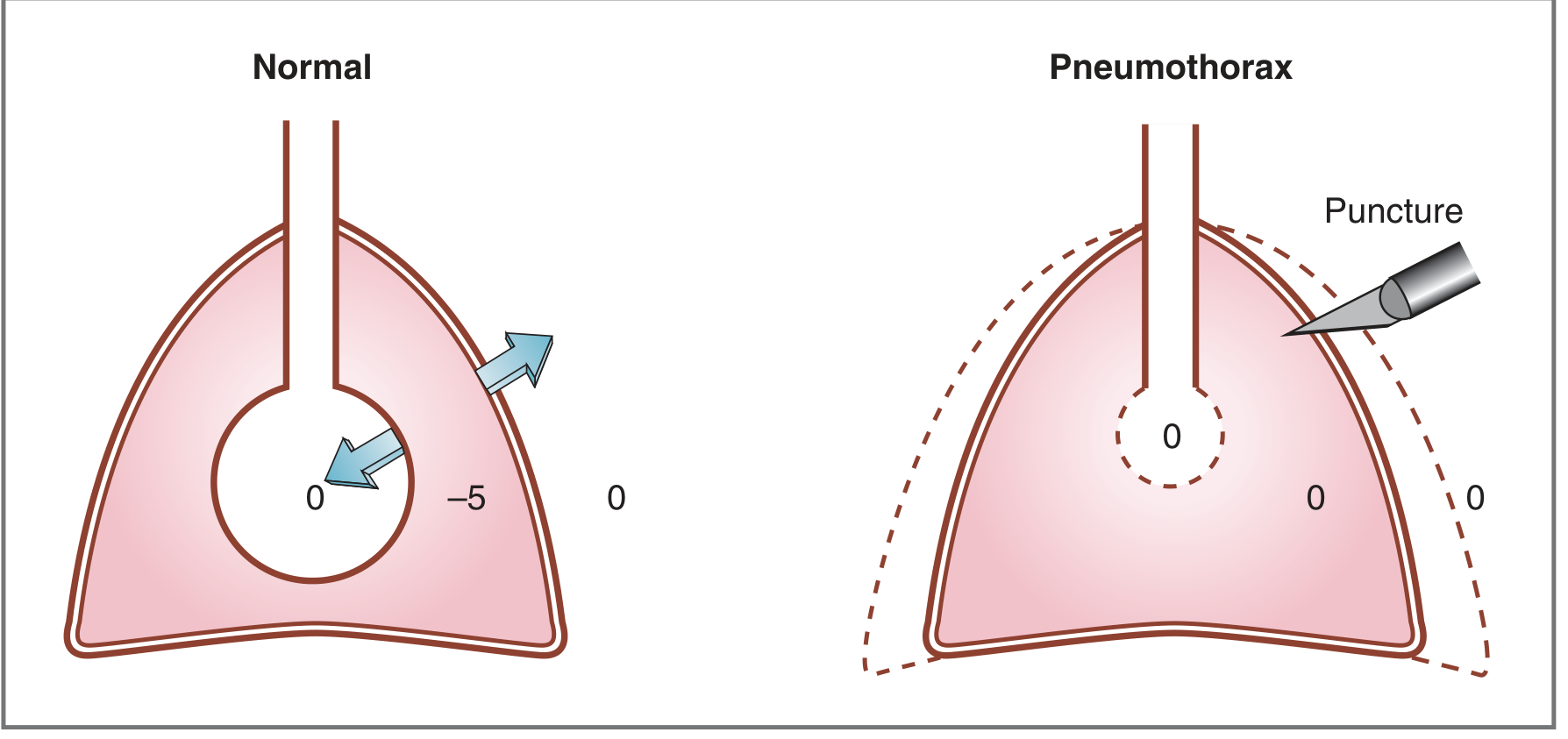
Normal: Intrapleural pressure = −5 cm H₂O (negative), held by opposing elastic forces — lung trying to collapse inward, chest wall trying to spring outward. This negative pressure keeps the lungs inflated.
Pneumothorax: Air enters the intrapleural space → pressure rises to 0 → lungs collapse inward (elastic recoil unopposed) → chest wall springs outward. — Costanzo Physiology 7th Ed., Fig. 5.9
Mechanism Summary
Neural stimulus (brainstem respiratory centres)
        ↓
Diaphragm + external intercostals CONTRACT
        ↓
Thoracic volume INCREASES
        ↓
Intrapleural pressure ↓ (more negative: −5 → −8 cm H₂O)
        ↓
Lung expands → Alveolar volume ↑ → Alveolar pressure ↓ (0 → −1 cm H₂O)
        ↓
Pressure gradient: Atmosphere (0) > Alveoli (−1)
        ↓
AIR FLOWS IN (Inspiration)
        ↓
Alveolar pressure returns to 0 → flow stops
        ↓
Diaphragm RELAXES → Elastic recoil of lung
        ↓
Alveolar pressure ↑ (0 → +1 cm H₂O)
        ↓
Pressure gradient: Alveoli (+1) > Atmosphere (0)
        ↓
AIR FLOWS OUT (Passive Expiration)
        ↓
Return to FRC — cycle repeats
The entire mechanism is driven by Boyle's Law within a compliant thoracopulmonary system, with the negative intrapleural pressure acting as the critical coupling force between the chest wall and the lung. — Costanzo Physiology 7th Ed.
This is a shared conversation. Sign in to Orris to start your own chat.