
Infertility with hypothyroid OB&G case
Reading File
Quick answer: Hypothyroidism is a common, treatable cause of infertility in women. It disrupts the HPG axis via elevated TRH stimulating excess prolactin, causes anovulation, luteal phase defects, and poor implantation. TSH is the key screening test; levothyroxine replacement typically restores fertility.
Searching sources...
Finding Sources
Finding Sources
Searching PubMed
hypothyroidism infertility treatment levothyroxine
Finding Sources
Finding Sources
Finding Sources
Good hits from Creasy & Resnik's Maternal-Fetal Medicine, Goldman-Cecil Medicine, and Berek & Novak's Gynecology. Let me read those sections in full.
Reading File
Reading File
Reading File
Excellent content. Now let me get the Creasy & Resnik section on thyroid hormone effects on reproductive disorders, and also the treatment section from Berek & Novak.
Reading File
Reading File
Finding Sources
Finding Sources
Finding Sources
I have comprehensive information from multiple authoritative sources. Let me also fetch the thyroid diagram image from Creasy & Resnik to include in the answer.
Loading Image
I now have all the content needed for a thorough, well-cited answer. Here it is:
Infertility with Hypothyroidism - OB&G Clinical Overview
1. Epidemiology & Etiology of Hypothyroidism in Women of Reproductive Age
Hashimoto thyroiditis (chronic lymphocytic thyroiditis) is the most common cause of hypothyroidism in iodine-sufficient areas, accounting for >90% of cases. It occurs in 8-10% of women of reproductive age. Anti-TPO antibodies are present in >90% of patients; anti-thyroglobulin (TG) antibodies in 50-70%.
Other causes: iodine deficiency (globally most common), post-radioiodine (131I) ablation, thyroidectomy, medications (checkpoint inhibitors, tyrosine kinase inhibitors), and central/pituitary causes such as Sheehan syndrome.
- Creasy & Resnik's Maternal-Fetal Medicine, p. 1502
2. How Hypothyroidism Causes Infertility - Pathophysiology
Hypothyroidism disrupts fertility through several interconnected mechanisms:
A. Disruption of the HPG Axis
-
Hypothyroidism decreases sex hormone levels and increases prolactin (via elevated TRH stimulating pituitary lactotrophs)
-
Elevated prolactin produces abnormal GnRH secretion/pulsatility, causing:
- Oligo/anovulation
- Menstrual disturbances (oligomenorrhea, amenorrhea, menorrhagia)
- Up to 25% of hypothyroid women have menstrual irregularities that may respond to thyroxine treatment
-
Creasy & Resnik's Maternal-Fetal Medicine, p. 1503
-
Berek & Novak's Gynecology, p. 1879
B. Uterine Receptivity Impairment
-
Deiodinases, T3 and T4 receptors in the uterine epithelium change expression throughout the menstrual cycle
-
Hypothyroidism alters uterine epithelial proliferation and differentiation, impairing fertilization and embryo implantation
-
Creasy & Resnik's Maternal-Fetal Medicine, p. 1503
C. Hyperprolactinemia (secondary)
-
Elevated TSH stimulates excess prolactin from the pituitary
-
Prolactin suppresses the HPG axis, causing additional anovulation and luteal phase defects
-
On lab evaluation: elevated TSH with or without elevated prolactin = primary hypothyroidism
-
Goldman-Cecil Medicine, p. 1649
3. Clinical Presentation
Menstrual symptoms:
- Oligomenorrhea or amenorrhea (amenorrhea occurs in only some hypothyroid women)
- Menorrhagia (heavy periods) - also possible
- Galactorrhea (if hyperprolactinemia is co-present)
Systemic symptoms (see diagram below):
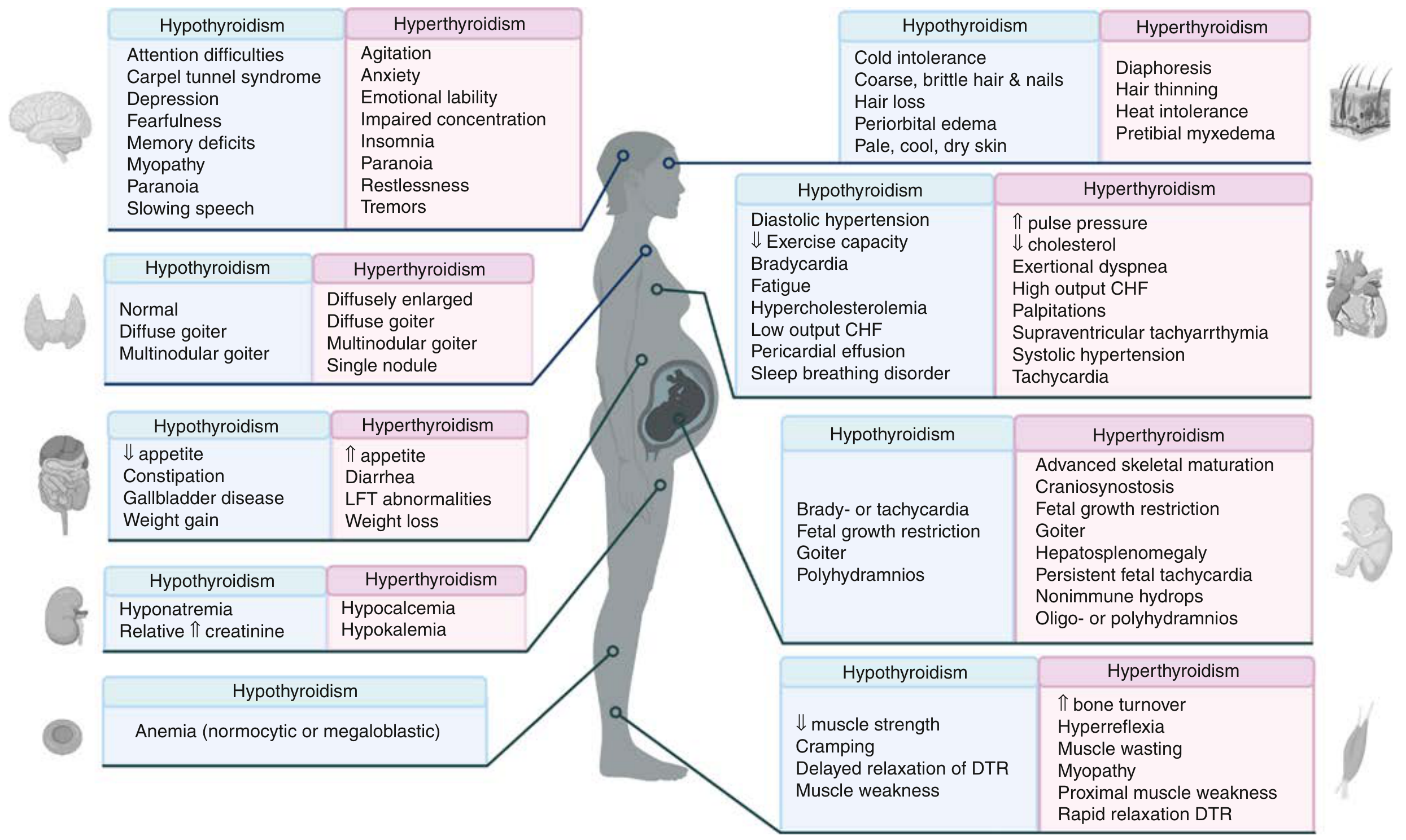
Figure: Signs and symptoms of hypothyroidism and hyperthyroidism across organ systems. - Creasy & Resnik's Maternal-Fetal Medicine
Key hypothyroid features relevant to the OB&G patient:
- Weight gain, constipation, cold intolerance
- Dry skin, coarse brittle hair/nails, periorbital edema
- Fatigue, bradycardia, diastolic hypertension
- Depression, memory deficits, slowing speech
- Anemia (normocytic or megaloblastic)
4. Investigations
For any woman presenting with amenorrhea, oligomenorrhea, or anovulatory infertility:
| Test | Purpose |
|---|---|
| TSH (sensitive immunoassay) | First-line screen; elevated = primary hypothyroid; suppressed = hyperthyroid |
| Free T4 | Confirms overt vs. subclinical hypothyroidism |
| Prolactin | Often elevated secondary to hypothyroidism; repeat if mildly elevated with normal TSH |
| Anti-TPO antibodies | Confirms Hashimoto; predicts need for treatment even in subclinical disease |
| FSH, LH | Rules out POI (FSH >30 mIU/mL) and PCOS (LH:FSH ratio) |
| Free testosterone | Rules out PCOS/hyperandrogenism |
| Pregnancy test | Always first in any woman of reproductive age with amenorrhea |
All amenorrheic and oligomenorrheic women should have basal FSH, prolactin, and TSH measured to confirm clinical impression. - Goldman-Cecil Medicine, p. 1647
The PCOS diagnosis explicitly excludes patients with significant thyroid dysfunction - thyroid disease must be ruled out before labeling as PCOS. - Berek & Novak's Gynecology, p. 1879
5. Subclinical Hypothyroidism (SCH) and Infertility
This is a clinically important and nuanced area:
-
Retrospective and cross-sectional studies in couples undergoing ART show a dose-dependent association between mild TSH elevations above the population median (1.7-2.0 mIU/L) and:
- Infertility
- Lower ovarian reserve
- Decreased pregnancy rates
-
LT4 treatment of mild SCH generally shows higher pregnancy and delivery rates in ART patients
-
Current evidence most strongly associates infertility with overt hypothyroidism, particularly in the setting of TPO antibody positivity
-
Creasy & Resnik's Maternal-Fetal Medicine, p. 1503
6. Management
Step 1: Treat the hypothyroidism with Levothyroxine (LT4)
LT4 monotherapy is the preferred treatment. This is especially important because:
- T4 is critical for fetal brain development
-
80% of circulating T3 comes from conversion of T4
Dosing:
| Situation | LT4 Dose |
|---|---|
| Overt hypothyroidism (non-pregnant) | 1.6 μg/kg/day |
| Overt hypothyroidism (pregnancy) | 1.5-2.0 μg/kg/day |
| Subclinical hypothyroidism (seeking pregnancy) | 50-75 μg/day (lower dose) |
TSH target for women desiring pregnancy or undergoing ART: 0.5-2.5 mIU/L
- Creasy & Resnik's Maternal-Fetal Medicine, p. 1504
Step 2: Optimize LT4 Absorption
Counsel patients:
- Take LT4 fasting in the morning, 60 min before breakfast, OR at bedtime (3+ hours after last meal)
- Avoid co-ingestion with: ferrous sulfate, iron-containing prenatal vitamins, high-dose calcium, soy products (take 4+ hours apart)
- Conditions like celiac disease, atrophic gastritis, gastroparesis may require higher doses or gel-cap formulation (Tirosint)
Step 3: Monitor and Adjust
- Recheck TSH 4-6 weeks after dose initiation or change
- Increase LT4 dose by ~25-30% as soon as pregnancy is confirmed (metabolic demands increase)
- If prolactin remains elevated despite euthyroid state on LT4, evaluate for pituitary adenoma (MRI pituitary)
Step 4: Induce Ovulation if Needed
- Once euthyroid, many women resume spontaneous ovulation
- If anovulation persists despite normal TSH, consider ovulation induction:
- First line: Letrozole
- Second line: Clomiphene citrate
- Harrison's Principles of Internal Medicine, p. 1404
7. Pregnancy Considerations
- LT4 requirements increase by ~30-50% in pregnancy - adjust immediately when pregnancy is confirmed
- Untreated overt hypothyroidism is associated with adverse perinatal outcomes: miscarriage, preeclampsia, preterm birth, fetal growth restriction, and impaired fetal neurologic development
- Screen all pregnant women with risk factors for thyroid disease (personal/family history, symptoms, autoimmune disease)
- Anti-TPO antibody positivity even with normal TSH is associated with increased risk of miscarriage and preterm birth
8. Summary Algorithm
Infertile woman
        |
        ↓
Rule out pregnancy (hCG)
        |
        ↓
Screen: TSH, Prolactin, FSH
        |
    ┌───┴───┐
Elevated TSH    Normal TSH
    |              |
    ↓              ↓
Free T4        Further workup (PCOS, POI,
Anti-TPO        hyperprolactinemia, structural)
    |
    ↓
Overt vs. Subclinical hypothyroidism
    |
    ↓
Start LT4 → Target TSH 0.5-2.5 mIU/L
    |
    ↓
Re-evaluate ovulation
    |
    ↓
If anovulation persists → Ovulation induction (Letrozole)
Key clinical pearls:
- TSH is the single most important first test in a woman with anovulatory infertility
- Hypothyroidism must be excluded before diagnosing PCOS
- Even mild TSH elevation above 2.5 mIU/L can impair fertility, especially with anti-TPO positivity
- LT4 treatment alone may restore fertility in overt/significant subclinical hypothyroidism
- LT4 dose must be increased immediately upon confirmed pregnancy
Sources: Creasy & Resnik's Maternal-Fetal Medicine (p. 1502-1504); Goldman-Cecil Medicine (p. 1647-1652); Berek & Novak's Gynecology (p. 1879); Harrison's Principles of Internal Medicine (p. 1404)
This is a shared conversation. Sign in to Orris to start your own chat.