
Tell me everything I need to know about " Popliteal Fossa, Popliteal Artery and Popliteal vein" it's features and everything in concise heading way and simple words, easier for me to understand
Reading File
Now let me search the medical library for content on popliteal fossa, popliteal artery, and popliteal vein in parallel.
Finding Sources
Finding Sources
Searching Images
popliteal fossa anatomy artery vein diagram
Now let me read the most detailed sections from Gray's Anatomy and the THIEME Atlas in parallel:
Reading File
Reading File
I now have rich content. Let me also read the continuation of Gray's Anatomy for the detailed artery/vein section and fetch the key anatomical diagram:
Reading File
Loading Image
I now have comprehensive, detailed content from authoritative textbooks. Let me compile the full answer.
Popliteal Fossa, Popliteal Artery & Popliteal Vein
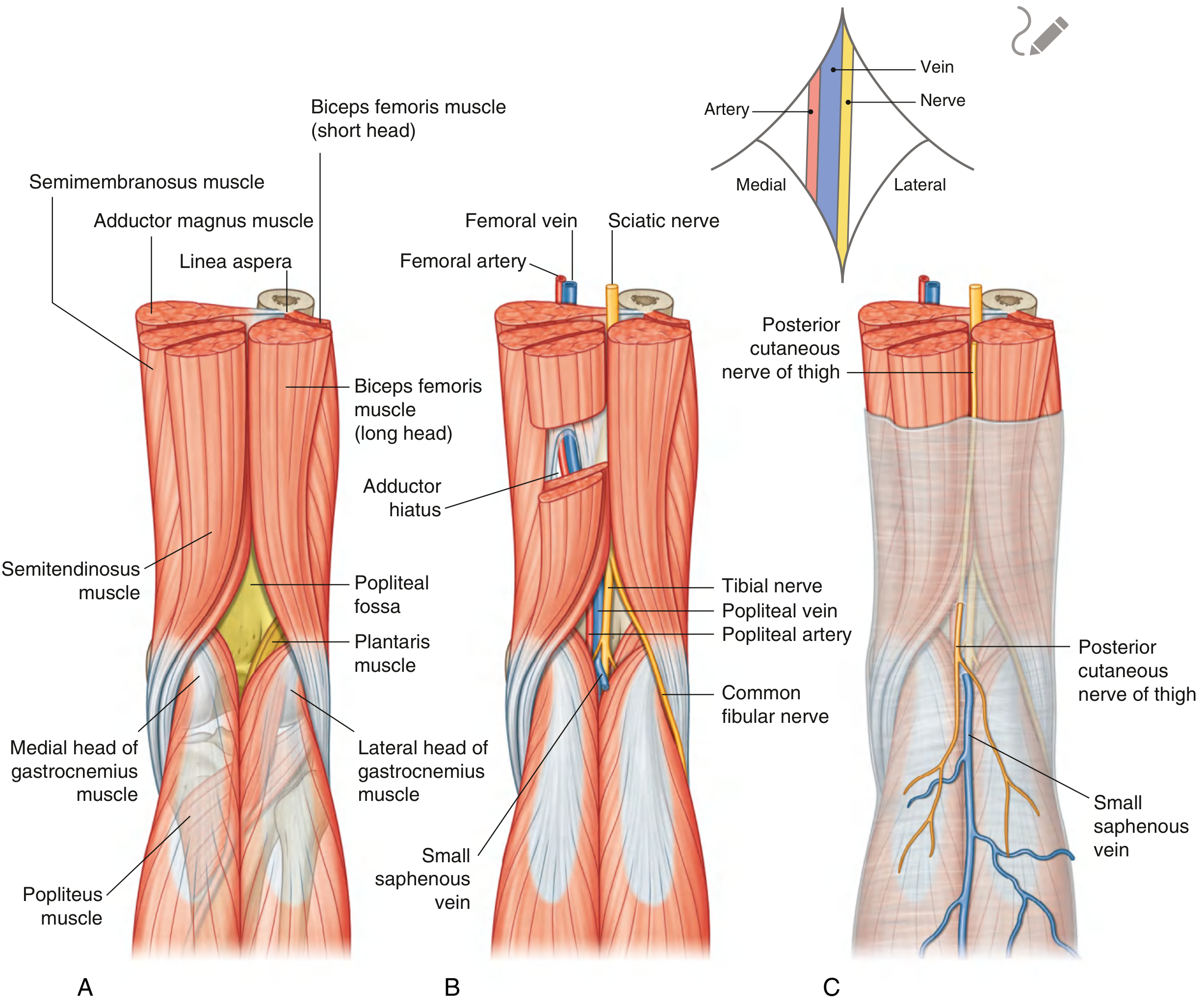
1. What Is the Popliteal Fossa?
The popliteal fossa is a diamond-shaped hollow space behind the knee joint. Think of it as a passageway — it's the main route through which blood vessels, nerves, and other structures travel between the thigh and the leg.
2. Shape & Boundaries
The diamond has two halves — upper (larger) and lower (smaller):
| Part | Medial Border | Lateral Border |
|---|---|---|
| Upper half | Semitendinosus + Semimembranosus muscles | Biceps femoris muscle |
| Lower half | Medial head of Gastrocnemius | Lateral head of Gastrocnemius + Plantaris muscle |
Floor (deep surface)
- Formed by the capsule of the knee joint, adjacent surfaces of the femur and tibia, and the popliteus muscle below.
Roof (superficial surface)
- Formed by deep fascia (continuous with fascia lata of the thigh above, and deep fascia of the leg below).
- The skin and superficial fascia cover the roof.
3. Contents of the Popliteal Fossa
The fossa contains 4 major structures (from superficial → deep):
Nerves (most superficial)
    ↓
Popliteal Vein
    ↓
Popliteal Artery (deepest)
- Tibial nerve — runs vertically through the fossa, exits into the posterior leg
- Common fibular (peroneal) nerve — exits by following the biceps femoris tendon laterally, wraps around the neck of the fibula
- Popliteal vein — superficial to the artery
- Popliteal artery — deepest of all, difficult to palpate
Also contains: fat, lymph nodes, and the small saphenous vein (in the roof/superficial fascia).
4. Popliteal Artery
What is it?
The popliteal artery is simply the continuation of the femoral artery, after the femoral artery passes through the adductor hiatus (a gap in the adductor magnus muscle).
Course
- Enters the popliteal fossa from the upper medial side, under the semimembranosus muscle
- Descends obliquely through the fossa alongside the tibial nerve
- Ends just below the popliteus muscle by dividing into:
- Anterior tibial artery → goes to front of leg
- Posterior tibial artery → goes to back of leg
Key Feature
- It is the deepest structure in the fossa (closest to the bone), making it hard to palpate
- A pulse can be felt by pressing deeply near the midline of the back of the knee
Branches in the Fossa
The popliteal artery gives off 5 genicular (knee) arteries that form a network around the knee joint:
- Medial superior genicular artery
- Lateral superior genicular artery
- Middle genicular artery (pierces joint capsule, supplies cruciate ligaments)
- Medial inferior genicular artery
- Lateral inferior genicular artery
It also gives off paired sural arteries → supply the gastrocnemius muscle.
Together, these form the articular rete (network) of the knee, important for collateral circulation.
5. Popliteal Vein
What is it?
The popliteal vein is formed below the knee (from the joining of the anterior and posterior tibial veins) and travels with the popliteal artery through the fossa.
Course
- Lies superficial to (above) the popliteal artery
- Exits the popliteal fossa superiorly, passes through the adductor hiatus, and becomes the femoral vein
Important Tributary
- The small saphenous vein (runs up the back of the leg in the superficial fascia) drains into the popliteal vein after penetrating the roof of the fossa
6. Relation of Structures (Medial → Lateral View)
At the level of the fossa, the arrangement from medial → lateral is roughly:
| Position | Structure |
|---|---|
| Lateral | Common fibular nerve |
| Middle | Tibial nerve |
| Deep middle | Popliteal vein |
| Deepest | Popliteal artery |
7. Roof: Superficial Structures
The roof fascia is pierced by two structures:
- Small saphenous vein → drains into popliteal vein
- Posterior cutaneous nerve of the thigh → innervates skin on the upper back of the leg
8. Clinical Importance
| Condition | Details |
|---|---|
| Popliteal artery aneurysm | Artery diameter > 7 mm = aneurysm. Risk of thrombosis & distal embolization → can cause leg ischemia or even amputation. Diagnosed with Doppler ultrasound. Often linked to femoral or aortic aneurysms — always check the whole arterial tree. |
| Baker's Cyst | A fluid-filled swelling in the popliteal fossa. Forms when the bursa of the semimembranosus communicates with the knee joint cavity and fills with synovial fluid. Common in knee joint disease. |
| Popliteal artery entrapment syndrome (PAES) | Abnormal gastrocnemius muscle compresses the popliteal artery → calf pain and reduced blood flow, especially with exercise. |
| Knee injury & vessel damage | Because the popliteal artery is tightly applied to the femur and tibia, knee dislocations can tear or compress it — a limb-threatening emergency. |
| Deep popliteal vein thrombosis (DVT) | Clot formation in the popliteal vein is a common site for DVT, risking pulmonary embolism. |
| Pulse palpation | Popliteal pulse is checked with the knee slightly flexed and deep thumb pressure applied. Difficult to feel because the artery is the deepest structure. |
Quick Summary Table
| Feature | Popliteal Fossa | Popliteal Artery | Popliteal Vein |
|---|---|---|---|
| Shape/nature | Diamond-shaped space | Blood vessel (artery) | Blood vessel (vein) |
| Location | Back of knee | Deepest in fossa | Superficial to artery |
| Comes from | Thigh–leg junction | Femoral artery (via adductor hiatus) | Anterior + posterior tibial veins |
| Ends as / drains into | — | Anterior + posterior tibial arteries | Femoral vein |
| Key branches | — | 5 genicular arteries + sural arteries | Receives small saphenous vein |
| Clinical note | Baker's cyst, PAES | Aneurysm, entrapment, dislocation injury | DVT |
Sources: Gray's Anatomy for Students; General Anatomy and Musculoskeletal System (THIEME Atlas of Anatomy); ROSEN's Emergency Medicine
This is a shared conversation. Sign in to Orris to start your own chat.