
Panacinar vs centriacinar gross specimen difference
Centriacinar (centrilobular) emphysema affects the central part of the acinus (respiratory bronchioles), sparing the peripheral alveoli - classically seen in smokers, upper lobe predominant.
Panacinar emphysema destroys the entire acinus uniformly from respiratory bronchiole to alveolar sacs - classically seen in alpha-1 antitrypsin deficiency, lower lobe predominant.
Searching sources...
Reading File
Finding Sources
Searching the Web
panacinar vs centriacinar emphysema gross specimen pathology difference
Finding Sources
Loading Image
Loading Image
Now let me read the key textbook sections directly:
Reading File
Reading File
Reading File
Reading File
Loading Image
Here is a detailed comparison with pathology images pulled directly from the textbooks:
Panacinar vs. Centriacinar Emphysema - Gross Specimen Differences
Gross Specimen Image (Fishman's Pulmonary Diseases)
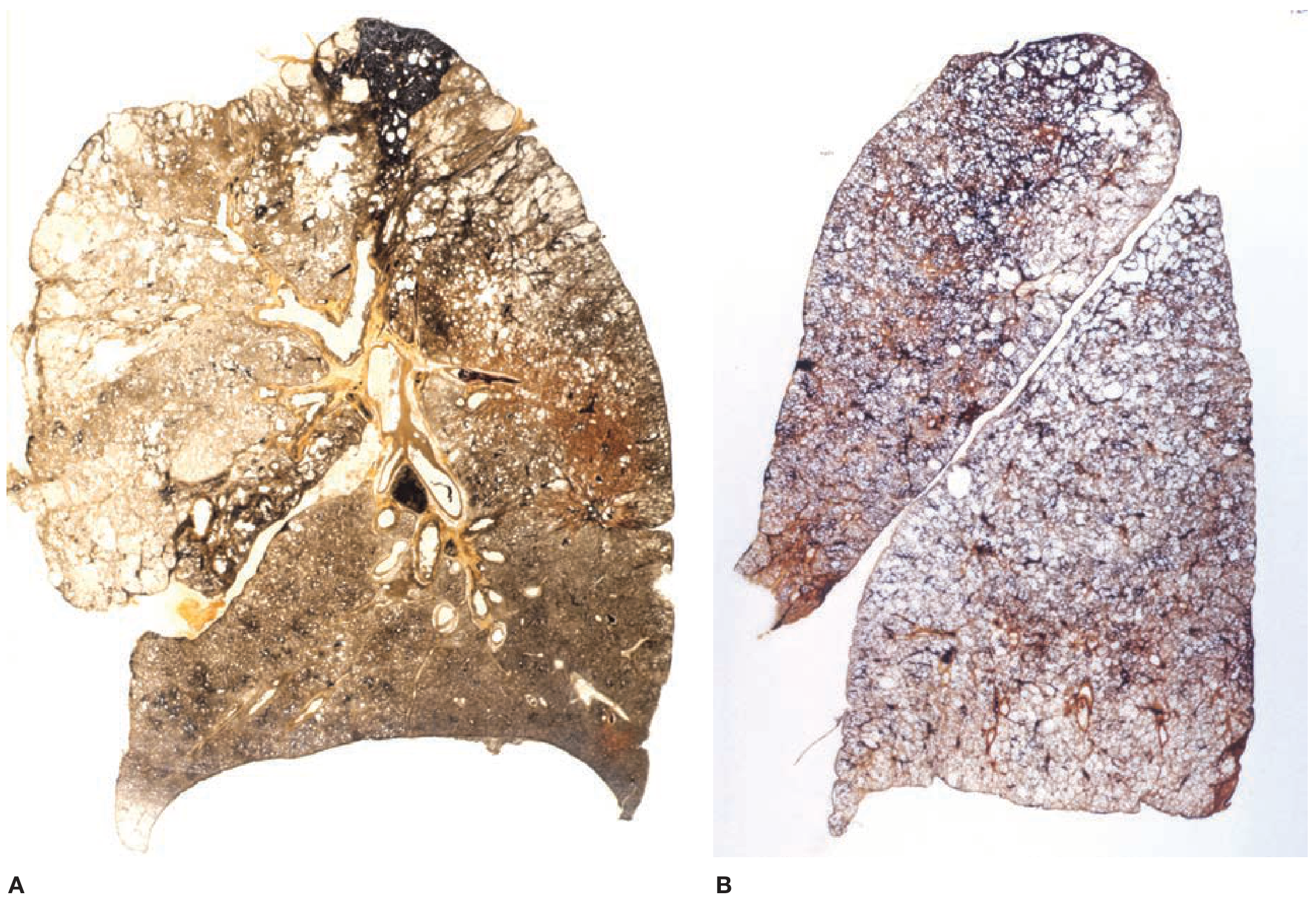
Fig. 37-3 from Fishman's Pulmonary Diseases: (A) Centriacinar - worse in upper lobes. (B) Panacinar - worse in lower lobes.
Key Gross Differences at a Glance
| Feature | Centriacinar | Panacinar |
|---|---|---|
| Lung size/volume | Less voluminous, macroscopic features less impressive until late | Pale, markedly voluminous - often obscures the heart at autopsy |
| Color | Deeper pink (more viable perfused parenchyma present) | Pale (extensive parenchymal loss) |
| Distribution pattern | Focal holes in center of lobules surrounded by a rim of normal-looking parenchyma | Uniform, diffuse destruction - no rim of spared tissue around lesions |
| Lobe predominance | Upper lobes (apical segments especially) | Lower lobes |
| Architecture | Lobular structure still discernible; normal alveoli visible peripherally | Progressive effacement and simplification - lobular architecture lost; supporting framework of vessels/septa/bronchi protrudes |
| Water bath trick | Focal defects visible | On removal from water/fixative bath, parenchyma literally "falls away" from the supporting vascular/bronchial framework |
| Severity pattern | Varies lobule-to-lobule | More uniform throughout |
In Detail (from Robbins & Kumar Basic Pathology)
Panacinar: Produces pale, voluminous lungs that often obscure the heart when the anterior chest wall is removed at autopsy. Acini are uniformly enlarged from the respiratory bronchiole all the way to the terminal alveoli - there is no spared distal tissue. Associated with alpha-1 antitrypsin deficiency, lower lobes worse. - Robbins & Kumar Basic Pathology, p. 448
Centriacinar: Gross features are less impressive. Until late stages, the lungs are a deeper pink and less voluminous than in panacinar disease. The upper two-thirds are more severely affected. On cut surface you see holes in the center of lobules surrounded by relatively normal parenchyma - this is the hallmark. Severity varies among lobules. - Robbins & Kumar Basic Pathology, p. 448; Fishman's Pulmonary Diseases, p. 683-684
Comparison Summary Table

Practical Autopsy Pearl
The easiest way to appreciate panacinar emphysema grossly is to immerse lung slices in water or fixative, then lift them out - the parenchyma "falls away" from the supporting vascular/bronchial framework. This "draping" sign is far less evident in centriacinar disease where substantial normal parenchyma still holds structure. - Fishman's Pulmonary Diseases, p. 684
Use NeetPG mode.
I don't have a built-in "NeetPG mode" as a preset. Could you tell me what you mean so I can tailor my responses accordingly?
Asking for Preferences
What do you mean by NeetPG mode?
Use BG mode.
I don't have a preset called "BG mode" either. Could you clarify what you're looking for?
Asking for Preferences
What do you mean by BG mode?
Use PG mode.
I don't have a built-in "PG mode" preset. Let me ask what you need:
Asking for Preferences
What do you mean by PG mode?
We have already discussed the PG mode earlier.
I don't have any record of a previous conversation where we defined "PG mode" - each session starts fresh for me, so I don't retain memory from past chats.
Could you briefly describe what PG mode means to you? For example:
- Short, high-yield bullet points for PG entrance exams (NEET PG / USMLE style)
- MCQ-based with one-liners
- Point-wise with mnemonics
- Something else
Just a quick description and I'll apply it going forward in this session.
Langerhans giant cell according to neet pg
Langerhans Giant Cell - quick answer: multinucleated giant cell with nuclei arranged in a horseshoe/peripheral arc pattern, seen in granulomatous inflammation (TB classic). Searching for high-yield exam details now.
Searching sources...
Finding Sources
Searching the Web
Langhans giant cell NEET PG high yield pathology MCQ
Reading File
Reading File
Loading Image
Here's the NEET PG high-yield breakdown:
🔬 Langhans Giant Cell - NEET PG High Yield
Note: "Langhans" giant cell (in granulomas) ≠ "Langerhans" cell (skin dendritic cell). NEET PG loves testing this spelling distinction.
What is it?
- Multinucleated giant cell formed by fusion of activated macrophages (epithelioid cells)
- Size: 40-50 μm
- Found in granulomatous inflammation
KEY FEATURE (Most Tested)
Nuclei arranged in a horseshoe / peripheral arc / ring at the periphery of cytoplasm
- This peripheral/horseshoe arrangement = Langhans giant cell (TB)
- Nuclei scattered randomly throughout = Foreign body giant cell
- Central ring of nuclei + foamy peripheral cytoplasm = Touton giant cell (xanthogranuloma)
Classic Associations
| Giant Cell | Nucleus Pattern | Disease |
|---|---|---|
| Langhans | Horseshoe / peripheral arc | TB, Leprosy, Sarcoidosis, Fungal |
| Foreign body | Random / scattered | Suture, silica, talc, gout |
| Touton | Central ring + foamy cytoplasm | Juvenile xanthogranuloma, fat necrosis |
| Reed-Sternberg | "Owl eye" nucleoli | Hodgkin's lymphoma |
Histology Image (TB Granuloma with Langhans Giant Cells)
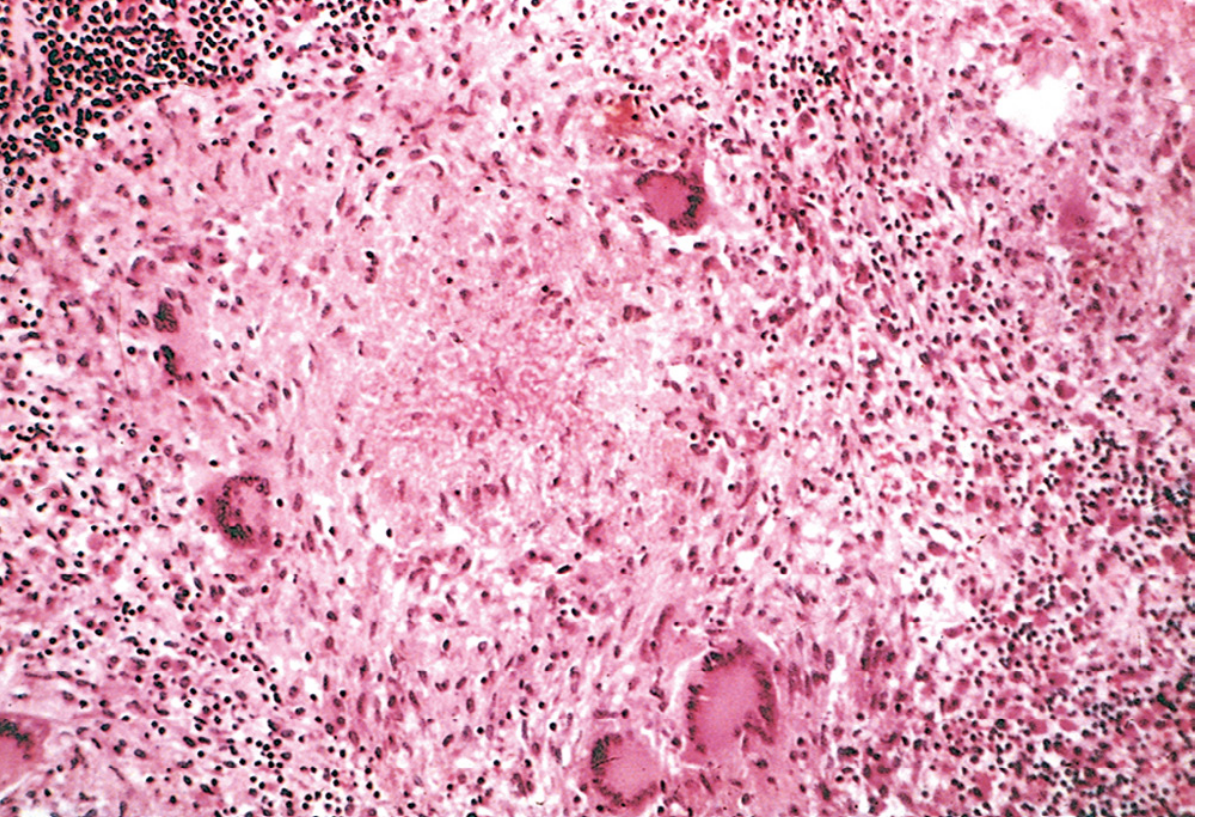
Robbins Pathology: Tuberculous granuloma - central caseous necrosis surrounded by epithelioid cells, giant cells, and lymphocyte collar
NEET PG One-Liners
- Prototype disease for Langhans giant cell = Tuberculosis
- Formed by fusion of: epithelioid macrophages (activated by IFN-γ from Th1 cells)
- Caseating granuloma = TB / fungi | Non-caseating = Sarcoidosis / Crohn's / foreign body
- In TB granuloma, the central necrosis = caseous (cheesy) necrosis - amorphous, eosinophilic, structureless debris
- "Naked tubercle" (no lymphocytic rim) = Sarcoidosis
Mnemonic
"Langhans Lives at the Periphery" - nuclei are pushed to the periphery in a horseshoe shape (vs foreign body = nuclei everywhere = random)
Sources: Robbins & Kumar Basic Pathology; Robbins, Cotran & Kumar Pathologic Basis of Disease
Can you give me all the diagrams that are important for giant cell for neet Pg syllabus 
Searching sources...
Finding Sources
Reading File
Finding Sources
Reading File
Finding Sources
Now let me fetch all the key images:
Loading Image
Finding Sources
Finding Sources
Finding Sources
Reading File
Finding Sources
Loading Image
Finding Sources
Finding Sources
Here are all the important NEET PG giant cell diagrams from the textbooks, compiled and explained:
🔬 Giant Cells - All Important Diagrams (NEET PG)
1. Seven Types of Granulomas (Histopathology)
(Includes Tuberculoid/Langhans, Sarcoidal, Foreign Body, Xanthogranuloma/Touton)
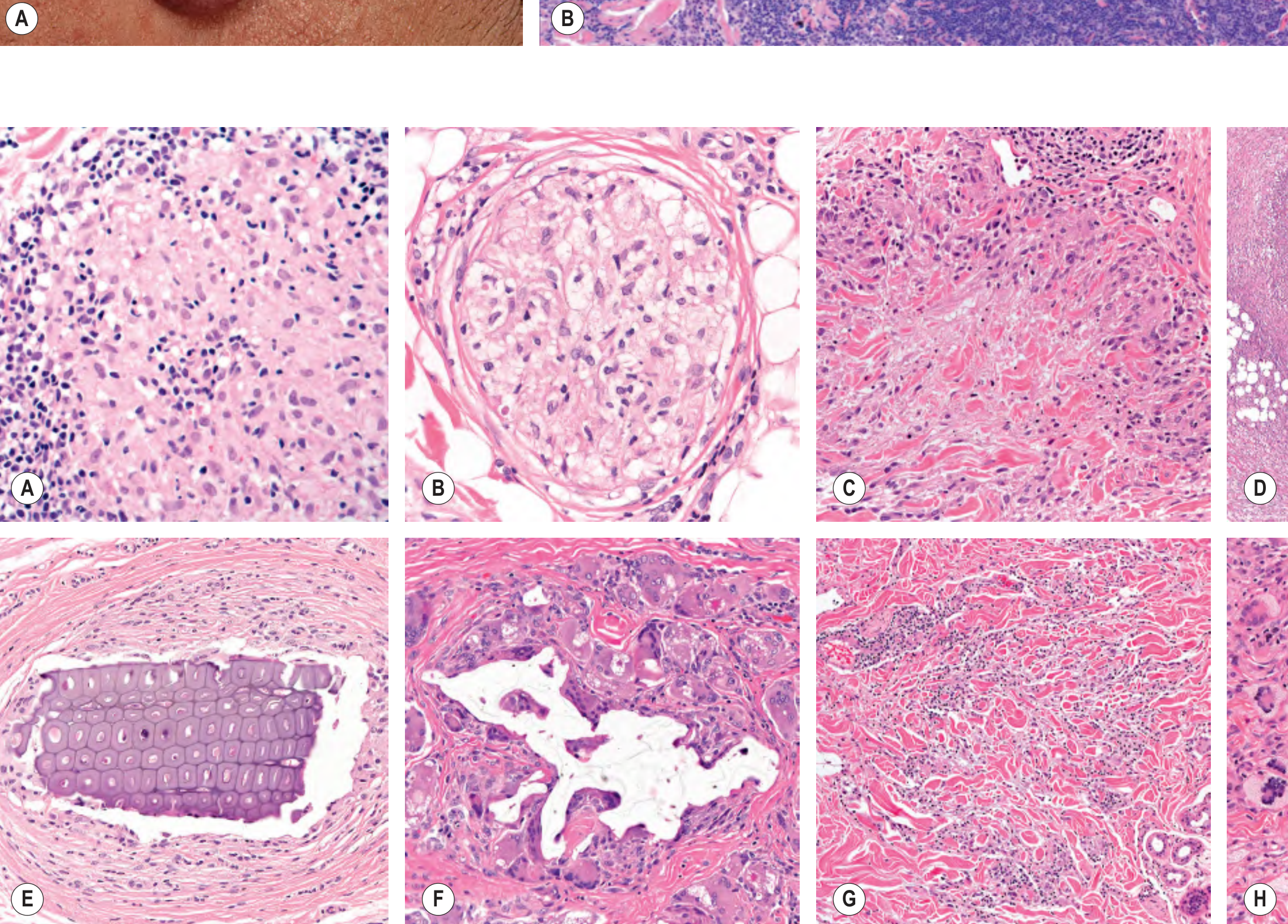
Dermatology 2-Volume Set 5e - Fig. 0.26: A = Tuberculoid (Langhans type, lymphocytic rim), B = Sarcoidal ("naked" granuloma), C = Palisaded, D = Suppurative, E/F = Foreign body giant cells (nuclei randomly scattered), G = Interstitial, H = Xanthogranuloma (Touton giant cells - central ring of nuclei + peripheral foamy cytoplasm)
2. Reed-Sternberg Cell - "Owl Eye" (Hodgkin Lymphoma)
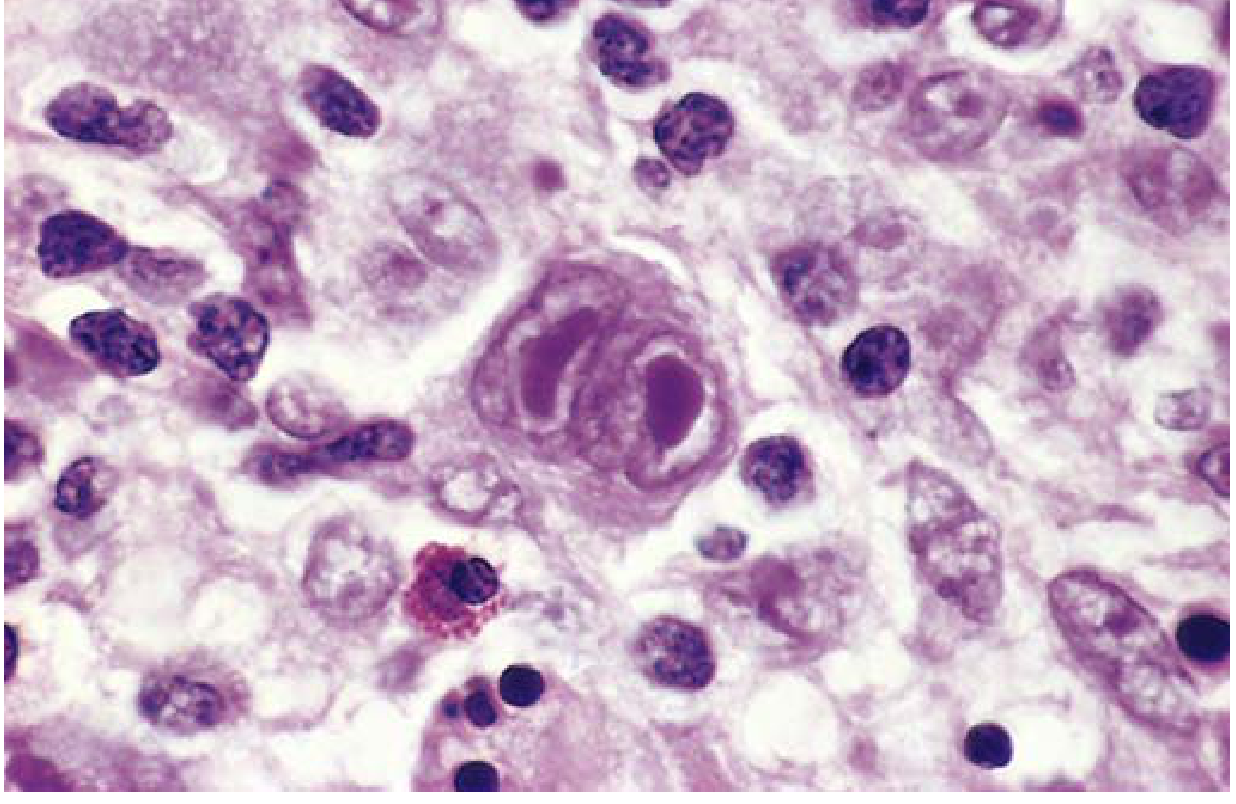
Robbins & Kumar Basic Pathology - Fig. 10.23: Classic RS cell - binucleate, enormous mirror-image nuclei, large inclusion-like acidophilic nucleoli = "owl eye" appearance
3. TB Granuloma (Langhans Giant Cell in context)
Robbins & Kumar Pathologic Basis of Disease - Fig. 3.22: Tuberculous granuloma - central caseous necrosis + epithelioid macrophages + lymphocyte collar + Langhans giant cells
NEET PG Master Summary Table
| Giant Cell | Nucleus Pattern | Key Disease | Marker |
|---|---|---|---|
| Langhans | Horseshoe / peripheral arc | TB, Leprosy | Caseating granuloma |
| Foreign body | Random / scattered throughout | Suture, silica, gout, talc | Non-caseating |
| Touton | Central ring + peripheral foamy cytoplasm | Juvenile xanthogranuloma, fat necrosis | Lipid-laden |
| Reed-Sternberg | Owl eye (2 large nucleoli) | Hodgkin lymphoma | CD15+, CD30+ |
| Warthin-Finkeldey | "Bunch of grapes" multinucleate | Measles | Lymphoid tissue |
| Osteoclast-type | Many nuclei, central or scattered | Giant cell tumor of bone | RANKL driven |
Inclusions inside Giant Cells (NEET PG Tested Separately)
| Inclusion | Giant Cell Type | Disease |
|---|---|---|
| Asteroid body (stellate eosinophilic) | Langhans type | Sarcoidosis |
| Schaumann body (laminated calcified) | Langhans type | Sarcoidosis |
| Michaelis-Gutmann body (target-like, calcified) | Macrophages | Malakoplakia |
Quick Mnemonic
"Langhans = Lives at the periphery (horseshoe)"
"Foreign body = Free nuclei everywhere (random)"
"Touton = Two zones (central ring + outer foam)"
"RS cell = Really Scary Owl Eyes"
Sources: Robbins & Kumar Basic Pathology; Robbins, Cotran & Kumar Pathologic Basis of Disease; Dermatology 2-Volume Set 5e
This is a shared conversation. Sign in to Orris to start your own chat.