
Explain latch bridge mechanism in simple terms
The "latch bridge mechanism" could refer to a few different things. Let me make sure I answer the right one.
Asking for Preferences
Which context are you asking about?
Smooth muscle contraction
The latch bridge mechanism in smooth muscle is a way the muscle maintains force (tone) for a long time without using much energy. Normal cross-bridge cycling burns a lot of ATP; the latch state lets smooth muscle "lock" in a shortened position cheaply.
Searching sources...
Reading File
Finding Sources
Finding Sources
Good results. Let me read the key sections from Ganong's and Guyton (latch bridge + smooth muscle contraction) in parallel.
Reading File
Reading File
Reading File
Excellent - I now have rich content from three authoritative sources. Let me also fetch the flowchart image from Ganong's which directly illustrates the contraction-relaxation sequence.
Loading Image
I now have everything needed for a clear, well-sourced answer. Here it is:
The Latch Bridge Mechanism in Smooth Muscle Contraction
Background: Normal Cross-Bridge Cycling
In smooth muscle (and skeletal muscle), contraction happens through cross-bridge cycling - myosin heads attach to actin, pull it, then detach and reattach. Each full cycle burns one ATP molecule. If a muscle had to sustain tone this way indefinitely, it would burn enormous amounts of energy.
The Basic Smooth Muscle Contraction Sequence
Here is how smooth muscle normally contracts, step by step:
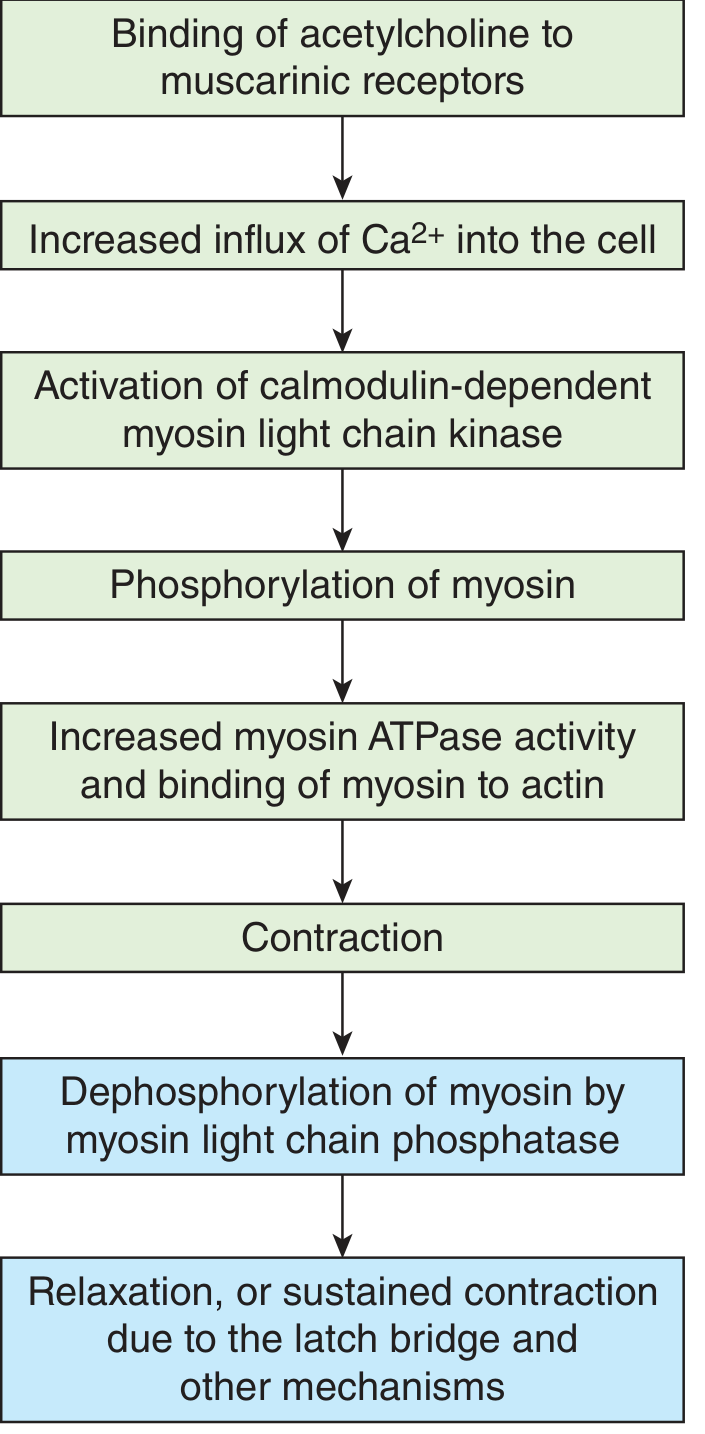
- Stimulus (e.g., ACh, stretch, hormone) raises cytosolic Ca²+
- Ca²+ binds calmodulin, forming a Ca²+-calmodulin complex
- This complex activates myosin light chain kinase (MLCK)
- MLCK phosphorylates the myosin light chain (at serine-19)
- Phosphorylated myosin binds actin → activates myosin ATPase → cross-bridge cycling begins → contraction
- When Ca²+ falls, myosin light chain phosphatase (MLCP) dephosphorylates myosin → normally leads to relaxation
The Latch Bridge Mechanism - The Key Point
Here is the problem: dephosphorylation of myosin does NOT always mean the muscle relaxes immediately. This is where the latch bridge comes in.
"Dephosphorylation of myosin light chain kinase does not necessarily lead to relaxation of the smooth muscle... One appears to be a latch bridge mechanism by which myosin cross-bridges remain attached to actin for some time after the cytoplasmic Ca²+ concentration falls. This produces sustained contraction with little expenditure of energy, which is especially important in vascular smooth muscle."
- Ganong's Review of Medical Physiology
In simple terms:
Think of a door latch. When you push a door shut, the latch clicks into place and holds the door closed - without you having to keep pushing. The latch bridge works the same way:
| State | Myosin | Ca²+ level | ATP use | Force |
|---|---|---|---|---|
| Normal cycling | Phosphorylated | High | High | Yes |
| Latch state | Dephosphorylated but still attached | Low/falling | Very low | Sustained |
| Relaxed | Dephosphorylated, detached | Low | None | No |
The myosin cross-bridge, once formed, can slow down its detachment rate dramatically. Even after Ca²+ falls and MLCK stops working, the myosin head stays attached to actin for an extended time - like a latch holding a door. This creates sustained force/tone without burning ATP.
Why Does the Latch State Occur? (Molecular Basis)
Two main contributors:
-
Slowly cycling dephosphorylated cross-bridges: A cross-bridge that was phosphorylated and attached can become dephosphorylated while still attached. It then cycles very slowly (or not at all), maintaining tension cheaply.
-
Calponin: This actin-binding protein can simultaneously bind actin and myosin, stabilizing the cross-bridge interaction and slowing detachment. As noted in Campbell-Walsh Urology, "calponin may play a role by simultaneously binding actin and myosin to stabilize cross-bridge interactions and slow the rate of detachment."
Why Is This Physiologically Important?
- Vascular smooth muscle maintains arterial tone (blood pressure) continuously. Without the latch mechanism, this would require enormous energy expenditure.
- Gut, bladder, uterus - organs that need sustained tone (e.g., holding urine, maintaining gut wall tension) rely on this to function economically.
- The latch state is especially important in tonic contraction vs. phasic contraction. Vascular muscle is mostly tonic - it needs to stay contracted for hours without fatigue.
Summary in One Sentence
The latch bridge is a state where dephosphorylated myosin cross-bridges remain slowly attached to actin after Ca²+ levels drop, allowing smooth muscle to maintain force and tone at very low ATP cost - like a lock that clicks shut and holds without further energy input.
Sources: Ganong's Review of Medical Physiology (26th ed.), Guyton & Hall Textbook of Medical Physiology, Campbell-Walsh-Wein Urology
This is a shared conversation. Sign in to Orris to start your own chat.