
Aim of my study interhemispheric connection
Reading File
Finding Sources
Finding Sources
Reading File
Reading File
Reading File
Loading Image
Reading File
Here is a comprehensive overview of interhemispheric connections — the structural and functional pathways linking the two cerebral hemispheres — drawn from authoritative medical textbooks.
Interhemispheric Connections
Interhemispheric connections are fiber tracts (commissures) that cross the midline and link corresponding or complementary areas of the left and right cerebral hemispheres. Their primary purpose is to allow the two hemispheres to share information, coordinate function, and act as a unified brain.
1. The Cerebral Commissures — Structure
The commissures form within the lamina terminalis, the anterior wall of the forebrain, which serves as the natural midline pathway between hemispheres. They develop in a specific developmental sequence:
| Commissure | Structure Connected | Notes |
|---|---|---|
| Anterior commissure | Olfactory bulbs, temporal lobes (including amygdala), anterior olfactory nuclei | First to develop; evolutionarily older; crosses in front of the fornix |
| Hippocampal commissure | Hippocampal formations (bilateral) | Also early-developing; phylogenetically old |
| Corpus callosum | All neocortical areas (except anterior temporal lobes) | Largest commissure; 4 parts: rostrum, genu, body, splenium |
| Posterior commissure | Caudal diencephalon | Smaller tract |
"The largest cerebral commissure is the corpus callosum, which connects neocortical areas." — The Developing Human: Clinically Oriented Embryology
2. The Corpus Callosum — Anatomy & Fiber Organization
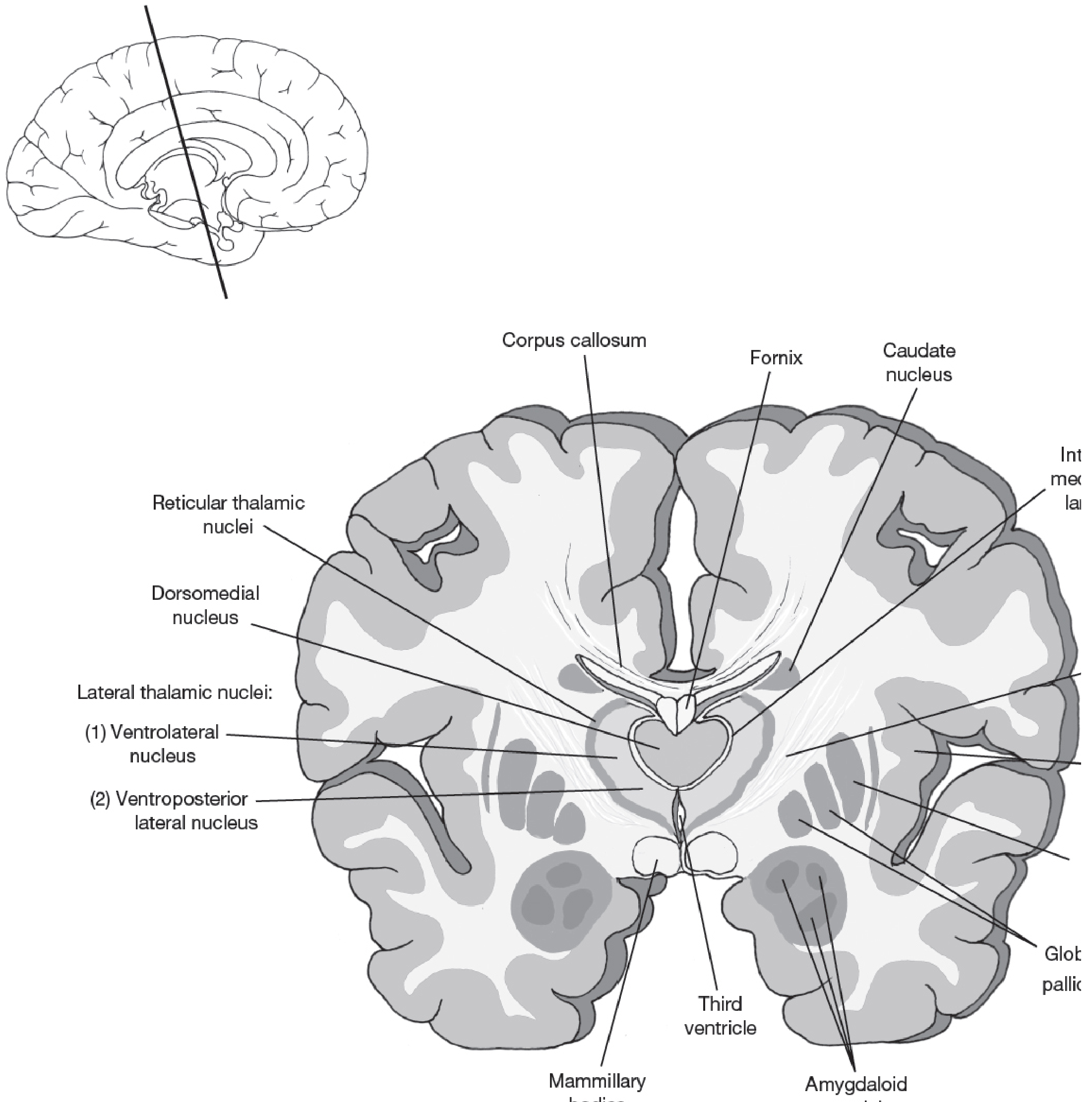
The corpus callosum has four regions, each carrying different types of information:
- Rostrum → anteriormost part
- Genu → curves anteriorly and dorsally; carries higher-order cognitive and prefrontal information
- Body (+ Isthmus) → largest section; carries visual, auditory, and somatosensory signals
- Splenium → enlarged posterior end; carries parietal, temporal, and occipital (visual) data
"Axons carrying higher-order cognitive and sensory information from the prefrontal, temporal, and parietal cortices primarily travel through the genu and splenium, whereas visual, auditory, and somatosensory information is carried predominantly in the body and isthmus." — Kaplan & Sadock's Comprehensive Textbook of Psychiatry
3. The Anterior Commissure
A compact bundle of fibers crossing the midline caudal to the corpus callosum, in front of the fornix. It specifically interconnects:
- The two temporal lobes (amygdala and related areas)
- The anterior olfactory nuclei
It is the key pathway for emotional integration between hemispheres — even when the corpus callosum is severed, emotional responses can still be shared via the anterior commissure.
4. Functions of Interhemispheric Connections
The corpus callosum and anterior commissure serve three main functions:
A. Information transfer
"One of the functions of the corpus callosum and the anterior commissure is to make information stored in the cortex of one hemisphere available to corresponding cortical areas of the opposite hemisphere." — Guyton & Hall Textbook of Medical Physiology
B. Language and motor coordination
- Cutting the corpus callosum blocks the Wernicke area (left hemisphere) from controlling the right motor cortex, disrupting voluntary movements of the left hand
- Somatic and visual information from the right hemisphere can no longer reach the left hemisphere's interpretive (Wernicke) area
C. Unified emotional responses
"The corpus callosum is required for the two sides to operate cooperatively at the superficial subconscious level, and the anterior commissure plays an important additional role in unifying the emotional responses of the two sides of the brain." — Guyton & Hall Textbook of Medical Physiology
5. Split-Brain Phenomenon (Callosotomy)
When the corpus callosum is surgically cut (callosotomy):
- The two hemispheres become functionally independent
- The left (dominant) hemisphere can understand spoken AND written language
- The right hemisphere can understand written words but not spoken speech
- The right hemisphere can initiate motor responses without the left hemisphere knowing the reason
- Emotional responses remain partially unified via the intact anterior commissure
6. Development
- The corpus callosum appears by week 10 of embryonic development and grows as the cortex enlarges
- It begins in the lamina terminalis and extends beyond it as the cortex expands
- The anterior and hippocampal commissures form first (older phylogenetically)
- Failure of formation leads to agenesis of the corpus callosum, which may be asymptomatic or cause seizures and cognitive deficits
Summary Table
| Feature | Corpus Callosum | Anterior Commissure |
|---|---|---|
| Size | Largest commissure | Small, compact bundle |
| Connects | All neocortex (except anterior temporal) | Temporal lobes, amygdala, olfactory areas |
| Primary role | Cognitive/sensorimotor integration | Emotional integration, olfaction |
| Developmental timing | Week 10 onwards | Early (phylogenetically older) |
| Effect of lesion | Split-brain syndrome | Partial loss of interhemispheric emotion sharing |
Sources:
- Guyton & Hall Textbook of Medical Physiology, p. 723
- Kaplan & Sadock's Comprehensive Textbook of Psychiatry, pp. 199–202
- The Developing Human: Clinically Oriented Embryology, p. 1073–1074
- Langman's Medical Embryology
Aim for research idea interhemispheric connection assessing
I want to make sure I help you craft the most relevant research aim. Let me clarify a few things first.
Asking for Preferences
What population or condition is your research focused on? · What assessment method are you planning to use? · What aspect of interhemispheric connection are you targeting?
This is a shared conversation. Sign in to Orris to start your own chat.