
Carbapenam
Carbapenems
Structure
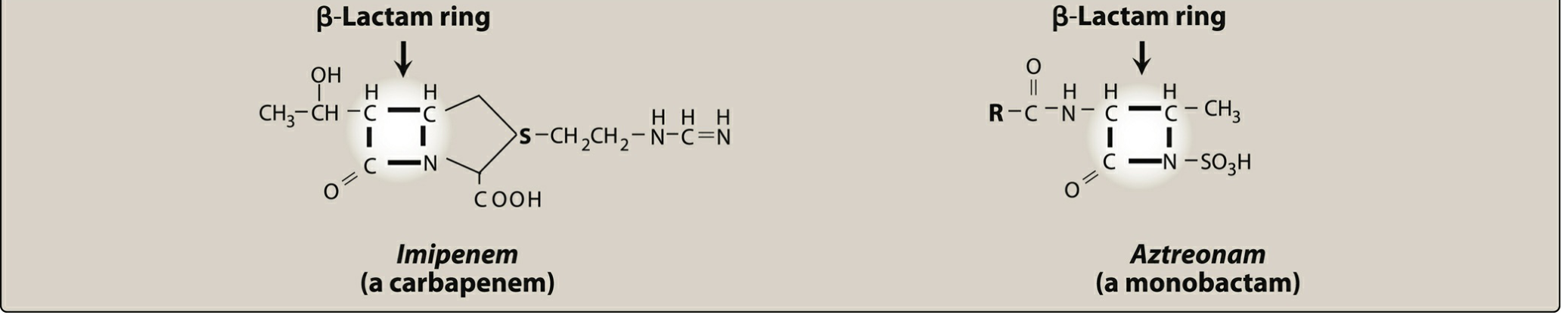
Drugs in the Class
| Drug | Trade Name | Key Feature |
|---|---|---|
| Imipenem/cilastatin | Primaxin | First carbapenem; requires cilastatin to prevent renal degradation |
| Meropenem | Merrem | Does not require cilastatin; less seizurogenic |
| Ertapenem | Invanz | Once-daily dosing; no Pseudomonas coverage |
| Doripenem | Doribax | Greatest Pseudomonas activity; no longer available in USA |
Mechanism of Action
Antibacterial Spectrum
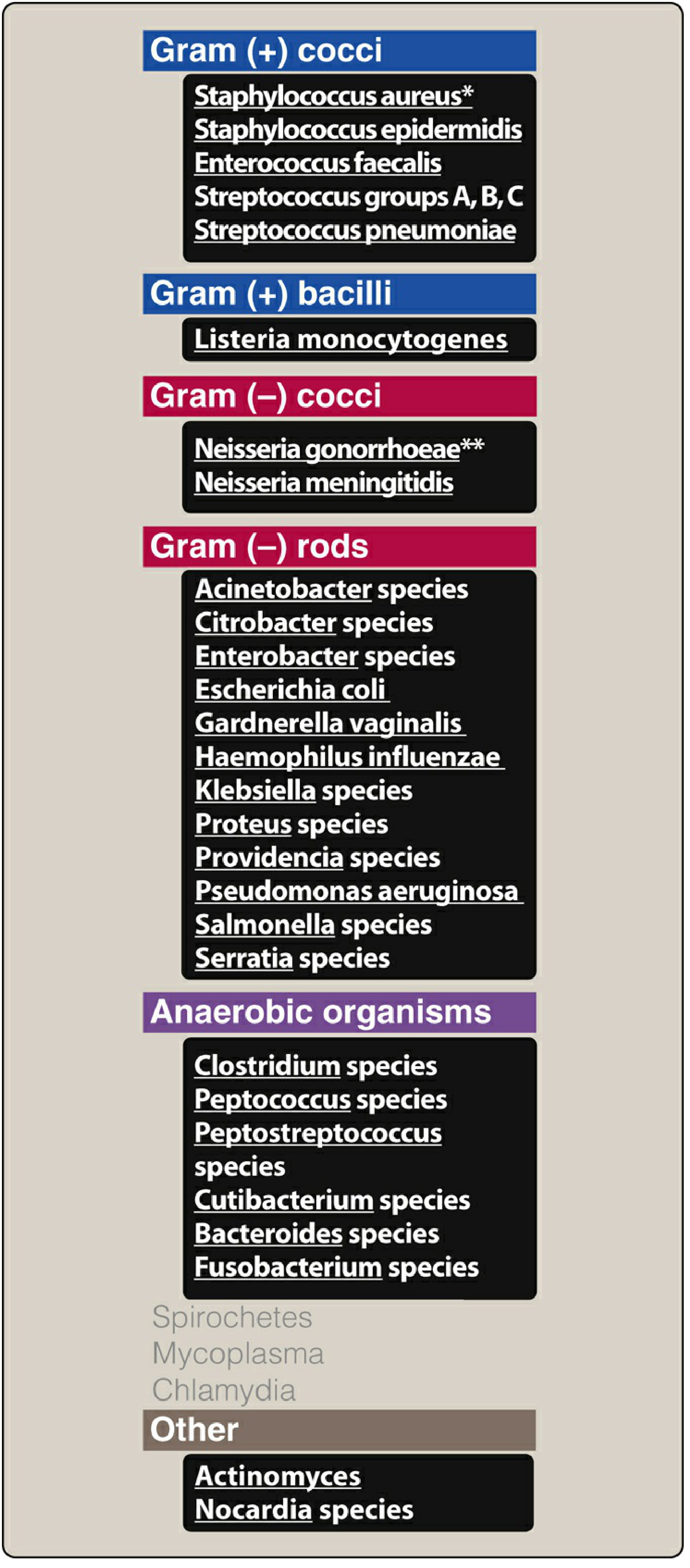
- Gram-positive cocci: S. aureus (MSSA), Streptococcus spp., Enterococcus faecalis, Listeria
- Gram-negative rods: E. coli, Klebsiella, Enterobacter, Serratia, Proteus, Acinetobacter, P. aeruginosa, Salmonella, H. influenzae
- Anaerobes: Bacteroides fragilis, Clostridium spp., Peptostreptococcus
Organisms NOT covered (resistant):
- Enterococcus faecium
- MRSA (methicillin-resistant S. aureus)
- Clostridioides difficile
- Stenotrophomonas maltophilia
- Burkholderia cepacia
- Ertapenem specifically: lacks P. aeruginosa, Enterococcus, and Acinetobacter coverage
Pharmacokinetics
| Feature | Details |
|---|---|
| Route | IV (all); ertapenem also IM (mixed with 1% lidocaine due to irritation) |
| Distribution | Penetrate well into body tissues and fluids, including CSF (except ertapenem); meropenem reaches therapeutic CSF levels even without meningeal inflammation |
| Elimination | Renal (glomerular filtration); dose adjustment required in renal insufficiency |
| Half-life | Imipenem ~1 hr; meropenem ~1 hr; ertapenem ~4 hr |
| Imipenem dosing | 0.25-0.5 g IV q6-8h |
| Meropenem dosing | 0.5-1 g IV q8h |
| Ertapenem dosing | 1 g IV/IM once daily |
Imipenem and Cilastatin
Adverse Effects
- GI: Nausea, vomiting, diarrhea (most common)
- Seizures: High doses of imipenem, particularly in patients with renal failure or CNS disease. Meropenem is much less epileptogenic.
- Hypersensitivity: Cross-reactivity with penicillin is possible (shared bicyclic beta-lactam core) - use with caution in true penicillin allergy
- Infusion site reactions
- Eosinophilia and neutropenia (less common than other beta-lactams)
Clinical Indications
- Polymicrobial infections (mixed aerobic/anaerobic)
- ESBL-producing gram-negative organisms (treatment of choice)
- Enterobacter infections (resist beta-lactamase destruction)
- Resistant P. aeruginosa infections (not ertapenem)
- Empiric therapy for severe, life-threatening infections
- Serious nosocomial infections (hospital-acquired/ventilator-associated pneumonia, complicated UTI, intra-abdominal infections)
Resistance - Carbapenem-Resistant Organisms (CRO)
Resistance Mechanisms:
- Carbapenemases (serine carbapenemases - KPC, OXA; metallo-beta-lactamases - MBL/NDM/VIM)
- Outer membrane porin loss
- Efflux pump upregulation
Newer Agents for CROs:
| Combination | Active Against |
|---|---|
| Meropenem-vaborbactam (Vabomere) | KPC-producing Enterobacterales |
| Imipenem-cilastatin-relebactam (Recarbrio) | KPC-producing Enterobacterales, hospital/VAP |
| Ceftazidime-avibactam | KPC, AmpC, OXA-48 (not MBL) |
| Cefiderocol | All classes including MBL |
- None of the carbapenem/beta-lactamase inhibitor combinations cover metallo-beta-lactamases (MBL/NDM), except cefiderocol.
- Colistin (5 mg/kg once, then 1.67 mg/kg q8h) remains an option for pan-resistant CRO infections.
Beta-Lactamase Inhibitor Activity Summary
| Inhibitor | Class A (KPC) | Class B (MBL) | Class C (AmpC) | Class D (OXA) |
|---|---|---|---|---|
| Vaborbactam | + | - | - | - |
| Relebactam | + | - | + | +/- |
| Avibactam | + | - | + | +/- |
- Lippincott Illustrated Reviews: Pharmacology, Ch. 29
- Katzung's Basic and Clinical Pharmacology, 16th Ed., Ch. 43
- Jawetz, Melnick & Adelberg's Medical Microbiology, 28th Ed.
- Goldman-Cecil Medicine, 2-Vol Set, Ch. 281
NSAIDs drugs lipincott create a a good dedign pic
A detailed medical pharmacology infographic poster about NSAIDs (Nonsteroidal Anti-Inflammatory Drugs) based on Lippincott Pharmacology. Dark navy blue and teal color scheme with clean professional medical design. Include the following clearly organized sections with icons: TITLE at top: "NSAIDs — Nonsteroidal Anti-Inflammatory Drugs" with subtitle "Lippincott Pharmacology" Section 1 - MECHANISM OF ACTION: COX inhibition pathway diagram showing: Arachidonic Acid → COX-1 / COX-2 → Prostaglandins → Pain / Inflammation / Fever. Aspirin = IRREVERSIBLE acetylation of COX. Other NSAIDs = reversible inhibition. Section 2 - CLASSIFICATION (two columns): • Non-selective COX inhibitors: Aspirin, Ibuprofen, Naproxen, Indomethacin, Ketorolac, Diclofenac, Piroxicam, Meloxicam • Selective COX-2 inhibitors: Celecoxib Section 3 - THREE MAJOR THERAPEUTIC ACTIONS (3 badge icons): 🔴 Anti-inflammatory | 🟡 Analgesic | 🔵 Antipyretic Section 4 - PHARMACOKINETICS: • Oral absorption: good; some IV/IM (Ketorolac) • Protein binding: high (albumin) • Metabolism: hepatic • Excretion: renal Section 5 - ADVERSE EFFECTS (red warning style): • GI: ulceration, bleeding (↓ PGE2 → ↓ mucus/HCO3) • Renal: ↓ GFR, Na/water retention, hyperkalemia • CV: ↑ thrombosis risk (COX-2 selective > non-selective) • Aspirin sensitivity: bronchospasm, nasal polyps • Reye syndrome: aspirin in children with viral illness • Platelet inhibition: aspirin = irreversible; others = reversible Section 6 - ASPIRIN SPECIAL USES (gold highlight box): • Low dose (81mg): antiplatelet — prevents MI/stroke (inhibits TXA2) • High dose: anti-inflammatory (RA, gout) Section 7 - CONTRAINDICATIONS: • Peptic ulcer disease | Renal insufficiency | 3rd trimester pregnancy (premature closure of ductus arteriosus) | Aspirin in children (Reye syndrome) Clean bold typography, color-coded sections, subtle icons, professional medical poster layout on a dark background.
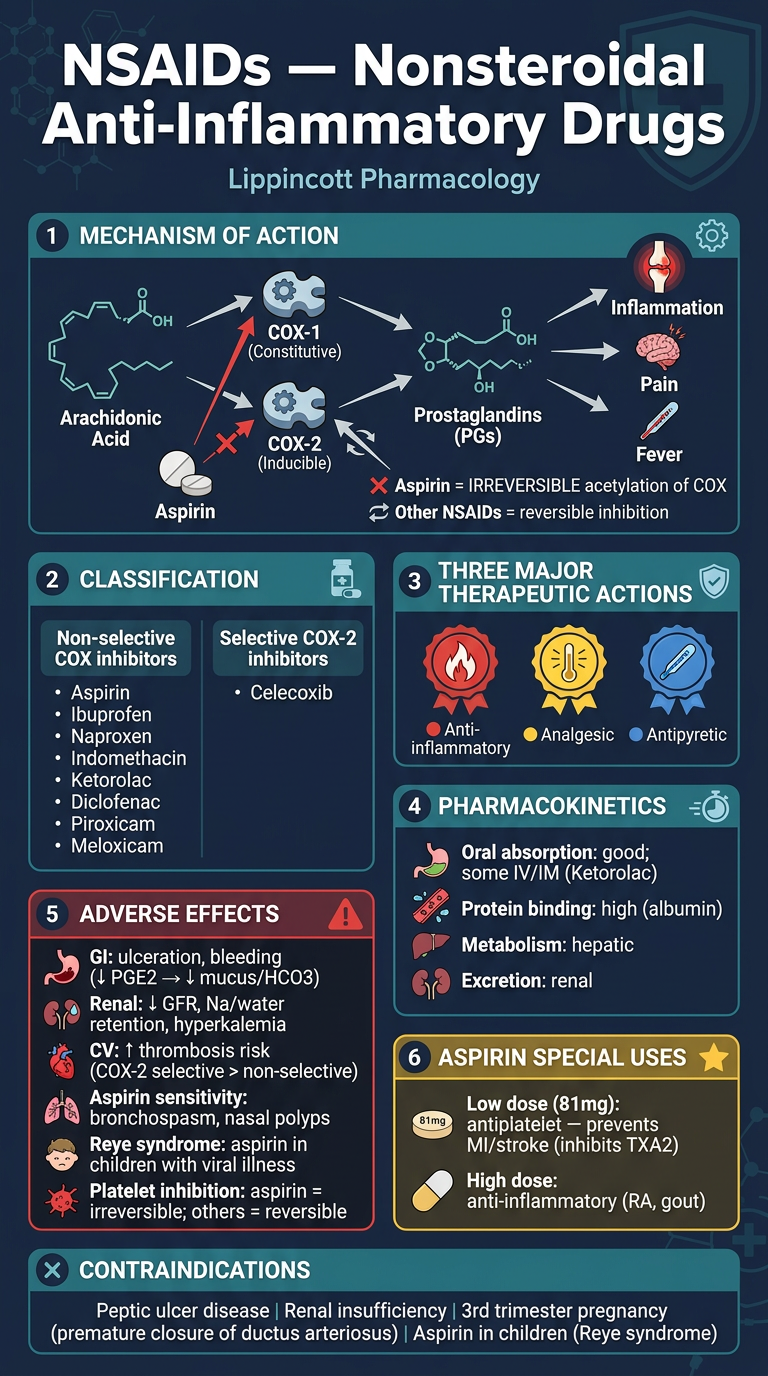
- Mechanism - COX-1/COX-2 inhibition pathway, with aspirin's unique irreversible acetylation
- Drug classification - non-selective vs. COX-2 selective (celecoxib) with all major agents
- 3 therapeutic actions - anti-inflammatory, analgesic, antipyretic
- Adverse effects - GI ulceration, renal effects, CV risk, Reye syndrome, bronchospasm
- Aspirin's special role - low-dose antiplatelet (TXA2 inhibition) vs. high-dose anti-inflammatory
- Key contraindications - PUD, renal insufficiency, 3rd trimester pregnancy, children with viral illness
Create a PPTX presentation on NSAID drug interactions and monitoring
mkdir -p /home/daytona/workspace/nsaid-pptx && ls /home/daytona/workspace/nsaid-pptx
~/nsaid-pptx/build.js
const pptxgen = require("pptxgenjs");

const pres = new pptxgen();
pres.layout = "LAYOUT_16x9";
pres.title = "NSAIDs: Drug Interactions & Monitoring";
pres.author = "Lippincott Pharmacology";

// ─── COLOR PALETTE ───────────────────────────────────────────────
const C = {
  navy:    "0D1B2A",   // dominant dark bg
  teal:    "1B998B",   // accent / headers
  amber:   "F4A261",   // warning / highlight
  red:     "E63946",   // danger / adverse
  white:   "FFFFFF",
  silver:  "D0D8E4",   // body text on dark
  midgray: "2D3E50",   // card bg
  lightbg: "EEF2F7",   // slide bg (light slides)
  darktext:"1A1A2E",   // text on light
  green:   "2DC653",   // safe/ok
  purple:  "7B2D8B",   // special note
};

// ─── HELPERS ─────────────────────────────────────────────────────
function titleBar(slide, text, sub) {
  slide.addShape(pres.ShapeType.rect, {
    x: 0, y: 0, w: 10, h: 1.05,
    fill: { color: C.teal },
  });
  slide.addText(text, {
    x: 0.3, y: 0.08, w: 9.4, h: 0.6,
    fontSize: 24, bold: true, color: C.white, fontFace: "Calibri", margin: 0,
  });
  if (sub) {
    slide.addText(sub, {
      x: 0.3, y: 0.67, w: 9.4, h: 0.3,
      fontSize: 12, color: C.navy, fontFace: "Calibri", margin: 0, italic: true,
    });
  }
}

function card(slide, x, y, w, h, fillColor) {
  slide.addShape(pres.ShapeType.roundRect, {
    x, y, w, h,
    fill: { color: fillColor || C.midgray },
    line: { color: C.teal, width: 1.5 },
    rectRadius: 0.12,
  });
}

function sectionLabel(slide, text, x, y, w, color) {
  slide.addShape(pres.ShapeType.rect, {
    x, y, w, h: 0.32,
    fill: { color: color || C.teal },
  });
  slide.addText(text, {
    x, y, w, h: 0.32,
    fontSize: 11, bold: true, color: C.white,
    fontFace: "Calibri", align: "center", valign: "middle", margin: 0,
  });
}

// ════════════════════════════════════════════════════════════════
// SLIDE 1 – TITLE
// ════════════════════════════════════════════════════════════════
{
  const s = pres.addSlide();
  // Full background
  s.addShape(pres.ShapeType.rect, { x:0, y:0, w:10, h:5.625, fill:{color: C.navy} });

  // Decorative accent bars
  s.addShape(pres.ShapeType.rect, { x:0, y:0, w:0.18, h:5.625, fill:{color: C.teal} });
  s.addShape(pres.ShapeType.rect, { x:9.82, y:0, w:0.18, h:5.625, fill:{color: C.amber} });
  s.addShape(pres.ShapeType.rect, { x:0.18, y:4.8, w:9.64, h:0.12, fill:{color: C.teal} });

  // Pill icon area
  s.addShape(pres.ShapeType.ellipse, { x:0.6, y:0.8, w:1.2, h:1.2, fill:{color: C.teal} });
  s.addText("💊", { x:0.6, y:0.8, w:1.2, h:1.2, fontSize:36, align:"center", valign:"middle" });

  s.addText("NSAIDs", {
    x:2, y:0.7, w:7.5, h:0.85,
    fontSize:46, bold:true, color:C.teal, fontFace:"Calibri", margin:0,
  });
  s.addText("Drug Interactions & Monitoring", {
    x:2, y:1.55, w:7.5, h:0.65,
    fontSize:26, bold:false, color:C.amber, fontFace:"Calibri", margin:0,
  });
  s.addText("Nonsteroidal Anti-Inflammatory Drugs", {
    x:2, y:2.2, w:7.5, h:0.4,
    fontSize:14, color:C.silver, fontFace:"Calibri", margin:0,
  });

  // Divider line
  s.addShape(pres.ShapeType.rect, { x:2, y:2.72, w:6.5, h:0.04, fill:{color: C.teal} });

  // Topics preview
  const topics = [
    "Mechanism of Action & COX Selectivity",
    "Key Drug Interactions",
    "Adverse Effects & Safety Profile",
    "Special Populations & Contraindications",
    "Monitoring Parameters",
  ];
  topics.forEach((t, i) => {
    s.addShape(pres.ShapeType.rect, { x:2, y:2.88+i*0.42, w:0.06, h:0.26, fill:{color:C.amber} });
    s.addText(t, {
      x:2.15, y:2.86+i*0.42, w:6.5, h:0.32,
      fontSize:12, color:C.silver, fontFace:"Calibri", margin:0,
    });
  });

  s.addText("Source: Lippincott Illustrated Reviews: Pharmacology", {
    x:0.3, y:5.25, w:9.4, h:0.25,
    fontSize:9, color:C.teal, fontFace:"Calibri", italic:true, margin:0,
  });
}

// ════════════════════════════════════════════════════════════════
// SLIDE 2 – MECHANISM & COX SELECTIVITY
// ════════════════════════════════════════════════════════════════
{
  const s = pres.addSlide();
  s.addShape(pres.ShapeType.rect, { x:0, y:0, w:10, h:5.625, fill:{color: C.lightbg} });
  titleBar(s, "Mechanism of Action & COX Selectivity", "Foundation for understanding interactions");

  // LEFT: pathway diagram
  card(s, 0.2, 1.2, 4.4, 4.1, "FFFFFF");
  sectionLabel(s, "COX INHIBITION PATHWAY", 0.2, 1.2, 4.4, C.navy);

  const pathway = [
    { label: "Membrane Phospholipids", color: C.navy },
    { label: "↓ Phospholipase A2", color: C.midgray },
    { label: "Arachidonic Acid", color: C.teal },
    { label: "↓ COX-1 / COX-2  ← NSAIDs BLOCK HERE", color: C.red },
    { label: "Prostaglandins / TXA2 / PGI2", color: C.amber },
  ];
  pathway.forEach((p, i) => {
    s.addShape(pres.ShapeType.rect, { x:0.4, y:1.65+i*0.56, w:3.9, h:0.42, fill:{color:p.color}, rectRadius:0.06 });
    s.addText(p.label, {
      x:0.4, y:1.65+i*0.56, w:3.9, h:0.42,
      fontSize:10.5, color:C.white, bold: p.color===C.red, fontFace:"Calibri",
      align:"center", valign:"middle", margin:0,
    });
  });

  // outcomes
  const outcomes = [
    { t:"Pain ↓", c:C.green }, { t:"Fever ↓", c:C.teal }, { t:"Inflammation ↓", c:C.amber },
    { t:"GI Mucosa ↓ (COX-1)", c:C.red }, { t:"Platelet Aggregation ↓", c:C.red },
  ];
  outcomes.forEach((o, i) => {
    s.addShape(pres.ShapeType.roundRect, { x:0.4+i%3*1.35, y:4.48+(i>2?0.42:0), w:1.22, h:0.35, fill:{color:o.c}, rectRadius:0.08 });
    s.addText(o.t, { x:0.4+i%3*1.35, y:4.48+(i>2?0.42:0), w:1.22, h:0.35, fontSize:8.5, color:C.white, bold:true, fontFace:"Calibri", align:"center", valign:"middle", margin:0 });
  });

  // RIGHT: selectivity table
  card(s, 4.8, 1.2, 4.95, 4.1, "FFFFFF");
  sectionLabel(s, "COX SELECTIVITY OF KEY NSAIDs", 4.8, 1.2, 4.95, C.purple);

  const drugs = [
    { name:"Aspirin", sel:"COX-1 >> COX-2", type:"Non-selective (irreversible)", tag:"IRREVERSIBLE", tc:C.red },
    { name:"Ibuprofen", sel:"COX-1 = COX-2", type:"Non-selective", tag:"SHORT-ACTING", tc:C.teal },
    { name:"Naproxen", sel:"COX-1 = COX-2", type:"Non-selective", tag:"LONG-ACTING", tc:C.teal },
    { name:"Indomethacin", sel:"COX-1 > COX-2", type:"Non-selective (potent)", tag:"POTENT", tc:C.amber },
    { name:"Ketorolac", sel:"COX-1 > COX-2", type:"Non-selective", tag:"SHORT USE ONLY", tc:C.amber },
    { name:"Diclofenac", sel:"COX-2 > COX-1", type:"Mild COX-2 preference", tag:"TOPICAL AVAIL.", tc:C.green },
    { name:"Meloxicam", sel:"COX-2 > COX-1", type:"Mild COX-2 preference", tag:"ONCE DAILY", tc:C.green },
    { name:"Celecoxib", sel:"COX-2 selective", type:"Selective COX-2", tag:"SELECTIVE", tc:C.green },
  ];

  // Header row
  ["Drug", "Selectivity", "Tag"].forEach((h, i) => {
    s.addShape(pres.ShapeType.rect, { x:4.85+[0,1.55,3.3][i], y:1.55, w:[1.5,1.75,1.35][i], h:0.28, fill:{color:C.navy} });
    s.addText(h, { x:4.85+[0,1.55,3.3][i], y:1.55, w:[1.5,1.75,1.35][i], h:0.28, fontSize:9, bold:true, color:C.white, fontFace:"Calibri", align:"center", valign:"middle", margin:0 });
  });

  drugs.forEach((d, i) => {
    const rowBg = i%2===0 ? "F0F4F8" : "FFFFFF";
    s.addShape(pres.ShapeType.rect, { x:4.85, y:1.86+i*0.38, w:4.85, h:0.36, fill:{color:rowBg} });
    s.addText(d.name, { x:4.87, y:1.88+i*0.38, w:1.48, h:0.32, fontSize:9.5, bold:true, color:C.darktext, fontFace:"Calibri", margin:2 });
    s.addText(d.sel, { x:6.42, y:1.88+i*0.38, w:1.72, h:0.32, fontSize:8.5, color:C.darktext, fontFace:"Calibri", margin:2 });
    s.addShape(pres.ShapeType.roundRect, { x:8.2, y:1.93+i*0.38, w:1.35, h:0.24, fill:{color:d.tc}, rectRadius:0.06 });
    s.addText(d.tag, { x:8.2, y:1.93+i*0.38, w:1.35, h:0.24, fontSize:7.5, bold:true, color:C.white, fontFace:"Calibri", align:"center", valign:"middle", margin:0 });
  });
}

// ════════════════════════════════════════════════════════════════
// SLIDE 3 – KEY DRUG INTERACTIONS (Part 1)
// ════════════════════════════════════════════════════════════════
{
  const s = pres.addSlide();
  s.addShape(pres.ShapeType.rect, { x:0, y:0, w:10, h:5.625, fill:{color: C.navy} });
  titleBar(s, "Key Drug Interactions — Part 1", "NSAIDs interact with many common medications");

  const interactions = [
    {
      drug: "Warfarin / Anticoagulants",
      icon: "🩸",
      mechanism: "NSAIDs inhibit platelet aggregation (↓ TXA2) + may displace warfarin from protein binding",
      effect: "↑ Bleeding risk — major hemorrhage",
      severity: "MAJOR",
      sc: C.red,
      mgmt: "Avoid combination; if unavoidable, monitor INR closely & use lowest NSAID dose for shortest duration",
    },
    {
      drug: "Aspirin + Other NSAIDs",
      icon: "⚠️",
      mechanism: "NSAIDs (e.g. ibuprofen) compete with aspirin for COX-1 binding site",
      effect: "Blocks aspirin's irreversible antiplatelet effect — reduces cardioprotection",
      severity: "MAJOR",
      sc: C.red,
      mgmt: "Take aspirin ≥30 min BEFORE other NSAID; use enteric-coated aspirin with caution",
    },
    {
      drug: "Antihypertensives (ACEi, ARBs, Diuretics, β-blockers)",
      icon: "💓",
      mechanism: "NSAIDs ↓ PGE2/PGI2 → Na+/water retention → ↑ BP; blunt vasodilatory prostaglandins",
      effect: "Reduced antihypertensive efficacy; risk of acute kidney injury (triple whammy: ACEi + diuretic + NSAID)",
      severity: "MODERATE",
      sc: C.amber,
      mgmt: "Monitor BP & renal function; avoid NSAID use in HF; counsel patients to report edema/weight gain",
    },
    {
      drug: "Lithium",
      icon: "⚡",
      mechanism: "NSAIDs ↓ renal prostaglandins → ↓ renal Li+ excretion",
      effect: "↑ Serum lithium levels → lithium toxicity (tremor, confusion, arrhythmia)",
      severity: "MAJOR",
      sc: C.red,
      mgmt: "Monitor lithium serum levels; sulindac and aspirin have least effect; avoid if possible",
    },
  ];

  interactions.forEach((inter, i) => {
    const col = i % 2 === 0 ? 0.15 : 5.1;
    const row = Math.floor(i / 2);
    const yBase = 1.2 + row * 2.12;

    card(s, col, yBase, 4.85, 1.95, C.midgray);

    // Drug name header
    s.addShape(pres.ShapeType.rect, { x:col, y:yBase, w:4.85, h:0.38, fill:{color:C.teal} });
    s.addText(inter.icon + "  " + inter.drug, {
      x:col+0.08, y:yBase, w:3.6, h:0.38,
      fontSize:11, bold:true, color:C.white, fontFace:"Calibri", valign:"middle", margin:0,
    });
    // Severity badge
    s.addShape(pres.ShapeType.roundRect, { x:col+3.72, y:yBase+0.06, w:1.05, h:0.26, fill:{color:inter.sc}, rectRadius:0.06 });
    s.addText(inter.severity, {
      x:col+3.72, y:yBase+0.06, w:1.05, h:0.26,
      fontSize:8, bold:true, color:C.white, fontFace:"Calibri", align:"center", valign:"middle", margin:0,
    });

    s.addText([
      { text: "Mechanism: ", options: { bold:true, color:C.amber } },
      { text: inter.mechanism },
    ], { x:col+0.12, y:yBase+0.44, w:4.6, h:0.35, fontSize:8.5, color:C.silver, fontFace:"Calibri", margin:0 });

    s.addText([
      { text: "Effect: ", options: { bold:true, color:C.red } },
      { text: inter.effect },
    ], { x:col+0.12, y:yBase+0.78, w:4.6, h:0.35, fontSize:8.5, color:C.silver, fontFace:"Calibri", margin:0 });

    s.addText([
      { text: "Management: ", options: { bold:true, color:C.green } },
      { text: inter.mgmt },
    ], { x:col+0.12, y:yBase+1.15, w:4.6, h:0.38, fontSize:8, color:C.silver, fontFace:"Calibri", margin:0 });
  });
}

// ════════════════════════════════════════════════════════════════
// SLIDE 4 – KEY DRUG INTERACTIONS (Part 2)
// ════════════════════════════════════════════════════════════════
{
  const s = pres.addSlide();
  s.addShape(pres.ShapeType.rect, { x:0, y:0, w:10, h:5.625, fill:{color: C.navy} });
  titleBar(s, "Key Drug Interactions — Part 2", "Additional clinically significant interactions");

  const interactions = [
    {
      drug: "Methotrexate",
      icon: "🧬",
      mechanism: "NSAIDs ↓ renal tubular secretion of methotrexate (compete for same transporter)",
      effect: "↑ Methotrexate toxicity — bone marrow suppression, mucositis, nephrotoxicity",
      severity: "MAJOR",
      sc: C.red,
      mgmt: "Avoid combination; if used, monitor CBC, renal function, and methotrexate levels closely",
    },
    {
      drug: "SSRIs / SNRIs",
      icon: "🧠",
      mechanism: "SSRIs inhibit platelet serotonin uptake → impaired platelet activation + NSAID antiplatelet effect",
      effect: "Synergistic ↑ GI bleeding risk (3-15x greater than NSAID alone)",
      severity: "MODERATE",
      sc: C.amber,
      mgmt: "Consider GI prophylaxis (PPI) if combination unavoidable; monitor for signs of GI bleeding",
    },
    {
      drug: "Corticosteroids",
      icon: "💊",
      mechanism: "Both ↓ GI mucosal protective prostaglandins via different mechanisms",
      effect: "Additive GI ulceration and bleeding risk",
      severity: "MODERATE",
      sc: C.amber,
      mgmt: "Co-prescribe PPI or misoprostol; use lowest steroid and NSAID doses; avoid in elderly",
    },
    {
      drug: "CYP2C9 Inhibitors (Fluconazole, Amiodarone)",
      icon: "🔬",
      mechanism: "CYP2C9 inhibitors ↓ metabolism of celecoxib (and some other NSAIDs)",
      effect: "↑ Celecoxib plasma levels → amplified adverse effects (CV, GI, renal)",
      severity: "MODERATE",
      sc: C.amber,
      mgmt: "Reduce celecoxib dose by 50% when combined with CYP2C9 inhibitors; monitor for toxicity",
    },
    {
      drug: "Cyclosporine / Tacrolimus",
      icon: "🫀",
      mechanism: "NSAIDs + calcineurin inhibitors have additive renal vasoconstrictive and nephrotoxic effects",
      effect: "Acute kidney injury; ↑ cyclosporine toxicity; hyperkalemia",
      severity: "MAJOR",
      sc: C.red,
      mgmt: "Avoid concurrent use; monitor renal function (serum Cr, BUN, eGFR) and electrolytes regularly",
    },
    {
      drug: "Probenecid",
      icon: "💉",
      mechanism: "Probenecid inhibits renal tubular excretion of many NSAIDs (especially ketorolac, indomethacin)",
      effect: "↑ NSAID plasma levels → prolonged half-life and enhanced adverse effects",
      severity: "MODERATE",
      sc: C.amber,
      mgmt: "Avoid combination with ketorolac; reduce NSAID doses; monitor closely for toxicity signs",
    },
  ];

  interactions.forEach((inter, i) => {
    const col = i % 2 === 0 ? 0.15 : 5.1;
    const row = Math.floor(i / 2);
    const yBase = 1.2 + row * 1.42;

    card(s, col, yBase, 4.85, 1.32, C.midgray);

    s.addShape(pres.ShapeType.rect, { x:col, y:yBase, w:4.85, h:0.32, fill:{color:C.teal} });
    s.addText(inter.icon + "  " + inter.drug, {
      x:col+0.08, y:yBase, w:3.5, h:0.32,
      fontSize:10, bold:true, color:C.white, fontFace:"Calibri", valign:"middle", margin:0,
    });
    s.addShape(pres.ShapeType.roundRect, { x:col+3.72, y:yBase+0.04, w:1.05, h:0.24, fill:{color:inter.sc}, rectRadius:0.06 });
    s.addText(inter.severity, {
      x:col+3.72, y:yBase+0.04, w:1.05, h:0.24,
      fontSize:7.5, bold:true, color:C.white, fontFace:"Calibri", align:"center", valign:"middle", margin:0,
    });

    s.addText([
      { text: "Mechanism: ", options: { bold:true, color:C.amber } },
      { text: inter.mechanism },
    ], { x:col+0.1, y:yBase+0.35, w:4.65, h:0.27, fontSize:8, color:C.silver, fontFace:"Calibri", margin:0 });

    s.addText([
      { text: "Effect: ", options: { bold:true, color:C.red } },
      { text: inter.effect },
    ], { x:col+0.1, y:yBase+0.62, w:4.65, h:0.25, fontSize:8, color:C.silver, fontFace:"Calibri", margin:0 });

    s.addText([
      { text: "Management: ", options: { bold:true, color:C.green } },
      { text: inter.mgmt },
    ], { x:col+0.1, y:yBase+0.88, w:4.65, h:0.32, fontSize:7.5, color:C.silver, fontFace:"Calibri", margin:0 });
  });
}

// ════════════════════════════════════════════════════════════════
// SLIDE 5 – ADVERSE EFFECTS PROFILE
// ════════════════════════════════════════════════════════════════
{
  const s = pres.addSlide();
  s.addShape(pres.ShapeType.rect, { x:0, y:0, w:10, h:5.625, fill:{color: C.lightbg} });
  titleBar(s, "Adverse Effects Profile", "Basis for drug interactions & monitoring targets");

  const sections = [
    {
      title: "GASTROINTESTINAL", icon: "🔴", color: C.red, x:0.2, y:1.15, w:3.0,
      points: [
        "Most common adverse effects",
        "COX-1 inhibition ↓ PGE2/PGI2 → ↓ mucus & ↑ gastric acid",
        "Risk: dyspepsia → peptic ulcers → GI bleeding/perforation",
        "Higher COX-1 selectivity = higher GI risk",
        "Take with food or fluids",
        "Prevention: PPI (preferred) or misoprostol (PGE1 analog)",
        "Celecoxib has ↓ GI risk (COX-2 selective) — benefit lost if aspirin added",
      ],
    },
    {
      title: "RENAL", icon: "🟡", color: C.amber, x:3.4, y:1.15, w:3.0,
      points: [
        "↓ PGE2/PGI2 → ↓ renal blood flow",
        "Na+/water retention → edema, ↑ BP",
        "Risk of acute kidney injury (especially: elderly, HF, CKD, volume-depleted)",
        "↓ Efficacy of antihypertensives & diuretics",
        "'Triple whammy': ACEi + diuretic + NSAID → AKI",
        "Hyperkalemia (↓ aldosterone-stimulating prostaglandins)",
        "Monitor: serum Cr, BUN, eGFR, electrolytes, urine output",
      ],
    },
    {
      title: "CARDIOVASCULAR", icon: "🔵", color: C.purple, x:6.6, y:1.15, w:3.2,
      points: [
        "COX-2 selective NSAIDs (celecoxib): ↓ PGI2 without ↓ TXA2 → prothrombotic state",
        "↑ Risk: MI, stroke, hypertension",
        "Non-selective NSAIDs: similar CV risk",
        "NSAIDs carry FDA Black Box Warning for CV risk",
        "Contraindicated post-CABG surgery",
        "Use lowest effective dose, shortest duration",
        "Monitor: BP, signs of fluid retention, chest pain",
      ],
    },
  ];

  sections.forEach(sec => {
    card(s, sec.x, sec.y, sec.w, 4.2, "FFFFFF");
    sectionLabel(s, sec.icon + "  " + sec.title, sec.x, sec.y, sec.w, sec.color);
    sec.points.forEach((pt, j) => {
      s.addText([
        { text: "• ", options: { bold:true, color:sec.color } },
        { text: pt },
      ], {
        x: sec.x + 0.1, y: sec.y + 0.44 + j * 0.52,
        w: sec.w - 0.2, h: 0.48,
        fontSize: 8.8, color: C.darktext, fontFace: "Calibri", margin: 0,
        wrap: true,
      });
    });
  });

  // Bottom: other adverse effects bar
  s.addShape(pres.ShapeType.rect, { x:0.2, y:5.12, w:9.6, h:0.38, fill:{color:C.navy} });
  s.addText("OTHER: Hepatotoxicity (rare) | Hypersensitivity / Aspirin-induced asthma (nasal polyps + eosinophilia) | Reye syndrome (aspirin in children with viral illness) | Prolonged bleeding time", {
    x:0.2, y:5.12, w:9.6, h:0.38, fontSize:8, color:C.silver, fontFace:"Calibri", align:"center", valign:"middle", margin:4,
  });
}

// ════════════════════════════════════════════════════════════════
// SLIDE 6 – SPECIAL POPULATIONS & CONTRAINDICATIONS
// ════════════════════════════════════════════════════════════════
{
  const s = pres.addSlide();
  s.addShape(pres.ShapeType.rect, { x:0, y:0, w:10, h:5.625, fill:{color: C.navy} });
  titleBar(s, "Special Populations & Contraindications", "When NSAIDs require dose adjustment, extra caution, or avoidance");

  const pops = [
    {
      label: "PREGNANCY", icon: "🤰",
      color: C.red,
      points: [
        "3rd trimester: CONTRAINDICATED",
        "Premature closure of ductus arteriosus",
        "Oligohydramnios (↓ fetal renal blood flow)",
        "1st/2nd trimester: use with caution",
        "Aspirin low-dose: used for pre-eclampsia prevention",
      ],
    },
    {
      label: "PEDIATRICS", icon: "👶",
      color: C.amber,
      points: [
        "ASPIRIN: CONTRAINDICATED in children <19 yrs with viral illness",
        "Risk of Reye syndrome (fulminating hepatitis + cerebral edema)",
        "Ibuprofen: safe for fever/pain in children ≥6 months",
        "Naproxen: approved for JIA in children ≥2 years",
      ],
    },
    {
      label: "ELDERLY", icon: "👴",
      color: C.amber,
      points: [
        "↑ Risk of GI bleeding, peptic ulcer disease",
        "↑ Risk of AKI and electrolyte disturbances",
        "↑ CV risk",
        "Use lowest effective dose; avoid long-term use (Beers Criteria)",
        "GI prophylaxis (PPI) routinely recommended",
      ],
    },
    {
      label: "RENAL IMPAIRMENT", icon: "🫘",
      color: C.red,
      points: [
        "CKD stages 3-5: avoid NSAIDs if possible",
        "↓ Renal prostaglandins → worsening GFR",
        "Risk of AKI, hyperkalemia, fluid retention",
        "If used: reduce dose, monitor eGFR and K+ frequently",
        "Sulindac: slightly renal-sparing (prodrug activated in liver)",
      ],
    },
    {
      label: "HEPATIC IMPAIRMENT", icon: "🩺",
      color: C.amber,
      points: [
        "NSAIDs metabolized by liver (CYP450, mainly CYP2C9)",
        "Severe hepatic disease: avoid NSAIDs",
        "Celecoxib: reduce dose by 50% in moderate hepatic impairment; avoid in severe",
        "Risk of ↑ plasma levels and enhanced toxicity",
      ],
    },
    {
      label: "CARDIOVASCULAR DISEASE", icon: "❤️",
      color: C.red,
      points: [
        "Post-CABG surgery: CONTRAINDICATED (all NSAIDs)",
        "Active angina, recent MI, HF: avoid or use with extreme caution",
        "COX-2 selective agents: highest CV risk",
        "If CV patient requires NSAID: naproxen may be safest option",
        "Do not substitute celecoxib for aspirin cardioprotection",
      ],
    },
  ];

  pops.forEach((pop, i) => {
    const col = i % 3;
    const row = Math.floor(i / 3);
    const x = 0.12 + col * 3.3;
    const y = 1.18 + row * 2.16;
    card(s, x, y, 3.18, 2.0, C.midgray);
    s.addShape(pres.ShapeType.rect, { x, y, w:3.18, h:0.34, fill:{color:pop.color} });
    s.addText(pop.icon + " " + pop.label, {
      x:x+0.08, y, w:3.0, h:0.34,
      fontSize:10.5, bold:true, color:C.white, fontFace:"Calibri", valign:"middle", margin:0,
    });
    pop.points.forEach((pt, j) => {
      s.addText([
        { text: "• ", options:{ bold:true, color:pop.color } },
        { text: pt },
      ], {
        x:x+0.1, y:y+0.38+j*0.31, w:3.0, h:0.29,
        fontSize:8, color:C.silver, fontFace:"Calibri", margin:0, wrap:true,
      });
    });
  });
}

// ════════════════════════════════════════════════════════════════
// SLIDE 7 – MONITORING PARAMETERS
// ════════════════════════════════════════════════════════════════
{
  const s = pres.addSlide();
  s.addShape(pres.ShapeType.rect, { x:0, y:0, w:10, h:5.625, fill:{color: C.lightbg} });
  titleBar(s, "Monitoring Parameters", "Systematic approach to safe NSAID therapy");

  // LEFT: Monitoring table
  card(s, 0.15, 1.15, 5.6, 4.3, "FFFFFF");
  sectionLabel(s, "CLINICAL & LABORATORY MONITORING", 0.15, 1.15, 5.6, C.navy);

  const monRows = [
    { param: "Renal Function", tests: "Serum Cr, BUN, eGFR", freq: "Baseline; 1-2 wks after start; q3-6 months", flag:C.amber },
    { param: "Electrolytes", tests: "Na+, K+, Cl−", freq: "Baseline; especially in HF/CKD; repeat PRN", flag:C.amber },
    { param: "Blood Pressure", tests: "Routine BP measurement", freq: "Baseline + at each follow-up visit", flag:C.amber },
    { param: "GI Symptoms", tests: "Clinical assessment", freq: "At every visit; instruct patient to report melena, hematemesis", flag:C.red },
    { param: "CBC", tests: "Complete Blood Count", freq: "Baseline; periodically for long-term use (anemia from GI blood loss)", flag:C.teal },
    { param: "LFTs", tests: "AST, ALT, ALP", freq: "Baseline if pre-existing liver disease; repeat if symptomatic", flag:C.teal },
    { param: "INR / Coag", tests: "PT, INR (if on warfarin)", freq: "Within 3-5 days of NSAID initiation; then per anticoag protocol", flag:C.red },
    { param: "Lithium Level", tests: "Serum lithium", freq: "5-7 days after starting NSAID; target 0.6-1.2 mEq/L", flag:C.red },
    { param: "Pain/Efficacy", tests: "VAS / NRS pain scale", freq: "At each visit; reassess need to continue therapy", flag:C.green },
  ];

  // Header
  ["Parameter", "Test/Assessment", "Frequency"].forEach((h, i) => {
    s.addShape(pres.ShapeType.rect, { x:0.2+[0,1.35,3.12][i], y:1.48, w:[1.1,1.72,2.38][i], h:0.28, fill:{color:C.teal} });
    s.addText(h, { x:0.2+[0,1.35,3.12][i], y:1.48, w:[1.1,1.72,2.38][i], h:0.28, fontSize:8.5, bold:true, color:C.white, fontFace:"Calibri", align:"center", valign:"middle", margin:0 });
  });

  monRows.forEach((r, i) => {
    const bg = i%2===0 ? "F0F4F8" : "FFFFFF";
    s.addShape(pres.ShapeType.rect, { x:0.2, y:1.79+i*0.36, w:5.5, h:0.34, fill:{color:bg} });
    s.addShape(pres.ShapeType.rect, { x:0.2, y:1.82+i*0.36, w:0.07, h:0.28, fill:{color:r.flag} });
    s.addText(r.param, { x:0.3, y:1.81+i*0.36, w:1.02, h:0.32, fontSize:8.5, bold:true, color:C.darktext, fontFace:"Calibri", margin:1 });
    s.addText(r.tests, { x:1.32, y:1.81+i*0.36, w:1.75, h:0.32, fontSize:8, color:C.darktext, fontFace:"Calibri", margin:1 });
    s.addText(r.freq, { x:3.1, y:1.81+i*0.36, w:2.5, h:0.32, fontSize:7.5, color:C.darktext, fontFace:"Calibri", margin:1, wrap:true });
  });

  // RIGHT: Monitoring in special contexts
  card(s, 5.95, 1.15, 3.9, 2.05, "FFFFFF");
  sectionLabel(s, "GI PROTECTION STRATEGY", 5.95, 1.15, 3.9, C.red);
  const giPts = [
    "Misoprostol (PGE1 analog): ↓ gastric acid, ↑ mucus — but SE: diarrhea",
    "PPIs (omeprazole, pantoprazole): preferred for NSAID ulcer prevention",
    "H2 blockers: second-line option",
    "Risk factors requiring prophylaxis: age >65, history of PUD, concurrent anticoagulants/steroids, H. pylori infection",
    "Celecoxib: lower GI risk but this benefit disappears when aspirin is co-administered",
  ];
  giPts.forEach((pt, j) => {
    s.addText([
      { text:"• ", options:{ bold:true, color:C.red } },
      { text:pt },
    ], { x:6.05, y:1.55+j*0.32, w:3.7, h:0.3, fontSize:8, color:C.darktext, fontFace:"Calibri", margin:0, wrap:true });
  });

  card(s, 5.95, 3.28, 3.9, 2.17, "FFFFFF");
  sectionLabel(s, "PATIENT COUNSELLING POINTS", 5.95, 3.28, 3.9, C.teal);
  const counselPts = [
    "Always take with food or a full glass of water",
    "Do not exceed recommended dose or duration",
    "Avoid alcohol — increases GI bleeding risk",
    "Report: dark/tarry stools, blood in urine, chest pain, sudden weight gain",
    "NSAIDs can raise BP — monitor regularly",
    "Inform all prescribers about NSAID use",
    "Avoid in last 3 months of pregnancy",
  ];
  counselPts.forEach((pt, j) => {
    s.addText([
      { text:"✓ ", options:{ bold:true, color:C.green } },
      { text:pt },
    ], { x:6.05, y:3.68+j*0.28, w:3.7, h:0.26, fontSize:8, color:C.darktext, fontFace:"Calibri", margin:0, wrap:true });
  });
}

// ════════════════════════════════════════════════════════════════
// SLIDE 8 – INTERACTION SEVERITY SUMMARY TABLE
// ════════════════════════════════════════════════════════════════
{
  const s = pres.addSlide();
  s.addShape(pres.ShapeType.rect, { x:0, y:0, w:10, h:5.625, fill:{color: C.navy} });
  titleBar(s, "Drug Interaction Severity — Quick Reference", "Clinical summary of all key NSAID interactions");

  const rows = [
    { drug:"Warfarin", sev:"MAJOR", mechanism:"↓ Platelet aggregation + protein displacement", outcome:"↑ Bleeding", action:"Avoid / Monitor INR", sc:C.red },
    { drug:"Aspirin (combo)", sev:"MAJOR", mechanism:"Competitive COX-1 binding", outcome:"Loss of cardioprotection", action:"Take aspirin 30 min before NSAID", sc:C.red },
    { drug:"Methotrexate", sev:"MAJOR", mechanism:"↓ Renal tubular secretion of MTX", outcome:"MTX toxicity", action:"Avoid / Monitor CBC + renal", sc:C.red },
    { drug:"Lithium", sev:"MAJOR", mechanism:"↓ Renal Li+ excretion", outcome:"Li+ toxicity", action:"Monitor serum Li+ levels", sc:C.red },
    { drug:"Cyclosporine/Tacrolimus", sev:"MAJOR", mechanism:"Additive nephrotoxicity", outcome:"AKI, hyperkalemia", action:"Avoid / Monitor renal & K+", sc:C.red },
    { drug:"ACEi / ARBs / Diuretics", sev:"MODERATE", mechanism:"Na+/water retention, ↓ PG vasodilation", outcome:"↑ BP, AKI (triple whammy)", action:"Monitor BP + renal function", sc:C.amber },
    { drug:"SSRIs / SNRIs", sev:"MODERATE", mechanism:"Synergistic antiplatelet effect", outcome:"GI bleeding ↑ 3-15x", action:"Add PPI prophylaxis", sc:C.amber },
    { drug:"Corticosteroids", sev:"MODERATE", mechanism:"Additive ↓ GI mucosa protection", outcome:"Peptic ulcer, GI bleed", action:"PPI or misoprostol co-therapy", sc:C.amber },
    { drug:"CYP2C9 Inhibitors", sev:"MODERATE", mechanism:"↓ Celecoxib metabolism", outcome:"↑ Celecoxib levels", action:"Reduce celecoxib dose by 50%", sc:C.amber },
    { drug:"Probenecid", sev:"MODERATE", mechanism:"↓ Renal tubular excretion of NSAIDs", outcome:"↑ NSAID plasma levels", action:"Reduce NSAID dose; avoid ketorolac", sc:C.amber },
  ];

  // Header
  const headers = ["Interacting Drug", "Severity", "Mechanism", "Clinical Outcome", "Management"];
  const widths = [1.6, 0.9, 2.5, 1.8, 2.85];
  let xPos = 0.1;
  headers.forEach((h, i) => {
    s.addShape(pres.ShapeType.rect, { x:xPos, y:1.1, w:widths[i], h:0.35, fill:{color:C.teal} });
    s.addText(h, { x:xPos, y:1.1, w:widths[i], h:0.35, fontSize:9, bold:true, color:C.white, fontFace:"Calibri", align:"center", valign:"middle", margin:0 });
    xPos += widths[i] + 0.03;
  });

  rows.forEach((r, i) => {
    const bg = i%2===0 ? "223344" : "1A2A38";
    xPos = 0.1;
    s.addShape(pres.ShapeType.rect, { x:0.1, y:1.48+i*0.39, w:9.7, h:0.37, fill:{color:bg} });

    const cells = [r.drug, r.sev, r.mechanism, r.outcome, r.action];
    cells.forEach((cell, ci) => {
      if (ci === 1) {
        s.addShape(pres.ShapeType.roundRect, { x:xPos+0.05, y:1.52+i*0.39, w:0.8, h:0.27, fill:{color:r.sc}, rectRadius:0.06 });
        s.addText(cell, { x:xPos+0.05, y:1.52+i*0.39, w:0.8, h:0.27, fontSize:7.5, bold:true, color:C.white, fontFace:"Calibri", align:"center", valign:"middle", margin:0 });
      } else {
        s.addText(cell, { x:xPos+0.04, y:1.5+i*0.39, w:widths[ci]-0.08, h:0.35, fontSize:8, color:C.silver, fontFace:"Calibri", margin:1, wrap:true, bold:ci===0 });
      }
      xPos += widths[ci] + 0.03;
    });
  });

  // Legend
  s.addShape(pres.ShapeType.roundRect, { x:0.1, y:5.38, w:0.75, h:0.18, fill:{color:C.red}, rectRadius:0.04 });
  s.addText("MAJOR", { x:0.1, y:5.38, w:0.75, h:0.18, fontSize:7, bold:true, color:C.white, fontFace:"Calibri", align:"center", valign:"middle", margin:0 });
  s.addText("= Avoid combination or requires intensive monitoring", { x:0.9, y:5.38, w:3.5, h:0.18, fontSize:7.5, color:C.silver, fontFace:"Calibri", margin:0 });
  s.addShape(pres.ShapeType.roundRect, { x:4.5, y:5.38, w:0.85, h:0.18, fill:{color:C.amber}, rectRadius:0.04 });
  s.addText("MODERATE", { x:4.5, y:5.38, w:0.85, h:0.18, fontSize:7, bold:true, color:C.white, fontFace:"Calibri", align:"center", valign:"middle", margin:0 });
  s.addText("= Use with caution; monitor closely and adjust dose as needed", { x:5.4, y:5.38, w:4.4, h:0.18, fontSize:7.5, color:C.silver, fontFace:"Calibri", margin:0 });
}

// ════════════════════════════════════════════════════════════════
// SLIDE 9 – CONCLUSION / SUMMARY
// ════════════════════════════════════════════════════════════════
{
  const s = pres.addSlide();
  s.addShape(pres.ShapeType.rect, { x:0, y:0, w:10, h:5.625, fill:{color:C.navy} });

  // Accent
  s.addShape(pres.ShapeType.rect, { x:0, y:0, w:0.22, h:5.625, fill:{color:C.teal} });
  s.addShape(pres.ShapeType.rect, { x:9.78, y:0, w:0.22, h:5.625, fill:{color:C.amber} });

  s.addText("Key Takeaways", {
    x:0.5, y:0.35, w:9, h:0.6, fontSize:30, bold:true, color:C.teal, fontFace:"Calibri", margin:0,
  });
  s.addShape(pres.ShapeType.rect, { x:0.5, y:1.0, w:8.5, h:0.04, fill:{color:C.teal} });

  const takeaways = [
    { icon:"⚠️", title:"Interactions are mechanism-based:", text:"NSAIDs affect prostaglandins, platelet function, protein binding, and renal drug excretion — making them interact with anticoagulants, antihypertensives, lithium, MTX, SSRIs, and immunosuppressants." },
    { icon:"🩺", title:"Monitor renal & GI function routinely:", text:"Serum Cr, eGFR, electrolytes and GI symptom assessment are the most critical monitoring parameters — especially in elderly, CKD, and HF patients." },
    { icon:"💊", title:"GI protection is often mandatory:", text:"PPI therapy (preferred over misoprostol) should be co-prescribed for high-risk patients on chronic NSAIDs — particularly with concomitant corticosteroids, anticoagulants, or age >65." },
    { icon:"💓", title:"Aspirin interaction is clinically important:", text:"Ibuprofen and other NSAIDs can block aspirin's irreversible COX-1 binding — give aspirin ≥30 min before taking any other NSAID to preserve cardioprotection." },
    { icon:"🚫", title:"Absolute contraindications to remember:", text:"NSAIDs post-CABG, aspirin in children with viral illness (Reye syndrome), NSAIDs in 3rd trimester (ductus arteriosus), and severe renal/hepatic impairment." },
    { icon:"📋", title:"Celecoxib requires special attention:", text:"Its CYP2C9 metabolism means fluconazole/amiodarone can double plasma levels. GI safety advantage is lost if aspirin is added. CV risk remains." },
  ];

  takeaways.forEach((t, i) => {
    const col = i%2 === 0 ? 0.4 : 5.2;
    const row = Math.floor(i/2);
    const y = 1.15 + row * 1.45;
    card(s, col, y, 4.6, 1.3, C.midgray);
    s.addText(t.icon, { x:col+0.1, y:y+0.1, w:0.5, h:0.5, fontSize:22, margin:0 });
    s.addText(t.title, {
      x:col+0.65, y:y+0.1, w:3.85, h:0.32,
      fontSize:10, bold:true, color:C.amber, fontFace:"Calibri", margin:0,
    });
    s.addText(t.text, {
      x:col+0.65, y:y+0.42, w:3.85, h:0.78,
      fontSize:8.5, color:C.silver, fontFace:"Calibri", margin:0, wrap:true,
    });
  });

  s.addText("Source: Lippincott Illustrated Reviews: Pharmacology, 8th Edition", {
    x:0.5, y:5.42, w:9, h:0.18, fontSize:8, color:C.teal, fontFace:"Calibri", italic:true, align:"right", margin:0,
  });
}

// ─── WRITE FILE ───────────────────────────────────────────────
pres.writeFile({ fileName: "/home/daytona/workspace/nsaid-pptx/NSAIDs_Drug_Interactions_Monitoring.pptx" })
  .then(() => console.log("✅ PPTX saved successfully."))
  .catch(err => console.error("❌ Error:", err));
cd /home/daytona/workspace/nsaid-pptx && node build.js 2>&1
ls -lh /home/daytona/workspace/nsaid-pptx/NSAIDs_Drug_Interactions_Monitoring.pptx
NSAIDs Drug Interactions Monitoring
Presentation · PPTX
| Slide | Content |
|---|---|
| 1 - Title | Cover slide with topic overview |
| 2 - Mechanism & COX Selectivity | COX pathway diagram + selectivity table for all major NSAIDs (aspirin through celecoxib) |
| 3 - Drug Interactions Part 1 | Warfarin, Aspirin+NSAIDs, Antihypertensives, Lithium - with mechanism, effect, severity badge & management |
| 4 - Drug Interactions Part 2 | Methotrexate, SSRIs/SNRIs, Corticosteroids, CYP2C9 inhibitors, Cyclosporine, Probenecid |
| 5 - Adverse Effects Profile | GI, Renal, Cardiovascular effects in color-coded columns |
| 6 - Special Populations | Pregnancy, Pediatrics, Elderly, Renal/Hepatic impairment, CVD - 6 cards with specific guidance |
| 7 - Monitoring Parameters | Full monitoring table (renal, GI, CBC, LFTs, INR, lithium levels) + GI protection strategy + patient counselling |
| 8 - Quick Reference Table | All 10 interactions in one severity-coded table (MAJOR/MODERATE) |
| 9 - Key Takeaways | 6 clinical pearls summarizing the whole presentation |