
ram sharma, 42 years male from Kathmandu ,chief complain: skin lesion over the trunk since 1 week. Making a provisional diagnosis of Pityriasis rosea along with other diiferntials make a case history
Reading File
Finding Sources
Finding Sources
Reading File
Reading File
Reading File
Reading File
Reading File
Reading File
Loading Image
I now have all the information needed to write a thorough, structured case history. Here it is:
CASE HISTORY
Ram Sharma | 42 Years | Male | Kathmandu
1. PATIENT IDENTIFICATION
| Parameter | Details |
|---|---|
| Name | Ram Sharma |
| Age | 42 years |
| Sex | Male |
| Address | Kathmandu, Nepal |
| Occupation | (To be elicited) |
| Date of Admission/Visit | June 20, 2026 |
| Informant | Patient himself |
| Reliability | Reliable |
2. CHIEF COMPLAINT
Skin lesion over the trunk since 1 week
3. HISTORY OF PRESENT ILLNESS
Mr. Ram Sharma, a 42-year-old male from Kathmandu, presented with a history of skin lesions over the trunk of 1 week duration.
Onset: The patient first noticed a single, larger, oval-shaped reddish lesion over the chest/trunk approximately 10 days ago. This was followed 1-2 days later by multiple smaller similar-looking lesions spreading over the trunk.
Character of lesions (to be elicited):
- Shape: Oval to round
- Color: Pink to salmon-colored
- Size: The initial solitary lesion (herald patch) approximately 3-5 cm; secondary lesions 0.5-2 cm
- Surface: Fine scales noted over the lesions
- Margin: Slightly raised advancing margin with a characteristic "collarette" of scale with free edge pointing inward (trailing scale)
- Distribution: Predominantly on the trunk; following skin cleavage lines in a "Christmas tree" / "fir-tree" pattern on the back
Evolution:
- First lesion (herald patch) appeared on trunk approximately 10-12 days ago
- Within 1-2 weeks, multiple smaller lesions blossomed predominantly over the trunk and proximal extremities
- No new lesions appearing outside trunk or extremities (face, palms, soles spared - to confirm)
Associated symptoms:
- Pruritus: Mild to moderate itching over lesions (variable; present in some patients)
- Prodromal symptoms (1-2 weeks before rash): Mild malaise, low-grade fever, headache, or bodyache (to be specifically asked)
- No burning sensation
- No vesicles, pustules, or bleeding from lesions (to confirm - atypical variants exist)
- No oral lesions (to confirm)
Aggravating factors: Heat, sweating (to elicit)
Relieving factors: Cooling, antihistamines (to elicit)
Treatment taken: Any OTC medications or antifungals tried (to elicit - many patients initially treat with antifungal cream mistaking for tinea)
4. HISTORY OF PAST ILLNESS
- Similar episode in the past? (relapse is rare, 1.8-3.7%)
- History of skin diseases (psoriasis, eczema, lichen planus)
- History of syphilis or STIs
- History of recent viral illness (URTI, fever)
- History of jaundice or hepatitis
- History of diabetes mellitus or immunosuppressive conditions
- History of tuberculosis
5. DRUG HISTORY
Critically important - drug-induced PR-like eruption must be excluded:
Specifically ask about recent use of:
- ACE inhibitors (captopril, enalapril)
- Beta-blockers
- Metronidazole
- Isotretinoin
- Terbinafine
- Omeprazole
- Hydrochlorothiazide
- NSAIDs
- Gold, arsenic, bismuth compounds
- TNF inhibitors
- Recent vaccines
(Drug-induced pityriasis rosea-like eruptions are often slower to resolve than the idiopathic form)
6. PERSONAL HISTORY
- Diet: Vegetarian / non-vegetarian
- Bowel and bladder habits: Regular
- Sleep: Adequate
- Alcohol, smoking, tobacco use
- Sexual history: Number of sexual partners, history of unprotected intercourse (important to exclude secondary syphilis as a differential)
- Recent travel history
- Contact with similarly affected individuals (case clustering supports viral etiology)
7. FAMILY HISTORY
- Similar skin lesions in family members or close contacts? (case clustering has been reported in pityriasis rosea, supporting an infectious etiology)
- Family history of psoriasis, atopy, or autoimmune skin disease
8. SOCIOECONOMIC HISTORY
- Middle / lower-middle class
- Occupation: to determine occupational exposure to chemicals, metals
- Living conditions: crowded housing? (relevant for tinea, secondary syphilis)
9. REVIEW OF SYSTEMS
- General: Fever, weight loss, night sweats, lymphadenopathy
- Respiratory: Cough, breathlessness
- GI: Nausea, vomiting, oral ulcers
- Musculoskeletal: Joint pains, arthralgia (relevant for secondary syphilis)
- Genitourinary: Genital ulcers or discharge (to exclude syphilis)
- Neurological: Headache
10. PHYSICAL EXAMINATION (To be performed)
General Examination
- General condition, build, nourishment
- Pallor, icterus, cyanosis, clubbing, lymphadenopathy, edema
- Temperature: may be mildly elevated in prodromal phase
- Pulse, BP, Respiratory rate
Dermatological Examination
Local Examination of Skin Lesions:
| Feature | Expected Finding in PR |
|---|---|
| Primary lesion (Herald Patch) | Single oval/round plaque, 2-10 cm, pink-salmon colored, on trunk; raised advancing edge; fine central scaling; trailing collarette of scale |
| Secondary lesions | Multiple smaller (0.5-1.5 cm), oval papules and plaques; similar morphology but smaller; bilateral and symmetric |
| Distribution | Trunk and proximal extremities; long axis of lesions parallel to Langer's cleavage lines; "Christmas tree" / "fir-tree" pattern on back |
| Scale | Fine, white pityriasiform scale; collarette scale with free edge pointing inward |
| Color | Pink to salmon; may be more papular and hyperpigmented in darker skin |
| Spared areas | Face, palms, soles usually spared |
| Mucosa | Oral lesions (uncommon, but possible) |
| Lymph nodes | May have mild lymphadenopathy |
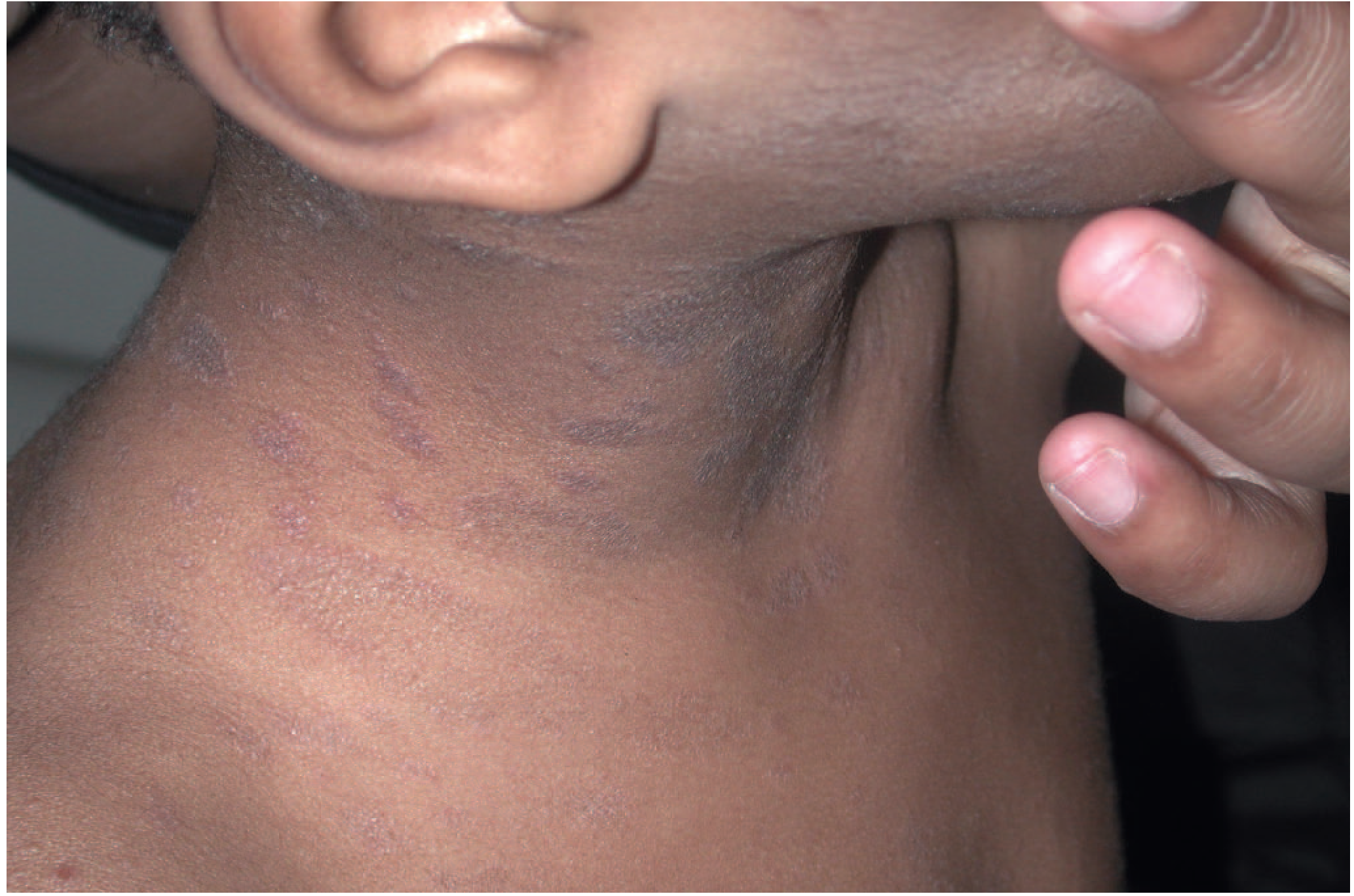
Pityriasis rosea: oval scaly plaques following skin cleavage lines - Symptom to Diagnosis, 4th Ed.
11. PROVISIONAL DIAGNOSIS
Pityriasis Rosea
Basis:
- Oval scaly lesions on trunk since 1 week
- Initial solitary herald patch followed by secondary eruption
- Lesions along Langer's cleavage lines ("Christmas tree" pattern)
- Collarette of scale with inward-pointing free edge
- Predominantly truncal distribution
- Self-limiting course, consistent with viral exanthem (HHV-6/HHV-7)
- Male, 42 years (PR peaks 10-35 but occurs at any age; worldwide distribution)
12. DIFFERENTIAL DIAGNOSES
1. Secondary Syphilis (must always be excluded)
- Maculopapular rash on trunk; can involve palms and soles (key distinguishing feature)
- Associated lymphadenopathy, condyloma lata, mucous patches
- History of primary chancre 3-6 weeks earlier
- Lesions do NOT follow cleavage lines; no collarette scale
- RPR / VDRL and TPHA/FTA-ABS mandatory to exclude
2. Tinea Corporis (Ringworm)
- Round/oval scaly plaques; but scale at the PERIPHERAL margin (vs. collarette scale pointing inward in PR)
- Central clearing; centrifugal spread
- Positive KOH examination (hyphae)
- Usually fewer lesions; does not follow cleavage lines
- Responds to antifungals
3. Tinea Versicolor (Pityriasis Versicolor)
- Hypopigmented or hyperpigmented fine scaly macules on trunk
- Fine branlike ("spaghetti and meatballs") KOH pattern
- No herald patch; no collarette scale
- Chronic, recurrent
- More in tropical/humid climate
4. Guttate Psoriasis
- Multiple small drop-like scaly papules on trunk; usually post-streptococcal
- Scale is thicker, silvery-white (micaceous); Auspitz sign positive
- Lesions smaller, do NOT have collarette scale or follow cleavage lines in fir-tree pattern
- Family history of psoriasis; nail changes, joint involvement possible
5. Nummular (Discoid) Eczema
- Round coin-shaped plaques; extremely pruritic
- Oozing, crusting, vesicles possible
- No herald patch; does not follow cleavage lines
- Chronic, recurrent course
- No collarette of scale
6. Pityriasis Lichenoides Chronica (PLC)
- Small scaly red-brown papules; chronic course (months to years)
- No herald patch; no Christmas tree pattern
- Lesions in various stages simultaneously
- Biopsy may be needed to distinguish
7. Drug-Induced Pityriasis Rosea-Like Eruption
- Morphologically identical to idiopathic PR
- History of causative drug (ACE inhibitor, terbinafine, beta-blocker, etc.)
- Slower to resolve than idiopathic form
- Excluded by careful drug history
8. Lichen Planus
- Violaceous, flat-topped, polygonal papules
- Wickham's striae on surface
- Pruritic; Koebner's phenomenon positive
- Can affect mucosae (oral, genital)
- No herald patch; different morphology
13. INVESTIGATIONS PLANNED
| Investigation | Purpose |
|---|---|
| RPR / VDRL (+ TPHA/FTA-ABS if positive) | Exclude secondary syphilis - mandatory |
| KOH examination of skin scraping | Exclude tinea corporis, tinea versicolor |
| Wood's lamp examination | Tinea versicolor (yellow-green fluorescence) |
| Skin biopsy (punch biopsy) | If diagnosis uncertain; shows subacute spongiotic dermatitis in PR |
| CBC, ESR | General inflammation markers |
| LFT | If drug reaction suspected |
| Blood glucose | Screen for immunosuppression |
| HIV screening | If secondary syphilis suspected or high-risk behavior |
14. MANAGEMENT
Non-pharmacological
- Reassurance: Condition is self-limiting; resolves spontaneously in 6-8 weeks (occasionally up to 5 months)
- Avoid hot water baths and friction (can worsen pruritus)
- Loose, cotton clothing
- Avoid excessive sun exposure (can cause post-inflammatory hyperpigmentation)
Pharmacological
| Indication | Treatment |
|---|---|
| Mild pruritus | Calamine lotion; low-to-medium potency topical corticosteroids (e.g., hydrocortisone 1%, clobetasone butyrate 0.05%) |
| Moderate-severe pruritus | Oral antihistamines (cetirizine 10 mg OD or loratadine 10 mg OD) |
| Severe/widespread eruption | Narrowband UVB phototherapy (NB-UVB) or natural sunlight exposure |
| Severe systemic symptoms | Oral acyclovir (800 mg 5x/day x 1 week) - may hasten resolution per Cochrane review |
| Rarely | Brief course of systemic corticosteroids if very severe |
Follow-up
- Review in 2-4 weeks to confirm resolution and address any dyspigmentation
- If no improvement in 3 months, reconsider diagnosis - biopsy and syphilis serology if not already done
15. PROGNOSIS
- Excellent - complete spontaneous resolution in 6-8 weeks in most patients
- Relapse is rare (1.8-3.7%)
- Post-inflammatory hypo- or hyperpigmentation may persist for weeks to months (more common in darker skin - relevant for a patient from South Asia/Nepal)
- No long-term sequelae in immunocompetent individuals
Sources: Fitzpatrick's Dermatology, 9th Ed., Chapter 31; Dermatology 2-Volume Set 5e (Bol and Dermatology); Symptom to Diagnosis: An Evidence-Based Guide, 4th Ed.
This is a shared conversation. Sign in to Orris to start your own chat.