
e coli
E. coli (Escherichia coli) is a gram-negative, facultative anaerobic rod-shaped bacterium that normally lives in the intestines of humans and animals. Most strains are harmless, but some cause serious infections - urinary tract infections, gastroenteritis, sepsis, and meningitis in newborns. Pathogenic strains are classified by virulence factors: ETEC, EPEC, EHEC (O157:H7), EIEC, EAEC, and ExPEC.
Searching sources...
Reading File
Searching the Web
E. coli microbiology pathogenesis clinical overview 2025
Now let me search the medical library for detailed E. coli content:
Finding Sources
Searching PubMed
"Escherichia coli" pathogenic classification virulence
Reading File
Reading File
Reading File
Reading File
Reading File
Loading Image
Here is a thorough overview of Escherichia coli drawn from authoritative medical microbiology textbooks.
Escherichia coli - Complete Overview
Basic Microbiology
E. coli is a gram-negative, facultative anaerobic rod (bacillus). Key lab features:
- Oxidase negative, lactose fermenter (most strains - rapid)
- Indole positive
- Grows on MacConkey agar (pink/red colonies due to lactose fermentation)
- Cell wall LPS consists of: O polysaccharide (outer, somatic antigen) + core polysaccharide + lipid A (endotoxin)
Antigenic Structure
Serotyping is based on three antigens:
- O antigen - somatic lipopolysaccharide (>150 distinct types)
- K antigen - polysaccharide capsule (e.g., K1 in neonatal meningitis strains)
- H antigen - flagellar protein
Serotype notation: O18:K1:H7 (a common uropathogenic and neonatal meningitis strain).
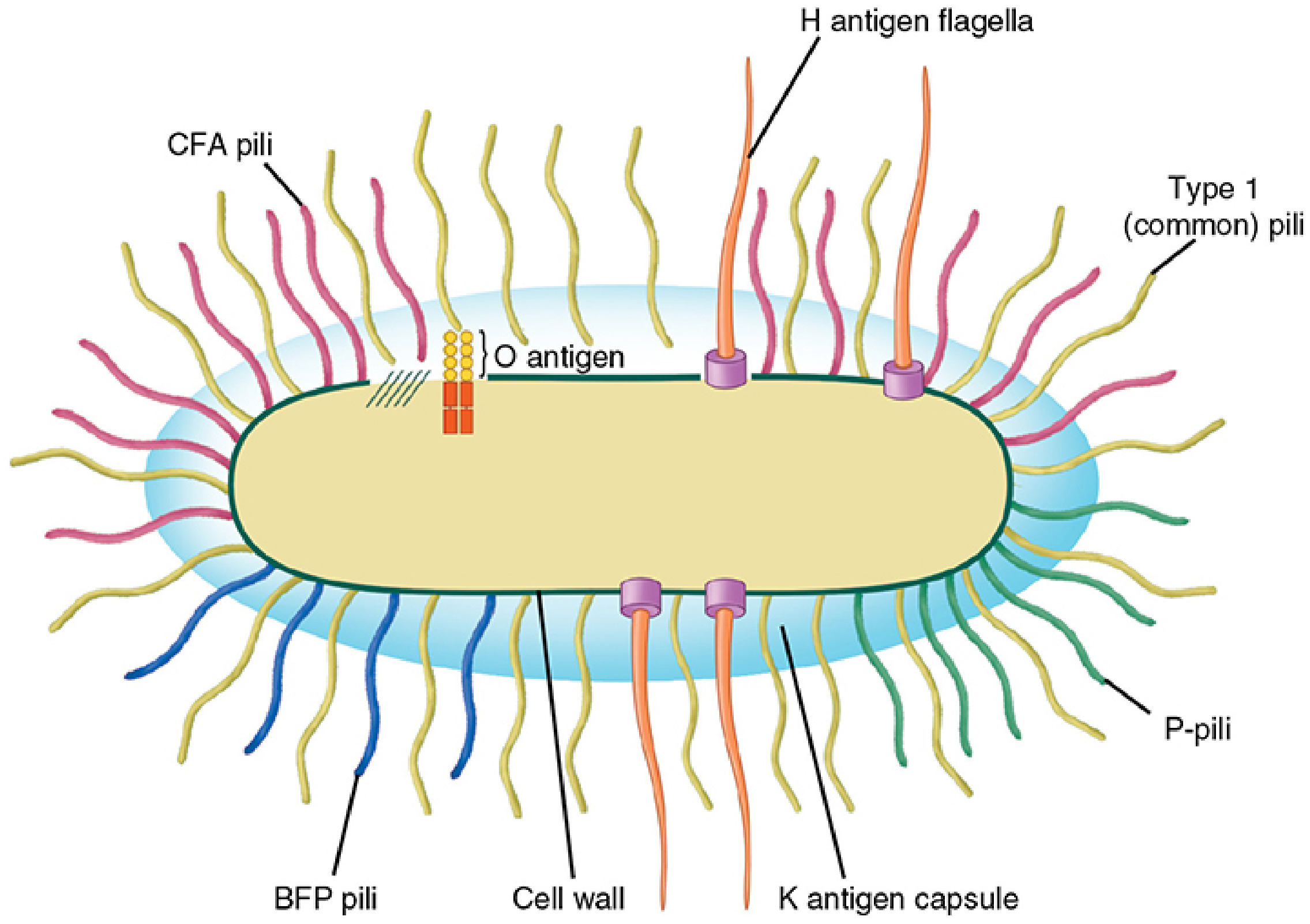
Antigenic structure of E. coli - Sherris & Ryan's Medical Microbiology, 8th Ed.
Epidemiology
- Most common aerobic gram-negative rod in the GI tract
- Most infections are endogenous (patient's own flora), except gastroenteritis strains, which are acquired exogenously via fecal-oral transmission
- Most common gram-negative rod isolated from septic patients
- Responsible for >80% of community-acquired UTIs
- Prominent cause of gastroenteritis, especially in developing countries
Pathogenic Groups and Virulence Factors
E. coli acquires virulence factors via plasmids, pathogenicity islands (PAIs), or bacteriophage DNA. The major pathotypes are:
| Pathotype | Key Adhesins | Key Toxins/Mechanism | Disease |
|---|---|---|---|
| ETEC (Enterotoxigenic) | Colonization factor antigens (CFA/I, II, III) | Heat-labile toxin (LT) - raises cAMP; Heat-stable toxin (ST) - raises cGMP | Traveler's diarrhea, watery diarrhea in infants |
| EPEC (Enteropathogenic) | Bundle-forming pili (BFP), Intimin | Attaching/Effacing (A/E) lesions - disrupts microvilli; no toxin | Watery diarrhea in infants (developing countries) |
| EAEC (Enteroaggregative) | Aggregative adherence fimbriae (AAF/I, II, III) | "Stacked brick" biofilm adherence; shortens microvilli | Persistent watery diarrhea, traveler's diarrhea |
| STEC/EHEC (Shiga toxin-producing / Enterohemorrhagic) | BFP, Intimin | Shiga toxins (Stx1, Stx2) - inhibit protein synthesis in endothelial cells | Hemorrhagic colitis, HUS (hemolytic uremic syndrome) |
| EIEC (Enteroinvasive) | Invasive plasmid antigens (Ipas) | Invades and destroys colonic epithelial cells | Dysentery (fever + bloody diarrhea) |
Extraintestinal pathotypes:
| Pathotype | Key Virulence Factors | Disease |
|---|---|---|
| UPEC (Uropathogenic) | Type 1 pili (mannose-binding), P pili (Gal-Gal binding to kidney cells), Dr fimbriae, α-hemolysin | UTI, pyelonephritis |
| NMEN (Neonatal Meningitic) | K1 capsule, α-hemolysin | Neonatal meningitis and sepsis |
Clinical Diseases
1. Urinary Tract Infection (UTI)
- Most common site of E. coli infection
- >90% of uncomplicated UTIs caused by E. coli
- Ascending route: colonization of periurethral area → bladder → ureter → kidney
- P pili bind to Gal-Gal receptors on kidney epithelium, driving pyelonephritis
- Pregnant women at higher risk (K1 strain colonization)
2. Gastroenteritis
- Five major groups (ETEC, EPEC, EAEC, STEC, EIEC) - see table above
- ETEC: most common cause of traveler's diarrhea; ST-producing strains predominate in U.S. outbreaks
- STEC O157:H7: most common cause of hemorrhagic colitis and HUS in the U.S.
- HUS triad: microangiopathic hemolytic anemia + thrombocytopenia + acute renal failure
- Stx2 is more virulent than Stx1; both cleave 28S rRNA
- Antibiotics are generally contraindicated in STEC - may increase Stx release and HUS risk
3. Neonatal Meningitis
- E. coli (K1 strain) causes ~20% of neonatal meningitis (group B Strep causes ~50%)
- K1 polysaccharide capsule resembles human neural cell adhesion molecules, allowing immune evasion
- High mortality; survivors often have neurological sequelae
4. Sepsis / Bacteremia
- Most common gram-negative rod in bacteremia
- Sources: urinary tract, intraabdominal (e.g., cholecystitis, cholangitis, peritonitis), pneumonia
- LPS (lipid A) triggers the sepsis cascade - TNF-α, IL-1, IL-6, complement activation
Diagnosis
- Culture: grows rapidly on blood agar, MacConkey agar, EMB agar (metallic green sheen)
- STEC O157:H7: sorbitol-MacConkey agar (O157:H7 does NOT ferment sorbitol - colorless colonies); confirm by serotyping or Stx immunoassay (ELISA/latex agglutination)
- Multiplex NAATs (PCR panels): now considered the gold standard for enteric pathogens
- Urine culture: gold standard for UTI (>10^5 CFU/mL)
Treatment
| Infection | Treatment |
|---|---|
| Uncomplicated UTI | Nitrofurantoin, trimethoprim-sulfamethoxazole, fosfomycin |
| Complicated UTI / pyelonephritis | Fluoroquinolones or beta-lactams (guided by sensitivity) |
| Bacteremia / sepsis | Carbapenems or 3rd/4th-gen cephalosporins (empiric) |
| Neonatal meningitis | Ampicillin + cefotaxime |
| STEC gastroenteritis | Supportive only - antibiotics contraindicated |
| Traveler's diarrhea (ETEC) | Azithromycin, rifaximin (fluoroquinolones where still sensitive) |
Key resistance issue: Extended-spectrum beta-lactamase (ESBL)-producing E. coli (especially ST131 clone) is a major global health threat, conferring resistance to most penicillins and cephalosporins. Carbapenems are the drugs of choice for ESBL infections.
Prevention and Control
- Proper cooking of beef and ground meat (STEC)
- Hand hygiene and safe food/water practices
- Avoiding unnecessary urinary catheters (nosocomial UTI prevention)
- Restricting broad-spectrum antibiotics to reduce ESBL selection pressure
- Vaccines under development for ETEC (travelers) and UPEC (recurrent UTI)
Sources: Medical Microbiology 9e (Murray), Sherris & Ryan's Medical Microbiology 8th Ed.
This is a shared conversation. Sign in to Orris to start your own chat.