
Posterior triangle
Reading File
Searching sources...
Finding Sources
Reading File
Reading File
Reading File
Reading File
Loading Image
Reading File
Reading File
Reading File
Reading File
Loading Image
Here is a thorough overview of the Posterior Triangle of the Neck, drawn from Gray's Anatomy for Students and Scott-Brown's Head & Neck Surgery.
Posterior Triangle of the Neck
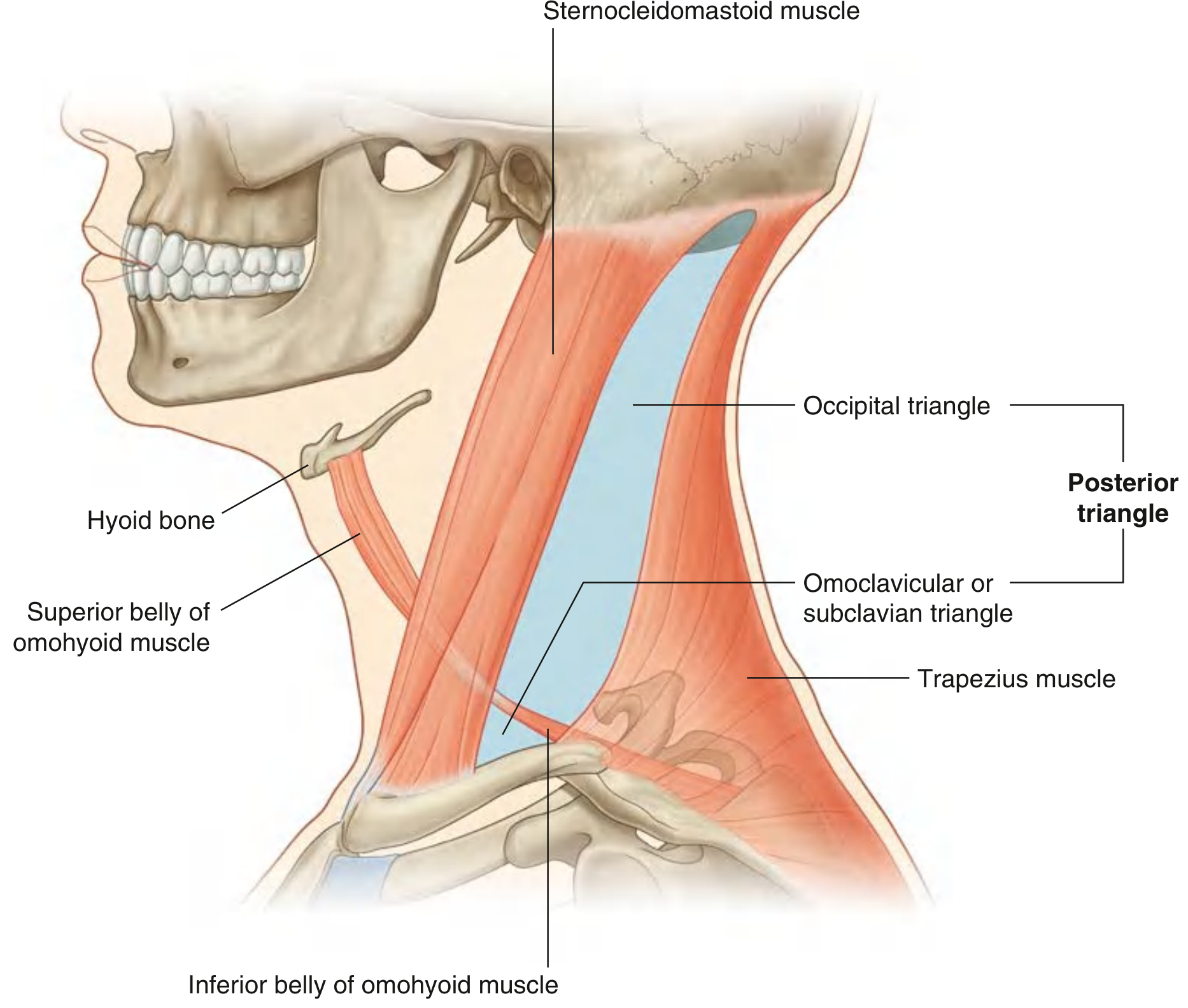
Borders
| Boundary | Structure |
|---|---|
| Anterior | Posterior edge of sternocleidomastoid (SCM) |
| Posterior | Anterior edge of trapezius |
| Inferior (base) | Middle one-third of the clavicle |
| Apex | Occipital bone just posterior to the mastoid process (where SCM and trapezius attachments converge) |
- Roof: Investing layer of deep cervical fascia, which surrounds both the SCM and trapezius as it passes across the region
- Floor: Prevertebral layer of cervical fascia covering (from superior to inferior): splenius capitis, levator scapulae, posterior scalene, middle scalene, anterior scalene
Subdivision by the Omohyoid
The inferior belly of the omohyoid crosses the lower portion of the posterior triangle diagonally (lateral to medial, inferior belly from scapula heading toward the hyoid), dividing it into two smaller triangles:
- Occipital triangle (larger, superior) - bounded by SCM anteriorly, trapezius posteriorly, omohyoid inferiorly
- Subclavian (omoclavicular) triangle (smaller, inferior) - bounded by omohyoid superiorly, clavicle inferiorly, SCM anteriorly
The subclavian triangle contains: brachial plexus trunks, subclavian artery (3rd part), transverse cervical and suprascapular arteries, subclavian vein, and the pleural dome.
Contents Summary
| Muscles | Vessels | Nerves | Other |
|---|---|---|---|
| Omohyoid (inferior belly) | Subclavian artery (3rd part) | Accessory nerve [XI] | Lymph nodes |
| (Floor: scalenes, levator scapulae, splenius capitis) | Transverse cervical artery | Cervical plexus (C1-C4) | |
| Suprascapular artery | Brachial plexus (C5-T1) | ||
| External jugular vein | Phrenic nerve (C3-C5) | ||
| Transverse cervical & suprascapular veins | Supraclavicular nerves |
Nerves in Detail
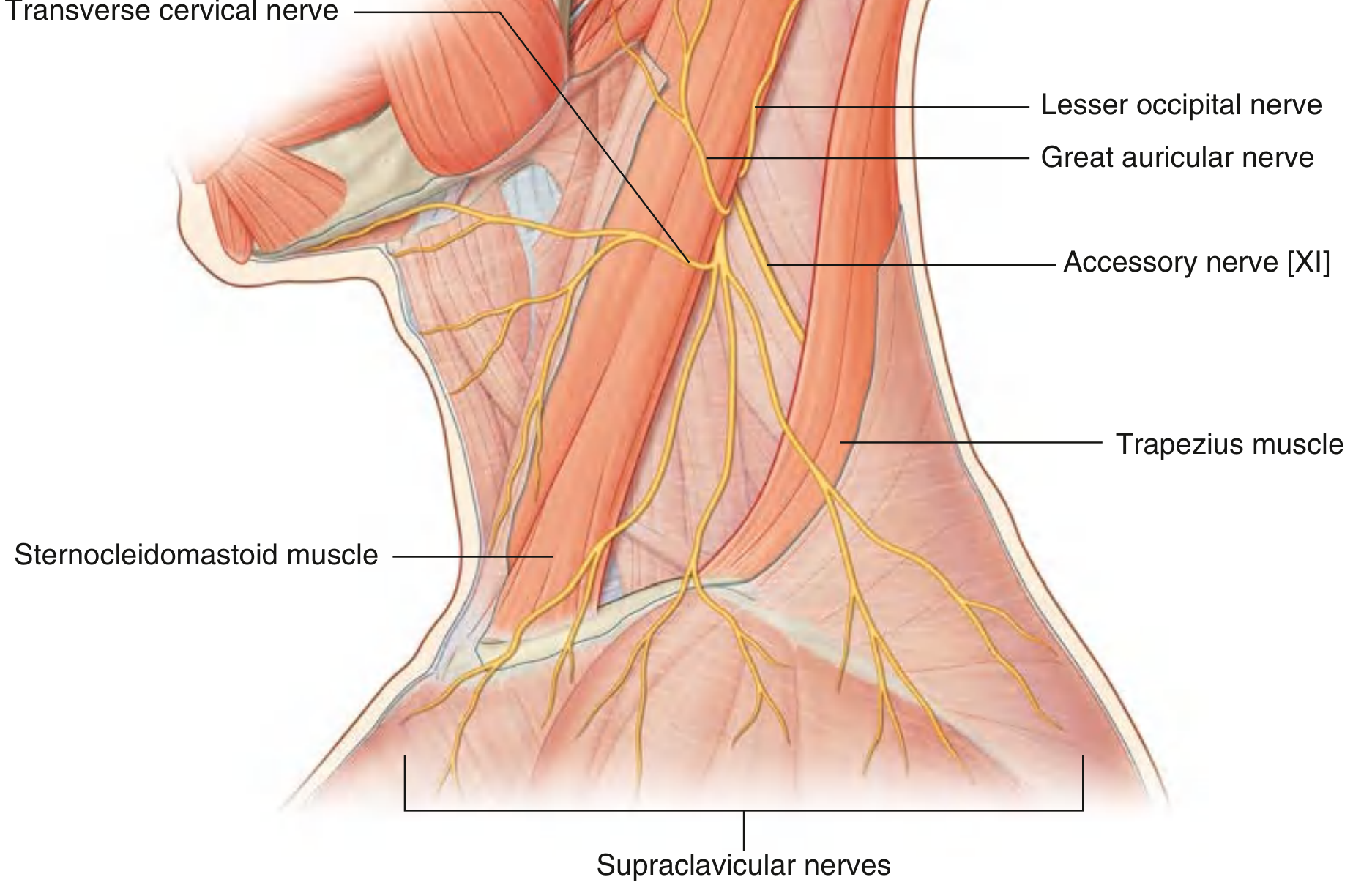
1. Accessory Nerve [CN XI]
- Exits the jugular foramen, descends through the neck, passes deep to or through the SCM (which it innervates), then enters the posterior triangle
- Crosses within the investing layer of cervical fascia, running obliquely downward
- Reaches the deep surface of the trapezius at its anterior border and innervates it
- Surgically important: runs across the roof of the triangle; all important lymph nodes lie caudal to it
2. Cervical Plexus (C1-C4)
Formed in the floor muscles within the prevertebral fascia. Cutaneous branches emerge from under the posterior border of the SCM at Erb's point:
- Lesser occipital nerve (C2) - skin of the posterior scalp
- Great auricular nerve (C2, C3) - skin over the parotid and ear
- Transverse cervical nerve (C2, C3) - anterior neck skin
- Supraclavicular nerves (C3, C4) - skin over clavicle, shoulder, and down to rib II
Deep (muscular) branches include contributions to the phrenic nerve (C3-C5), which hooks around the superior lateral border of the anterior scalene and descends across its anterior surface to the thorax.
3. Brachial Plexus (C5-T1)
- Roots emerge from between the anterior and middle scalene muscles
- Form trunks (upper C5/C6, middle C7, lower C8/T1) that cross the base of the posterior triangle
- Branches visible in the triangle: dorsal scapular nerve, long thoracic nerve, nerve to subclavius, suprascapular nerve
Vessels in Detail
Arteries:
- Subclavian artery (3rd part): Emerges lateral to the anterior scalene, crosses the base of the triangle, becomes the axillary artery at the lateral border of rib I
- Transverse cervical artery: Branch of thyrocervical trunk; crosses the base anterior to the scalenes and brachial plexus, then divides into superficial and deep branches at the trapezius
- Suprascapular artery: Also from the thyrocervical trunk; crosses the base inferiorly, passing over the superior transverse scapular ligament
Veins:
- External jugular vein: One of the most superficial structures; crosses the SCM in superficial fascia, enters the posterior triangle, receives tributaries (transverse cervical, suprascapular, anterior jugular), then pierces the investing fascia to drain into the subclavian vein
- Subclavian vein: Continuation of the axillary vein from the lateral border of rib I; lies anterior to and slightly below the subclavian artery
Lymph Nodes
Lymph nodes occupy the posterior triangle, particularly along the accessory nerve (Level V nodes in neck dissection classification). They receive drainage from the scalp and back of the neck and drain into the deep cervical chain.
Surgical Relevance
- The prevertebral fascia (floor) is the deep limit of resection in neck dissection
- The accessory nerve is the key landmark - all important nodes lie caudal to it
- The subclavian triangle requires care to avoid injuring the brachial plexus, subclavian vessels, and the dome of the pleura (which projects into this region)
Sources: Gray's Anatomy for Students, p. 1163-1169; Scott-Brown's Otorhinolaryngology Head & Neck Surgery, p. 590
This is a shared conversation. Sign in to Orris to start your own chat.