
General surgical instruments and use with image
Reading File
Now let me search the medical library for surgical instruments content, in parallel with a web search for images.
Finding Sources
Searching the Web
general surgical instruments names uses images labeled
Let me now read the textbook content and fetch the best reference images in parallel.
Finding Sources
Reading Web Page
https://www.facs.org/media/wgcmalet/common_surgical_instrume…
Now let me get the textbook content and fetch some good instrument images in parallel.
Reading File
Loading Image
Searching the Web
labeled diagram surgical instruments scalpel scissors forceps retractor clamp needle holder
Let me fetch two more high-quality labeled images:
Loading Image
Loading Image
I now have comprehensive content from the ACS surgical instruments guide and textbooks, plus labeled images. Here is the complete guide:
General Surgical Instruments and Their Uses
Surgical instruments are classified into functional categories based on what they do in the operative field. Below is a systematic overview of all major categories, with key instruments described in detail.
Visual Reference

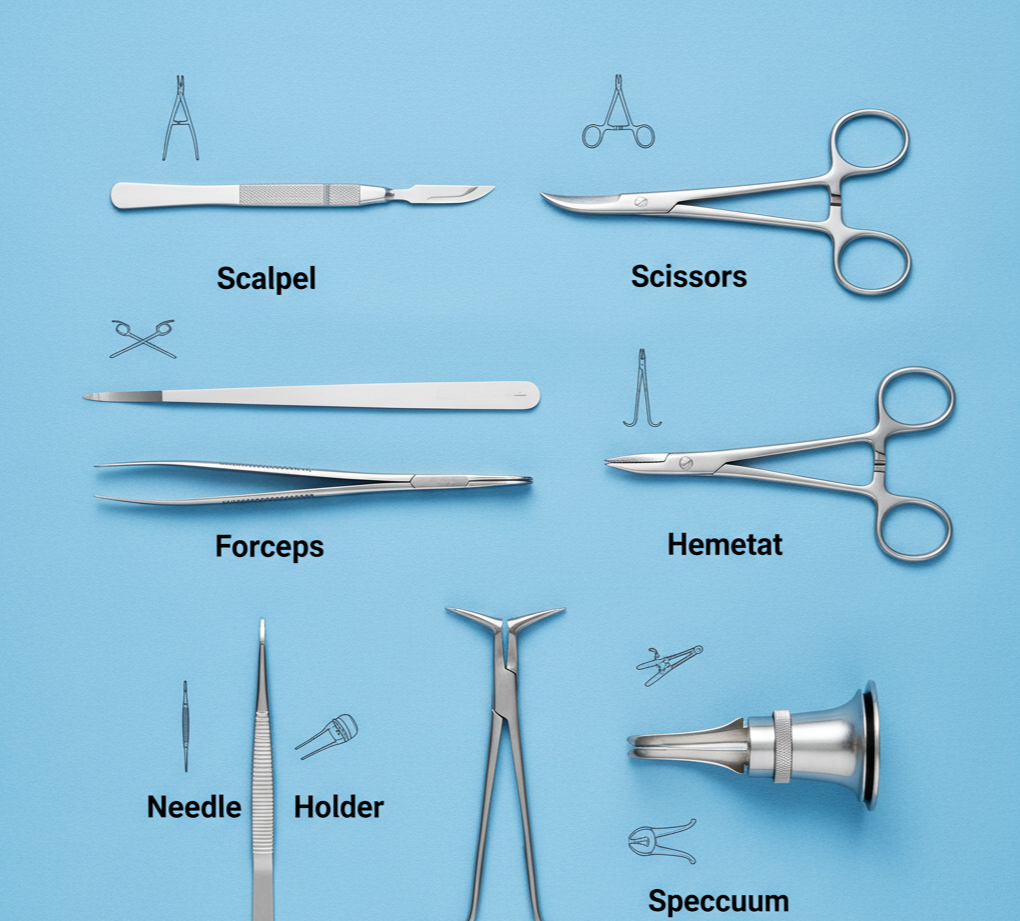
1. CUTTING & DISSECTING
Scalpel
The scalpel consists of a handle and a detachable blade. The surgeon refers to the instrument by its blade number:
| Blade | Use |
|---|---|
| #10 | Large skin incisions (laparotomy, thoracic surgery, hernia repair); curved edge for broad cuts |
| #11 | Precise, sharply angled incisions; used to open abscesses or vessels |
| #15 | Finer incisions in delicate tissue; smaller version of the #10 |
| #3 Handle | Most commonly used with #10 and #15 blades (superficial work) |
| #4 Handle | Longer, for deeper work or use with larger blades |
Scissors
| Instrument | Description | Use |
|---|---|---|
| Mayo Scissors (Straight) | Heavy, straight blades | Cutting suture material ("suture scissors") |
| Mayo Scissors (Curved) | Heavy, curved blades | Cutting heavy tissue such as fascia |
| Metzenbaum Scissors | Long, delicate blades | Cutting delicate tissue (e.g. cardiac tissue); blunt dissection |
2. GRASPING & HOLDING (Forceps)
Also called non-locking forceps - they work like tweezers and do not ratchet.
| Instrument | Description | Use |
|---|---|---|
| Adson Forceps | Toothed tips | Grasping dense tissue, skin closures |
| DeBakey Forceps | Fine, atraumatic serrations | Atraumatic grasping during vascular dissection |
| Bonney Forceps | Heavy, toothed | Holding thick tissue during fascial closure |
| Russian Forceps | Broad, rounded tip | Atraumatic tissue grasping during dissection |
| Tissue Forceps (non-toothed) | Smooth tips | Fine tissue handling and traction |
| Babcock Forceps | Fenestrated, rounded jaws | Grasping delicate structures like bowel without crushing |
| Allis Forceps | Interlocking teeth | Grasping tissue during removal; has some traumatic effect |
| Forester (Sponge) Forceps | Circular, fenestrated jaws | Holding surgical sponges/Raytecs; applying antiseptic |
3. CLAMPING & OCCLUDING
Also called locking forceps - these ratchet closed to hold tissue, provide hemostasis, or occlude vessels.
| Instrument | Description | Use |
|---|---|---|
| Crile Hemostat ("Snap") | Atraumatic, non-toothed | Grasping tissue/vessels to be ligated; blunt dissection |
| Kelly Clamp | Larger hemostat | Clamping larger vessels or tissue bundles |
| Kocher Forceps | Toothed jaws | Grasping heavy tissue (traumatic - not for vessels) |
| Rochester-Pean Forceps | Long, heavy, curved | Clamping large vessels or pedicles |
| Right-Angle Clamp | 90-degree jaw | Passing ligatures around a vessel; clamping in tight angles |
| Lahey Gall Duct Forceps | Angled, fine tip | Dissecting around the common bile duct; right-angle work |
| DeBakey Vascular Clamp | Atraumatic jaws | Occluding major blood vessels without intimal damage |
| Fogarty Clamp | Vascular, atraumatic | Temporary occlusion of arteries during vascular repair |
| Penetrating Towel Clamp | Sharp pointed tips | Securing sterile drapes to patient; reducing small bone fractures |
4. RETRACTING & EXPOSING
Retractors hold the incision open or move tissue out of the operative field. They can be hand-held or self-retaining.
Hand-Held Retractors
| Instrument | Use |
|---|---|
| Deaver Retractor | Retracting deep wounds and abdominal viscera |
| Richardson Retractor | Retracting superficial and medium-depth wounds |
| Army-Navy Retractor | Superficial wound retraction; double-ended |
| Volkman (Rake) Retractor | Sharp or blunt teeth; holds back surface structures |
| Malleable Retractor | Can be bent to any angle; also protects bowel during abdominal closure |
Self-Retaining Retractors
| Instrument | Use |
|---|---|
| Balfour Retractor | Deep abdominal retraction; used in laparotomy |
| Gelpi Retractor | Small wound retraction; commonly used in orthopedic and spine surgery |
| Weitlaner Retractor | General wound retraction; self-locking |
5. SUTURING & STAPLING
Needle Holders
Needle holders grip the suture needle and allow the surgeon to drive it through tissue.
| Instrument | Use |
|---|---|
| Mayo-Hegar Needle Holder | Standard needle holder for most suturing; heavy jaws for larger needles |
| Castroviejo Needle Holder | Fine ophthalmic/microsurgery suturing |
| DeBakey Needle Holder | Long handle (250 mm); used in deep or cardiovascular suturing |
Needles & Suture
- Curved needles - used in most general surgical procedures
- Straight needles - used for skin and subcuticular suturing
- Cutting needles cut through tough tissue (skin, fascia); tapered needles pierce without cutting (intestine, vessels)
Stapling Devices
| Instrument | Use |
|---|---|
| Linear Cutter (GIA) | Creates a linear cut and staples both free edges simultaneously; used in resections and anastomosis |
| Circular Stapler (EEA) | Creates end-to-end or end-to-side bowel anastomosis |
| Endostapler | Laparoscopic version; simultaneous cutting and stapling; may be manual or electronic with articulating head |
6. SUCTION DEVICES
| Instrument | Use |
|---|---|
| Yankauer Suction Tube | Surface suction; oropharyngeal and intra-abdominal use |
| Poole Suction Tube | Removes large volumes of fluid from deep cavities (e.g. peritoneal irrigation) |
| Frazier Suction Tip | Angled; primarily used in ENT and neurosurgery for fine, precise suction |
7. ELECTROSURGICAL & ENERGY DEVICES
| Instrument | Use |
|---|---|
| Electrocautery (Bovie) | Cuts or coagulates tissue using alternating electrical current; monopolar or bipolar |
| Bipolar Forceps | Current passes only between the tips; safer near nerves and vessels |
| Harmonic Scalpel (Ultrasonic) | Uses high-frequency ultrasound to cut and simultaneously seal tissue; less thermal spread than electrocautery |
8. LAPAROSCOPIC INSTRUMENTS
All laparoscopic instruments are adapted versions of open instruments, designed to pass through narrow trocars (5 mm, 10 mm, 12 mm ports).
| Instrument | Use |
|---|---|
| Trocar/Cannula | Port placed through skin to allow passage of laparoscopic instruments |
| Laparoscopic Grasper | Grasping/retracting tissue through a trocar |
| Laparoscopic Scissors | Cutting tissue laparoscopically |
| Clip Applier | Applying titanium/polymer clips to ligate vessels or ducts |
| Laparoscopic Needle Driver | Intracorporeal suturing |
| Endostapler | Simultaneous cutting and stapling; articulating head for difficult angles |
Quick Summary Table by Function
| Function | Key Instruments |
|---|---|
| Cutting | Scalpel (#10, #11, #15), Mayo scissors, Metzenbaum scissors |
| Grasping | DeBakey, Adson, Babcock, Allis, Russian forceps |
| Clamping/Hemostasis | Crile hemostat, Kelly clamp, Kocher, Rochester-Pean |
| Retracting | Deaver, Balfour, Gelpi, Malleable, Rake retractor |
| Suturing | Mayo-Hegar needle holder, curved/straight needles |
| Stapling | GIA linear cutter, EEA circular stapler, Endostapler |
| Suction | Yankauer, Poole, Frazier |
| Energy | Bovie electrocautery, Bipolar, Harmonic scalpel |
Sources: ACS Common Surgical Instruments Guide | Cummings Otolaryngology Head and Neck Surgery | CSTSetup 54 Basic Surgical Instruments
This is a shared conversation. Sign in to Orris to start your own chat.