
Difference between kf ring and arcus senils
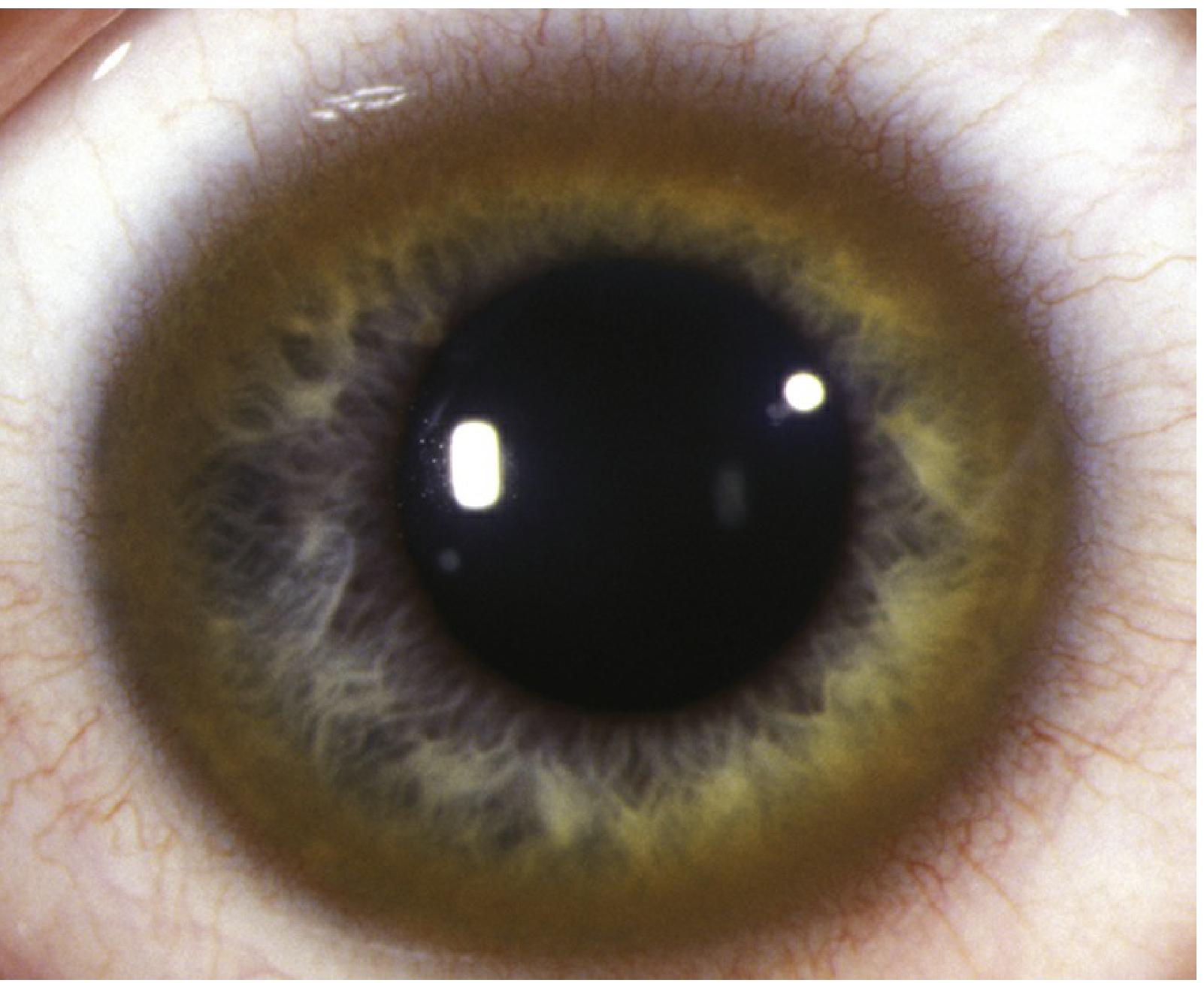
- Kayser-Fleischer (KF) ring: copper deposition in Wilson's disease, appears at the corneal periphery in Descemet's membrane, golden-brown/green color, starts superiorly
- Arcus senilis: lipid (cholesterol) deposition, also at the corneal periphery but in the stroma, white/grey color, age-related and generally benign
Kayser-Fleischer (KF) Ring vs. Arcus Senilis
Side-by-Side Comparison
| Feature | Kayser-Fleischer Ring | Arcus Senilis |
|---|---|---|
| Cause | Copper deposition | Lipid (cholesterol/fat) deposition |
| Layer of cornea | Descemet's membrane (posterior) | Stroma (anterior and mid) |
| Color | Golden, greenish-brown, yellow, or reddish | White, grey, or blue-white |
| Width | 1-3 mm band | ~1 mm band |
| Clear zone at limbus | Extends TO the limbus (no clear zone) | 1 mm clear zone separates ring from limbus |
| Progression direction | Starts superiorly, then inferiorly, then complete ring | Starts superiorly and inferiorly, then complete ring |
| Slit lamp finding | Linear hyperreflective material on Descemet membrane | Diffuse central border; sharp peripheral edge |
| Reversibility | Yes - resolves with treatment of Wilson's disease | No - permanent once formed |
| Systemic disease | Wilson's disease (pathognomonic) | Usually benign in elderly; may signal dyslipidemia if age <40 |
| Clinical significance | Highly significant - diagnostic marker | Benign in older adults; check fasting lipid profile if <40 years |
Kayser-Fleischer Ring - Key Points
- Present in >90% of Wilson's disease patients with neurologic manifestations
- Present in 50-60% of patients with only hepatic involvement
- May only be visible on gonioscopy in early stages (superior crescent)
- Anterior segment OCT can detect early deposits as linear hyperreflective material
Arcus Senilis - Key Points
- Starts in the superior and inferior perilimbal cornea, then progresses circumferentially
- Band is ~1 mm wide, usually wider vertically than horizontally
- Central border is diffuse; peripheral edge is sharp
- Separated from the limbus by a clear zone (this is the key distinguishing feature from KF ring)
- Benign and common in the elderly (no systemic workup needed)
- In patients under 40, check a fasting lipid profile - it may represent arcus juvenilis associated with dyslipidemia or hyperlipoproteinemia
The Critical Distinguishing Feature (Exam Favorite)
- Arcus senilis: always has a clear zone (lucid interval) between the ring and the limbus
- KF ring: extends all the way to the limbus with no clear zone, AND is brown/golden (not white)
Generate a visual comparison chart of KF ring vs arcus senilis
A clean medical comparison chart titled "KF Ring vs Arcus Senilis" with two columns side by side. Left column header: "Kayser-Fleischer Ring" with a golden-brown color accent. Right column header: "Arcus Senilis" with a grey-white color accent. Each column contains a simple diagram of an eye cross-section showing the ring location, followed by rows comparing: Deposit (Copper vs Lipid/Cholesterol), Corneal Layer (Descemet's membrane vs Stroma), Color (Golden-brown/green vs White-grey), Clear zone at limbus (None - extends to limbus vs Present - 1mm lucid interval), Progression (Superior first then complete vs Superior+inferior then complete), Reversible (Yes - with treatment vs No), Age group (Young adults vs Elderly), Systemic disease (Wilson's disease - pathognomonic vs Dyslipidemia if under 40), and a bottom highlight box stating the key differentiator: "KF ring touches the limbus. Arcus senilis has a 1mm clear zone." Medical illustration style, white background, professional clinical chart layout.
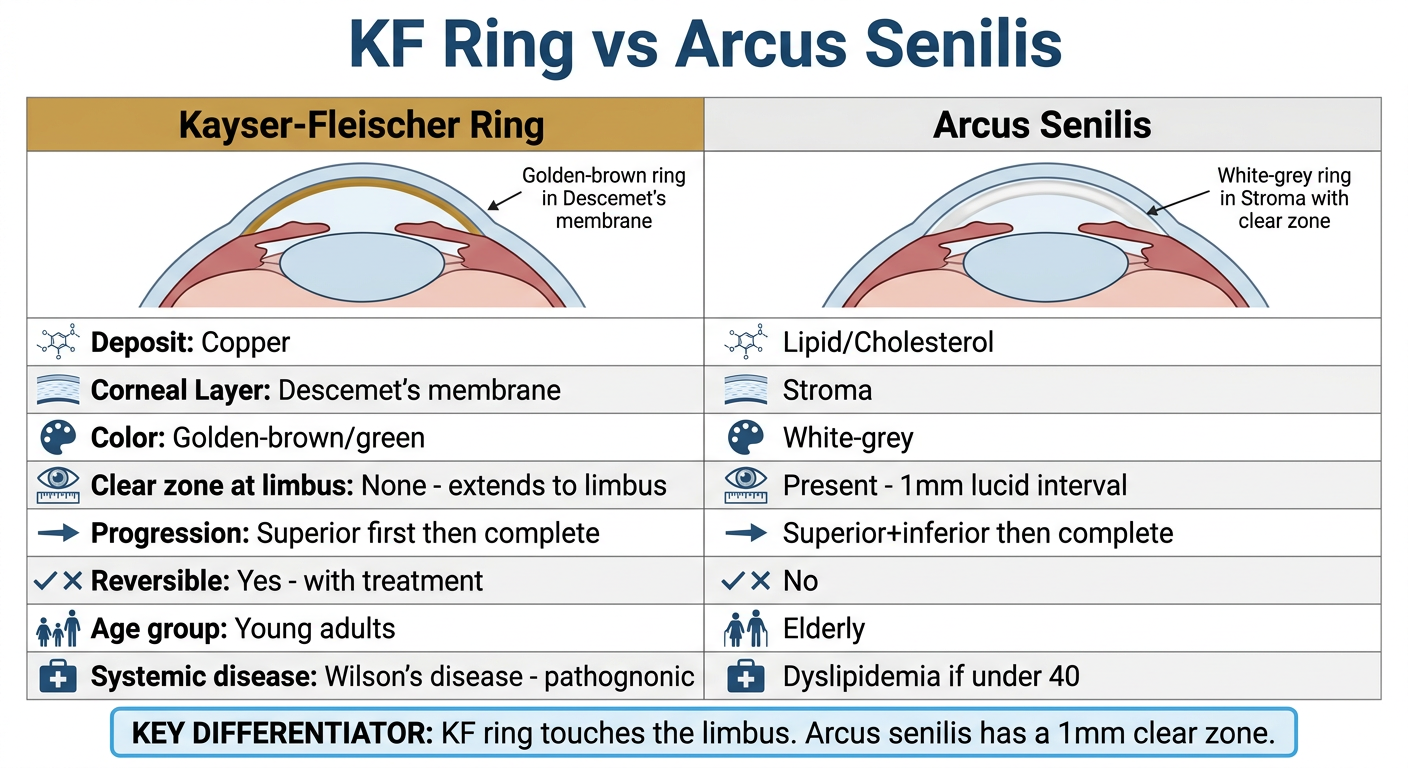
- Color: KF ring is golden-brown/green (copper); Arcus is white-grey (lipid)
- Layer: KF ring sits in Descemet's membrane; Arcus sits in the stroma
- The classic differentiator: KF ring extends all the way to the limbus - arcus senilis always has a 1 mm clear (lucid) interval between the ring and the limbus
- Significance: KF ring = Wilson's disease until proven otherwise; Arcus in elderly = benign, but check lipid profile if the patient is under 40