
Anaemia in pregnancy and 2 3 dpg role
Reading File
Reading File
Finding Sources
Finding Sources
Finding Sources
Searching PubMed
"anemia"[MeSH Terms] AND "pregnancy"[MeSH Terms]
Reading File
Reading File
Finding Sources
Anaemia in pregnancy and the role of 2,3-DPG
1. Physiological background
- Plasma volume rises by 40 to 50% over baseline, peaking at weeks 16 to 24. Red cell mass rises less, so Hb falls. This is the "physiologic anemia of pregnancy" (Goldman-Cecil Medicine, Physiologic Anemia of Pregnancy). Harrison's 22E describes the same dilutional mechanism. Barash's Clinical Anesthesia says the relative anaemia peaks at 32 to 34 weeks.
- True anaemia is defined by the CDC as Hb <11 g/dL in the 1st and 3rd trimesters, or <10.5 g/dL in the 2nd (Swanson's Family Medicine Review).
- Iron, folate and B12 deficiency are the common true causes (Harrison's 22E, Hematologic Disorders). Iron deficiency is the commonest, because of repeated pregnancies and blood loss (Textbook of Family Medicine 9e).
2. Why it matters
Anaemia is linked to preterm birth and low birth weight. Recent meta-analyses support this: maternal anemia and preterm birth (PMID 42692818) and Ethiopian data on low birth weight (PMID 39264971). Neither changes the textbook picture.
3. Role of 2,3-DPG (2,3-BPG)
Basic mechanism
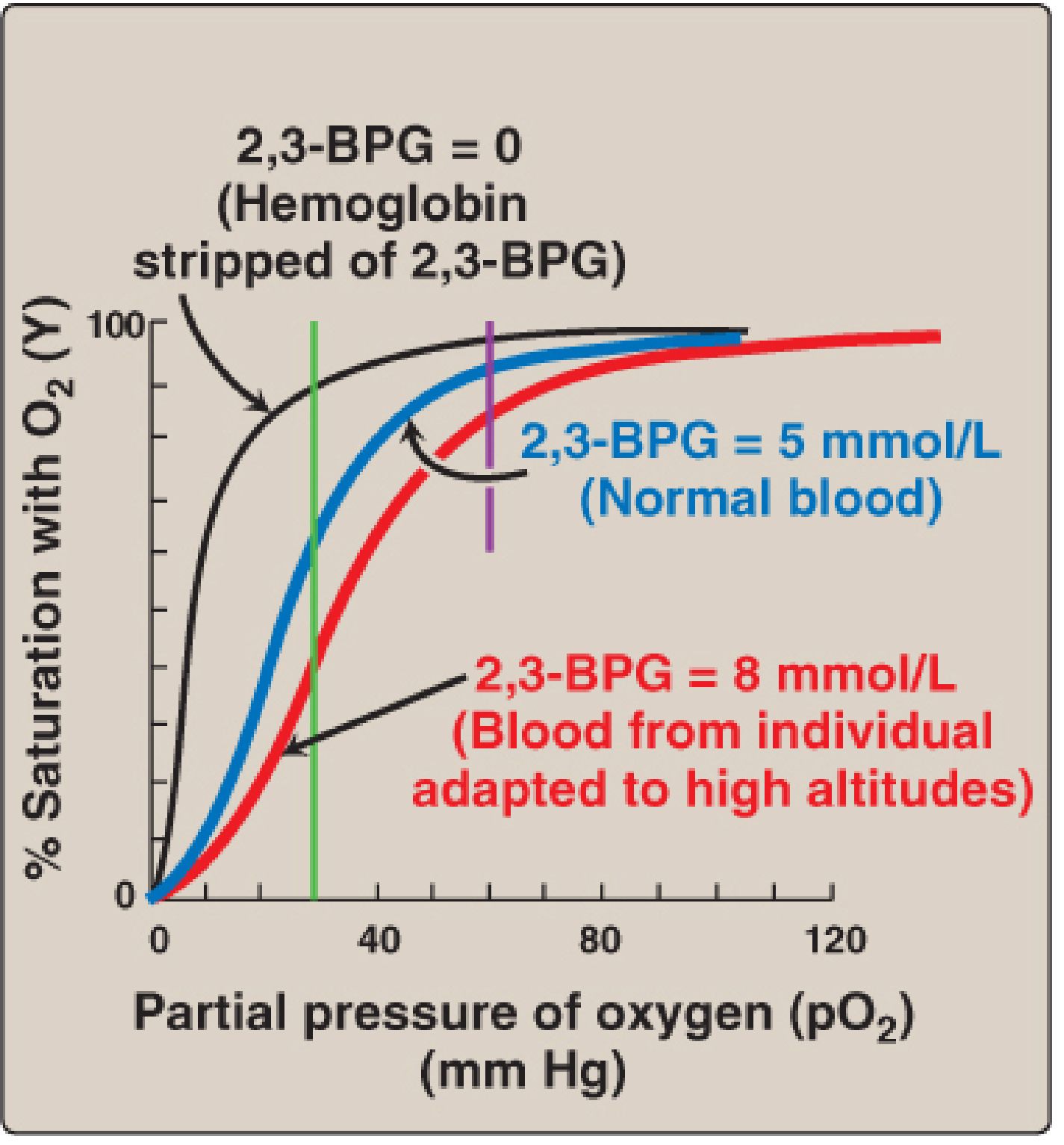
- 2,3-DPG binds the central cavity between the two β chains of deoxy-Hb in a 1:1 ratio. Deoxy-Hb binds it about 100 times more tightly than oxy-Hb. This stabilises the T (tense) state, lowers O2 affinity and shifts the O2-dissociation curve to the right, so more O2 is released to tissues (Medical Physiology, Ch. 29).
- Low PO2 in red cells stimulates glycolysis and raises 2,3-DPG. The levels rise in chronic hypoxia, high altitude and chronic anaemia (Medical Physiology; Lippincott Biochemistry 8e, 2,3-BPG levels in chronic hypoxia or anemia).
Relevance to anaemia (any cause, including pregnancy)
- With less Hb available, red cells raise 2,3-DPG. The right shift lets each Hb molecule unload a larger fraction of its O2 in the tissues. This is a compensatory mechanism, alongside increased cardiac output and heart rate.
- The cost is a slightly reduced O2 uptake in the lungs. This is minor because the upper part of the curve is flat.
Relevance to pregnancy and the fetus
- From my own knowledge rather than the retrieved texts: maternal red-cell 2,3-DPG rises during pregnancy, and maternal P50 increases from about 27 to about 30 mmHg. This favours O2 release to the placenta. Together with the double Bohr effect, it helps transfer O2 to the fetus.
- HbF (α2γ2) binds 2,3-DPG poorly because the γ chain lacks key positively charged residues. The result is high fetal O2 affinity (a left-shifted curve), so fetal blood can extract O2 from maternal blood across the placenta (Medical Physiology: "2,3-DPG reduces the affinity of adult, but not of fetal, Hb"; Mulholland & Greenfield's Surgery, fetal circulation).
- Net effect: maternal Hb has a lower affinity (it releases O2) and fetal Hb has a higher affinity (it takes O2 up). This gradient is why moderate maternal anaemia is partly compensated, but severe anaemia still compromises fetal oxygenation.
Clinical points on 2,3-DPG
- Stored blood becomes depleted of 2,3-DPG. It then has a high O2 affinity and delivers O2 poorly. Levels recover within 6 to 24 h of transfusion (Lippincott Biochemistry 8e). This matters when transfusing a bleeding obstetric patient.
- Iron deficiency is a different problem from 2,3-DPG. It limits Hb synthesis, whereas 2,3-DPG only modulates how well existing Hb unloads O2.
4. Management summary
- Prophylaxis: about 30 mg/day of elemental iron (Lippincott Pharmacology, Iron).
- Treatment of iron-deficiency anaemia: the CDC recommends 60 to 120 mg/day of oral elemental iron in divided doses (Lippincott Pharmacology).
- IV iron: not used in the first trimester. It is preferred in the third trimester and for severe iron-deficiency anaemia (Hb <9 g/dL) when oral iron fails or is not tolerated (Rosen's Emergency Medicine, Iron Deficiency Anemia).
- Check for folate and B12 deficiency, and for haemoglobinopathies where relevant.
- Keep Hb at the physiologic level in chronic kidney disease (about 10 to 11 g/dL), per Creasy & Resnik's Maternal-Fetal Medicine.
I did not find any recent systematic review that contradicts the textbook content above.
This is a shared conversation. Sign in to Orris to start your own chat.