
Anatomy of mouth and dentition according to standard ENT textbook
Reading File
Now let me search the medical library for anatomy of the mouth and dentition in ENT textbooks.
Finding Sources
Finding Sources
Finding Sources
Two ENT textbooks found. Let me search for mouth/oral cavity and dentition sections in both.
Finding Sources
Finding Sources
Finding Sources
Excellent! Found the key sections. Let me read the main anatomy sections and dentition content in parallel.
Reading File
Reading File
Reading File
Good content coming in. Let me read more of the teeth/dentition section and the Cummings anatomy section, and also get the oral cavity examination content.
Reading File
Reading File
Excellent content. Now let me read the Cummings block19 for the subsites section and the Cummings block1 for the oral cavity overview, plus continue reading K.J. Lee for tongue anatomy.
Reading File
Reading File
Excellent content. Let me now fetch the key anatomical diagram from Cummings and also read the floor of mouth/hard palate/buccal mucosa subsites section.
Loading Image
Reading File
I now have comprehensive content from both Cummings Otolaryngology and K.J. Lee's Essential Otolaryngology. Let me compile the complete, detailed response.
Anatomy of the Mouth and Dentition
Sources: Cummings Otolaryngology Head and Neck Surgery; K.J. Lee's Essential Otolaryngology
Overview and Boundaries
The oral cavity extends from the vermilion border of the lips anteriorly to:
- Posterosuperiorly: the hard palate-soft palate junction
- Posteroinferiorly: the circumvallate papillae (linea terminalis)
- Posterolaterally: the anterior tonsillar pillars
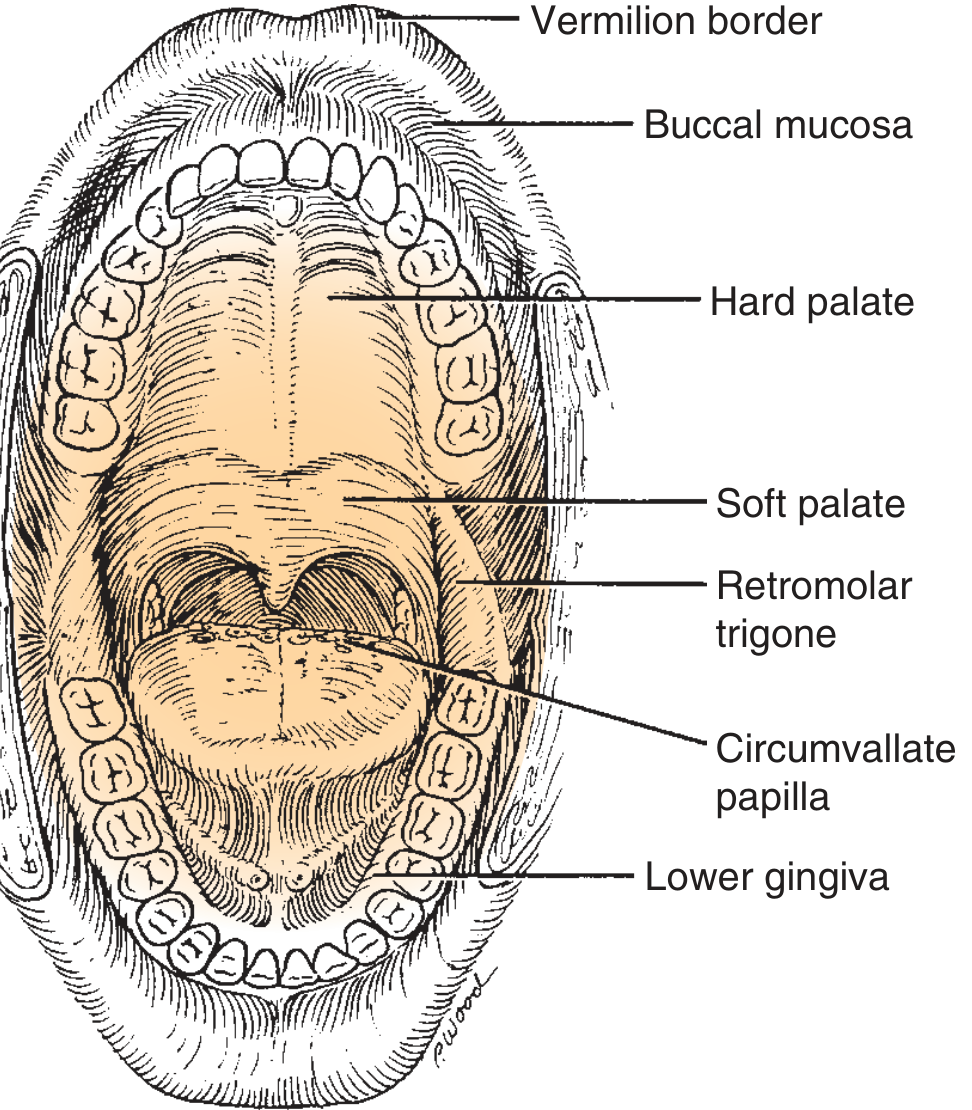
Fig. 91.1 - Overview of the oral cavity showing the posterior boundary at the hard palate-soft palate junction and the retromolar trigone relative to the inferior alveolar ridge. (Cummings Otolaryngology)
Seven Subsites of the Oral Cavity
- Lips
- Dentoalveolar ridges (upper and lower alveolar ridges)
- Oral tongue
- Retromolar trigone
- Floor of mouth
- Buccal mucosa
- Hard palate
Functions: Intake and mastication of food, oral phase of deglutition, speech/communication, and protection from noxious substances.
1. The Lips
Surface Anatomy
- Vermilion: Composed of nonkeratinized squamous epithelium; underlying capillaries give it its characteristic red color. No hair follicles or sebaceous glands.
- Vermilion border: The transition point from external skin to internal mucous membrane.
- Philtrum ridges and Cupid's bow on the upper lip.
- Oral commissure: The lateral junction between upper and lower lips.
- Modiolus: A tendinous thickening at each oral commissure serving as the attachment for several perioral muscles.
Perioral Musculature (all innervated by CN VII)
| Muscle | Action |
|---|---|
| Orbicularis oris | Sphincter around the mouth; purses lips; presses lips against teeth |
| Buccinator | Presses lips and cheek against the teeth |
| Levator anguli oris | Elevates the commissure |
| Depressor anguli oris | Depresses and laterally moves commissure |
| Zygomaticus major | Elevates and laterally moves commissure |
| Risorius | Draws the commissure laterally |
| Levator labii superioris | Elevates upper lip |
| Depressor labii inferioris | Depresses lower lip |
| Mentalis | Elevates lower lip |
| Platysma | Lip depressor |
Sensory Innervation
- Upper lip: Infraorbital nerve (CN V2)
- Lower lip: Mental nerve (CN V3)
Vascular Supply
- Inferior and superior labial arteries from the facial artery
Lymphatic Drainage
- Primarily to submandibular lymph nodes
- Midline lower lip also drains to submental lymph nodes
- Upper lip also to preauricular, infraparotid, and perifacial lymph nodes
2. Alveolar Ridges
- The lateral aspect is demarcated by the mucosal sulcus where tissue transitions to buccal mucosa.
- Lower alveolus medially: transitions to the floor of the mouth.
- Upper (maxillary) alveolus: transitions horizontally to the hard palate.
- Lower alveolus posteriorly: the ascending ramus of the mandible.
- Upper alveolus posteriorly: the superior aspect of the pterygopalatine arch.
- The close approximation of mucosa to underlying bone facilitates early cortical invasion by malignant tumors.
3. Oral Tongue
The oral tongue is the portion anterior to the linea terminalis (circumvallate papillae).
Muscles of the Tongue
Extrinsic muscles (originate outside the tongue):
| Muscle | Origin | Insertion | Function | Nerve |
|---|---|---|---|---|
| Genioglossus | Mental symphysis | Tongue body | Depress and protrude; provides the bulk of the tongue | CN XII |
| Hyoglossus | Body and greater cornu of hyoid | Side of tongue | Depress and retract | CN XII |
| Styloglossus | Styloid process | Tip and side of tongue | Retract and elevate | CN XII |
| Palatoglossus | Palatine aponeurosis | Side and dorsum of tongue | Elevates posterior tongue; closes oropharyngeal isthmus; initiates swallowing | CN X (pharyngeal branch) |
Intrinsic muscles (superior/inferior longitudinal, transverse, vertical): innervated by CN XII; function to alter the overall shape of the tongue.
- A fibrous septum linguae defines the midline and contains a triangular fat pad visible on axial CT.
Surface Anatomy of the Tongue
- Filiform papillae: Make up the bulk of papillae; contain trigeminal nerve endings (temperature, texture, pain); no taste function
- Fungiform papillae: Mushroom-shaped; diffuse distribution, most anteriorly; contain taste buds
- Circumvallate (vallate) papillae: 7-12 large papillae arranged in a V-shape at the junction between anterior and posterior tongue (linea terminalis); contain abundant taste buds
- Foliate papillae: Along the lateral tongue margins; also contain taste buds
Sensory Innervation of the Tongue
| Region | Touch/Pain/Temperature | Taste |
|---|---|---|
| Anterior 2/3 (oral tongue) | Lingual nerve (CN V3) | Chorda tympani (CN VII) via lingual nerve → geniculate ganglion → nucleus solitarius |
| Posterior 1/3 (tongue base) | Glossopharyngeal nerve (CN IX) | Glossopharyngeal nerve (CN IX) |
| Epiglottic region | Superior laryngeal nerve (CN X) | Superior laryngeal nerve (CN X) |
Motor: Hypoglossal nerve (CN XII) to all tongue muscles except palatoglossus (CN X).
Vascular Supply
- Arterial: Lingual artery (second branch of the external carotid artery)
- Venous: Lingual vein and the ranine vein (vena comitans of the hypoglossal nerve)
Lymphatic Drainage
- Tip of tongue: Submental nodes
- Central anterior tongue: Ipsilateral and contralateral nodes
- Lateral anterior tongue: Ipsilateral nodes (levels I-III); may have skip metastases to level IV
- Posterior tongue (base): Both ipsilateral and contralateral deep cervical nodes (jugulodigastric)
4. Retromolar Trigone
A small triangular area of mucosa posterior to the last molar tooth, overlying the ascending ramus of the mandible. It connects the oral cavity to the oropharynx. Arterial supply from ascending pharyngeal and lesser palatine vessels.
5. Floor of Mouth
A horseshoe-shaped region bounded by the lower alveolar ridge and tongue. Contains the openings of the sublingual and submandibular (Wharton's) ducts.
6. Buccal Mucosa
The mucosal lining of the inner cheeks, extending from the commissures anteriorly to the pterygomandibular raphes posteriorly. The parotid (Stensen's) duct opens opposite the upper second molar.
7. Hard Palate
Forms the roof of the oral cavity. Derived from the palatine processes of the maxillae and the horizontal plates of the palatine bones.
Arterial supply: Greater palatine artery and superior alveolar arteries (anterior, middle, posterior - terminal branches of internal maxillary artery after becoming sphenopalatine artery at pterygopalatine fossa). The greater palatine artery exits via the greater palatine foramen medial to the second maxillary molar and runs anteromedially through the soft tissue of the palate.
Venous drainage: Pterygoid plexus → internal jugular system.
Arteriovenous Anatomy of the Oral Cavity
The arterial supply comes from multiple branches of the external carotid artery:
- Lingual artery - majority of supply to oral tongue and tongue base; runs deep to the hyoglossus muscle; the hypoglossal nerve and lingual veins lie superficial to hyoglossus and deep to mylohyoid
- Superior alveolar arteries (anterior, middle, posterior) - supply maxillary gingiva, alveolar ridge, and dentition
- Ascending pharyngeal and lesser palatine vessels - supply posterior floor of mouth and retromolar trigone
Dentition
Layers of the Tooth (Four Major Components)
| Layer | Description | Formed By |
|---|---|---|
| Enamel | Hardest outer layer; white; mostly calcium phosphate | Ameloblasts (amelogenesis) |
| Dentin | Layer underlying enamel; continues to form throughout life | Odontoblasts (dentinogenesis) |
| Pulp | Inner structure; contains blood vessels and nerves | - |
| Cementum | Surface layer of the tooth root; binds roots to gingiva and alveolar bone via connective tissue | Cementoblasts |
Supporting Structures
- Periodontal ligament: Connects teeth to alveolar bone through cementum; formed by fibroblasts
- Alveolar bone: Surrounds the tooth roots; formed by osteoblasts
Nomenclature and Types
| Type | Number (Adult) | Description |
|---|---|---|
| Incisors (central/lateral) | 8 | For cutting |
| Canines | 4 | Between incisors and premolars |
| Premolars (1st and 2nd) | 8 | Only in permanent dentition |
| Molars (1st, 2nd, 3rd/wisdom) | 12 | Grinding; 3rd molars are wisdom teeth |
Total permanent (adult) teeth: 32, numbered superiorly right to left (1-16) and inferiorly left to right (17-32).
Deciduous (primary) teeth: 20 (no premolars), named superiorly right to left (A-J) and inferiorly left to right (K-T).
Muscles of Mastication
All four muscles are innervated by the mandibular nerve (CN V3):
| Muscle | Origin | Insertion | Action |
|---|---|---|---|
| Masseter | Zygomatic arch and maxillary process of zygomatic bone | Angle and lateral ramus of mandible, coronoid process | Elevation and protrusion of mandible |
| Temporalis | Superior/inferior temporal lines; temporal surface of sphenoid | Coronoid process of mandible | Elevation and retraction of mandible |
| Lateral pterygoid | Greater wing of sphenoid (superior head); lateral pterygoid plate (inferior head) | Anterior condyle (superior); pterygoid fovea/medial ramus (inferior) | Depression, protrusion, and side-to-side movement |
| Medial pterygoid | Medial lateral pterygoid plate (deep); pyramidal process of palatine bone and maxillary tuberosity (superficial) | Medial angle of mandible | Elevation and side-to-side movement |
Lymphatic Drainage Summary
| Subsite | Primary Drainage |
|---|---|
| Upper lip | Submandibular; also preauricular, infraparotid, perifacial |
| Lower lip (lateral) | Submandibular |
| Lower lip (midline) | Submental |
| Tip of tongue | Submental |
| Anterior oral tongue | Levels I-III (ipsilateral; central also contralateral) |
| Posterior tongue | Bilateral deep cervical (jugulodigastric) |
| Floor of mouth | Submental and submandibular |
Sources:
- Cummings Otolaryngology Head and Neck Surgery, Ch. 91 - Anatomy of the Oral Cavity (pp. 1653-1656)
- K.J. Lee's Essential Otolaryngology - Boundaries, Teeth, Lip Anatomy, Tongue Anatomy (pp. 663-665)
This is a shared conversation. Sign in to Orris to start your own chat.