
Hoarseness of voice since birth for 10 yr Female ayurveda medicine
Reading File
Now let me search the medical library and web in parallel for this clinical case.
Finding Sources
Finding Sources
Searching the Web
hoarseness of voice since birth child 10 years causes diagnosis treatment Ayurveda
Finding Sources
Finding Sources
Finding Sources
Reading File
Reading File
Finding Sources
Loading Image
Reading Web Page
https://www.ijorl.com/index.php/ijorl/article/view/4760
Finding Sources
Now I have enough information to provide a thorough answer. Let me compile this.
Hoarseness of Voice Since Birth - 10-Year-Old Female (Ayurveda Context)
Clinical Interpretation
Hoarseness present since birth in a 10-year-old girl strongly points to a congenital structural cause of the larynx. This is referred to as Swarabheda (स्वरभेद) in Ayurveda.
Most Likely Differential Diagnoses (Congenital/Structural)
| # | Condition | Key Features |
|---|---|---|
| 1 | Congenital Laryngeal Web (most likely) | Anterior glottic web from incomplete recanalization of embryologic larynx; presents at birth with hoarse/weak cry, persists for years if thin |
| 2 | Congenital Vocal Cord Paralysis | Unilateral - hoarse voice; may be traumatic, neurologic, or idiopathic; 52-65% spontaneous recovery |
| 3 | Congenital Subglottic Stenosis | Narrow subglottis, stridor, voice changes |
| 4 | Vocal Cord Sulcus (sulcus vocalis) | Congenital scar-like groove; constant hoarseness, breathy voice |
| 5 | Recurrent Respiratory Papillomatosis (RRP) | HPV-related; typically 2-4 yrs; progressive hoarseness, may have stridor |
Congenital laryngeal web is the top priority to rule out - thin (Type 1) webs can cause isolated hoarseness without stridor and go undiagnosed for years.
From Cummings Otolaryngology: "Some anterior webs are gossamer thin and may go undiagnosed for years... type 1 consists of a thin anterior web with less than 35% glottic involvement that may be asymptomatic or associated with hoarseness."
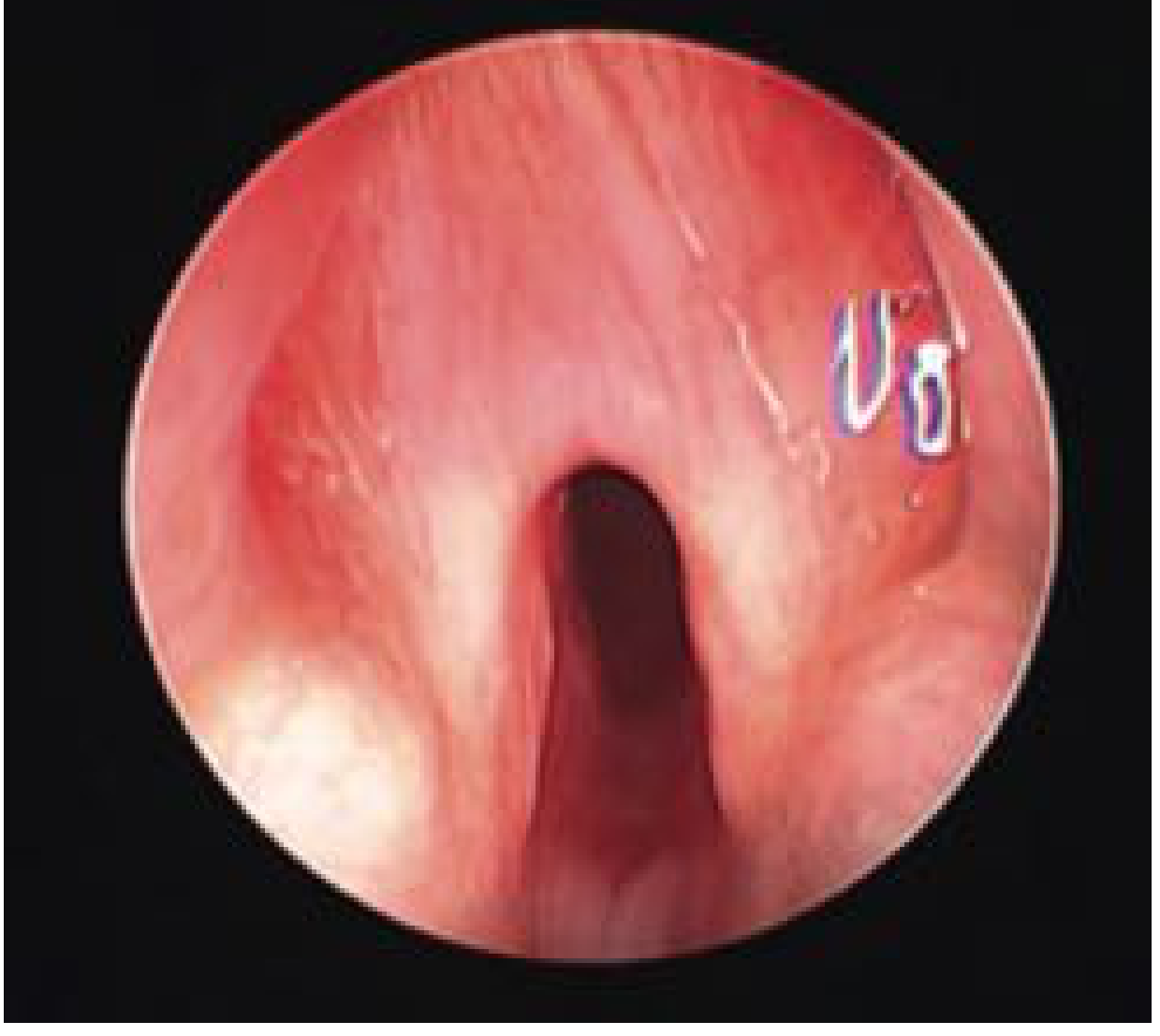
Endoscopic view of an anterior glottic web - Cummings Otolaryngology
Important genetic note: All children with congenital anterior laryngeal webs should undergo genetic testing for chromosome 22q11.2 deletion (velocardiofacial/DiGeorge syndrome). - Cummings Otolaryngology, Key Points
Essential Investigation Before Any Treatment
Flexible nasopharyngoscopy / laryngoscopy is mandatory to visualize the vocal cords. Without direct visualization, the etiology cannot be confirmed and treatment (Ayurvedic or otherwise) cannot be appropriately targeted.
Ayurvedic Perspective - Swarabheda (स्वरभेद)
In Ayurveda, hoarseness is classified under Swarabheda and described in detail in Charaka Samhita (Rajyakshma Chikitsa), Sushruta Samhita (Uttaratantra Ch. 53), and Ashtanga Hridayam (Chikitsa Sthana Ch. 5).
Nidana (Cause)
Congenital hoarseness corresponds to Sahaja (congenital/Prakriti-ja) Swarabheda - a constitutional/structural voice defect present from birth.
Classical Ayurvedic Medicines Used for Swarabheda
| Medicine | Form | Action |
|---|---|---|
| Lavangadi Vati | Tablet (oral/buccal) | Kaphahara, voice-clearing, anti-inflammatory of throat |
| Gandamala Khandan Ras | Rasa preparation | For glandular/structural throat conditions |
| Marma Gutika / Marma Gutika Lepa | Tablet + topical paste | Classical Kantha (throat) rasayana |
| Khadiradi Vati | Buccal tablet | Throat and voice disorders, Kapha-Pitta |
| Sitopladi Churna | Powder with honey | Kaphahara, voice improvement |
| Talisadi Churna | Powder | Upper respiratory, voice |
| Kanakasava / Vasarishta | Liquid formulation | Respiratory and voice disorders |
Ayurvedic External Therapies
- Nasya (nasal instillation): Anu taila or Shadbindu taila - clears Kapha from Srotas above the neck
- Gandoosha/Kavala (gargling): With Tila taila (sesame oil), Triphala kashaya, or warm salt water
- Dhoomapana (medicated fumigation): Used in classical texts for Swarabheda
Key Texts Reference
The case study published in International Journal of ORL and Head & Neck Surgery documents successful Ayurvedic management of vocal cord growth with Lavangadi Vati + Gandamala Khandan Ras + Marma Gutika Lepa, referencing Vangasen Samhita Chapter 51 (Swarabheda Adhikara) and Chakradutta Chapter 13 (Swarabheda Chikitsa).
Management Plan Summary
Step 1 - Mandatory Diagnostic Workup
- Flexible laryngoscopy (ENT/Pediatric ENT referral) to identify structural cause
- If laryngeal web found: Chromosomal 22q11.2 deletion testing
- Voice assessment (GRBAS scale)
Step 2 - Modern Management (based on cause)
- Thin laryngeal web (Type 1): May not require surgery; voice therapy
- Thick web / VCP / SGS: Surgical correction (laryngoscopic web division, laser, or open reconstruction)
- RRP: Surgical excision (laser) + possibly cidofovir/bevacizumab
Step 3 - Ayurvedic Adjuvant Therapy
(Most appropriate after diagnosis is confirmed; helpful for functional/inflammatory components)
- Lavangadi Vati 1-2 tablets twice daily (dissolved in mouth)
- Khadiradi Vati 1 tablet TDS (sucked slowly)
- Anu Taila Nasya - 2 drops each nostril in morning
- Tila taila kavala (oil pulling/gargling) daily
- Avoid cold, iced, and sour foods (increases Kapha/Vata)
- Avoid shouting and voice misuse (vocal hygiene)
Important Cautions
- Do not treat with Ayurveda alone without a diagnosis - a structural lesion like laryngeal web cannot be resolved with medicines; it requires endoscopic confirmation and possibly surgery.
- If there is any associated stridor, breathing difficulty, or failure to thrive, this is urgent and requires immediate ENT referral.
- Congenital hoarseness for 10 years is unlikely to be inflammatory - structural etiology must be ruled out first.
- After surgical correction (if needed), Ayurvedic rasayana and vocal hygiene measures are excellent adjuvants for voice rehabilitation.
In summary: Hoarseness since birth in a 10-year-old girl most likely represents a congenital laryngeal web or vocal cord anomaly (Sahaja Swarabheda in Ayurveda). A laryngoscopy is essential before starting any treatment. Ayurvedic medicines like Lavangadi Vati, Khadiradi Vati, Anu Taila Nasya, and Tila Taila Kavala can support voice quality, but cannot substitute for structural diagnosis or surgical correction if indicated.
This is a shared conversation. Sign in to Orris to start your own chat.