
adequate mouth opening criteria like whats standard condition to say its normal or abnormal
Normal mouth opening is typically 35-50 mm (roughly 3 finger-breadths) measured between the upper and lower incisal edges. Anything below 35 mm is generally considered restricted, and below 25 mm is severely restricted (relevant for difficult airway/trismus). Let me pull the precise clinical criteria from the medical library.
Searching sources...
Reading File
Finding Sources
Finding Sources
Searching the Web
normal mouth opening criteria mm interincisal distance trismus classification
Now let me pull the detailed content from the Scott-Brown's ENT textbook section on "GAPE" and also the Rheumatology section on mouth opening assessment:
Reading File
Reading File
Let me also fetch that mouth opening image and search for the trismus classification in the Scott-Brown's ENT Vol 2 textbook:
Loading Image
Reading File
I now have comprehensive data from multiple authoritative sources. Here is the full answer:
Mouth Opening - Normal vs. Abnormal Criteria
How It Is Measured
Mouth opening is quantified as Maximal Inter-Incisal Opening (MIO) - the distance between the incisal edges of the upper (maxillary) and lower (mandibular) central incisors, measured with a ruler or calipers in millimetres. In an edentulous patient, you measure between the maxillary and mandibular alveolar crests at the midline.
Normal Values
| Parameter | Value |
|---|---|
| Normal MIO (dentate adults) | 35 - 55 mm |
| Most commonly cited average | ~40-50 mm |
| Finger-breadth equivalent | 3 finger-breadths (fb) |
| Centimetre equivalent | ~5 cm |
| Sex difference | Males tend to have slightly wider opening than females (up to ~60 mm in men) |
- Scott-Brown's Otorhinolaryngology Head & Neck Surgery Vol 1 states: "Normal values are 3fb or 5cm."
- Normal lateral movement is 8-12 mm, and protrusive movement is approximately 10 mm.
Abnormal / Restricted Opening (Trismus)
The widely accepted clinical threshold is < 35 mm = trismus (restricted mouth opening).
Severity Classification
| Grade | MIO | Clinical Significance |
|---|---|---|
| Normal | 35 - 55 mm (3 fb) | No restriction |
| Mild restriction | 20 - 30 mm (2 fb) | Limited; some difficulty |
| Moderate restriction | 10 - 20 mm | Significant difficulty eating, speaking |
| Severe restriction | < 10 mm (< 1 fb) | Near-complete restriction; emergency concern |
- Scott-Brown's notes: "A mouth opening of 2 fb is limited and 1 fb is severely limited, making direct laryngoscopy very difficult."
- Inserting a laryngeal mask airway becomes very difficult when gape is < 2 cm.
- For airway management, a gape of < 3.5 cm combined with class C jaw slide indicates the greatest intubation difficulty.
Context-Specific Thresholds
Different clinical contexts use slightly different cut-offs:
| Context | Threshold Used |
|---|---|
| Head & neck cancer / radiotherapy | < 35 mm = trismus (most validated) |
| Odontogenic infections | < 30 mm can be consistent with significant infection |
| Airway / emergency medicine | < 2 cm = contraindication to some channel-guided devices; < 3.5 cm = difficult direct laryngoscopy |
| Anaesthesia | Part of combined scoring with Mallampati, thyromental distance, and neck mobility |
The Quick 3-Finger Test (Bedside Method)
A simple bedside screen: ask the patient to place 3 fingers (index, middle, ring) vertically between their upper and lower incisors. If all 3 fit comfortably, mouth opening is normal. If only 2 or 1 fit, opening is limited or severely limited respectively.
What Can Cause Restricted Mouth Opening?
| Category | Examples |
|---|---|
| Muscular | Masticatory muscle spasm, myositis, infection involving pterygoid muscles |
| TMJ | Ankylosis, disc displacement, osteoarthritis, RA |
| Dental/oral | Pericoronitis (especially wisdom teeth), dental abscess, odontogenic infection |
| Post-treatment | Radiation fibrosis (head & neck cancer), surgical scarring |
| Neurological | Tetanus (classic "lockjaw"), trigeminal nerve pathology |
| Systemic | Systemic sclerosis (scleroderma), psoriatic arthropathy |
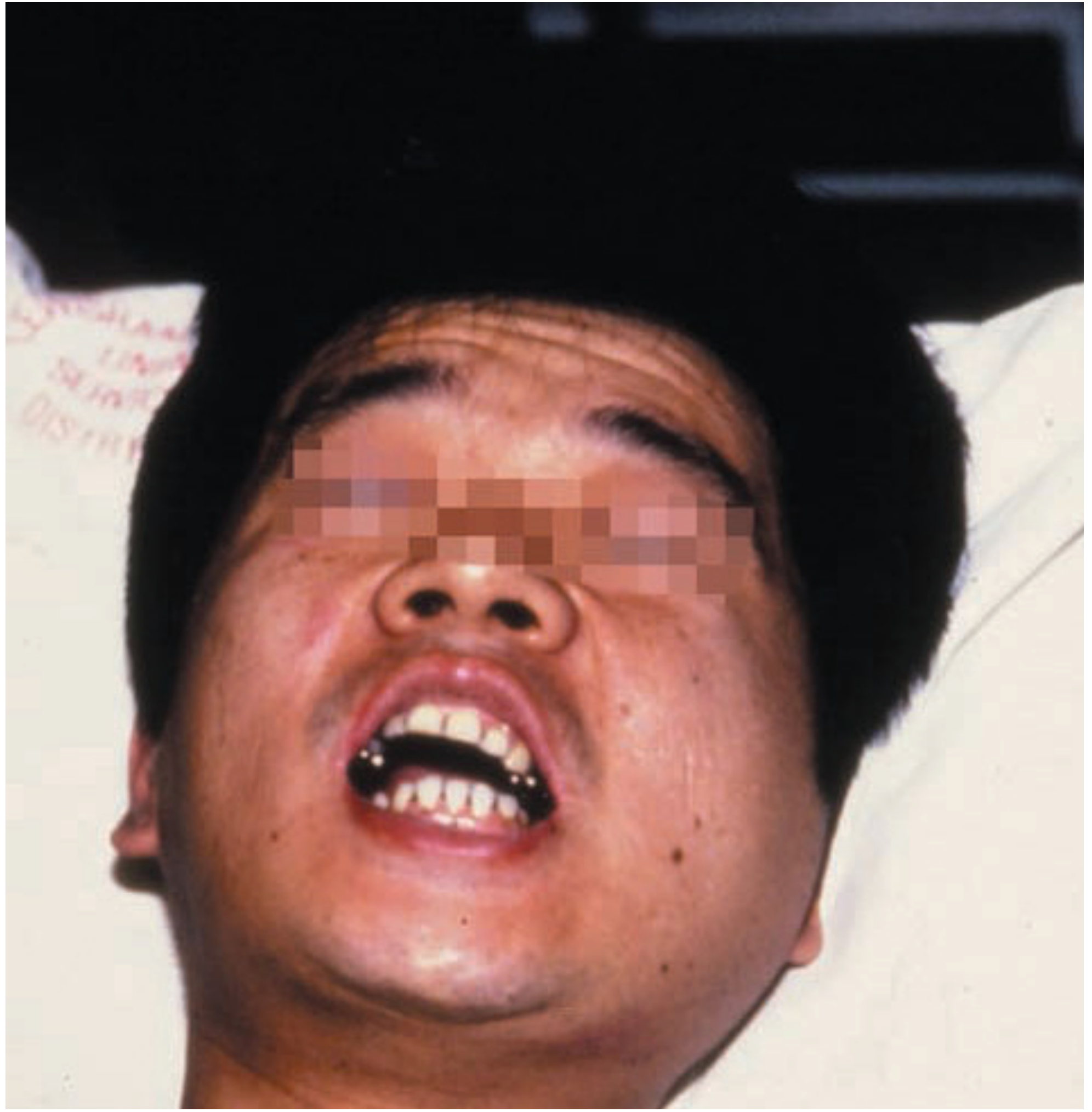
The image below shows limited mouth opening due to a dental abscess - note how the inter-incisal gap is markedly reduced:
Key Takeaway
- Normal: 35-55 mm (3 finger-breadths, ~5 cm)
- Restricted (trismus): < 35 mm
- Severely restricted: < 20 mm (important for airway management decisions)
- Always consider the clinical context - the same MIO can be functionally significant in one setting (e.g. radiotherapy follow-up) and less so in another.
Sources: Scott-Brown's Otorhinolaryngology Head & Neck Surgery (Vol 1, p.359); Rheumatology 2022 (Elsevier); Roberts & Hedges' Clinical Procedures in Emergency Medicine; Barash Clinical Anesthesia 9e; StatPearls - Trismus; JCDA Trismus Management
This is a shared conversation. Sign in to Orris to start your own chat.