
Hiii I am preparing for exam of Plastic Surgery and I am giving you the name of topic and you will give me following and remember, add as much images as possible and also use standard books and in the end crisp point or crux flow chart of management. Now the sequence you will give me is first demography mention if any most common or least common thing is there , causes like genetic and environmental, clinical features and any classification based on etiology or features, with whichever investigation needed, tell about when to do it and when not to do it and also specific finding images then different surgery and it’s diagram then indications contraindications limitations and surgical steps and try as much as images use standard books and try to explain things and take simplest things in count and also add specific investigation or any other charts are there add them AND THE TOPIC IS Hypospadias
hypospadias surgical repair techniques outcomes
🔬 HYPOSPADIAS - Complete Exam Guide for Plastic Surgery
Sources: Campbell-Walsh Urology (5th Ed), Bailey & Love's Surgery (28th Ed), Hinman's Atlas of Urologic Surgery, The Developing Human (Moore & Persaud), Schwartz's Principles of Surgery
1. DEMOGRAPHY & EPIDEMIOLOGY
| Parameter | Fact |
|---|---|
| Incidence | 1 in 125-300 male live births |
| Most common congenital abnormality | Of the urethra (MOST COMMON) |
| Most common type | Glanular hypospadias |
| Distal types | Account for ~70% of all cases |
| Glanular + Penile | ~80% of all cases together |
| Least common / most severe | Perineal hypospadias |
| Perineal type | Only 1% - associated with bifid scrotum + ambiguous genitalia |
| Familial risk | Father affected → 8% risk in son; sibling affected → 14% risk |
| Trend | Incidence increasing in developed countries (possible endocrine disruptor link) |
Exam crux: Hypospadias is the MOST COMMON congenital urethral anomaly. Glanular type = MOST COMMON. Perineal = LEAST COMMON but MOST SEVERE.
2. EMBRYOLOGY & PATHOGENESIS
- Urethral folds fuse in the midline (ventral) under androgen stimulation between weeks 8-16 of gestation
- The spongy (penile) urethra forms by fusion of urethral folds
- The glanular urethra forms separately by canalization of the ectodermal cord
- Complete development depends on testosterone and its conversion to DHT (5-alpha reductase)
- Failure of canalization of the ectodermal cord in the glans (→ glanular hypospadias)
- Failure of fusion of the urethral folds (→ penile/proximal hypospadias)
- Both mechanisms together → complete ventral hypoplasia with chordee
3. ETIOLOGY
Genetic Factors
- Polygenic/multifactorial inheritance pattern
- Associated genes: SRD5A2 (5-alpha reductase 2), AR (androgen receptor), ATF3, MAMLD1, FGF8, FGF10, BMP7, MID1, CXorf6
- Monozygotic twins: 18% concordance (not 100% → environmental component)
- Family history present in ~7-10% of cases
Hormonal/Endocrine Factors
- Inadequate androgen production by fetal testes
- Inadequate androgen receptor sensitivity (partial androgen insensitivity)
- 5-alpha reductase deficiency → inability to convert T → DHT
- Maternal progestagen/estrogen exposure during pregnancy
Environmental Factors (Endocrine Disruptors)
- Pesticides (DDT, DDE, vinclozolin) - anti-androgenic
- Phthalates (plastics industry)
- Phytoestrogens (soy-based foods)
- Maternal obesity, preeclampsia, placental insufficiency
- ART (Assisted Reproductive Techniques) - doubles the risk
- Low birth weight / prematurity
Associated Conditions (exam favourite!)
| Condition | Association |
|---|---|
| Cryptorchidism | 9% of hypospadias cases |
| Inguinal hernia | 9% of cases |
| Disorders of Sex Development (DSD) | Severe hypospadias + cryptorchidism = investigate for DSD |
| CAH | Perineal hypospadias in virilized females |
EXAM KEY: If perineal hypospadias + bilateral cryptorchidism + micropenis → ALWAYS investigate for DSD/intersex
4. CLINICAL FEATURES - THE TRIAD
| Feature | Description |
|---|---|
| 1. Ectopic meatus | Ventrally placed urethral meatus, proximal to normal position |
| 2. Ventral chordee | Ventral penile curvature due to fibrous tissue replacing spongiosum |
| 3. Dorsal hood / incomplete prepuce | Foreskin present dorsally but absent ventrally (hooded foreskin) |
Note: In mild distal cases, chordee may be absent. The meatus + hooded foreskin may be the only findings.
Additional Features
- Incomplete foreskin (dorsal hood)
- Bifid scrotum (severe cases)
- Penoscrotal transposition (severe cases)
- Urethral dimple / blind pit at normal meatal site
- Downward deflection of urinary stream
- Spraying of urine (40-50%)
- Post-void dribbling (20-40%)
5. CLASSIFICATION
Anatomical / By Meatal Position (Most Used)
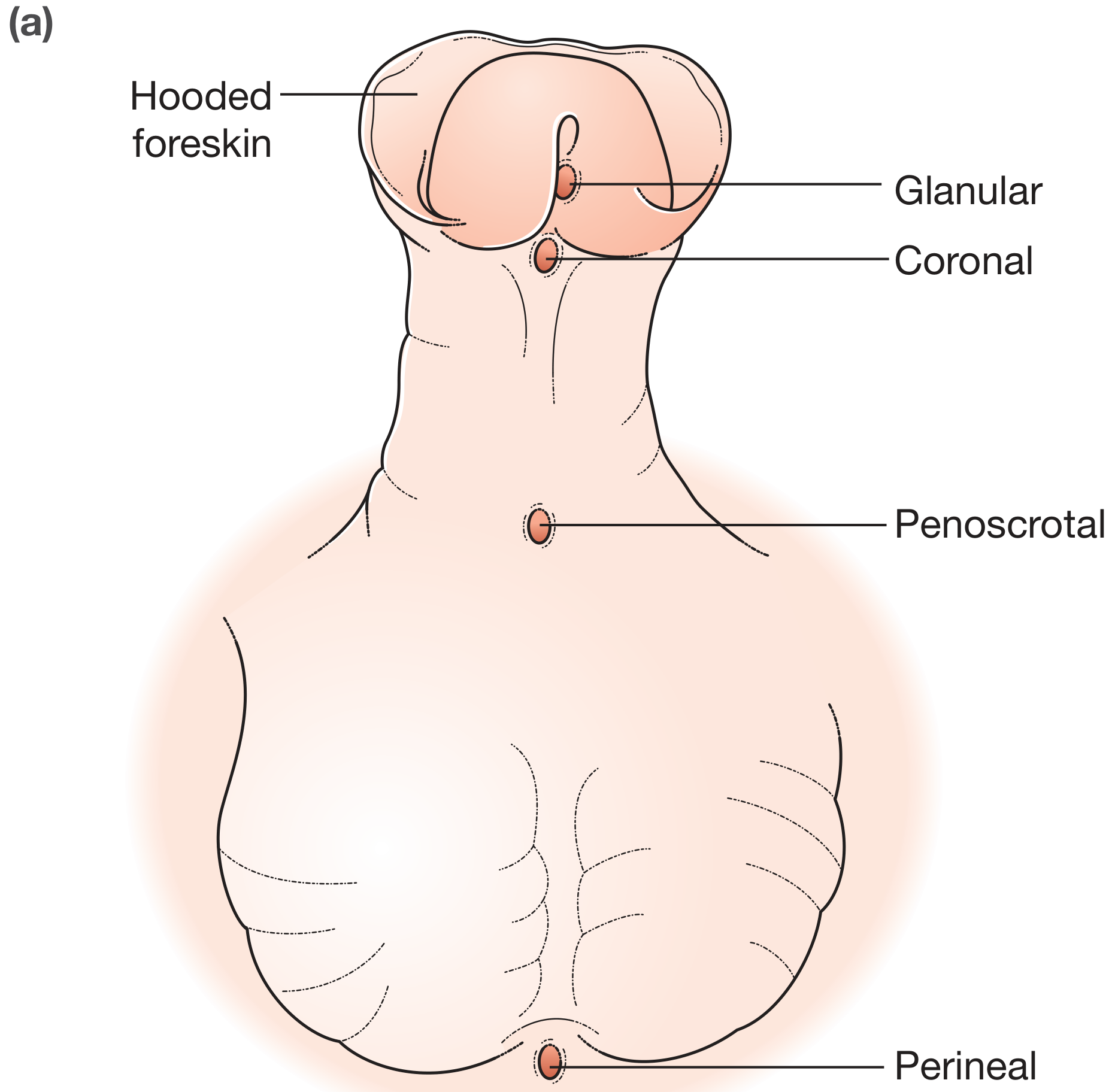
| Type | Meatal Position | Frequency |
|---|---|---|
| Glanular | On glans, proximal to normal site | Most common |
| Coronal | At coronal sulcus | Common |
| Penile (Mid-shaft) | Under penile shaft | Moderate |
| Penoscrotal | At penoscrotal junction | Less common |
| Scrotal | On scrotum (bifid scrotum) | Rare |
| Perineal | Between scrotal halves | Least common |
Simplified Clinical Classification
| Group | Types Included | Surgery |
|---|---|---|
| Anterior (Distal) ~70% | Glanular, Coronal, Distal penile | Often single-stage |
| Middle ~10% | Mid-shaft penile | Single-stage possible |
| Posterior (Proximal) ~20% | Penoscrotal, Scrotal, Perineal | Often two-stage |
Barcat Classification (for severity)
| Grade | Position |
|---|---|
| Grade I | Glanular / Coronal |
| Grade II | Distal penile / Mid-penile |
| Grade III | Proximal penile / Penoscrotal |
| Grade IV | Scrotal / Perineal |
6. CLINICAL PHOTOGRAPHS
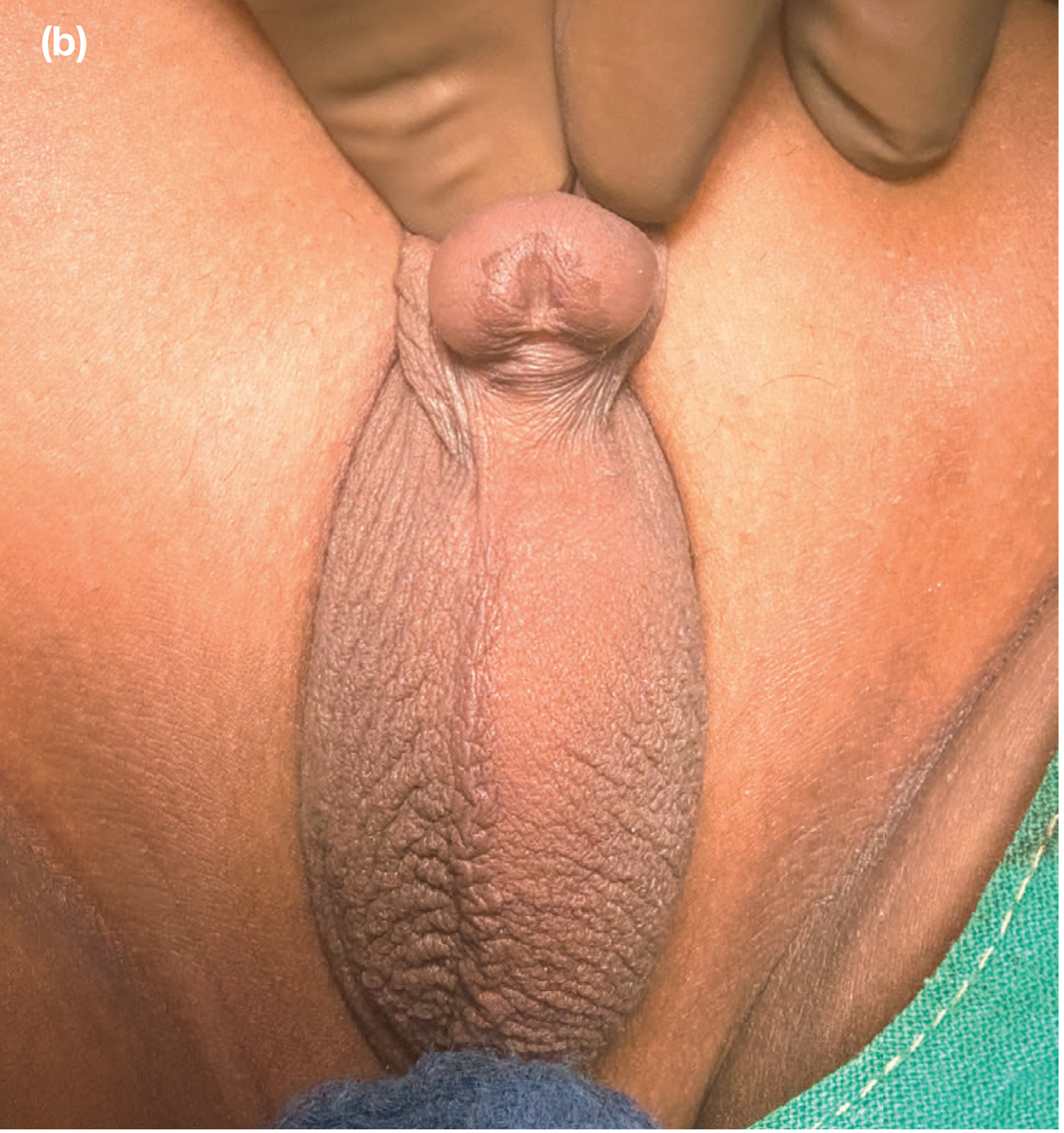
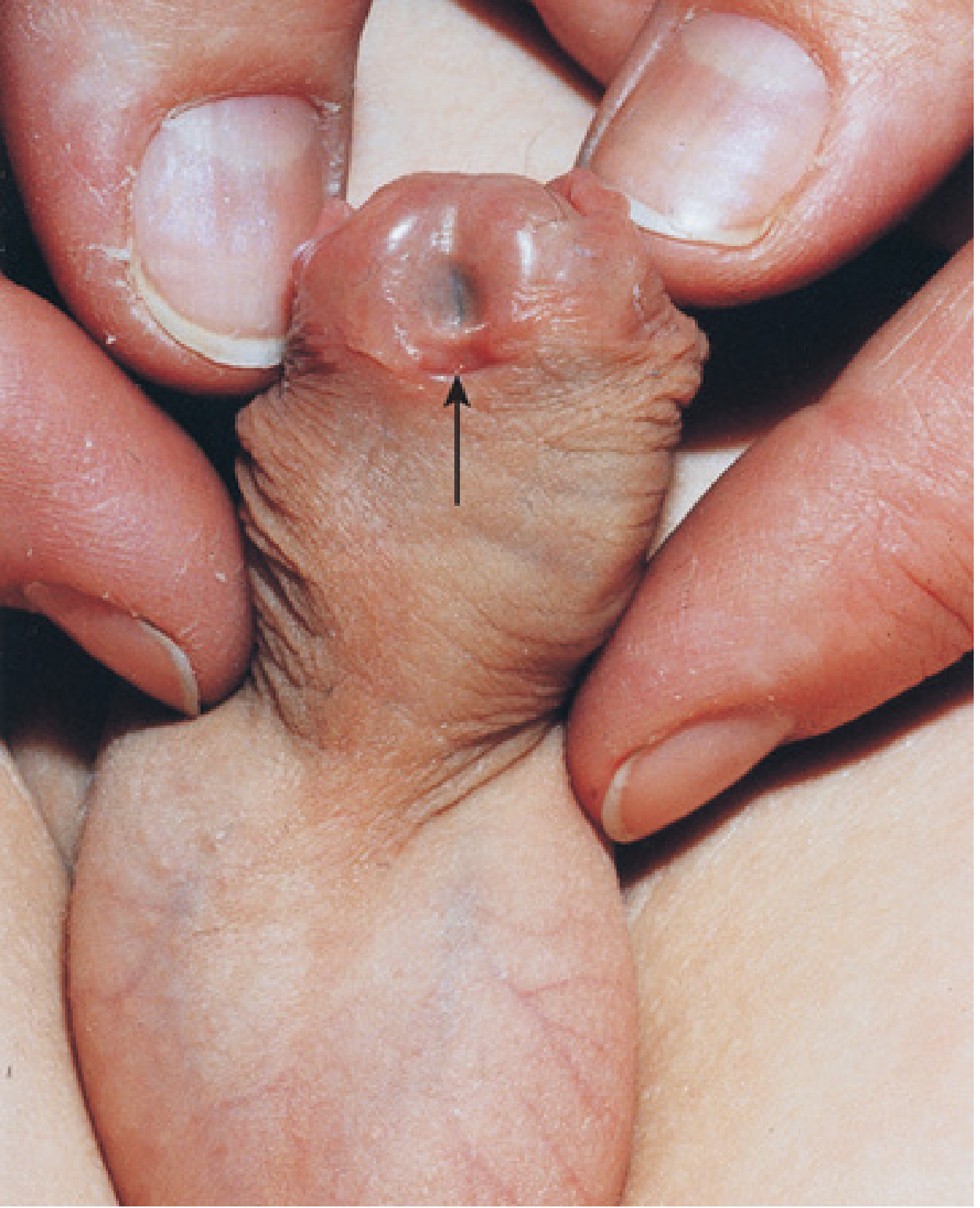
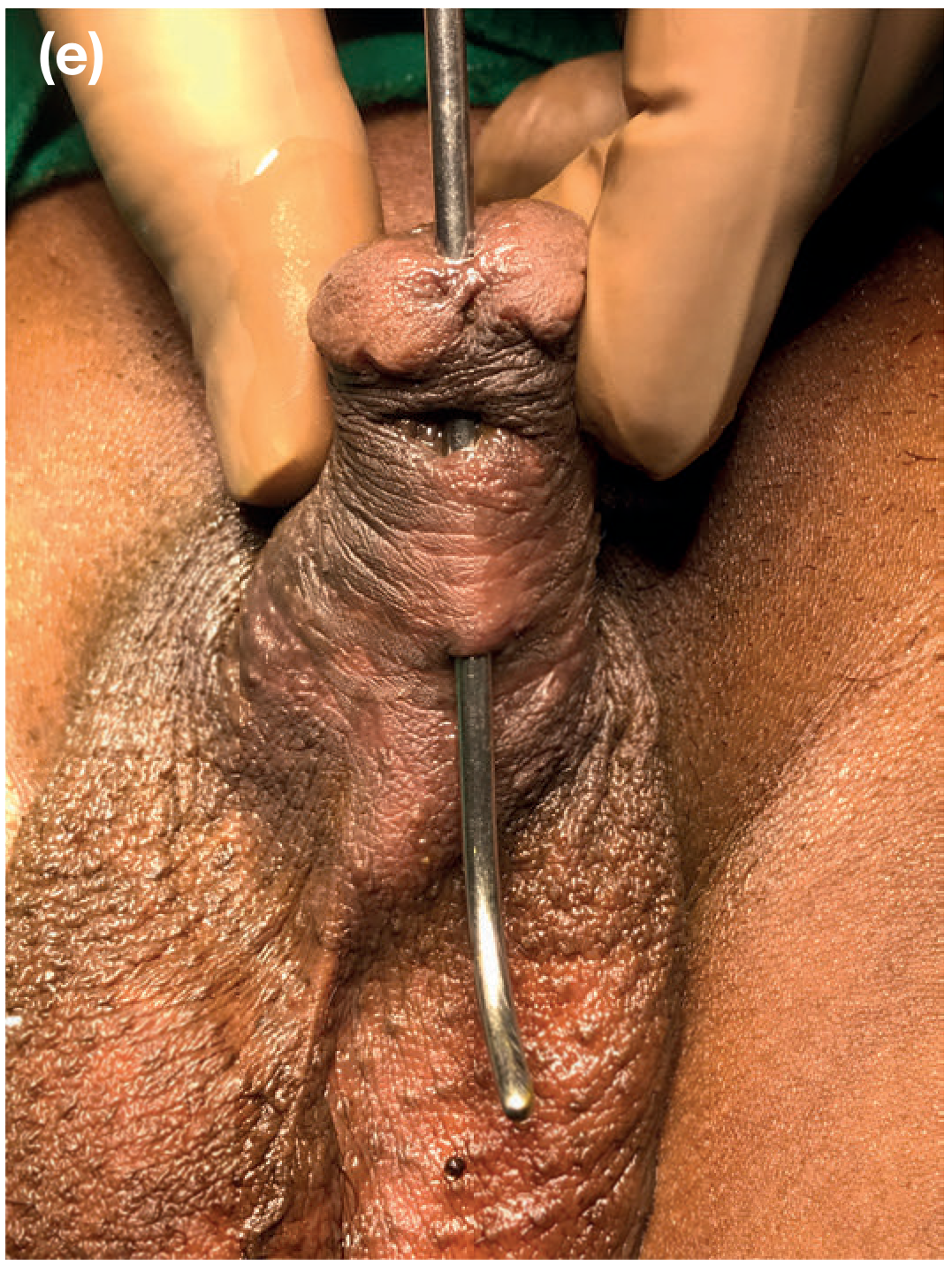
7. INVESTIGATIONS
When to Investigate?
- Diagnosis is purely clinical - NO investigations needed routinely
- Physical examination is sufficient
| Indication | Investigation | Rationale |
|---|---|---|
| Severe hypospadias (penoscrotal/perineal) | Karyotype (chromosomal analysis) | Rule out DSD |
| Perineal hypospadias + bilateral cryptorchidism | Karyotype + pelvic USS | Rule out 46,XX CAH or gonadal dysgenesis |
| Micropenis + severe hypospadias | LH, FSH, testosterone, DHT, 17-OH progesterone | Endocrine workup |
| Any suspicion of DSD | FISH for SRY, estrogen, androgens | Intersex evaluation |
| Recurrent UTI / poor stream | MCUG (voiding cystourethrogram) | Rule out reflux / stricture |
| Pre-operative workup (proximal cases) | RGU (retrograde urethrogram) / MCUG | Assess urethral anatomy |
| Post-operative evaluation | Uroflowmetry | Assess voiding function |
| Failed repair / fistula | RGU + MCU | Assess recurrence, stricture |
Specific Investigations Table
| Investigation | Finding in Hypospadias | When to Do |
|---|---|---|
| Clinical Exam | Ventral meatus + hooded foreskin + chordee | ALWAYS first |
| Karyotype | 46,XX → DSD; 46,XY → confirmed male | Perineal/scrotal type |
| Serum 17-OHP | Elevated in CAH | Ambiguous genitalia |
| Testosterone + DHT ratio | >20:1 ratio → 5-alpha reductase deficiency | Small phallus + hypospadias |
| Pelvic USS | Mullerian structures (uterus?) | DSD workup |
| RGU/MCU | Shows urethral anatomy, strictures | Pre/post-op in proximal cases |
| Uroflowmetry | Reduced flow, prolonged void | Post-operative follow-up |
| HCG stimulation test | Assess testosterone response | Micropenis / undescended testes |
When NOT to Investigate
- Distal glanular or coronal hypospadias with no associated anomalies - no workup needed
- Isolated hypospadias without ambiguous genitalia or cryptorchidism - clinical diagnosis only
8. PREOPERATIVE CONSIDERATIONS
Key Rules Before Surgery
- NEVER CIRCUMCISE a child with hypospadias - preputial skin is the most valuable graft material
- Correct age: 6-18 months is the optimal window (before toilet training, penile development)
- Most surgeons prefer 6-12 months
- Anesthetic risk is acceptable after 6 months
- Magnification (2.5x-3.5x loupes or operating microscope) is mandatory
- Preoperative testosterone cream/DHT cream (topical) for 4-6 weeks may enlarge a small phallus
- Assess: meatal position, urethral plate quality, degree of chordee, foreskin amount
Hormonal Priming (Preoperative)
- Topical DHT or testosterone applied for 4-6 weeks pre-op
- Used for small phallus or in proximal cases
- Systemic HCG or testosterone for severe micropenis
- A 2024 systematic review (PMID 38739164) confirmed benefit of topical estrogen / hormone priming in hypospadias management
9. SURGICAL PRINCIPLES - GOALS OF REPAIR
- Orthotopic meatus - vertical slit at tip of glans
- Straight penis - correction of chordee
- Normal voiding - forward, non-deflected stream
- Cosmetically normal appearance
- Normal sexual function in adulthood
- Low complication rate - fistula rate <5% is the benchmark
10. SURGICAL TECHNIQUES
OVERVIEW: Which technique for which type?
| Type of Hypospadias | Preferred Repair |
|---|---|
| Glanular (meatal advancement possible) | MAGPI or Urethromeatoplasty |
| Coronal / Distal penile - good urethral plate | TIP (Snodgrass) - GOLD STANDARD |
| Distal - wide plate, no chordee | Thiersch-Duplay (Tubularization) |
| Distal - parameatal skin available | Mathieu (Flip-Flap) |
| Mid/proximal - intact urethral plate | TIP or Onlay Island Flap (OIF) |
| Proximal with chordee - needs plate division | Two-stage Bracka/Byars repair |
| Severe - inadequate local tissue | Buccal mucosa graft (staged) |
| Failed/redo cases | Buccal mucosa graft / staged repair |
A. MAGPI (Meatal Advancement and Glanuloplasty Incorporated)
- Transverse incision distal to meatus (Heineke-Mikulicz principle)
- Close transversely to advance meatus distally
- Dorsal skin bridge excised
- Glanular wings approximated to create conical glans
B. TIP REPAIR (Tubularized Incised Plate) - SNODGRASS
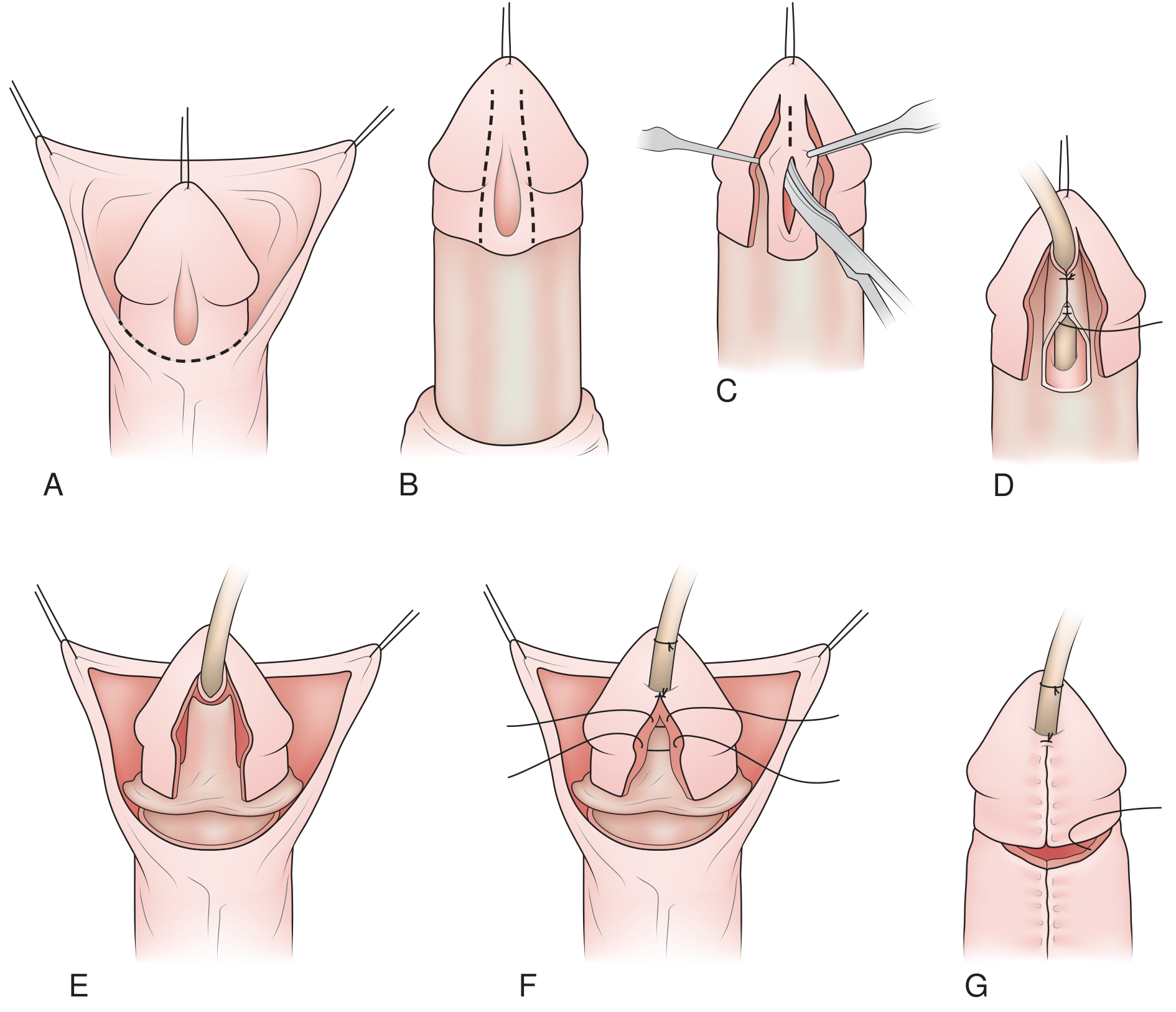
- A - Circumscribing skin incision around hypospadiac meatus, preserving urethral plate
- B - Penile degloving - skin retracted proximally, chordee assessed
- C - Deep midline incision of urethral plate to underlying corporal bodies (the KEY step - widens the plate)
- D - Tubularization - plate rolled into tube over catheter using 7-0 PDS running sutures; first stitch ~3mm proximal to meatal end (creates oval opening)
- E - Dartos flap cover - pedicled dartos/subcutaneous flap interposed between neourethra and skin (reduces fistula risk - WATERPROOFING LAYER)
- F - Glansplasty - glans wings approximated over neourethra creating neo-meatus at tip
- G - Skin closure + circumcision or preputioplasty
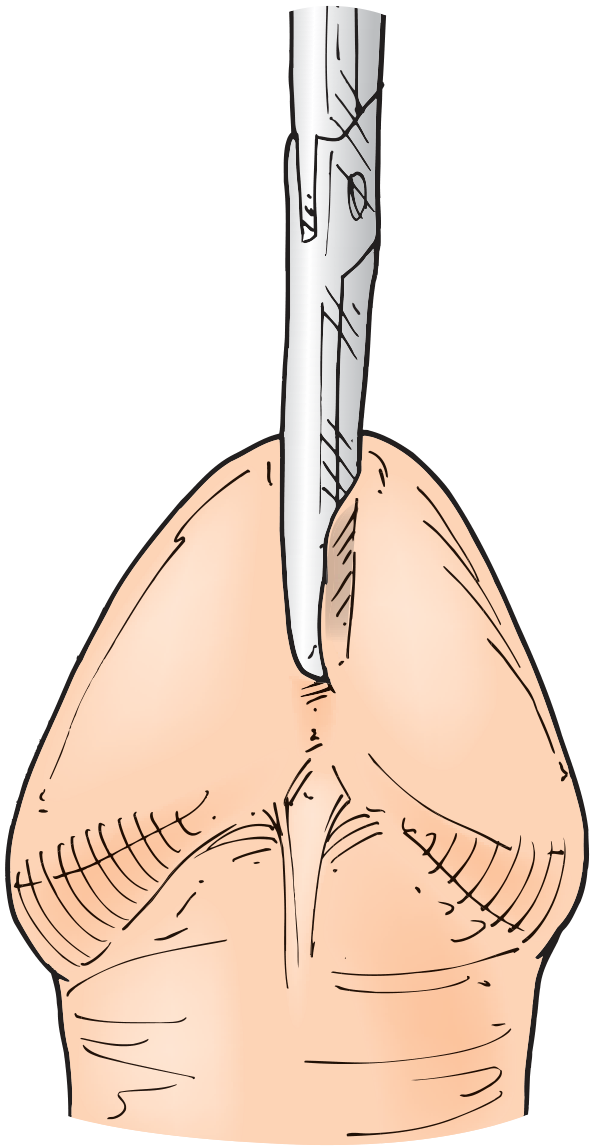
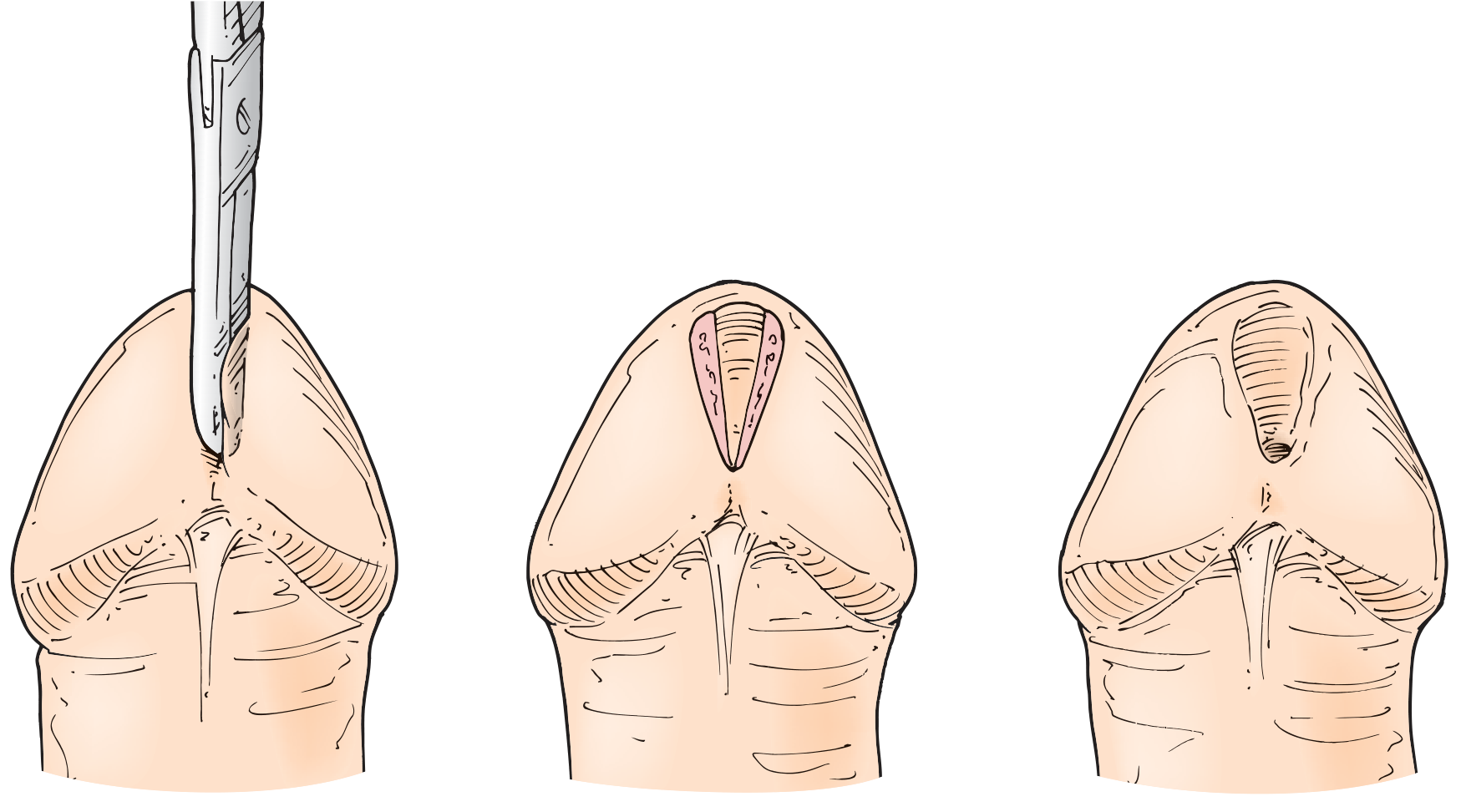
- Most cosmetically normal meatus (vertical slit)
- Single-stage
- No graft/flap needed in distal cases
- 90%+ used for distal hypospadias in surveys
- Requires a GOOD, flat, wide urethral plate
- If plate is narrow/stenotic → risk of meatal stenosis
- Long TIP repair (penoscrotal) → HIGH RESISTANCE neourethra → prolonged voiding, poor flow
- Not ideal for proximal hypospadias with severe chordee
- Severe chordee requiring urethral plate division
- Very narrow or scarred urethral plate
- Redo cases with scarred tissues
C. MATHIEU (FLIP-FLAP) REPAIR
- Parameatal-based proximal flap raised (equal in length to deficient urethra)
- Flap FLIPPED (rotated 180°) onto ventral glans over urethral plate
- Flap and plate edges sutured together distally
- Creates neo-meatus at tip
D. ONLAY ISLAND FLAP (OIF) / DUCKETT
- Inner preputial skin island flap raised on vascular pedicle (dartos)
- Flap transposed ventrally and sutured as an ONLAY onto the retained urethral plate (augments width)
- Glansplasty performed
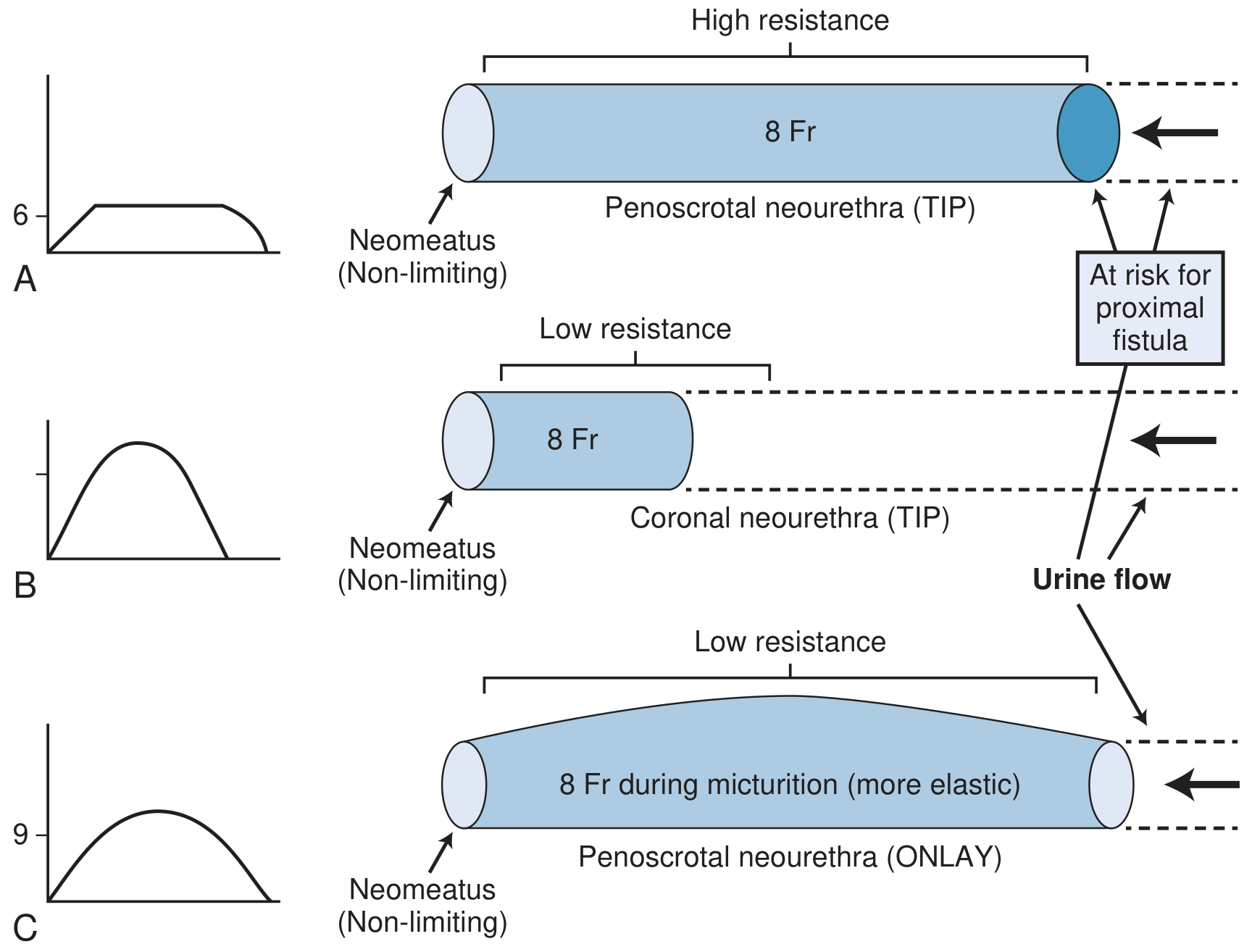
E. TRANSVERSE PREPUTIAL ISLAND FLAP (TPIF) / DUCKETT TUBE
- Penile degloving + artificial erection to assess curvature
- Transverse preputial inner skin island harvested on dartos pedicle
- Island flap TUBULARIZED into a neourethra
- Anastomosed to native proximal urethra
- Transposed ventrally through buttonhole in pedicle
- Glansplasty completed
F. TWO-STAGE REPAIR (BRACKA / BYARS)
- Full penile degloving
- Chordee correction - division of urethral plate + division of fibrous tissue
- Multiple ventral corporotomies if needed (corporal lengthening)
- BRACKA: Buccal mucosa graft (BMG) or inner prepucial graft laid on ventral surface and quilted
- BYARS: Dorsal prepucial skin transposed ventrally as pedicled flaps sutured in midline
- Penis allowed to heal for minimum 6 months
- U-shaped (Thiersch-Duplay) incision around neourethral template
- Tubularize the graft/flap into neourethra over catheter
- Multilayer closure with dartos cover
- Glansplasty
G. THIERSCH-DUPLAY TUBULARIZATION
- U-incision around urethral plate
- Plate edges rolled into tube over catheter
- Closed in 2 layers with dartos cover
- Glansplasty
H. BUCCAL MUCOSA GRAFT (BMG)
11. CHORDEE CORRECTION
| Degree of Curvature | Management |
|---|---|
| < 30° | Dorsal plication (Nesbit/modified) |
| 30-60° | Extensive dorsal plication OR corporotomy |
| > 60° | Multiple ventral corporotomies + graft; plate MUST be divided; two-stage preferred |
12. POSTOPERATIVE CARE
| Element | Detail |
|---|---|
| Catheter | 6-Fr silicone "drip stent" sutured to glans |
| Duration | 7-10 days (distal), 10-14 days (proximal) |
| Dressing | Tegaderm/Op-Site wrapped compressively |
| Antibiotics | Co-trimoxazole prophylaxis during catheterization |
| Diaper | Double-diaper technique (catheter drains into outer diaper) |
| Bathing | Avoided 2-4 days; then sitz baths |
| Follow-up | 3-6 months minimum; uroflowmetry at follow-up |
13. COMPLICATIONS
Most Common Complication: Urethrocutaneous Fistula (~10%)
| Complication | Incidence | Time of Presentation |
|---|---|---|
| Urethrocutaneous fistula | ~10% | Weeks-months post-op |
| Meatal/urethral stenosis | 5-10% | Weeks-years post-op |
| Glans dehiscence | 5-10% | Early post-op |
| Urethral stricture | Variable | Months-years |
| Urethral diverticulum | Commoner with OIF/TPIF | Months-years |
| Chordee recurrence | 5-30% (proximal) | At puberty |
| Hair in urethra | If scrotal skin used | Puberty |
| Erectile dysfunction | ~25% in adulthood | Adulthood |
| Ejaculatory dysfunction | ~37% | Adulthood |
Most common complication = Urethrocutaneous Fistula Most common site of fistula = at original meatal site or coronal margin
14. INDICATIONS / CONTRAINDICATIONS / TIMING SUMMARY
Indications for Surgery
- All hypospadias except the most minor glanular type
- Functional: poor urinary stream direction, spraying, incomplete emptying
- Cosmetic: abnormal penile appearance
- Psychological: normal appearance for peer development
- Sexual: to enable normal penetrative intercourse
When NOT to Operate
- Isolated minor glanular hypospadias with normal meatus caliber and no chordee (relative)
- Very small phallus → operate only after hormonal priming
- Active local infection
- Before 6 months of age (anesthetic risk)
- In a major syndromic child where surgery adds undue risk
TIMING - Optimal Window
- 6-18 months is universally accepted optimal window
- Before toilet training (typically before 2 years)
- Before psychological awareness of genital differences (~18 months)
- NEVER circumcise before repair
15. KEY EXAM FLOWCHART - MANAGEMENT OF HYPOSPADIAS
NEWBORN MALE → CLINICAL DIAGNOSIS (Ventral meatus + Hooded foreskin + Chordee)
↓
┌──────────────┴──────────────┐
DISTAL (70%) PROXIMAL (30%)
Glanular/Coronal Penoscrotal/Perineal
│ │
No workup needed INVESTIGATE:
• Karyotype
• Hormone panel
• Pelvic USS
• Rule out DSD
│ │
↓ ↓
AVOID CIRCUMCISION ←──── In ALL cases ────→ AVOID CIRCUMCISION
│ │
↓ ↓
Hormonal priming Hormonal priming
if small phallus MANDATORY
│ │
↓ ↓
OPERATE AT 6-18 months OPERATE AT 6-18 months
│ │
↓ ↓
Good urethral plate? Good urethral plate?
Minimal chordee? Severe chordee?
│ │
↓ ↓
TIP (SNODGRASS) ← GOLD STANDARD Two-Stage Repair
[90% of distal repairs] (Bracka BMG or Byars)
│ │
If OIF needed (proximal Stage 1: Chordee correction
but plate OK): ONLAY FLAP + graft/flap placement
│ (wait 6 months)
↓ │
POST-OP: Stage 2: Tubularization
Catheter 7-10 days + Glansplasty
Antibiotics prophylaxis
Uroflowmetry at follow-up
│
↓
COMPLICATION? (10% fistula, 5-10% stenosis)
│
↓
Wait 6 months → Redo/Fistula closure
(Buccal mucosa graft for major redo)
16. CRISP POINT SUMMARY (Exam Crux)
| # | High-Yield Point |
|---|---|
| 1 | Hypospadias = MOST COMMON congenital urethral anomaly (1:300 males) |
| 2 | Glanular = most common type; Perineal = least common, most severe |
| 3 | Classic triad: Ventral meatus + Hooded foreskin + Chordee |
| 4 | Etiology: Inadequate androgen (T/DHT) effect on urethral folds/ectoderm |
| 5 | Genes: SRD5A2, AR, MAMLD1 most important |
| 6 | Perineal + bilateral cryptorchidism → DSD workup (karyotype mandatory) |
| 7 | NEVER circumcise - prepuce = future graft material |
| 8 | Optimal surgical age = 6-18 months |
| 9 | TIP (Snodgrass) = Gold standard for distal hypospadias |
| 10 | TIP key step = Midline incision of urethral plate (widens it) |
| 11 | Dartos flap = waterproofing layer over neourethra (reduces fistula) |
| 12 | Most common complication = Urethrocutaneous fistula (~10%) |
| 13 | Proximal + severe chordee → Two-stage repair (Bracka BMG or Byars) |
| 14 | Fistula management: wait 6 months then surgical closure |
| 15 | Buccal mucosa graft = graft of choice for redo/salvage |
| 16 | Artificial erection test done intra-operatively to assess chordee |
| 17 | Chordee > 60° → corporal lengthening + two-stage |
| 18 | Post-op follow-up includes uroflowmetry |
| 19 | ART (IVF) doubles hypospadias risk |
| 20 | Onlay Island Flap → risk of urethral diverticulum (elastic preputial skin) |
- Topical estrogen/hormone priming systematic review 2024 - supports pre-op hormonal priming for small phallus (PMID: 38739164)
- Oral mucosa graft outcomes 2025 - confirms good post-pubertal outcomes for buccal mucosa urethral reconstruction (PMID: 39945907)
- Platelet-rich plasma in hypospadias repair meta-analysis 2026 - emerging adjunct to reduce fistula risk (PMID: 42001334)
- TIP repair: interrupted vs continuous sutures meta-analysis 2026 - interrupted sutures may have lower fistula rate (PMID: 42240839)
Can you make pdf of above content
mkdir -p /home/daytona/workspace/hypospadias-pdf && ls /home/daytona/workspace/
~/hypospadias-pdf/hypospadias.html
<!DOCTYPE html>
<html lang="en">
<head>
<meta charset="UTF-8">
<title>Hypospadias - Complete Exam Guide for Plastic Surgery</title>
<style>
@import url('https://fonts.googleapis.com/css2?family=Roboto:wght@400;700&family=Roboto+Slab:wght@700&display=swap');
* { box-sizing: border-box; margin: 0; padding: 0; }
body {
font-family: 'Roboto', Arial, sans-serif;
font-size: 10.5pt;
color: #1a1a1a;
background: #fff;
line-height: 1.55;
}
/* ── Cover Page ── */
.cover {
width: 100%; height: 100vh;
background: linear-gradient(135deg, #0d3b6e 0%, #1a6fa8 55%, #2ec4b6 100%);
display: flex; flex-direction: column;
align-items: center; justify-content: center;
page-break-after: always;
padding: 40px;
text-align: center;
}
.cover .badge {
background: rgba(255,255,255,0.15);
border: 2px solid rgba(255,255,255,0.4);
border-radius: 30px;
padding: 6px 22px;
color: #fff;
font-size: 10pt;
letter-spacing: 2px;
text-transform: uppercase;
margin-bottom: 24px;
}
.cover h1 {
font-size: 42pt;
font-weight: 900;
color: #fff;
letter-spacing: 1px;
margin-bottom: 10px;
text-transform: uppercase;
}
.cover h2 {
font-size: 16pt;
font-weight: 400;
color: rgba(255,255,255,0.85);
margin-bottom: 36px;
}
.cover .divider {
width: 80px; height: 4px;
background: #2ec4b6;
border-radius: 2px;
margin: 0 auto 36px;
}
.cover .subtitle {
font-size: 12pt;
color: rgba(255,255,255,0.9);
max-width: 580px;
line-height: 1.7;
margin-bottom: 50px;
}
.cover .sources {
font-size: 9pt;
color: rgba(255,255,255,0.65);
letter-spacing: 0.5px;
}
.cover .icon-row {
display: flex; gap: 18px;
margin-bottom: 30px;
}
.cover .icon-box {
background: rgba(255,255,255,0.15);
border-radius: 12px;
padding: 12px 18px;
color: #fff;
font-size: 9pt;
text-align: center;
}
/* ── Content ── */
.content { padding: 28px 36px; }
/* Section headers */
.section-header {
background: linear-gradient(90deg, #0d3b6e, #1a6fa8);
color: #fff;
padding: 10px 18px;
border-radius: 6px;
font-size: 14pt;
font-weight: 700;
margin: 30px 0 14px;
letter-spacing: 0.5px;
page-break-after: avoid;
}
.section-header .num {
background: rgba(255,255,255,0.2);
border-radius: 50%;
display: inline-block;
width: 28px; height: 28px;
text-align: center;
line-height: 28px;
font-size: 11pt;
margin-right: 10px;
}
h3 {
color: #0d3b6e;
font-size: 12pt;
margin: 18px 0 8px;
border-left: 4px solid #2ec4b6;
padding-left: 10px;
page-break-after: avoid;
}
h4 {
color: #1a6fa8;
font-size: 11pt;
margin: 14px 0 6px;
page-break-after: avoid;
}
p { margin-bottom: 8px; }
/* Tables */
table {
width: 100%;
border-collapse: collapse;
margin: 12px 0 18px;
font-size: 9.5pt;
page-break-inside: avoid;
}
th {
background: #0d3b6e;
color: #fff;
padding: 7px 10px;
text-align: left;
font-weight: 700;
}
td {
padding: 6px 10px;
border-bottom: 1px solid #dde4ee;
vertical-align: top;
}
tr:nth-child(even) td { background: #f0f5fb; }
tr:hover td { background: #e3edf8; }
/* Highlight boxes */
.highlight-box {
background: #e8f4fd;
border-left: 5px solid #1a6fa8;
padding: 12px 16px;
border-radius: 0 8px 8px 0;
margin: 12px 0;
font-size: 10pt;
}
.highlight-box.danger {
background: #fff3f3;
border-left-color: #d32f2f;
}
.highlight-box.success {
background: #f0fff4;
border-left-color: #2e7d32;
}
.highlight-box.warning {
background: #fffde7;
border-left-color: #f9a825;
}
.highlight-box strong { display: block; margin-bottom: 4px; font-size: 10.5pt; }
/* Exam crux */
.exam-crux {
background: linear-gradient(135deg, #0d3b6e 0%, #1a6fa8 100%);
color: #fff;
border-radius: 10px;
padding: 16px 20px;
margin: 14px 0;
font-size: 10pt;
}
.exam-crux .crux-title {
font-size: 12pt;
font-weight: 700;
margin-bottom: 8px;
color: #2ec4b6;
letter-spacing: 1px;
}
/* Images */
.img-box {
text-align: center;
margin: 14px 0;
page-break-inside: avoid;
}
.img-box img {
max-width: 90%;
max-height: 340px;
border-radius: 8px;
border: 1px solid #ccd9ea;
box-shadow: 0 2px 8px rgba(0,0,0,0.12);
}
.img-box .caption {
font-size: 8.5pt;
color: #555;
margin-top: 6px;
font-style: italic;
max-width: 85%;
margin-left: auto;
margin-right: auto;
}
.img-row {
display: flex;
gap: 14px;
justify-content: center;
margin: 14px 0;
page-break-inside: avoid;
}
.img-row .img-box { flex: 1; }
/* Bullet lists */
ul, ol { margin: 8px 0 10px 22px; }
li { margin-bottom: 4px; }
/* Flowchart / code block */
.flowchart {
background: #f8f9ff;
border: 1px solid #ccd9ea;
border-radius: 8px;
padding: 16px 20px;
font-family: 'Courier New', monospace;
font-size: 8.5pt;
white-space: pre;
overflow-x: auto;
margin: 14px 0;
line-height: 1.7;
color: #1a1a1a;
}
/* Key points numbered list */
.key-points {
counter-reset: kp;
list-style: none;
margin: 0;
padding: 0;
}
.key-points li {
counter-increment: kp;
display: flex;
align-items: flex-start;
gap: 10px;
padding: 6px 0;
border-bottom: 1px solid #eee;
}
.key-points li::before {
content: counter(kp);
background: #0d3b6e;
color: #fff;
font-weight: 700;
font-size: 9pt;
min-width: 24px; height: 24px;
border-radius: 50%;
display: flex;
align-items: center;
justify-content: center;
flex-shrink: 0;
margin-top: 1px;
}
/* Surgery technique card */
.surgery-card {
border: 1px solid #ccd9ea;
border-radius: 10px;
overflow: hidden;
margin: 16px 0;
page-break-inside: avoid;
}
.surgery-card .card-header {
background: #1a6fa8;
color: #fff;
padding: 9px 16px;
font-weight: 700;
font-size: 11pt;
}
.surgery-card .card-body {
padding: 12px 16px;
background: #fbfcff;
}
/* Steps */
.steps {
counter-reset: step;
list-style: none;
margin: 6px 0;
padding: 0;
}
.steps li {
counter-increment: step;
display: flex;
gap: 10px;
margin-bottom: 6px;
align-items: flex-start;
}
.steps li::before {
content: counter(step);
background: #2ec4b6;
color: #fff;
font-weight: 700;
font-size: 8.5pt;
min-width: 22px; height: 22px;
border-radius: 50%;
display: flex;
align-items: center;
justify-content: center;
flex-shrink: 0;
margin-top: 1px;
}
/* Reference */
.ref-box {
background: #f5f5f5;
border-radius: 8px;
padding: 12px 16px;
font-size: 8.5pt;
color: #555;
margin: 16px 0;
}
/* Page break */
.page-break { page-break-before: always; }
/* Footer note */
.footer-note {
text-align: center;
font-size: 8pt;
color: #888;
margin-top: 30px;
padding-top: 12px;
border-top: 1px solid #ddd;
}
@page {
size: A4;
margin: 18mm 16mm 18mm 16mm;
@bottom-center {
content: "Hypospadias Exam Guide | Page " counter(page);
font-size: 8pt;
color: #888;
}
}
</style>
</head>
<body>
<!-- COVER PAGE -->
<div class="cover">
<div class="badge">Plastic Surgery Exam Preparation</div>
<h1>Hypospadias</h1>
<h2>Complete Clinical & Surgical Reference Guide</h2>
<div class="divider"></div>
<div class="subtitle">
Demography · Etiology · Classification · Clinical Features · Investigations<br>
Surgical Techniques · Complications · Management Flowchart
</div>
<div class="icon-row">
<div class="icon-box">📚 Campbell-Walsh Urology</div>
<div class="icon-box">📖 Bailey & Love (28e)</div>
<div class="icon-box">🔬 Hinman's Atlas</div>
<div class="icon-box">🧬 The Developing Human</div>
</div>
<div class="sources">Compiled from Standard Surgical & Urological Textbooks · June 2026</div>
</div>
<!-- CONTENT -->
<div class="content">
<!-- ═══════════════════════════════════════════════ -->
<div class="section-header"><span class="num">1</span> DEMOGRAPHY & EPIDEMIOLOGY</div>
<table>
<tr><th>Parameter</th><th>Key Fact</th></tr>
<tr><td>Incidence</td><td>1 in 125–300 male live births</td></tr>
<tr><td>Most common congenital urethral anomaly</td><td><strong>YES</strong> — Hypospadias is #1</td></tr>
<tr><td>Most common type</td><td><strong>Glanular hypospadias</strong></td></tr>
<tr><td>Distal types combined</td><td>~70% of all cases</td></tr>
<tr><td>Glanular + Penile together</td><td>~80% of all cases</td></tr>
<tr><td>Least common / most severe</td><td><strong>Perineal hypospadias</strong> (~1%)</td></tr>
<tr><td>Familial risk (affected father)</td><td>8% risk in son</td></tr>
<tr><td>Familial risk (affected sibling)</td><td>14% risk</td></tr>
<tr><td>Trend</td><td>Incidence rising in developed countries (endocrine disruptors)</td></tr>
<tr><td>Associated with ART (IVF)</td><td>Risk doubled</td></tr>
</table>
<div class="exam-crux">
<div class="crux-title">⭐ EXAM CRUX</div>
Hypospadias = <strong>MOST COMMON congenital urethral anomaly</strong> (1 in 300 males).
<strong>Glanular</strong> = most common type. <strong>Perineal</strong> = least common but most severe.
</div>
<!-- ═══════════════════════════════════════════════ -->
<div class="section-header"><span class="num">2</span> EMBRYOLOGY & PATHOGENESIS</div>
<h3>Normal Urethral Development</h3>
<ul>
<li>Urethral folds fuse ventrally under <strong>androgen stimulation</strong> — weeks 8–16 of gestation</li>
<li>The spongy (penile) urethra: formed by <strong>fusion of urethral folds</strong></li>
<li>The glanular urethra: formed by <strong>canalization of ectodermal cord</strong> in glans</li>
<li>Full development requires <strong>testosterone → DHT</strong> (via 5-alpha reductase type 2)</li>
</ul>
<h3>Mechanism of Hypospadias</h3>
<ul>
<li><strong>Failure of canalization</strong> of ectodermal cord → glanular hypospadias</li>
<li><strong>Failure of fusion of urethral folds</strong> → penile / proximal hypospadias</li>
<li>Combined failure → complete ventral hypoplasia + chordee</li>
<li>Result: <em>hypospadias is principally a ventral hypoplasia</em> — meatal position is only the most visible sign</li>
</ul>
<p><em>Source: The Developing Human — Moore & Persaud</em></p>
<!-- ═══════════════════════════════════════════════ -->
<div class="section-header"><span class="num">3</span> ETIOLOGY</div>
<h3>Genetic Factors</h3>
<ul>
<li>Polygenic / multifactorial inheritance</li>
<li>Key genes: <strong>SRD5A2</strong> (5α-reductase 2), <strong>AR</strong> (androgen receptor), <strong>MAMLD1</strong>, ATF3, FGF8, FGF10, BMP7, MID1, CXorf6</li>
<li>Monozygotic twins: 18% concordance (not 100% → environmental component)</li>
<li>Family history in ~7–10% of cases</li>
</ul>
<h3>Hormonal / Endocrine Factors</h3>
<ul>
<li>Inadequate androgen production by fetal testes</li>
<li>Inadequate androgen receptor sensitivity (partial androgen insensitivity)</li>
<li><strong>5-alpha reductase deficiency</strong> → cannot convert testosterone → DHT</li>
<li>Maternal progestagen/estrogen exposure</li>
</ul>
<h3>Environmental Factors (Endocrine Disruptors)</h3>
<table>
<tr><th>Agent</th><th>Mechanism</th></tr>
<tr><td>Pesticides (DDT, DDE, vinclozolin)</td><td>Anti-androgenic</td></tr>
<tr><td>Phthalates (plastics)</td><td>Anti-androgenic</td></tr>
<tr><td>Phytoestrogens (soy)</td><td>Estrogen-like effect</td></tr>
<tr><td>ART (IVF/ICSI)</td><td>Doubles risk</td></tr>
<tr><td>Maternal obesity / preeclampsia</td><td>Placental insufficiency → reduced androgen</td></tr>
<tr><td>Low birth weight / prematurity</td><td>Reduced androgen exposure</td></tr>
</table>
<h3>Associated Conditions</h3>
<table>
<tr><th>Condition</th><th>Frequency</th><th>Significance</th></tr>
<tr><td>Cryptorchidism</td><td>~9%</td><td>Investigate for DSD if bilateral</td></tr>
<tr><td>Inguinal hernia</td><td>~9%</td><td>Patent processus vaginalis</td></tr>
<tr><td>DSD / Intersex</td><td>Severe cases</td><td>Perineal + cryptorchidism → mandatory workup</td></tr>
<tr><td>CAH (46,XX)</td><td>Rare</td><td>Virilized female — perineal "hypospadias"</td></tr>
</table>
<div class="highlight-box danger">
<strong>⚠ EXAM TRAP:</strong>
Perineal hypospadias + bilateral cryptorchidism + micropenis → <strong>ALWAYS investigate for DSD</strong> (karyotype mandatory before any surgical planning)
</div>
<!-- ═══════════════════════════════════════════════ -->
<div class="section-header"><span class="num">4</span> CLINICAL FEATURES — THE TRIAD</div>
<div class="highlight-box success">
<strong>Classic Triad (Pathognomonic):</strong>
<ol style="margin-top:6px; margin-left:18px;">
<li><strong>Ectopic ventral urethral meatus</strong> — proximal to normal site</li>
<li><strong>Ventral chordee</strong> — penile curvature (fibrous dysplastic tissue replacing spongiosum)</li>
<li><strong>Dorsal hood / incomplete prepuce</strong> — foreskin present dorsally, absent ventrally</li>
</ol>
</div>
<h3>Additional Features</h3>
<ul>
<li>Urethral dimple / blind pit at normal meatal site on glans</li>
<li>Bifid scrotum (severe/perineal cases)</li>
<li>Penoscrotal transposition (severe cases)</li>
<li>Downward deflection of urinary stream</li>
<li>Urinary spraying (40–50%)</li>
<li>Post-void dribbling (20–40%)</li>
<li>Incomplete bladder emptying in proximal cases</li>
</ul>
<p><strong>Note:</strong> In mild distal cases, chordee may be <em>absent</em> — meatus position + hooded foreskin are the only signs.</p>
<!-- ═══════════════════════════════════════════════ -->
<div class="section-header"><span class="num">5</span> CLASSIFICATION</div>
<h3>Anatomical Classification by Meatal Position</h3>
<div class="img-box">
<img src="https://cdn.orris.care/cdss_images/35080b5b5ef07864b808be5059d9cdbf868a919af69ae921cbbae9a1ec50092a.png" alt="Hypospadias Classification Diagram">
<div class="caption">Fig 5.1: Hypospadias classification — Glanular, Coronal, Penoscrotal, Perineal positions shown with hooded foreskin. <em>(Bailey & Love, 28th Ed)</em></div>
</div>
<table>
<tr><th>Type</th><th>Meatal Position</th><th>Frequency</th></tr>
<tr><td><strong>Glanular</strong></td><td>On glans, proximal to normal tip</td><td>Most common</td></tr>
<tr><td>Coronal</td><td>At coronal sulcus</td><td>Common</td></tr>
<tr><td>Penile (Mid-shaft)</td><td>Under penile shaft</td><td>Moderate</td></tr>
<tr><td>Penoscrotal</td><td>At penoscrotal junction</td><td>Less common</td></tr>
<tr><td>Scrotal</td><td>On scrotum (bifid scrotum)</td><td>Rare</td></tr>
<tr><td><strong>Perineal</strong></td><td>Between scrotal halves</td><td>Least common (~1%)</td></tr>
</table>
<h3>Simplified Clinical Groups</h3>
<table>
<tr><th>Group</th><th>Types</th><th>% of Cases</th><th>Surgical Approach</th></tr>
<tr><td><strong>Anterior (Distal)</strong></td><td>Glanular, Coronal, Distal penile</td><td>~70%</td><td>Single-stage (TIP)</td></tr>
<tr><td>Middle</td><td>Mid-shaft penile</td><td>~10%</td><td>Single-stage possible</td></tr>
<tr><td><strong>Posterior (Proximal)</strong></td><td>Penoscrotal, Scrotal, Perineal</td><td>~20%</td><td>Often two-stage</td></tr>
</table>
<h3>Barcat Classification (Severity Grade)</h3>
<table>
<tr><th>Grade</th><th>Position</th></tr>
<tr><td>Grade I</td><td>Glanular / Coronal</td></tr>
<tr><td>Grade II</td><td>Distal penile / Mid-penile</td></tr>
<tr><td>Grade III</td><td>Proximal penile / Penoscrotal</td></tr>
<tr><td>Grade IV</td><td>Scrotal / Perineal</td></tr>
</table>
<!-- ═══════════════════════════════════════════════ -->
<div class="section-header"><span class="num">6</span> CLINICAL PHOTOGRAPHS</div>
<div class="img-row">
<div class="img-box">
<img src="https://cdn.orris.care/cdss_images/a4958ecd4f14d5f1ffe5d80766d2e442086f8df6c740e16d044702c4691d1568.png" alt="Glanular Hypospadias">
<div class="caption">Glanular hypospadias in infant — meatus on ventral glans surface (arrow). <em>(The Developing Human)</em></div>
</div>
<div class="img-box">
<img src="https://cdn.orris.care/cdss_images/32d9dd043fe215282415281167c0270a97a9b528fff5f9629d9332d8e865716a.png" alt="Perineal Hypospadias">
<div class="caption">Perineal / severe hypospadias with bifid scrotum and chordee. <em>(Bailey & Love, 28th Ed)</em></div>
</div>
</div>
<div class="img-box">
<img src="https://cdn.orris.care/cdss_images/39dda82ccff3714a11ada2cb410e0fdfcf7a9277a4eca5ce80b27c6851d9375a.png" alt="Urethrocutaneous Fistula">
<div class="caption">Urethrocutaneous fistula — most common complication of hypospadias repair, seen here with instrument through the fistulous opening. <em>(Bailey & Love, 28th Ed)</em></div>
</div>
<!-- ═══════════════════════════════════════════════ -->
<div class="section-header"><span class="num">7</span> INVESTIGATIONS</div>
<h3>When to Investigate vs When NOT to</h3>
<div class="highlight-box success">
<strong>✅ Distal glanular/coronal hypospadias (no associated anomalies):</strong>
Diagnosis is purely clinical — NO investigations needed.
</div>
<div class="highlight-box warning">
<strong>⚠ INVESTIGATE when:</strong>
Severe/proximal hypospadias, perineal type, bilateral cryptorchidism, micropenis, ambiguous genitalia, or DSD suspected.
</div>
<table>
<tr><th>Investigation</th><th>Indication</th><th>Finding / Significance</th></tr>
<tr><td><strong>Karyotype</strong></td><td>Perineal/scrotal hypospadias; bilateral undescended testes</td><td>46,XX → DSD; 46,XY → confirmed male</td></tr>
<tr><td><strong>Serum 17-OHP</strong></td><td>Ambiguous genitalia</td><td>Elevated → CAH (congenital adrenal hyperplasia)</td></tr>
<tr><td>Testosterone / DHT ratio</td><td>Micropenis + hypospadias</td><td>>20:1 → 5-alpha reductase deficiency</td></tr>
<tr><td>LH, FSH, testosterone</td><td>Small phallus / possible gonadal dysfunction</td><td>Hormonal axis assessment</td></tr>
<tr><td><strong>Pelvic USS</strong></td><td>DSD workup</td><td>Presence of uterus / Mullerian structures</td></tr>
<tr><td>SRY gene (FISH)</td><td>DSD / ambiguous genitalia</td><td>Confirms genetic sex</td></tr>
<tr><td>RGU / MCU (voiding cystourethrogram)</td><td>Proximal cases pre-op; post-op assessment</td><td>Urethral anatomy, strictures, reflux</td></tr>
<tr><td>Uroflowmetry</td><td>Post-operative follow-up</td><td>Assesses voiding function; detects stenosis</td></tr>
<tr><td>HCG stimulation test</td><td>Micropenis / bilateral undescended testes</td><td>Tests testosterone response</td></tr>
</table>
<!-- ═══════════════════════════════════════════════ -->
<div class="page-break"></div>
<div class="section-header"><span class="num">8</span> PREOPERATIVE CONSIDERATIONS</div>
<h3>Golden Rules Before Surgery</h3>
<ul>
<li><strong>NEVER CIRCUMCISE</strong> — preputial skin is the most valuable graft material for future repairs</li>
<li>Optimal surgical age: <strong>6–18 months</strong> (before toilet training and penile growth spurt)</li>
<li>Most surgeons prefer <strong>6–12 months</strong></li>
<li>Anaesthetic risk acceptable after 6 months</li>
<li>Surgical magnification mandatory: <strong>2.5×–3.5× loupes</strong> (or operating microscope)</li>
<li>Assess: meatal position, urethral plate width and quality, degree of chordee, foreskin availability</li>
</ul>
<h3>Preoperative Hormonal Priming</h3>
<table>
<tr><th>Indication</th><th>Agent</th><th>Duration</th><th>Purpose</th></tr>
<tr><td>Small phallus (local)</td><td>Topical DHT or testosterone cream</td><td>4–6 weeks pre-op</td><td>Enlarges phallus, improves tissue quality</td></tr>
<tr><td>Severe micropenis (systemic)</td><td>IM testosterone or HCG</td><td>3–4 injections</td><td>Penile growth for surgery</td></tr>
</table>
<p><em>A 2024 systematic review (PMID 38739164) confirmed benefit of preoperative hormonal priming in hypospadias management.</em></p>
<!-- ═══════════════════════════════════════════════ -->
<div class="section-header"><span class="num">9</span> SURGICAL GOALS</div>
<div class="highlight-box">
<strong>The Ideal Repair Achieves:</strong>
<ol style="margin-top:6px; margin-left:18px;">
<li>Orthotopic meatus — vertical slit at tip of glans</li>
<li>Straight penis — complete correction of chordee</li>
<li>Normal voiding — forward, non-deflected stream, single stream</li>
<li>Cosmetically normal appearance</li>
<li>Normal sexual function in adulthood</li>
<li>Low complication rate — fistula rate <5% is the benchmark</li>
</ol>
</div>
<!-- ═══════════════════════════════════════════════ -->
<div class="section-header"><span class="num">10</span> SURGICAL TECHNIQUES — OVERVIEW</div>
<table>
<tr><th>Hypospadias Type</th><th>Preferred Repair</th></tr>
<tr><td>Glanular (very distal, mobile meatus)</td><td><strong>MAGPI</strong> or Urethromeatoplasty</td></tr>
<tr><td>Coronal / Distal penile — good urethral plate</td><td><strong>TIP (Snodgrass)</strong> — GOLD STANDARD</td></tr>
<tr><td>Distal — wide plate, parameatal skin available</td><td>Mathieu (Flip-Flap)</td></tr>
<tr><td>Mid/proximal — intact urethral plate, no severe chordee</td><td>TIP or Onlay Island Flap (OIF)</td></tr>
<tr><td>Proximal with severe chordee (plate must be divided)</td><td><strong>Two-stage Bracka/Byars Repair</strong></td></tr>
<tr><td>Scarred/redo/salvage cases</td><td><strong>Buccal Mucosa Graft (staged)</strong></td></tr>
</table>
<div class="exam-crux">
<div class="crux-title">⭐ EXAM CRUX</div>
TIP (Snodgrass) = used in <strong>>90%</strong> of distal and <strong>>80%</strong> of mid-shaft hypospadias repairs in surveys.<br>
Two-stage = preferred for proximal hypospadias with severe chordee.
</div>
<!-- ═══════════════════════════════════════════════ -->
<div class="section-header"><span class="num">11</span> DETAILED SURGICAL TECHNIQUES</div>
<div class="surgery-card">
<div class="card-header">A. MAGPI — Meatal Advancement and Glanuloplasty Incorporated (Duckett 1981)</div>
<div class="card-body">
<p><strong>Indication:</strong> Glanular / subcoronal hypospadias with mobile meatus capable of distal advancement</p>
<p><strong>Contraindications:</strong> Any chordee; meatus that cannot advance; narrow glans</p>
<h4>Steps:</h4>
<ol class="steps">
<li>Transverse incision distal to meatus (Heineke-Mikulicz principle)</li>
<li>Close transversely — advances meatus distally</li>
<li>Excise dorsal skin bridge</li>
<li>Approximate glanular wings to create conical glans</li>
</ol>
</div>
</div>
<div class="surgery-card">
<div class="card-header">B. TIP REPAIR — Tubularized Incised Plate (Snodgrass 1994) ⭐ GOLD STANDARD</div>
<div class="card-body">
<p><strong>Indication:</strong> Distal to mid-penile hypospadias with a good, flat urethral plate (90%+ of distal repairs)</p>
<p><strong>KEY PRINCIPLE:</strong> A deep midline incision in the urethral plate paradoxically <em>WIDENS</em> it, allowing tubularization without tension and creating a slit-like meatus.</p>
<div class="img-box" style="margin:12px 0;">
<img src="https://cdn.orris.care/cdss_images/397b6ef25694d9f8db6df6ceb27fef845b00cef31e1ba3cbc00b1750ff401efa.png" alt="TIP Repair Steps A-G">
<div class="caption">Fig: Distal TIP Repair — Steps A to G. (A) Circumscribing incision, (B) Incision along glans-plate junction, (C) Deep midline plate incision, (D) Tubularization, (E) Dartos cover, (F) Glansplasty, (G) Final result. <em>(Campbell-Walsh Urology)</em></div>
</div>
<h4>Surgical Steps:</h4>
<ol class="steps">
<li><strong>Circumscribing skin incision</strong> around hypospadiac meatus — urethral plate preserved</li>
<li><strong>Penile degloving</strong> — skin retracted proximally; artificial erection to assess chordee</li>
<li><strong>Deep midline incision of urethral plate</strong> extending to underlying corpora (KEY step — widens plate)</li>
<li><strong>Tubularization</strong> — plate rolled into tube over catheter using 7-0 PDS running sutures; first stitch ~3mm proximal to meatal end (creates oval opening)</li>
<li><strong>Dartos flap cover</strong> — pedicled dartos/subcutaneous flap interposed between neourethra and skin (waterproofing layer — reduces fistula risk)</li>
<li><strong>Glansplasty</strong> — glans wings approximated over neourethra creating neo-meatus at tip</li>
<li><strong>Skin closure</strong> ± circumcision or preputioplasty</li>
</ol>
<div class="img-row">
<div class="img-box">
<img src="https://cdn.orris.care/cdss_images/a3bdf0fd72c53be6c0fe23d92dd20c07e7aad2913a8b3932b36d81d66ab80762.png" alt="Midline incision of urethral plate">
<div class="caption">Midline incision into urethral plate — defining step of TIP repair. <em>(Hinman's Atlas)</em></div>
</div>
<div class="img-box">
<img src="https://cdn.orris.care/cdss_images/df34a53ece21a01acd9853a62e744f21167c5014eaa3e07c7d23b552d3a84178.png" alt="TIP sequence: incision, widened, tubularized">
<div class="caption">L→R: midline incision, widened plate, tubularized/closed neourethra. <em>(Hinman's Atlas)</em></div>
</div>
</div>
<table>
<tr><th>Advantages</th><th>Limitations / Contraindications</th></tr>
<tr><td>Most cosmetically normal meatus (vertical slit)</td><td>Requires a good, flat, wide urethral plate</td></tr>
<tr><td>Single-stage procedure</td><td>Narrow plate → risk of meatal stenosis</td></tr>
<tr><td>No graft/flap needed for distal cases</td><td>Proximal long-segment TIP → high resistance, poor flow</td></tr>
<tr><td>Used >90% of the time for distal repairs</td><td>Not suitable for severe chordee (plate must be divided)</td></tr>
</table>
</div>
</div>
<div class="surgery-card">
<div class="card-header">C. MATHIEU (FLIP-FLAP) REPAIR (Mathieu 1932)</div>
<div class="card-body">
<p><strong>Indication:</strong> Distal / coronal hypospadias with parameatal skin, wide urethral plate, no chordee</p>
<h4>Steps:</h4>
<ol class="steps">
<li>Parameatal-based proximal flap raised (equal length to deficient urethra)</li>
<li>Flap FLIPPED (rotated 180°) onto ventral glans over urethral plate</li>
<li>Flap edges sutured to plate edges distally</li>
<li>Creates neo-meatus at tip</li>
</ol>
<p><strong>Advantage:</strong> Simple, single-stage, no plate incision. <strong>Disadvantage:</strong> Tendency to fish-mouth meatus; vascular risk if flap base narrow.</p>
</div>
</div>
<div class="surgery-card">
<div class="card-header">D. ONLAY ISLAND FLAP (OIF) — Duckett</div>
<div class="card-body">
<p><strong>Indication:</strong> Mid-to-proximal hypospadias with intact urethral plate insufficient for TIP alone</p>
<h4>Steps:</h4>
<ol class="steps">
<li>Inner preputial skin island flap raised on vascular dartos pedicle</li>
<li>Flap transposed ventrally and sutured as an <strong>ONLAY</strong> onto retained urethral plate (augments width)</li>
<li>Glansplasty performed</li>
</ol>
<p><strong>Advantage:</strong> Elastic tissue → lower neourethral resistance → better voiding flow than proximal TIP</p>
<p><strong>Risk:</strong> <strong>Urethral diverticulum</strong> (due to elasticity of preputial skin); fish-mouth meatus</p>
<div class="img-box" style="margin:10px 0;">
<img src="https://cdn.orris.care/cdss_images/63797d8e7f7e478092e397e344253e955573f2cb9c1f74e5ff158c1bc5cea9ad.png" alt="TIP vs Onlay flow comparison">
<div class="caption">Urethral resistance & flow comparison: (A) Long TIP = high resistance, prolonged void; (B) Short TIP = low resistance; (C) Onlay = elastic, low resistance, best flow. <em>(Campbell-Walsh)</em></div>
</div>
</div>
</div>
<div class="surgery-card">
<div class="card-header">E. TRANSVERSE PREPUTIAL ISLAND FLAP (TPIF) / DUCKETT TUBE</div>
<div class="card-body">
<p><strong>Indication:</strong> Proximal hypospadias — one-stage repair when curvature corrected after degloving</p>
<h4>Steps:</h4>
<ol class="steps">
<li>Penile degloving + artificial erection to assess curvature</li>
<li>Transverse inner preputial skin island raised on dartos pedicle</li>
<li>Island flap <strong>TUBULARIZED</strong> into neourethra</li>
<li>Anastomosed to native proximal urethra</li>
<li>Transposed ventrally through buttonhole in pedicle</li>
<li>Glansplasty completed</li>
</ol>
<p><strong>Note:</strong> Higher complication rate than OIF; fish-mouth meatus; Duckett later preferred OIF even for severe cases.</p>
</div>
</div>
<div class="page-break"></div>
<div class="surgery-card">
<div class="card-header">F. TWO-STAGE REPAIR (BRACKA / BYARS)</div>
<div class="card-body">
<p><strong>Indication:</strong> Proximal hypospadias with severe chordee requiring plate division; failed primary repairs; redo/salvage</p>
<table>
<tr><th>Stage 1 (Correction)</th><th>Stage 2 (Tubularization, ≥6 months later)</th></tr>
<tr>
<td>
<ul>
<li>Full penile degloving</li>
<li>Chordee correction: divide urethral plate + fibrous tissue</li>
<li>Corporotomies for corporal lengthening if needed</li>
<li><strong>Bracka:</strong> Buccal mucosa graft (BMG) or inner preputial graft quilted onto ventral surface</li>
<li><strong>Byars:</strong> Dorsal preputial skin transposed ventrally as pedicled flaps sutured in midline</li>
<li>Allow healing ≥6 months</li>
</ul>
</td>
<td>
<ul>
<li>U-shaped (Thiersch-Duplay) incision around graft/flap template</li>
<li>Tubularize into neourethra over catheter</li>
<li>Multilayer closure with dartos cover</li>
<li>Glansplasty</li>
</ul>
</td>
</tr>
</table>
<p><strong>Advantages:</strong> Best correction of severe curvature; allows corporal lengthening; versatile</p>
<p><strong>Disadvantage:</strong> Two operations 6 months apart; overall higher complication rate</p>
</div>
</div>
<div class="surgery-card">
<div class="card-header">G. BUCCAL MUCOSA GRAFT (BMG) — Salvage/Redo</div>
<div class="card-body">
<p><strong>Indication:</strong> Scarred/stenotic urethra; redo/salvage repairs; inadequate local tissue; failed TIP</p>
<p><strong>Harvest site:</strong> Inner cheek or lower lip</p>
<p><strong>Advantages:</strong> Robust wet-environment epithelium; resistant to infection; low contracture rate; good long-term outcomes</p>
<p><em>A 2025 systematic review (PMID 39945907) confirmed good post-pubertal outcomes for buccal mucosa urethral reconstruction in hypospadias.</em></p>
<p><strong>Staged approach:</strong> BMG spread-quilted onto ventral shaft (Stage 1) → tubularization at Stage 2</p>
</div>
</div>
<!-- ═══════════════════════════════════════════════ -->
<div class="section-header"><span class="num">12</span> CHORDEE CORRECTION</div>
<div class="highlight-box">
<strong>Intra-operative Artificial Erection Test:</strong> Saline injected into corpora cavernosa via butterfly needle — ALWAYS done to assess degree of curvature before and after release.
</div>
<table>
<tr><th>Degree of Curvature</th><th>Management</th></tr>
<tr><td><30°</td><td>Dorsal plication (Nesbit/modified) — midline sutures on dorsal tunica</td></tr>
<tr><td>30–60°</td><td>Extensive dorsal plication OR ventral corporotomy</td></tr>
<tr><td>>60°</td><td>Multiple ventral corporotomies + graft; urethral plate MUST be divided; two-stage preferred</td></tr>
</table>
<p><strong>Dorsal plication note:</strong> Simple and effective for <30°. Single 5-0 or 6-0 polypropylene stitch traversing ~5mm buried in tunica. No appreciable length loss with single plication. Caution with multiple stitches.</p>
<!-- ═══════════════════════════════════════════════ -->
<div class="section-header"><span class="num">13</span> POSTOPERATIVE CARE</div>
<table>
<tr><th>Element</th><th>Detail</th></tr>
<tr><td>Catheter type</td><td>6-Fr silicone "drip stent" sutured to glans with 4-0 monofilament</td></tr>
<tr><td>Catheter duration</td><td>7–10 days (distal); 10–14 days (proximal/staged)</td></tr>
<tr><td>Dressing</td><td>Tegaderm/Op-Site compressive wrap; removed in 2–3 days after warm baths</td></tr>
<tr><td>Antibiotic prophylaxis</td><td>Co-trimoxazole / nitrofurantoin during catheterization</td></tr>
<tr><td>Diaper technique</td><td>Double-diaper technique — catheter drains into outer diaper; inner diaper changed only after bowel movement</td></tr>
<tr><td>Bathing</td><td>Avoid 2–4 days; then daily sitz baths</td></tr>
<tr><td>Petroleum jelly</td><td>Applied to diaper area for 1 week to prevent adhesion</td></tr>
<tr><td>Follow-up</td><td>3–6 months minimum; uroflowmetry at follow-up</td></tr>
</table>
<!-- ═══════════════════════════════════════════════ -->
<div class="section-header"><span class="num">14</span> COMPLICATIONS</div>
<div class="highlight-box danger">
<strong>Most Common Complication: Urethrocutaneous Fistula (~10%)</strong><br>
Most often at original meatal site or coronal margin. Multifactorial — ischaemia, infection, distal obstruction.
</div>
<table>
<tr><th>Complication</th><th>Incidence</th><th>Management</th></tr>
<tr><td><strong>Urethrocutaneous fistula</strong></td><td>~10%</td><td>Wait 6 months → layered fistula closure with dartos cover</td></tr>
<tr><td>Meatal / urethral stenosis</td><td>5–10%</td><td>Regular dilatation; meatoplasty if severe</td></tr>
<tr><td>Glans dehiscence</td><td>5–10% (early)</td><td>Re-repair after healing</td></tr>
<tr><td>Urethral stricture</td><td>Variable</td><td>Dilatation; urethroplasty</td></tr>
<tr><td>Urethral diverticulum</td><td>Commoner with OIF/TPIF</td><td>Surgical excision</td></tr>
<tr><td>Chordee recurrence</td><td>5–30% (proximal)</td><td>Reassess at puberty; dorsal plication or corporal procedures</td></tr>
<tr><td>Hair in neourethra</td><td>If scrotal skin used</td><td>Endoscopic hair removal / laser</td></tr>
<tr><td>Erectile dysfunction</td><td>~25% in adulthood</td><td>Counselling; PDE5i</td></tr>
<tr><td>Ejaculatory dysfunction</td><td>~37% in adulthood</td><td>Investigative; urethral dilitation</td></tr>
<tr><td>Psychological impact</td><td>Significant (bullying etc.)</td><td>Early repair, psychological support</td></tr>
</table>
<!-- ═══════════════════════════════════════════════ -->
<div class="section-header"><span class="num">15</span> INDICATIONS, CONTRAINDICATIONS & TIMING</div>
<h3>Indications for Surgery</h3>
<ul>
<li>All hypospadias except the most trivial isolated glanular type with normal meatal caliber</li>
<li>Functional: abnormal stream direction, spraying, incomplete emptying</li>
<li>Cosmetic: abnormal penile appearance</li>
<li>Psychological: normal appearance for peer development and toilet training</li>
<li>Sexual: normal penetrative intercourse in adulthood</li>
</ul>
<h3>Relative Contraindications / When to Delay</h3>
<ul>
<li>Age <6 months (anaesthetic risk)</li>
<li>Very small phallus — delay until after hormonal priming</li>
<li>Active local infection</li>
<li>DSD not yet characterized — investigation and multidisciplinary discussion first</li>
<li>Major comorbidities that increase operative risk</li>
</ul>
<h3>Timing Summary</h3>
<table>
<tr><th>Aspect</th><th>Recommendation</th></tr>
<tr><td>Optimal age</td><td><strong>6–18 months</strong></td></tr>
<tr><td>Most preferred window</td><td>6–12 months</td></tr>
<tr><td>Rationale</td><td>Before toilet training, before psychological awareness (~18 months), penile size adequate, hormonal milieu favourable</td></tr>
<tr><td>Circumcision</td><td><strong>NEVER</strong> before hypospadias repair is complete</td></tr>
<tr><td>Two-stage interval</td><td>Minimum 6 months between Stage 1 and Stage 2</td></tr>
<tr><td>Fistula repair interval</td><td>Minimum 6 months after primary repair</td></tr>
</table>
<!-- ═══════════════════════════════════════════════ -->
<div class="page-break"></div>
<div class="section-header"><span class="num">16</span> MANAGEMENT FLOWCHART</div>
<div class="flowchart">
NEWBORN MALE
│
▼
CLINICAL DIAGNOSIS
(Ventral meatus + Hooded foreskin ± Chordee)
│
├───────────────────────────────────────────┐
│ │
DISTAL (~70%) PROXIMAL (~30%)
Glanular / Coronal / Penile Penoscrotal / Scrotal / Perineal
│ │
No workup needed INVESTIGATE:
● Karyotype (rule out DSD)
● Hormone panel (17-OHP, T/DHT)
● Pelvic USS (Mullerian structures)
● Rule out DSD / CAH
│ │
└────────── AVOID CIRCUMCISION ─────────────┘
(in ALL cases)
│ │
▼ ▼
Hormonal priming Hormonal priming
if small phallus MANDATORY for small phallus
│ │
▼ ▼
OPERATE AT 6–18 MONTHS OPERATE AT 6–18 MONTHS
│ │
▼ ▼
Good urethral plate? Severe chordee / plate division needed?
No / minimal chordee? ───────────────────────────────
│ YES → TWO-STAGE REPAIR
▼ Stage 1: Chordee correction
TIP (SNODGRASS) + BMG/Byars flap placement
GOLD STANDARD (wait ≥6 months)
(90%+ of distal repairs) Stage 2: Tubularization
│ + Glansplasty
If plate too narrow → OIF (Onlay)
If glanular + mobile → MAGPI
If parameatal skin → Mathieu
│
▼
POST-OPERATIVE CARE:
● 6-Fr catheter 7–14 days
● Antibiotic prophylaxis
● Compressive dressing 2–3 days
● Double diaper technique
● Uroflowmetry at follow-up
│
▼
COMPLICATION? (Fistula ~10%, Stenosis 5–10%)
│
▼
Wait 6 months → Redo surgery
(Buccal mucosa graft for major redo cases)
</div>
<!-- ═══════════════════════════════════════════════ -->
<div class="section-header"><span class="num">17</span> CRISP EXAM POINTS — TOP 20</div>
<ol class="key-points">
<li>Hypospadias = <strong>MOST COMMON</strong> congenital urethral anomaly (1 in 300 males)</li>
<li><strong>Glanular</strong> = most common type; <strong>Perineal</strong> = least common, most severe</li>
<li>Classic triad: <strong>Ventral meatus + Hooded foreskin + Chordee</strong></li>
<li>Etiology: Inadequate androgen (testosterone/DHT) effect on urethral folds and ectodermal cord</li>
<li>Key genes: <strong>SRD5A2</strong>, <strong>AR</strong>, <strong>MAMLD1</strong></li>
<li>Perineal + bilateral cryptorchidism → <strong>DSD workup MANDATORY</strong> (karyotype)</li>
<li><strong>NEVER circumcise</strong> — prepuce = essential graft material for future repair</li>
<li>Optimal surgical age = <strong>6–18 months</strong></li>
<li><strong>TIP (Snodgrass)</strong> = Gold standard for distal hypospadias (90%+ usage)</li>
<li>TIP key step = <strong>Deep midline incision of urethral plate</strong> (widens it paradoxically)</li>
<li><strong>Dartos flap</strong> = waterproofing/barrier layer over neourethra (critical for reducing fistula)</li>
<li>Most common complication = <strong>Urethrocutaneous Fistula (~10%)</strong></li>
<li>Proximal + severe chordee → <strong>Two-stage repair</strong> (Bracka BMG or Byars)</li>
<li>Fistula management: wait <strong>6 months</strong> then staged surgical closure</li>
<li><strong>Buccal mucosa graft</strong> = graft of choice for redo/salvage repair</li>
<li>Artificial erection test done <strong>intra-operatively</strong> to assess degree of chordee</li>
<li>Chordee >60° → <strong>corporal lengthening + two-stage</strong></li>
<li>Post-op follow-up MUST include <strong>uroflowmetry</strong></li>
<li>Onlay Island Flap → main risk = <strong>urethral diverticulum</strong> (elastic preputial skin)</li>
<li>ART (IVF) <strong>doubles</strong> the risk of hypospadias</li>
</ol>
<!-- ═══════════════════════════════════════════════ -->
<div class="section-header"><span class="num">18</span> RECENT EVIDENCE (2024–2026)</div>
<table>
<tr><th>Study</th><th>Finding</th><th>PMID</th></tr>
<tr><td>Topical estrogen in hypospadias (Systematic Review 2024)</td><td>Supports preoperative hormonal priming to improve phallus size and tissue quality</td><td>38739164</td></tr>
<tr><td>Oral mucosa graft post-pubertal outcomes (SR 2025)</td><td>Good long-term urethral and functional outcomes with buccal mucosa grafts</td><td>39945907</td></tr>
<tr><td>PRP in hypospadias repair (Meta-Analysis 2026)</td><td>Platelet-rich plasma reduces fistula and complication rates — emerging adjunct</td><td>42001334</td></tr>
<tr><td>Interrupted vs continuous sutures for TIP (Meta-Analysis 2026)</td><td>Interrupted sutures may have lower fistula rate than continuous sutures</td><td>42240839</td></tr>
<tr><td>Sexual function & fertility after hypospadias repair (SR 2026)</td><td>~25% erectile dysfunction, ~37% ejaculatory issues; ~13% infertility in adulthood</td><td>41866511</td></tr>
</table>
<!-- ═══════════════════════════════════════════════ -->
<div class="ref-box">
<strong>Sources:</strong> Campbell-Walsh Wein Urology (10th Ed) | Bailey & Love's Short Practice of Surgery (28th Ed) | Hinman's Atlas of Urologic Surgery | The Developing Human — Moore & Persaud | Schwartz's Principles of Surgery (11th Ed) | Mulholland & Greenfield's Surgery (7th Ed) | PubMed systematic reviews 2024–2026
</div>
<div class="footer-note">
Prepared for Plastic Surgery Exam Preparation · Compiled June 2026 · Orris Medical AI
</div>
</div><!-- /content -->
</body>
</html>
cd /home/daytona/workspace/hypospadias-pdf && python3 -c " import subprocess, sys # Try WeasyPrint first try: import weasyprint weasyprint.HTML(filename='hypospadias.html').write_pdf('Hypospadias_Exam_Guide.pdf') print('WeasyPrint: SUCCESS') except Exception as e: print(f'WeasyPrint failed: {e}') # Try wkhtmltopdf try: result = subprocess.run([ 'wkhtmltopdf', '--page-size', 'A4', '--margin-top', '18mm', '--margin-bottom', '18mm', '--margin-left', '16mm', '--margin-right', '16mm', '--enable-local-file-access', '--load-error-handling', 'ignore', '--images', 'hypospadias.html', 'Hypospadias_Exam_Guide.pdf' ], capture_output=True, text=True, timeout=120) print('wkhtmltopdf stdout:', result.stdout[:500]) print('wkhtmltopdf stderr:', result.stderr[:500]) print('Exit code:', result.returncode) except Exception as e2: print(f'wkhtmltopdf also failed: {e2}') "
which chromium chromium-browser google-chrome-stable google-chrome 2>/dev/null; python3 -c "import reportlab; print('reportlab OK')" 2>/dev/null; python3 -c "import fpdf; print('fpdf OK')" 2>/dev/null; python3 -c "import fpdf2; print('fpdf2 OK')" 2>/dev/null; python3 -c "from xhtml2pdf import pisa; print('xhtml2pdf OK')" 2>/dev/null
cd /home/daytona/workspace/hypospadias-pdf && chromium --headless --no-sandbox --disable-gpu --print-to-pdf="Hypospadias_Exam_Guide.pdf" --print-to-pdf-no-header --no-pdf-header-footer "file:///home/daytona/workspace/hypospadias-pdf/hypospadias.html" 2>&1 | tail -5; ls -lh Hypospadias_Exam_Guide.pdf 2>/dev/null && echo "PDF created successfully"
Hypospadias Exam Guide
PDF Document · PDF
- Cover page with a professional gradient design
- All 18 sections with colour-coded headers
- All clinical photographs and surgical diagrams from Campbell-Walsh, Bailey & Love, and Hinman's Atlas
- All tables (demography, classification, investigations, complications, recent evidence)
- Surgery technique cards with step-by-step numbered steps for TIP, MAGPI, Mathieu, OIF, TPIF, Two-stage, and BMG
- Management flowchart (text-based, clearly laid out)
- Top 20 crisp exam points with numbered bubbles
- Recent 2024-2026 PubMed evidence table