
Half head anatomy model of respiration
Reading File
Finding Sources
Finding Sources
Searching the Web
half head anatomy model respiration sagittal section respiratory tract anatomy
Reading File
Reading File
Loading Image
Loading Image
Loading Image
Finding Sources
Reading File
Finding Sources
Loading Image
Reading File
Reading Web Page
half head respiratory model anatomy structures
Finding Sources
I now have everything I need for a comprehensive, well-illustrated answer. Here is the full breakdown of the half-head anatomy model of respiration:
Half-Head Anatomy Model: Respiration
The half-head (midsagittal section) model shows the upper respiratory tract in its entirety - from the external nares down to the larynx and upper trachea. Below is the labeled model:
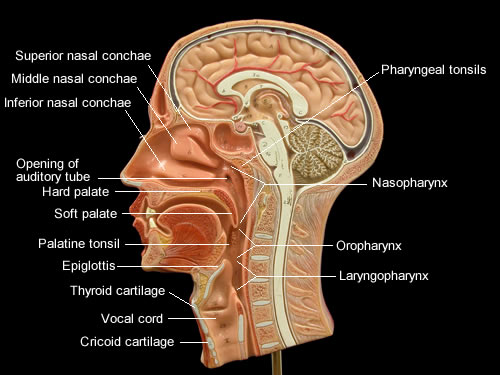
Structures Identified on the Model
Nasal Cavity
- External Nares - the openings of the nose through which air enters
- Superior, Middle, and Inferior Nasal Conchae (turbinates) - scroll-like bony projections that increase surface area, warm, humidify, and filter inspired air
- Nasal septum - divides the cavity into left and right sides
- Opening of the Pharyngotympanic (Auditory/Eustachian) tube - connects middle ear to nasopharynx, visible on the lateral wall
Sinuses
- Frontal Sinus - paired air-filled cavities in the frontal bone; drain into the nasal cavity; warm and humidify air
- Sphenoid Sinus - posterior to the nasal cavity, within the sphenoid bone
Palate
- Hard Palate - bony anterior roof of the oral cavity; separates oral from nasal cavities
- Soft Palate - muscular posterior continuation; the levator palati, tensor palati, palatopharyngeus, and palatoglossus muscles keep it from collapsing against the posterior pharynx during breathing
- Uvula - the dangling projection at the posterior margin of the soft palate
Pharynx (3 Divisions)
The pharynx connects the nasal and oral cavities to the larynx and esophagus.
| Division | Location | Function |
|---|---|---|
| Nasopharynx | Behind the nasal cavity, above the soft palate | Air passage only; contains pharyngeal tonsil (adenoid) |
| Oropharynx | Behind the oral cavity, from soft palate to epiglottis | Air and food passage; contains palatine tonsils |
| Laryngopharynx (Hypopharynx) | From epiglottis to esophageal opening | Air to larynx, food to esophagus |
Pharyngeal Tonsil (Adenoid) - lymphoid tissue on the posterior wall of the nasopharynx; part of Waldeyer's ring of immune defense.
Palatine Tonsil - lymphoid tissue at the oropharynx, between the anterior and posterior tonsillar pillars.
Tongue and Epiglottis
- Tongue - occupies the floor of the oral cavity; the genioglossus muscle maintains its forward position, preventing posterior airway obstruction
- Epiglottis - leaf-shaped cartilage at the root of the tongue; deflects over the laryngeal inlet during swallowing to protect the airway
- Vallecula - the depression between the base of the tongue and the lingual surface of the epiglottis; the landmark for Macintosh laryngoscope blade placement during intubation
Larynx
The larynx consists of:
- Hyoid Bone - the only bone with no articulation to another bone; serves as anchor for tongue and laryngeal muscles
- Thyroid Cartilage - the largest laryngeal cartilage; forms the "Adam's apple"
- Cricoid Cartilage - the only complete cartilaginous ring; the narrowest part of the adult airway (~17 mm diameter in men, ~13 mm in women)
- Vestibular Folds (False Vocal Cords) - superior folds; involved in vocalization support and protection
- Vocal Folds (True Vocal Cords) - inferior folds; vibrate to produce sound; the glottis is the space between them
Into the Lower Airway
- Trachea - begins at the inferior border of the cricoid, extends ~10-13 cm to the carina; composed of C-shaped cartilaginous rings connected posteriorly by the membranous wall
- Esophagus - visible posterior to the trachea; receives food from the laryngopharynx
Airway Zones: Conducting vs. Respiratory
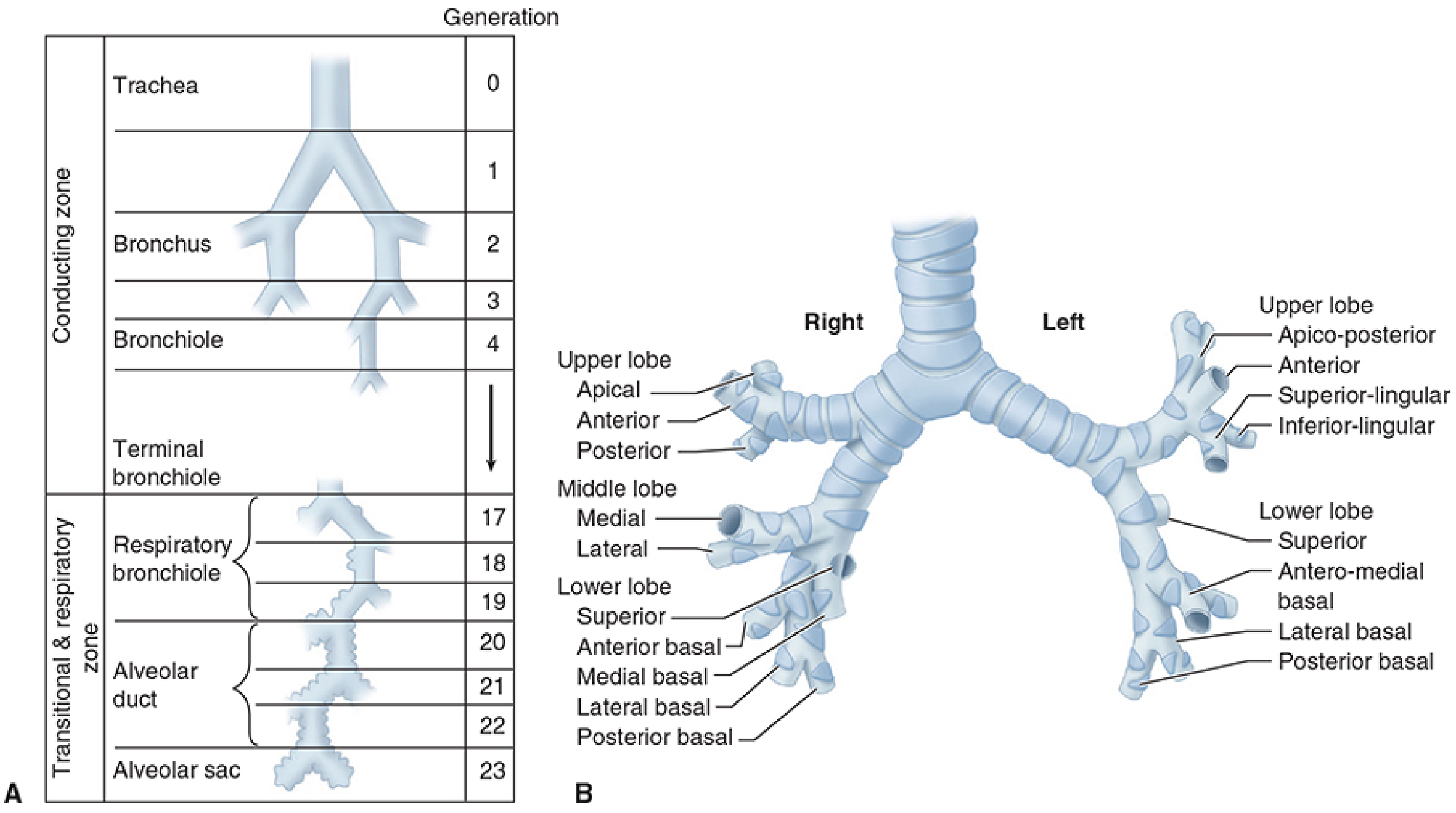
The airway undergoes ~23 generations of dichotomous branching from trachea to alveolar sacs. The conducting zone (generations 0-16, trachea to terminal bronchioles) carries air but does not exchange gas - this is anatomical dead space (~150 mL). The respiratory zone (generations 17-23, respiratory bronchioles to alveolar sacs) is where gas exchange occurs across ~300-500 million alveoli, with a total surface area of 50-100 m².
Muscles of Respiration (Not Visible on Half-Head Model)
The half-head model shows the upper airway, but breathing is driven by:
- Diaphragm - principal muscle; accounts for ~75% of chest volume change; descends 1.5-7 cm during inspiration
- External intercostals - assist inspiration by lifting ribs upward and outward
- Accessory muscles (sternocleidomastoid, scalenes) - recruited during increased respiratory effort
- Abdominal muscles - active during forced expiration
- Pharyngeal muscles - genioglossus, levator/tensor palati, palatopharyngeus keep the upper airway patent during both waking and sleep
Functional Summary of Upper Airway Structures
| Structure | Respiratory Function |
|---|---|
| Nasal conchae & sinuses | Filter, warm, humidify inspired air |
| Soft palate & pharyngeal muscles | Maintain patent airway, prevent collapse |
| Epiglottis | Directs air to larynx; closes over airway during swallowing |
| Vocal cords / glottis | Airway gatekeeper; phonation |
| Trachea | Conduit; mucociliary clearance of secretions |
Sources: Morgan & Mikhail's Clinical Anesthesiology, 7e (Ch. 23); Fishman's Pulmonary Diseases and Disorders (Ch. 145); Indiana University A215 Half-Head Model Lab
This is a shared conversation. Sign in to Orris to start your own chat.