
solid media for culture of bacteria
Solid Media for Culture of Bacteria
- Tietz Textbook of Laboratory Medicine, 7th Ed., p. 3229
- Jawetz Melnick & Adelberg's Medical Microbiology, 28th Ed.
Classification of Solid Media
| Category | Definition | Example |
|---|---|---|
| General purpose | Supports growth of a wide range of organisms | Nutrient agar, 5% Sheep Blood Agar (BAP) |
| Enriched | Contains extra nutrients (blood, serum, vitamins) for fastidious organisms | Chocolate agar, Brain Heart Infusion agar |
| Selective | Contains inhibitory agents (dyes, bile salts, antibiotics) that suppress unwanted organisms and favor target organisms | MacConkey agar, Mannitol Salt agar, TCBS agar |
| Differential | Allows distinction between organisms based on visible reactions (hemolysis, color change, colony morphology) | Blood agar (hemolysis), MacConkey agar (lactose fermentation) |
| Enrichment | Usually liquid but can be semi-solid; promotes multiplication of a target organism from a small inoculum | Selenite broth (for Salmonella) |
Common Solid Media and Their Uses
1. Blood Agar Plate (BAP)
- Components: Tryptic soy or Columbia agar base + 5% sheep blood (rabbit/horse blood used for Haemophilus)
- Type: General purpose + differential
- Use: Primary isolation of fastidious and non-fastidious organisms; differentiates organisms by hemolysis pattern
- Hemolysis patterns:
- Alpha (α): Partial/green hemolysis - Streptococcus pneumoniae, viridans streptococci
- Beta (β): Complete, clear hemolysis - S. pyogenes (Group A Strep), S. agalactiae, Staphylococcus aureus
- Gamma: No hemolysis - enterococci
- No growth: Haemophilus spp. (lacks X and V factors)
2. Chocolate Agar (CHOC)
- Components: Beef heart digest, peptone, starch + sheep blood (heated to release factors X and V)
- Type: Enriched, general purpose
- Use: Isolation of fastidious organisms that require hemin (Factor X) and NAD (Factor V)
- Notable organisms: Haemophilus influenzae, Neisseria gonorrhoeae, N. meningitidis, Abiotrophia spp.
3. MacConkey Agar (MAC)
- Components: Lactose, bile salts, neutral red indicator, crystal violet, digests of casein/animal tissue
- Type: Selective + differential
- Selective action: Bile salts + crystal violet inhibit Gram-positive organisms
- Differential action: Lactose fermenters produce acid → neutral red turns pink/red; non-fermenters produce colorless/translucent colonies
- Lactose fermenters (pink): E. coli, Klebsiella, Enterobacter
- Non-fermenters (colorless): Salmonella, Shigella, Pseudomonas aeruginosa, Proteus
4. Mannitol Salt Agar (MSA)
- Components: High salt (7.5% NaCl), mannitol, phenol red indicator
- Type: Selective + differential
- Selective for: Staphylococci (tolerate high salt); inhibits most other organisms
- Differential: S. aureus ferments mannitol → yellow colonies; S. epidermidis does not → red/pink colonies
5. Xylose Lysine Deoxycholate (XLD) Agar
- Type: Selective + differential
- Use: Isolation of enteric pathogens, especially Salmonella and Shigella from stool
- Salmonella: black center colonies (H₂S production); Shigella: red colonies
6. Thiosulfate Citrate Bile Salts Sucrose (TCBS) Agar
- Type: Selective + differential
- Use: Isolation of Vibrio species
- V. cholerae: yellow colonies (sucrose fermenter); V. parahaemolyticus: blue-green colonies
7. Lowenstein-Jensen (L-J) Medium
- Components: Egg protein, potato flour, salts, glycerol, malachite green (inhibits other bacteria)
- Type: Selective enriched solid (egg-based)
- Use: Primary isolation and culture of Mycobacterium tuberculosis and other mycobacteria
- Takes 3-8 weeks for visible growth
8. Brain Heart Infusion (BHI) Agar
- Components: Brain heart infusion, glucose, meat peptones, yeast extract, 5% horse blood
- Type: Enriched
- Use: Cultivation of fastidious aerobic and anaerobic organisms, including fungi
9. Bacteroides Bile Esculin (BBE) Agar
- Components: Bile, esculin, gentamicin, animal tissue digest
- Type: Selective
- Use: Isolation of Bacteroides spp. from mixed anaerobic cultures
- Bacteroides fragilis group hydrolyzes esculin → black colonies
10. Charcoal Cefoperazone Deoxycholate (CCDA) / Campylobacter Selective Agar
- Type: Selective
- Use: Isolation of Campylobacter (microaerophilic; requires 42°C incubation)
Key Sensitivity Note
| Concentration | Solid Media | Liquid Media |
|---|---|---|
| ≥10² - 10³ organisms/mL | Produces visible colonies | May not detect |
| ≤10 organisms/mL | May miss | Can detect (enrichment) |
Physical Forms of Agar Media
-
Plates (Petri dishes): Most common; used for colony counting, streak plate isolation, and sensitivity testing
-
Slopes/Slants: Test tubes with agar set at an angle; used for stock culture maintenance
-
Deeps/Butts: Test tubes with agar set vertically; used for anaerobic culture, motility testing, H₂S production
-
Tietz Textbook of Laboratory Medicine, 7th Ed., Table 84.3, pp. 3229-3234
Create a reference poster comparing selective vs. differential media?
A clean, professional microbiology reference poster titled "Selective vs. Differential Bacterial Culture Media" with two main columns side by side. Left column header "SELECTIVE MEDIA" in bold blue, right column header "DIFFERENTIAL MEDIA" in bold green. Center column header "SELECTIVE + DIFFERENTIAL" in bold purple. SELECTIVE MEDIA section (blue): - Definition box: "Inhibits growth of unwanted organisms; allows target organisms to grow" - Mechanism: Contains inhibitory agents — bile salts, dyes, antibiotics, high salt - Examples listed with bullet points: • Mannitol Salt Agar (MSA) — 7.5% NaCl selects Staphylococci • Thayer-Martin Agar — antibiotics select Neisseria • TCBS Agar — selects Vibrio spp. • Bacteroides Bile Esculin (BBE) — selects Bacteroides • Lowenstein-Jensen — malachite green selects Mycobacteria - Pros: Suppresses normal flora; enriches target pathogen DIFFERENTIAL MEDIA section (green): - Definition box: "Allows visual distinction between organisms based on colony appearance" - Mechanism: Contains indicators (pH dyes, blood) that produce color changes or visible reactions - Examples listed with bullet points: • Blood Agar (BAP) — alpha vs beta vs gamma hemolysis • Eosin Methylene Blue (EMB) — metallic sheen for E. coli • CLED Agar — differentiates lactose fermenters - Pros: Identifies organism groups without biochemical tests SELECTIVE + DIFFERENTIAL section (purple, center): - Definition: "Both suppresses unwanted flora AND differentiates remaining organisms" - Examples listed: • MacConkey Agar (MAC) — gram-negative selective; pink = lactose fermenter (E. coli, Klebsiella), colorless = non-fermenter (Salmonella, Shigella) • XLD Agar — enteric pathogens; black colonies = Salmonella, red = Shigella • TCBS — blue-green = V. parahaemolyticus, yellow = V. cholerae • Mannitol Salt — yellow = S. aureus, pink = S. epidermidis Bottom section: Comparison table with rows: Purpose | Mechanism | Key Agent | Example | Colony Result Dark background with white text for headers. Scientific, academic style. No cartoon graphics. Clean typography.
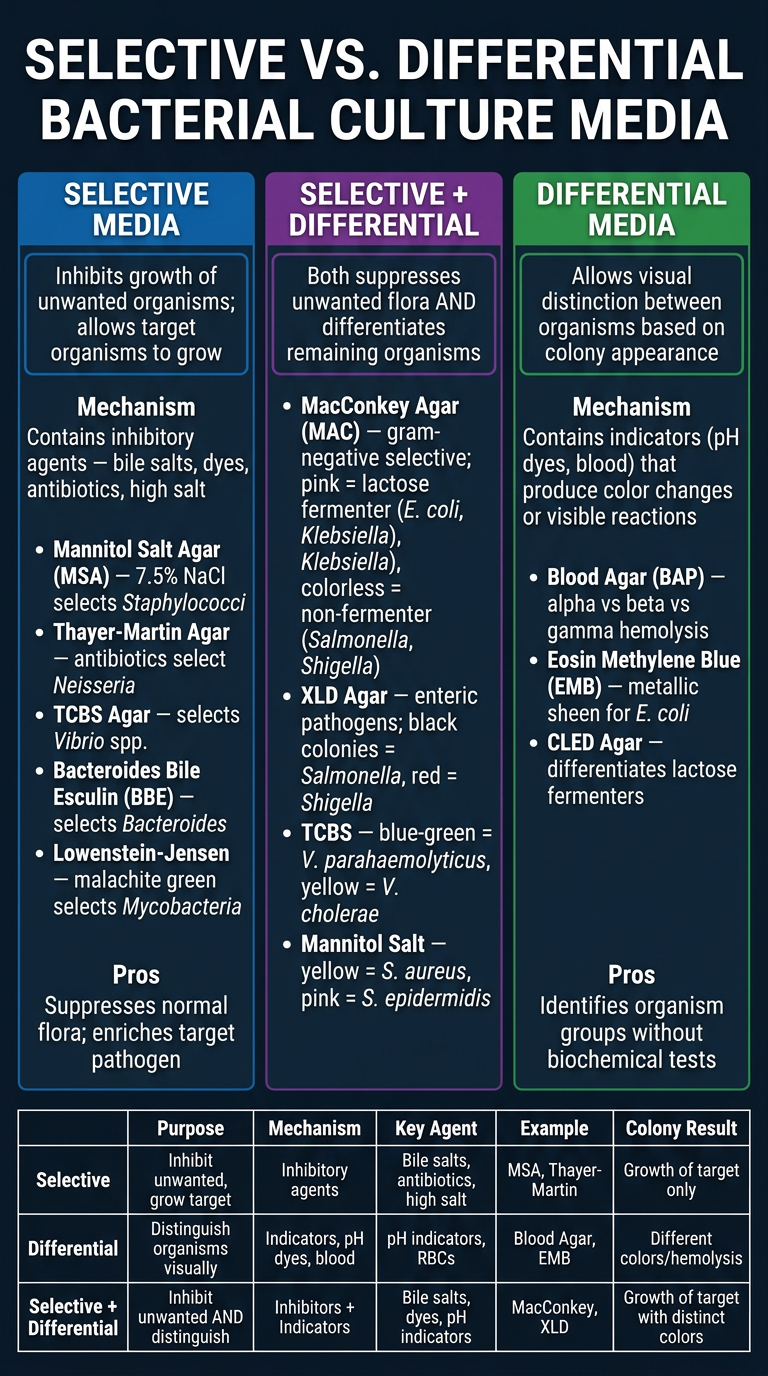
- Selective media (blue) - definition, inhibitory mechanism, and key examples like MSA, Thayer-Martin, TCBS, and L-J
- Differential media (green) - definition, indicator-based mechanism, and examples like Blood Agar and EMB
- Selective + Differential media (purple) - the combined category with the most clinically important examples: MacConkey, XLD, and TCBS with their colony color interpretations
- Selective = controls what grows (suppresses unwanted organisms)
- Differential = controls how colonies look (visible reactions distinguish species)
- Many media like MacConkey do both simultaneously - it kills off Gram-positives (selective) AND turns lactose fermenters pink (differential)