
Long Question: Mode of Action of RAS Inhibitors in the Treatment of Chronic Heart Failure (CHF) with Their Advantages and Disadvantages (According to K.D. Tripathi, Essentials of Medical Pharmacology – MBBS)
renin angiotensin aldosterone system mechanism heart failure ACE inhibitor ARB
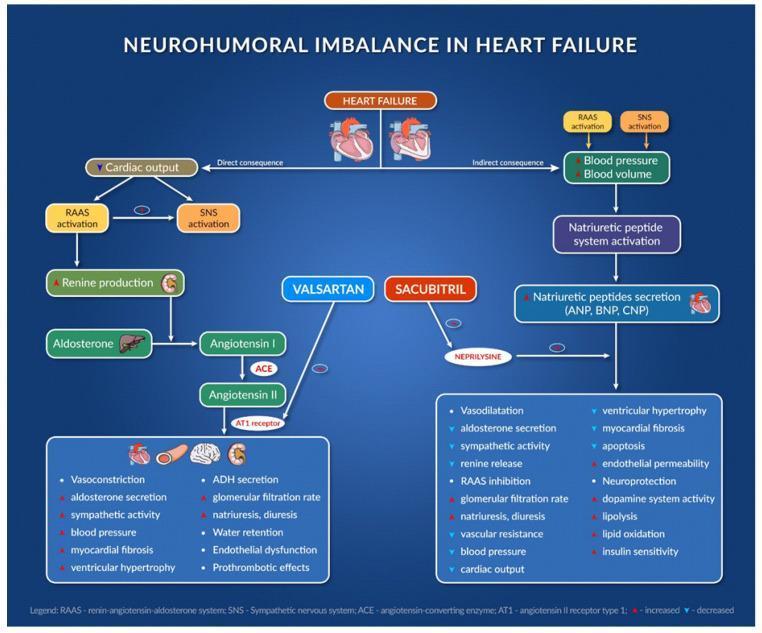
A complex pathophysiology diagram and pharmacological flowchart titled 'Neurohumoral Imbalance in Heart Failure'. It illustrates the interaction between the Renin-Angiotensin-Aldosterone System (RAAS), the Sympathetic Nervous System (SNS), and the Natriuretic Peptide (NP) system in the context of heart failure. The left side of the diagram outlines the RAAS cascade: Renin production leads to Angiotensin I, which is converted to Angiotensin II by ACE, ultimately binding to the AT1 receptor to cause deleterious effects like vasoconstriction, myocardial fibrosis, and water retention. The right side shows the NP system (ANP, BNP, CNP) which promotes diuresis and vasodilation. Centrally, the diagram depicts the pharmacological intervention of the ARNI class: Valsartan (an ARB) inhibiting the AT1 receptor, and Sacubitril (a neprilysin inhibitor) preventing the breakdown of natriuretic peptides. A comparison list at the bottom contrasts the pathological effects of uncontrolled RAAS/SNS activation against the beneficial physiological outcomes of ARNI therapy, including reduced ventricular hypertrophy, increased insulin sensitivity, and improved cardiac output. The diagram uses standard medical icons for the heart, kidneys, and liver to indicate anatomical sites of hormone production and action.
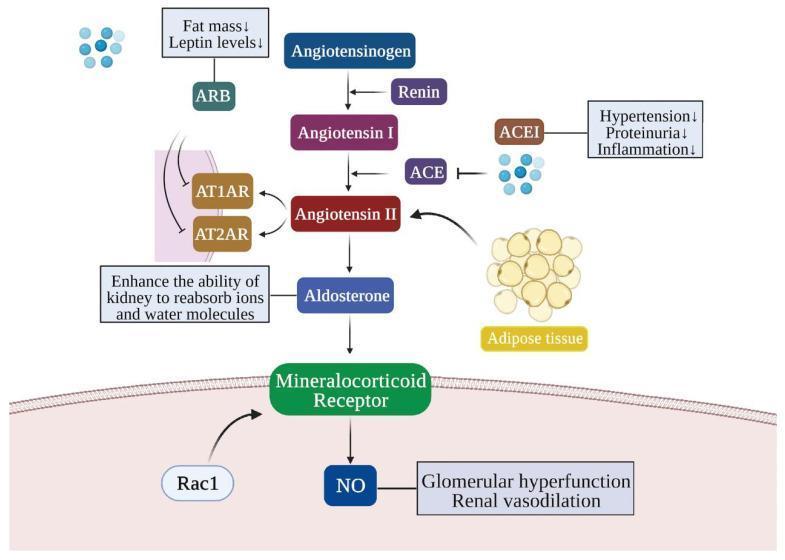
This pathophysiology diagram illustrates the Renin-Angiotensin-Aldosterone System (RAAS) pathway and its role in obesity-related kidney injury, highlighting pharmaceutical intervention points. The central pathway shows the enzymatic conversion of Angiotensinogen to Angiotensin I by Renin, and Angiotensin I to Angiotensin II via Angiotensin-Converting Enzyme (ACE). Angiotensin II acts on receptors AT1AR and AT2AR, facilitating kidney reabsorption of ions and water. The diagram specifically notes that adipose tissue contributes to increased Angiotensin II levels. Further down the cascade, Angiotensin II stimulates Aldosterone, which activates the Mineralocorticoid Receptor (supported by Rac1). This activation leads to the production of Nitric Oxide (NO), contributing to glomerular hyperfunction and renal vasodilation. Two major drug classes are highlighted: ACE Inhibitors (ACEI), which block the ACE enzyme to reduce hypertension, proteinuria, and inflammation; and Angiotensin Receptor Blockers (ARB), which inhibit AT1AR/AT2AR receptors and are associated with decreased fat mass and leptin levels.
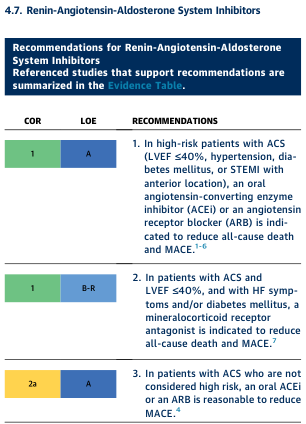
Summary : This image presents a structured set of recommendations for the use of Renin-Angiotensin-Aldosterone System Inhibitors in patients with Acute Coronary Syndrome (ACS), based on class of recommendation (COR) and level of evidence (LOE). The recommendations are organized in a table format, specifying clinical scenarios and the indicated therapies. table: # Title & Structure : • Title: "Recommendations for Renin-Angiotensin-Aldosterone System Inhibitors" • Subtitle: "Referenced studies that support recommendations are summarized in the Evidence Table." • Columns: COR (Class of Recommendation), LOE (Level of Evidence), RECOMMENDATIONS # Recommendations : • Recommendation 1: – COR: 1 (green) – LOE: A (blue) – Text: "In high-risk patients with ACS (LVEF ≤40%, hypertension, diabetes mellitus, or STEMI with anterior location), an oral angiotensin-converting enzyme inhibitor (ACEi) or an angiotensin receptor blocker (ARB) is indicated to reduce all-cause death and MACE.¹⁻⁶" • Recommendation 2: – COR: 1 (green) – LOE: B-R (blue) – Text: "In patients with ACS and LVEF ≤40%, and with HF symptoms and/or diabetes mellitus, a mineralocorticoid receptor antagonist is indicated to reduce all-cause death and MACE.⁷" • Recommendation 3: – COR: 2a (yellow) – LOE: A (blue) – Text: "In patients with ACS who are not considered high risk, an oral ACEi or an ARB is reasonable to reduce MACE.⁴" # Design Encodings : • COR is color-coded: 1 (green), 2a (yellow) • LOE is color-coded: A (blue), B-R (blue) • Recommendations are numbered and referenced with superscript citations. # Analysis : • The table prioritizes ACEi/ARB therapy for high-risk ACS patients (strongest recommendation, highest evidence). • Mineralocorticoid receptor antagonists are recommended for ACS patients with reduced LVEF and additional risk factors. • For lower-risk ACS patients, ACEi/ARB therapy is considered reasonable but with a lower class of recommendation. • The recommendations are evidence-based and stratified by risk and comorbidities.
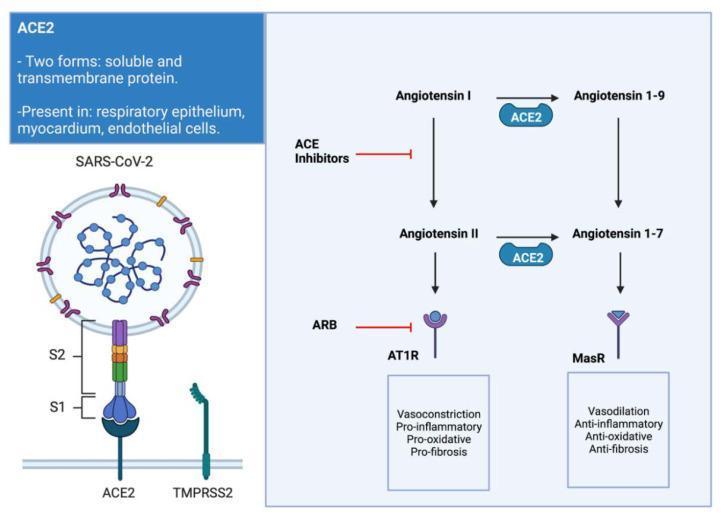
A medical illustration and pathophysiology diagram depicting the interaction between SARS-CoV-2 and the Renin-Angiotensin-Aldosterone System (RAAS). The left side shows the structural mechanism of viral entry, with the SARS-CoV-2 spike protein (S1 and S2 subunits) binding to the transmembrane ACE2 receptor, facilitated by the TMPRSS2 protease. The right side outlines the biochemical pathways of Angiotensin conversion. It illustrates the 'classic' pathway where Angiotensin I is converted to Angiotensin II, which activates the AT1R receptor to promote vasoconstriction, pro-inflammatory, pro-oxidative, and pro-fibrotic effects. This pathway is targeted by ACE inhibitors and Angiotensin Receptor Blockers (ARBs). The 'alternative' pathway shows ACE2 mediating the conversion of Angiotensin I to Angiotensin 1-9, and Angiotensin II to Angiotensin 1-7. Angiotensin 1-7 interacts with the Mas Receptor (MasR), triggering cardioprotective effects including vasodilation and anti-inflammatory, anti-oxidative, and anti-fibrotic responses. The diagram highlights the clinical significance of ACE2 downregulation during infection and its role in myocardial remodeling.
Mode of Action of RAS Inhibitors in CHF - Advantages and Disadvantages
Background: RAAS Activation in CHF
- Reduced renal perfusion → Juxtaglomerular cells release Renin
- Renin cleaves angiotensinogen → Angiotensin I (inactive decapeptide)
- Angiotensin-Converting Enzyme (ACE) on lung endothelium converts Ang I → Angiotensin II (active octapeptide)
- Ang II acts on AT1 receptors → vasoconstriction, aldosterone release, ADH release, sympathetic activation, myocardial hypertrophy and fibrosis
- Aldosterone → Na⁺/water retention → increased preload
Classes of RAS Inhibitors Used in CHF
| Class | Mechanism | Examples |
|---|---|---|
| ACE Inhibitors (ACEIs) | Block conversion of Ang I → Ang II; also inhibit bradykinin breakdown | Enalapril, Captopril, Lisinopril, Ramipril |
| Angiotensin Receptor Blockers (ARBs) | Block AT1 receptor directly | Losartan, Valsartan, Candesartan |
| Aldosterone Antagonists (MRAs) | Block mineralocorticoid receptor | Spironolactone, Eplerenone |
| ARNIs (ARB + Neprilysin Inhibitor) | ARB + blocks neprilysin (which degrades natriuretic peptides) | Sacubitril/Valsartan (Entresto) |
1. ACE Inhibitors (ACEIs)
Mechanism of Action
- Less AT1 receptor stimulation → reduced vasoconstriction → decreased afterload (systemic vascular resistance falls)
- Less aldosterone secretion → less Na⁺ and water retention → decreased preload (venous return falls)
- Less sympathetic activation → reduced heart rate and myocardial oxygen demand
- Less ADH (vasopressin) release → additional natriuresis
- Bradykinin accumulates → causes vasodilation (via NO and prostaglandin release) → further reduces preload and afterload
- This contributes to the antihypertensive and cardiac protective effect, but also causes dry cough and angioedema (see disadvantages)
- Reduced Ang II → less myocyte hypertrophy, less interstitial fibrosis, and attenuation of ventricular remodeling
- Slows progressive left ventricular dilatation by reducing wall stress throughout the cardiac cycle
- Inhibits intracellular signaling pathways involved in myocardial hypertrophy
- Reduced preload + reduced afterload → increased cardiac output without reflex tachycardia
- Reduced filling pressures → relief of dyspnea and pulmonary congestion
Clinical Benefits in CHF
- Reduce left ventricular size and improve ejection fraction
- Reduce symptoms (NYHA class improvement) and hospitalizations
- Reduce mortality - landmark CONSENSUS and SOLVD trials showed 20-40% reduction in mortality
- Beneficial across all stages - from asymptomatic LV dysfunction (Stage B) to severe symptomatic CHF (Stage C/D)
- Reduce risk of MI, stroke, and new-onset atrial fibrillation
- Mitigate diuretic-induced hypokalemia
- This benefit is a class effect - all ACEIs appear equally effective
2. Angiotensin Receptor Blockers (ARBs)
Mechanism of Action
- Do NOT inhibit ACE - Ang II is still produced, but cannot act on AT1 receptors
- Ang II is "redirected" to AT2 receptors, which have cardioprotective, vasodilatory, and anti-proliferative effects
- They do NOT inhibit bradykinin breakdown (bradykinin is degraded normally)
- Clinical effects (preload/afterload reduction, anti-remodeling) are similar to ACEIs
Clinical Benefits
- As effective as ACEIs when used alone in CHF with reduced ejection fraction (HFrEF)
- Preferred alternative when ACEIs are not tolerated (mainly due to cough or angioedema)
- No advantage shown over ACEIs when used alone; combination of ACEI + ARB is not recommended (no added benefit, increased adverse effects)
3. Aldosterone Antagonists (Mineralocorticoid Receptor Antagonists - MRAs)
Mechanism of Action
- Block aldosterone's actions in the kidney (tubular Na⁺ retention), heart (fibrosis), and blood vessels
- Reduce myocardial fibrosis and ventricular remodeling independently of ACEIs
- K⁺-sparing diuretic effect - counteracts hypokalemia from loop diuretics
Clinical Benefits
- Reduce mortality in moderate-severe CHF (RALES trial - spironolactone reduced mortality by 30%)
- Reduce sudden cardiac death and death from progressive pump failure
- Reduce hospitalizations and improve symptoms
4. ARNI - Sacubitril/Valsartan (Entresto)
Mechanism of Action
- Valsartan (ARB): blocks AT1 receptor
- Sacubitril (Neprilysin inhibitor): blocks neprilysin, the enzyme that degrades natriuretic peptides (ANP, BNP, CNP), bradykinin, and adrenomedullin
Clinical Benefits
- Superior to enalapril in the PARADIGM-HF trial: greater reduction in cardiovascular death, CHF hospitalizations, and all-cause mortality
- Now recommended as first-line over ACEI/ARB alone in symptomatic HFrEF (NYHA Class II-IV)
- A washout period of 36 hours is mandatory between stopping ACEI and starting ARNI (to prevent angioedema)
Advantages of RAS Inhibitors in CHF
| Advantage | Detail |
|---|---|
| Mortality reduction | ACEIs, ARBs, MRAs, and ARNIs all reduce all-cause and cardiovascular mortality in RCTs |
| Anti-remodeling | Prevent/reverse ventricular dilation, hypertrophy, and fibrosis - slow disease progression |
| Hemodynamic improvement | Reduce both preload and afterload → increase cardiac output without tachycardia |
| Neurohormonal blockade | Break the vicious RAAS-SNS cycle that perpetuates CHF |
| Renal protection | Reduce proteinuria; beneficial in CHF with co-existing diabetic nephropathy |
| Tolerable side effect profile | Generally well tolerated; can be slowly uptitrated |
| K⁺ conservation (MRAs) | Counter diuretic-induced hypokalemia and reduce sudden death |
| Broad applicability | Benefit across all CHF stages (symptomatic and asymptomatic LV dysfunction) |
| Combination benefit | Additive effects with beta-blockers, diuretics, and SGLT2 inhibitors |
Disadvantages / Adverse Effects
| Drug/Class | Adverse Effect | Mechanism |
|---|---|---|
| ACEIs | Dry, persistent, non-productive cough (~5-10% of patients) | Bradykinin accumulation in respiratory tract |
| ACEIs | Angioedema (rare but dangerous) | Bradykinin accumulation → capillary leakage in face/tongue/throat |
| ACEIs | Hyperkalemia | Reduced aldosterone → reduced K⁺ excretion |
| ACEIs | Hypotension (first dose) | Marked fall in Ang II → vasodilation; most common in volume-depleted patients |
| ACEIs | Renal dysfunction / azotemia | Ang II normally maintains GFR in low perfusion states via efferent arteriolar constriction; removing this support can precipitate acute renal failure, especially in bilateral renal artery stenosis |
| ARBs | Hyperkalemia, hypotension, renal dysfunction (same as ACEIs, similar frequency) | Same mechanism - AT1 blockade |
| ARBs | No cough (advantage over ACEIs), but angioedema can still occur (lower rate) | No bradykinin accumulation |
| MRAs (Spironolactone) | Hyperkalemia (most dangerous - can be life-threatening) | K⁺ retention via aldosterone blockade |
| MRAs (Spironolactone) | Gynecomastia, breast tenderness, menstrual irregularity | Anti-androgenic effects of spironolactone |
| Eplerenone | Fewer hormonal side effects (selective MRA) | No anti-androgenic activity |
| ARNIs | Hypotension (more than ACEI) | Dual vasodilation from both valsartan and natriuretic peptide augmentation |
| ARNIs | Angioedema (contraindicated if prior ACEI-related angioedema) | Bradykinin accumulation from sacubitril |
| All RAAS agents | Contraindicated in pregnancy (fetotoxicity, oligohydramnios, renal dysgenesis) | Ang II needed for fetal renal development |
| All RAAS agents | Contraindicated in bilateral renal artery stenosis | Acute prerenal failure |
Key Contraindications (Summary)
- Pregnancy (absolute - teratogenic/fetotoxic)
- Bilateral renal artery stenosis
- Significant hyperkalemia (K⁺ > 5.5 mEq/L)
- Symptomatic hypotension (SBP < 90-95 mmHg)
- History of ACE inhibitor-associated angioedema (for ACEIs and ARNIs)
- ACEIs should never be combined with ARNIs (36-hour washout required)
- Triple therapy (ACEI + ARB + MRA) is not recommended - high risk of hyperkalemia and renal failure
Clinical Pearls (Tripathi Style)
- ACEIs are the cornerstone of CHF pharmacotherapy - indicated in all patients with LV systolic dysfunction regardless of symptoms.
- ARBs are not superior to ACEIs when used alone - use them only as substitutes when ACEIs are not tolerated.
- Aldosterone escape occurs with long-term ACEI use (aldosterone rises again) - add MRAs for additional benefit in moderate-severe CHF.
- ARNI (sacubitril/valsartan) is now preferred over ACEI/ARB alone as first-line in symptomatic HFrEF with EF ≤40%.
- The RAAS inhibitor combination with beta-blockers + diuretics + SGLT2 inhibitors forms the "4 pillars" of modern HFrEF therapy.
- ACEIs cannot replace digoxin in patients already on glycosides - patients withdrawn from digoxin while on ACEI therapy deteriorate.
- Monitoring: Check renal function (creatinine/BUN), serum K⁺, and blood pressure after every dose increment.