
Explain myocardial infarction
Reading File
Finding Sources
Searching PubMed
"myocardial infarction"[MeSH Terms] AND "management"[MeSH Terms]
Good results. I'll read the most comprehensive sources in parallel — Braunwald's (the gold-standard cardiology text), Robbins Pathology, and Ganong's Physiology — plus search for relevant images.
Reading File
Reading File
Reading File
Searching Images
myocardial infarction pathology coronary artery atherosclerosis
Now I have rich content from Robbins Pathology and Ganong's Physiology. Let me read more from Robbins (pathological changes, morphology) and also read the Guyton physiology section.
Reading File
Reading File
Searching Images
myocardial infarction ECG ST elevation STEMI
I now have excellent, comprehensive content from multiple textbooks. Let me also quickly read the clinical presentation and management sections from Goldman-Cecil and the complications from Robbins.
Reading File
Reading File
I now have comprehensive information from multiple authoritative sources. Let me compile a thorough, well-organized response.
Myocardial Infarction
Myocardial infarction (MI), commonly called a "heart attack," is the death (necrosis) of cardiac muscle resulting from prolonged ischemia. The 2018 joint U.S./European Cardiology task force defines it as "acute myocardial injury detected by abnormal cardiac biomarkers in the setting of evidence of acute myocardial ischemia." — Robbins, Basic Pathology, p. 465
Epidemiology
- ~800,000 MIs occur in the United States each year (nearly one every 40 seconds), causing ~400,000 deaths annually
- 10% occur in people <40 years; 45% occur in people <65 years
- Males carry higher relative risk before menopause; after menopause, the gap narrows significantly — ischemic heart disease is the leading cause of death in older women
- Postmenopausal hormone replacement therapy has not been proven protective and may be pro-thrombotic in some cases
— Robbins & Kumar, Pathologic Basis of Disease
Pathogenesis
The Atherothrombotic Cascade
The overwhelming majority of MIs follow this sequence:
- Plaque disruption — An atheromatous plaque undergoes erosion or rupture due to endothelial injury, intraplaque hemorrhage, or mechanical stress, exposing subendothelial collagen and necrotic plaque contents to the bloodstream
- Platelet activation — Platelets adhere, aggregate, and release thromboxane A₂, ADP, and serotonin, driving further platelet aggregation and vasoconstriction
- Coagulation activation — Tissue factor exposure activates the coagulation cascade, expanding the thrombus
- Occlusion — Within minutes, the thrombus can completely occlude the coronary lumen
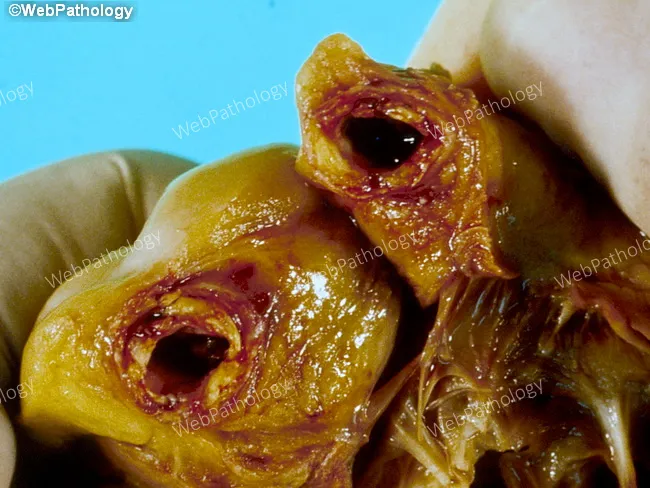
Angiography within 4 hours of MI onset demonstrates thrombotic occlusion in ~90% of cases. By 12–24 hours, this falls to 60% (due to spontaneous thrombolysis), which has clear therapeutic implications for early intervention. — Robbins, Pathologic Basis of Disease, p. 511
Non-atherosclerotic Causes (~10% of MIs)
- Coronary artery vasospasm (with or without atherosclerosis)
- Embolism from mural thrombi (e.g., in atrial fibrillation) or valve vegetations
- Small vessel disease: vasculitis, amyloid deposition, sickle cell disease
- Subendocardial infarcts from prolonged demand (tachycardia, hypertension) on a marginally perfused heart
Coronary Anatomy & Infarct Territory
| Occluded Vessel | Area Infarcted |
|---|---|
| Left anterior descending (LAD) | Anterior LV, anterior septum, apex (most common) |
| Right coronary artery (RCA) | Posterior LV, posterior septum, RV; often AV node |
| Left circumflex (LCx) | Lateral LV wall |
The subendocardium is most vulnerable because it has higher oxygen consumption and its vessels are compressed during systolic contraction. — Guyton & Hall Textbook of Medical Physiology
Gross Pathology: Gross image of coronary thrombosis
Morphological Evolution Over Time
| Time | Gross Features | Light Microscopy | Electron Microscopy |
|---|---|---|---|
| 0–0.5 hr | None | None | Myofibril relaxation, glycogen loss, mitochondrial swelling |
| 0.5–4 hr | None | Variable wavy fibers at border | Sarcolemmal disruption, amorphous mitochondrial densities |
| 4–12 hr | Dark mottling (occasional) | Early coagulative necrosis, edema, hemorrhage | — |
| 12–24 hr | Dark mottling | Coagulative necrosis; pyknosis; myocyte hypereosinophilia; early neutrophils | — |
| 1–3 days | Yellow-tan center | Coagulative necrosis with brisk neutrophilic infiltrate | — |
| 3–7 days | Hyperemic border; soft center | Neutrophil death; early macrophage phagocytosis; granulation tissue at border | — |
| 7–10 days | Maximally soft, yellow-tan | Well-developed phagocytosis; granulation tissue at margins | — |
| 10–14 days | Red-gray depressed borders | Granulation tissue with new vessels and collagen | — |
| 2–8 weeks | Gray-white scar | Increasing collagen, decreasing cellularity | — |
| >2 months | Dense white scar | Dense fibrous scar | — |
Triphenyl tetrazolium chloride (TTC) stain: Normal myocardium stains brick-red (intact lactate dehydrogenase); infarcted tissue appears as an unstained pale zone due to enzyme leakage from damaged membranes. Useful for infarcts >2–3 hours old. — Robbins, Pathologic Basis of Disease
ECG Changes
Three electrical abnormalities underlie the ECG findings in acute MI:
| Defect in Infarcted Cells | Current Flow | ECG Change (leads over infarct) |
|---|---|---|
| Rapid repolarization (K⁺ channel opening) | Out of infarct | ST elevation |
| Decreased resting membrane potential | Into infarct | TQ depression (recorded as ST elevation) |
| Delayed depolarization | Out of infarct | ST elevation |
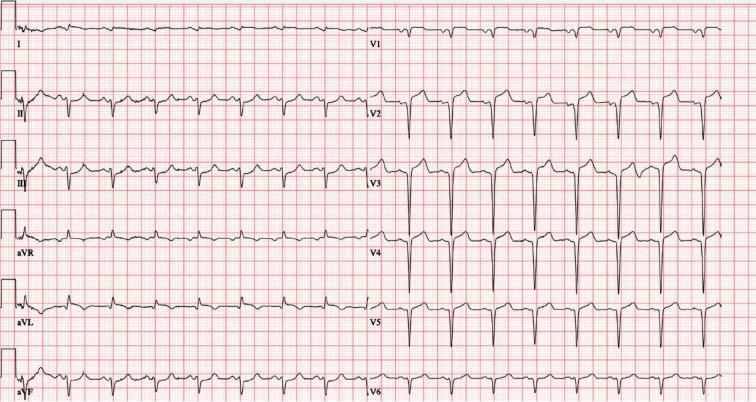
The hallmark of acute MI is ST-segment elevation in leads overlying the infarcted area, with reciprocal ST depression in opposing leads. After days–weeks, dead muscle becomes electrically silent → pathological Q waves develop. "Non-Q-wave" infarcts (NSTEMIs) tend to be less severe but carry high risk of reinfarction. — Ganong's Review of Medical Physiology, p. 534
STEMI ECG Example
Clinical Classification
| Type | Definition |
|---|---|
| STEMI | ST-elevation MI — full-thickness (transmural) occlusion; requires emergent reperfusion |
| NSTEMI | Non-ST-elevation MI — partial occlusion or subendocardial; biomarker-positive without persistent ST elevation |
| Unstable angina | Ischemia without biomarker elevation; precursor to MI |
Cardiac Biomarkers
- Troponin I and T — Most sensitive and specific; begin rising 3–6 hours after onset, peak at 24–48 hours, remain elevated for up to 14 days
- CK-MB — Rises within 3–4 hours; returns to normal within 48–72 hours (useful for detecting reinfarction)
- Myoglobin — Rises earliest (1–3 hours) but is non-specific
Complications
Immediate / Early
- Arrhythmias — ~90% of MI patients develop some rhythm disturbance; highest risk in the first hour. Includes ventricular fibrillation (most lethal), heart block, ventricular tachycardia, bradycardia
- Cardiogenic shock — Reduced cardiac output from loss of contractile mass; worsened by "systolic stretch" (infarcted zone bulges outward during systole, stealing energy from healthy myocardium)
- Pulmonary edema — From LV failure and back-pressure into pulmonary circulation
Days to Weeks
- Myocardial rupture (1–3% of MIs, often fatal): Occurs 3–7 days post-MI (peak of neutrophilic lysis):
- Free wall rupture → hemopericardium, cardiac tamponade
- Ventricular septal rupture → VSD with left-to-right shunt
- Papillary muscle rupture → acute mitral regurgitation
- Risk factors: age >60, anterior/lateral infarcts, female sex, first MI, no LVH
- Pericarditis — Fibrinohemorrhagic; appears 2–3 days post-MI with chest pain and friction rub; rare late form = Dressler syndrome (autoimmune, weeks later)
- Mural thrombus — From stasis + endocardial damage → risk of systemic embolism
Late
- Ventricular aneurysm — Thinned scar wall, commonly from large anteroseptal infarcts → arrhythmias, mural thrombus, heart failure (rarely ruptures)
- Progressive heart failure — Most common cause of delayed death after MI
— Robbins, Pathologic Basis of Disease, pp. 518–520
Causes of Death Summary
| Cause | Mechanism |
|---|---|
| Decreased cardiac output | Infarcted zone cannot contract; systolic stretch worsens pump failure |
| Pulmonary edema | LV failure → pulmonary venous hypertension |
| Ventricular fibrillation | Electrical instability in ischemic zone |
| Cardiac rupture | Softening of necrotic wall 3–7 days post-MI |
— Guyton & Hall Textbook of Medical Physiology
Management Principles
Time is muscle. The goal is rapid reperfusion:
- STEMI: Primary percutaneous coronary intervention (PCI) is preferred (ideally within 90 min of first medical contact); thrombolysis if PCI unavailable within 120 min
- NSTEMI/UA: Risk-stratified approach — anticoagulation, antiplatelet therapy, early invasive strategy for high-risk patients
- Adjunct therapies: Aspirin + P2Y12 inhibitor (dual antiplatelet), heparin/LMWH, beta-blockers, ACE inhibitors/ARBs, high-intensity statins
- Secondary prevention: Lifelong antiplatelet therapy, statins, BP and glycemic control, cardiac rehabilitation
Key Points Summary
| Feature | Detail |
|---|---|
| Core mechanism | Atherosclerotic plaque rupture → coronary thrombosis → ischemic necrosis |
| Most vulnerable region | Subendocardium (highest O₂ demand, lowest perfusion) |
| Earliest reversible change | Mitochondrial swelling (0–30 min) |
| Irreversibility threshold | ~20–40 min of complete ischemia |
| Earliest gross change | TTC pale zone (>2–3 hr), dark mottling by 12–24 hr |
| Peak rupture risk | 3–7 days (maximal neutrophilic lysis) |
| Scar complete | >2 months |
| Most common cause of immediate death | Ventricular fibrillation |
| Most common late complication | Heart failure |
This is a shared conversation. Sign in to Orris to start your own chat.