
CSF analysis pediatrics
Reading File
Searching for pediatric CSF analysis across normal values, interpretation, and key clinical conditions.
search_medical_text
CSF cerebrospinal fluid analysis pediatrics normal values interpretation
Sexually Transmitted Infections
Page 54
search_medical_text
CSF findings bacterial viral meningitis pediatric lumbar puncture
Harrison's Principles of Internal Medicine, Twenty First Edition
Page 4153
search_medical_image
CSF analysis pediatric meningitis table comparison
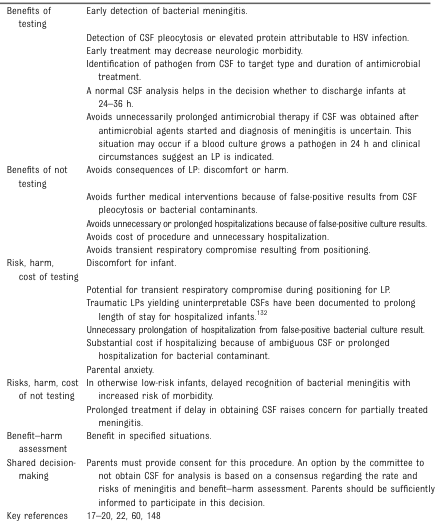
Evaluation and Management of Well-Appearing Febrile Infants 8 to 60 Days Old
Page 20
GradeResponse
GradeResponse
GradeResponse
search_medical_text
CSF normal reference values neonates infants children WBC protein glucose opening pressure
search_medical_text
CSF interpretation bacterial viral fungal tuberculous meningitis differential diagnosis glucose protein cell count
Here is a comprehensive overview of CSF Analysis in Pediatrics.
Cerebrospinal Fluid (CSF) Analysis in Pediatrics
Age-Specific Normal CSF Reference Values
Normal CSF values vary significantly with age — a critical pediatric consideration.
| Parameter | Neonates (Preterm) | Neonates (Term) | Infants 1–3 months | Children (>3 months) |
|---|---|---|---|---|
| WBC (cells/mm³) | ≤25–29 | ≤16–19 | ≤9–11 | ≤5 |
| Protein (mg/dL) | ≤150 | ≤115–118 | ≤89–91 | ≤40–45 |
| Glucose (mg/dL) | 30–60 | 34–119 | 40–80 | 40–80 |
| CSF:Serum glucose ratio | ≥0.44 | ≥0.44 | ≥0.5 | ≥0.6 |
| Opening pressure (cmH₂O) | — | 8–10 | 10–15 | 10–20 |
Key point (STI Guidelines, p. 54): CSF values in the neonatal period are difficult to interpret — normal values differ by gestational age and are higher in preterm infants. The upper limit of normal for older infants is ~5 WBCs/mm³ and protein ~40 mg/dL.
CSF Interpretation by Condition
Differential Diagnosis Table
| Feature | Normal | Bacterial Meningitis | Viral (Aseptic) Meningitis | Tuberculous Meningitis | Fungal Meningitis |
|---|---|---|---|---|---|
| Appearance | Clear, colorless | Turbid/purulent | Clear or slightly turbid | Clear/xanthochromic | Clear |
| WBC (cells/mm³) | <5 (child) | 1,000–10,000+ | 10–500 | 100–500 | 20–500 |
| Predominant cell | Lymphocytes | PMNs (neutrophils) | Lymphocytes | Lymphocytes | Lymphocytes |
| Protein (mg/dL) | <45 | >100 (often >200) | 50–100 | 100–500 | 50–200 |
| Glucose (mg/dL) | 40–80 | Very low (<40) | Normal | Low (<45) | Low |
| CSF:Serum glucose | >0.6 | <0.4 | >0.6 | <0.5 | <0.5 |
| Opening pressure | Normal | Elevated | Normal/slightly elevated | Elevated | Elevated |
| Gram stain | Negative | Positive in ~75–80% | Negative | Negative (AFB ~20%) | India ink (+) in Crypto |
| Culture | Sterile | Positive | Negative | Positive (slow) | Positive |
Lumbar Puncture in Pediatrics — Key Points
Indications
- Suspected meningitis/encephalitis
- Febrile infants 8–60 days old (AAP guideline)
- Suspected subarachnoid hemorrhage
- Evaluation for CNS malignancy, demyelinating disease, neurosyphilis
- ICP measurement (pseudotumor cerebri)
When to Obtain Neuroimaging BEFORE LP (Harrison's, p. 4153)
LP without prior CT/MRI is safe in immunocompetent patients with:
- No recent head trauma
- Normal level of consciousness
- No papilledema
- No focal neurologic deficits
If LP must be delayed for neuroimaging, start empirical antibiotics immediately after blood cultures are drawn. A few hours of antibiotic therapy prior to LP will not significantly alter CSF WBC or glucose, nor prevent Gram stain visualization.
Febrile Infants 8–60 Days — AAP Framework (GLGCA, p. 20)
Benefits of Performing LP
- Early detection of bacterial meningitis
- Detection of CSF pleocytosis from HSV — early treatment reduces neurologic morbidity
- Pathogen identification to guide antimicrobial type and duration
- Normal CSF supports discharge at 24–36 hours
- Avoids prolonged therapy when meningitis is uncertain but blood culture grows pathogen
Benefits of NOT Performing LP
- Avoids infant discomfort and transient respiratory compromise from positioning
- Prevents false-positive results (pleocytosis, bacterial contaminants) causing unnecessary hospitalization and parental anxiety
- Reduces costs
Traumatic LP (blood-contaminated sample) prolongs hospital stay and complicates interpretation — document opening pressure and tube order, and use the WBC-correction formula if needed.
Traumatic Tap — WBC Correction
When blood contaminates the CSF sample:
Corrected WBC = CSF WBC – (Peripheral WBC × CSF RBC / Peripheral RBC)
A corrected WBC >5 still suggests true pleocytosis.
Special Considerations
HSV Encephalitis
- CSF: lymphocytic pleocytosis, elevated protein, normal glucose
- PCR for HSV is the gold standard (sensitivity ~95%)
- RBCs may be present (hemorrhagic necrosis)
- Start acyclovir empirically in neonates and young infants pending results
Neonatal Meningitis
- Common organisms: Group B Streptococcus, E. coli, Listeria monocytogenes
- Higher normal WBC thresholds make interpretation tricky — a "normal" neonatal LP does NOT exclude meningitis
- Repeat LP at 48–72 hours is recommended to confirm CSF sterilization
Tuberculous Meningitis
- CSF glucose falls progressively — often dramatically low
- Protein can rise to several hundred mg/dL
- Fibrin web formation is characteristic
- PCR + ADA (adenosine deaminase) adjuncts to culture
Pseudotumor Cerebri (IIH) in Adolescents
- Elevated opening pressure >28 cmH₂O (measured in lateral decubitus)
- CSF composition otherwise normal
- Associated with obesity, tetracycline use, vitamin A toxicity
CSF Tube Collection (Standard Order)
| Tube | Tests |
|---|---|
| Tube 1 | Culture & Gram stain |
| Tube 2 | Glucose & protein |
| Tube 3 | Cell count & differential |
| Tube 4 | Additional studies (PCR, VDRL, cytology, etc.) |
Some institutions reverse tubes 1 and 4 to send the least bloody tube for cell count (tube 3 or 4).
Quick Red Flags — "Don't Miss" CSF Patterns
| Pattern | Think of... |
|---|---|
| Very low glucose + very high protein + neutrophils | Bacterial meningitis — treat immediately |
| Lymphocytes + normal glucose + PCR positive | Viral (HSV/enterovirus) meningitis |
| RBCs + xanthochromia (centrifuged) | Subarachnoid hemorrhage |
| Low glucose + high protein + lymphocytes + long prodrome | TB meningitis |
| India ink (+) / Cryptococcal Ag (+) | Cryptococcal meningitis (consider in immunocompromised) |
| Malignant cells on cytology | CNS malignancy / leptomeningeal disease |
Sources: Harrison's Principles of Internal Medicine, 21st ed. (p. 4153); STI Guidelines / CDC (p. 54); AAP — Evaluation and Management of Well-Appearing Febrile Infants 8–60 Days Old (p. 20).
This is a shared conversation. Sign in to Orris to start your own chat.