


Compare the two wounds 3 days apart
Reading File
I'll research wound healing stages and assessment criteria to support a thorough comparison of these two wound images.
search_medical_text
wound healing stages assessment granulation tissue slough exudate
Bailey and Love's Short Practice of Surgery 28th Edition
Page 45
search_medical_image
wound healing progression granulation tissue leg laceration
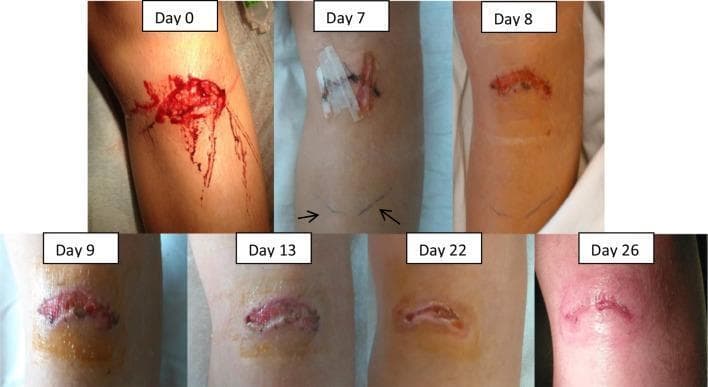
Hugging Face pmc clinical VQA raw
Page 0
GradeResponse
GradeResponse
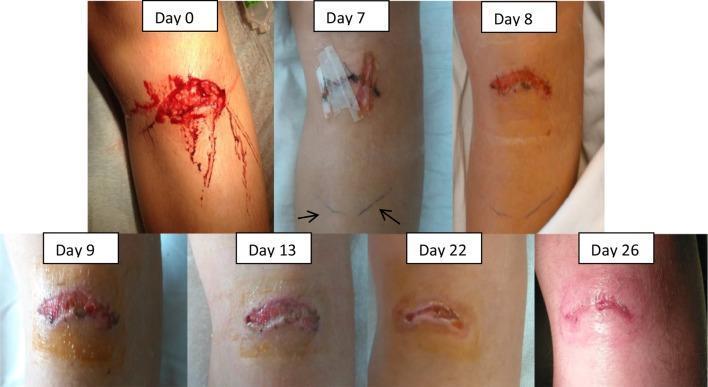
Wound Comparison — Day 1 vs. Day 4 (3 Days Apart)
Both images show an open wound on the lower leg (shin/anterior tibia region), being soaked in water. Here is a structured side-by-side comparison:
Visual Assessment
| Feature | Image 1 (Earlier) | Image 2 (3 Days Later) |
|---|---|---|
| Wound size | Larger, more open and gaping | Visibly smaller; wound margins have begun to contract |
| Wound bed | Significant red granulation tissue mixed with yellow slough/fibrin across the entire bed | Granulation tissue now more centrally concentrated; yellow slough still present but reduced in area |
| Edges/margins | Wound edges widely separated, everted, with surrounding pale/white macerated skin | Edges appear closer together; less maceration of surrounding skin |
| Periwound skin | Marked peri-wound erythema and bluish-purple discoloration (bruising/inflammation) extending broadly | Perilesional erythema and bruising still present but noticeably reduced in extent |
| Exudate | Yellow serous/seropurulent exudate visible at lower pole | Yellow exudate persists but appears less voluminous |
| Depth | Appears deeper, more cavitated | Wound bed appears slightly shallower — consistent with granulation tissue filling |
| Slough | Substantial white/yellow slough covering wound bed | Slough persists but is less dominant relative to red granulation tissue |
| Healing phase | Late inflammatory / early proliferative phase | Early-to-mid proliferative phase (granulation + early contraction) |
Interpretation
Positive signs of progression (Day 4 vs. Day 1):
- Wound contraction is occurring — the overall wound appears smaller
- Periwound inflammation has reduced
- Red granulation tissue is more prominent relative to slough, indicating active tissue repair (Bailey & Love's, p. 45)
- Less maceration of surrounding skin
- No obvious signs of spreading cellulitis or worsening infection between the two images
Ongoing concerns to monitor:
- Yellow slough remains in the wound bed — debridement (mechanical or autolytic) may be needed to fully clear it and promote granulation
- The wound is still open with significant depth; healing by secondary intention will continue but may be slow
- The soaking method (hydrotherapy) is being used, which can help loosen slough but should not be prolonged, as it can macerate peri-wound skin
- The residual purple/bruised discoloration at the wound margins needs monitoring — if it darkens or spreads, early ischemia or infection should be ruled out
Summary
The wound is showing early positive healing response over the 3-day interval. Wound contraction has begun, inflammation is subsiding, and granulation tissue is developing — all consistent with expected progression through the proliferative phase of wound healing (as seen in the reference image above, which documents a similar lower leg wound healing over 26 days). The yellow slough still present warrants ongoing wound care, ideally with appropriate dressings (e.g., hydrocolloid or antimicrobial dressings) to facilitate autolytic debridement.
Note: This is an observational image-based assessment only. Clinical evaluation by a wound care specialist or healthcare provider is essential for formal management decisions.
This is a shared conversation. Sign in to Orris to start your own chat.