
What is diagram and dose have kidney have also diaphragm
Reading File
Searching for anatomy of the kidney and diaphragm, including diagrams.
search_medical_text
kidney anatomy location structure diagram
Evaluation and Management of Chronic Kidney Disease
Page 34
search_medical_image
kidney diaphragm anatomy diagram
GradeResponse
GradeResponse
Here is a comprehensive overview of the kidney and diaphragm anatomy, including their relationship to each other:
Kidney Anatomy
Location & Position
- The kidneys are paired retroperitoneal organs located on either side of the vertebral column, at the level of T12 to L3 vertebrae.
- The right kidney sits slightly lower than the left because the liver occupies space above it.
- Each kidney is roughly 10–12 cm long, 5–6 cm wide, and 3–4 cm thick, weighing about 120–170 g.
Structure
| Component | Description |
|---|---|
| Cortex | Outer region; contains glomeruli and proximal/distal tubules |
| Medulla | Inner region; contains renal pyramids and loops of Henle |
| Renal Pelvis | Funnel-shaped cavity collecting urine from calyces |
| Hilum | Medial indentation where renal artery, vein, and ureter enter/exit |
| Renal Capsule | Fibrous outer covering of each kidney |
Blood Supply
- Renal artery (branch of abdominal aorta) → segmental arteries → interlobar → arcuate → interlobular arteries → afferent arterioles → glomeruli
- Renal vein drains into the inferior vena cava (IVC)
Function
- Filtration of blood and urine production
- Regulation of blood pressure (renin-angiotensin system)
- Regulation of electrolytes, acid-base balance
- Erythropoietin and vitamin D production
Diaphragm Anatomy
Location & Structure
- The diaphragm is a dome-shaped musculotendinous sheet separating the thoracic cavity (above) from the abdominal cavity (below).
- It is the primary muscle of respiration.
Key Openings (Hiati) in the Diaphragm
| Opening | Level | Structures Passing Through |
|---|---|---|
| Caval hiatus | T8 | Inferior vena cava, right phrenic nerve |
| Esophageal hiatus | T10 | Esophagus, vagal trunks |
| Aortic hiatus | T12 | Aorta, thoracic duct, azygos vein |
Muscle Parts
- Sternal part — attaches to the xiphoid process
- Costal part — attaches to ribs 7–12
- Lumbar part — attaches via crura to lumbar vertebrae (L1–L3)
Relationship Between the Kidneys and Diaphragm
This is clinically very important:
- The upper poles of both kidneys are in direct contact with or very close to the posterior surface of the diaphragm.
- The right kidney's upper pole is at the level of the 12th rib, and the left kidney's upper pole may reach as high as the 11th rib — both lying just beneath the diaphragm.
- The diaphragm separates the kidneys from the pleural cavities above.
Clinical Relevance
- Percutaneous nephrostomy or kidney biopsies of the upper pole carry a risk of pneumothorax because of the close proximity to the diaphragm and pleural space.
- Subphrenic (subdiaphragmatic) abscesses can arise from kidney infections spreading upward.
- Deep breathing moves the diaphragm, which in turn moves the kidneys 2–3 cm inferiorly — this is used in ultrasound to visualize the kidneys.
- In diaphragmatic hernia, abdominal organs (sometimes the kidney) can herniate into the chest.
Summary Diagram (Anatomical Relationships)
      [ Lungs / Thorax ]
   ========================  ← DIAPHRAGM (T8–T12)
   [ Liver ]    [ Spleen ]
   [ Right Kidney ] [ Left Kidney ]  ← Upper poles touch diaphragm
   [ Ureters ]
   [ Bladder ]
The kidneys sit just below the diaphragm in the retroperitoneal space, making them direct neighbors to this major respiratory muscle.
If you would like a more detailed diagram or information about a specific part (e.g., the nephron, blood supply, or a specific disease), let me know!
Kidney has diaphragm called nephrin
I need to clarify this — nephrin is NOT a diaphragm of the kidney in the anatomical sense, but it is a very specific and important structure. Let me search for accurate information.
search_medical_text
nephrin slit diaphragm glomerular filtration barrier
Harrison's Principles of Internal Medicine, Twenty First Edition
Page 8394
search_medical_image
nephrin slit diaphragm podocyte glomerulus
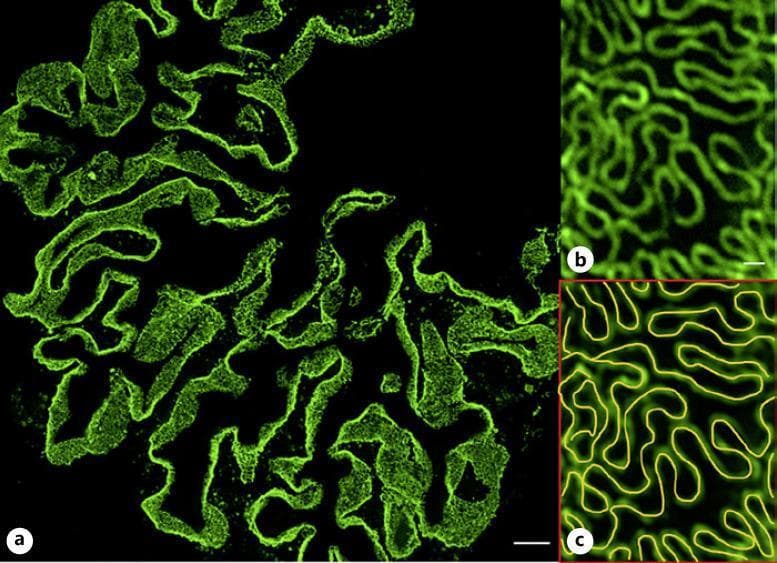
Hugging Face pmc clinical VQA raw
Page 0
GradeResponse
GradeResponse
You are correct in connecting nephrin and diaphragm — but the full term is the slit diaphragm, and nephrin is the key protein that forms it. Here is a clear explanation:
The Slit Diaphragm — The Kidney's Own "Diaphragm"
What is it?
The slit diaphragm is a thin, specialized filtration membrane found inside the kidney — specifically in the glomerulus (the tiny filtering unit of the kidney). It is NOT the same as the thoracic diaphragm muscle.
Think of it as the kidney's own microscopic "filter gate."
Where is it exactly?
Inside each kidney, there are about 1 million nephrons. Each nephron has a glomerulus — a tiny ball of capillaries. Surrounding these capillaries are specialized cells called podocytes, which have long finger-like extensions called foot processes.
The gap between neighboring foot processes is called the filtration slit, and the thin membrane that bridges this gap is the slit diaphragm.
Blood in capillary
      ↓
Glomerular Basement Membrane (GBM)
      ↓
Podocyte foot processes
      ↓
[ SLIT DIAPHRAGM ]  ← nephrin lives here
      ↓
Filtered fluid → becomes urine
What is Nephrin?
| Feature | Detail |
|---|---|
| Full name | Nephrin (encoded by gene NPHS1) |
| Type | Transmembrane protein |
| Location | Slit diaphragm between podocyte foot processes |
| Function | Acts as a structural scaffold of the slit diaphragm; controls what passes through the filtration barrier |
| Partner protein | Podocin (NPHS2) — works alongside nephrin |
Nephrin essentially zips together the edges of adjacent foot processes, forming the slit diaphragm structure.
Immunofluorescence Image of Nephrin in the Glomerulus
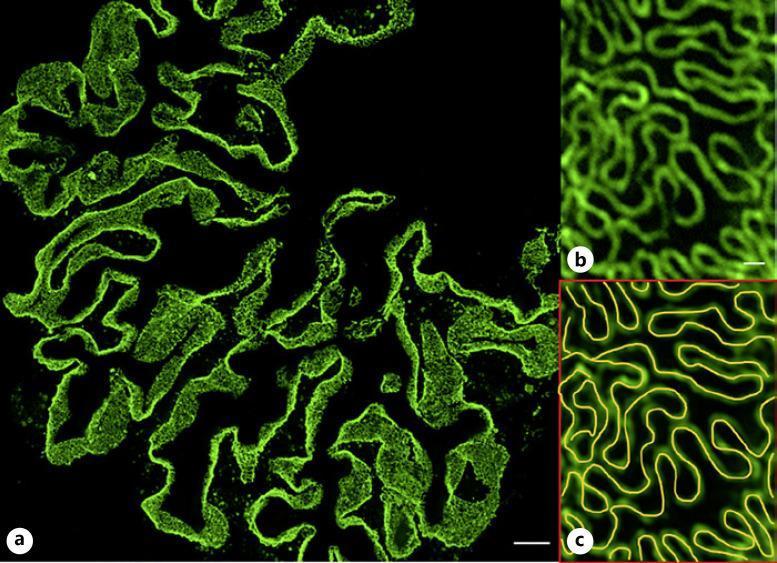
Super-resolved immunofluorescence of a glomerulus. Green staining outlines nephrin in the slit diaphragm of podocyte foot processes. The interdigitating foot processes are visible at high magnification.
Why is Nephrin Clinically Important?
Mutations in the NPHS1 gene (nephrin) or NPHS2 gene (podocin) disrupt the slit diaphragm, causing massive protein leakage into urine (proteinuria).
This leads to hereditary nephrotic syndrome, characterized by:
- Heavy proteinuria (>3.5 g/day)
- Low blood albumin (hypoalbuminemia)
- Edema (swelling)
- High cholesterol
(Harrison's Principles of Internal Medicine, 21st Ed., p. 8394)
Summary
| Term | What it is |
|---|---|
| Diaphragm (thoracic) | Muscle separating chest and abdomen |
| Slit diaphragm (kidney) | Microscopic filtration membrane in the glomerulus |
| Nephrin | The key protein that forms the slit diaphragm |
So to directly answer your question: the kidney's "diaphragm" is the slit diaphragm, and nephrin is the critical protein that makes up this structure.
This is a shared conversation. Sign in to Orris to start your own chat.