
Arterivenoous gradient in pregnancy
I'll look up the arteriovenous (A-V) gradient in pregnancy from the medical library.
Reading File
Now let me search the library for arteriovenous gradient in pregnancy:
Finding Sources
Finding Sources
Good - I found the key reference in Creasy & Resnik's Maternal-Fetal Medicine. Let me now search more specifically for A-V oxygen difference and cardiac output changes in pregnancy:
Finding Sources
Finding Sources
I found a dedicated section in Creasy & Resnik's. Let me read it:
Reading File
Reading File
Now let me search specifically for the A-V oxygen gradient/difference values and Fick's principle in pregnancy:
Finding Sources
Finding Sources
Let me now search the obstetric physiology chapters directly for the A-V oxygen gradient:
Finding Sources
Finding Sources
Let me read the relevant Creasy & Resnik cardiovascular physiology section and also search for the Fick principle context in pregnancy:
Finding Sources
Searching the Web
arteriovenous oxygen gradient pregnancy physiology narrowed decreased
The GLOWM source mentions the A-V oxygen difference specifically. Let me extract more detail from it and also fetch the image from Fishman's:
Reading Web Page
https://www.glowm.com/section-view/heading/Cardiorespiratory…
I now have comprehensive information to give a thorough answer. Let me compile it:
Arteriovenous (A-V) Oxygen Gradient in Pregnancy
The A-V oxygen difference (or A-V O₂ gradient) refers to the difference in oxygen content between arterial blood and mixed venous blood. By the Fick principle:
Cardiac Output (CO) = O₂ Consumption (VO₂) / A-V O₂ Difference
In pregnancy, understanding this gradient is key to the hemodynamic physiology of the mother.
What Happens to the A-V O₂ Gradient in Pregnancy?
The A-V oxygen difference is NARROWED (decreased) in early-to-mid pregnancy.
This is one of the hallmark hemodynamic changes and here is why:
Cardiac Output rises disproportionately compared to O₂ consumption
| Parameter | Change in Pregnancy |
|---|---|
| Cardiac Output | Increases ~40-50% by term |
| Plasma Volume | Increases ~40-50% |
| Oxygen Consumption (VO₂) | Increases ~20% above baseline at rest |
| Heart Rate | Increases 20-30 bpm |
| Systemic Vascular Resistance (SVR) | Decreases ~25-40% |
| A-V O₂ difference | Narrows (decreases) in early pregnancy |
Since CO rises by 40-50% but VO₂ only rises by ~20%, the denominator of the Fick equation (A-V O₂ difference) must fall. More blood flows per unit time through the tissues than they need to extract oxygen from - so venous blood returns richer in oxygen, narrowing the gap.
- Fishman's Pulmonary Diseases and Disorders states: cardiac output increases ~30-50% and oxygen consumption increases ~20% above prepregnancy levels.
- Creasy & Resnik's Maternal-Fetal Medicine notes: VO₂ at rest reaches ~331 mL/min at term (roughly 20% above nonpregnant baseline), while CO increases ~50%.
The "A-V Fistula" Analogy
The discrepancy between the large rise in cardiac output, the fall in peripheral vascular resistance, and the relatively modest rise in O₂ consumption was compared by Burwell (1954) to the hemodynamic picture of an arteriovenous fistula - high flow, low extraction, narrowed A-V gradient. This analogy highlights how early pregnancy seems to establish hyperdynamic circulation before fetal metabolic demands fully manifest. (GLOWM: Cardiorespiratory Physiology of Pregnancy)
Temporal Changes Through Gestation
- Early pregnancy: A-V O₂ difference is most narrowed. CO rises dramatically (begins by 5-8 weeks), but fetal demands are still small.
- Later pregnancy / term: As fetal oxygen consumption rises and uterine blood flow increases substantially, the A-V O₂ difference widens back toward nonpregnant levels.
- GLOWM: "The arteriovenous oxygen difference widens to nonpregnant levels later in pregnancy."
During Labor
- O₂ consumption increases 40-60% above resting pregnancy values during labor.
- CO increases a further ~22% in labor.
- With uterine contractions, O₂ consumption can triple.
- This means the A-V O₂ difference widens significantly during active labor, as tissue extraction increases faster than cardiac output can compensate.
- Creasy & Resnik's Maternal-Fetal Medicine, block 14 (p. ~3975): "During labor, oxygen consumption increases by 40% to 60%, and cardiac output increases by about 22%."
Clinical Significance
-
Compensatory reserve: In normal pregnancy, O₂ delivery far exceeds consumption due to the high CO, so the pregnant woman has significant reserve. However, this reserve depends critically on maintaining cardiac output.
-
Critical O₂ delivery threshold: If cardiac output is compromised (e.g., hemorrhage, severe aortocaval compression, cardiomyopathy), the pregnant patient can reach critical O₂ delivery much faster during labor because of the already narrowed reserve.
-
Hemodilution effect: Physiologic anemia of pregnancy reduces hemoglobin (and arterial O₂ content), but the high CO compensates. The pregnant patient depends on CO for O₂ delivery more than a nonpregnant patient - Creasy & Resnik's Maternal-Fetal Medicine.
-
Supine hypotension: IVC compression in the supine position reduces CO, which can rapidly widen the A-V gradient and impair O₂ delivery to both mother and fetus.
Summary Table
| Phase | A-V O₂ Difference | Mechanism |
|---|---|---|
| Early-mid pregnancy | Decreased (narrowed) | CO rises >> VO₂; AV fistula-like state |
| Late pregnancy (at term) | Returns toward normal | Rising fetal + uterine O₂ demand narrows the gap |
| Labor (active) | Increased (widened) | VO₂ rises 40-60%; CO increase is insufficient to match |
| Uterine contraction peak | Markedly widened | VO₂ triples during contractions |
Sources: Creasy & Resnik's Maternal-Fetal Medicine, block 14; Fishman's Pulmonary Diseases and Disorders, block 19; GLOWM Cardiorespiratory Physiology of Pregnancy; PMC Physiological Changes in Pregnancy
why does regurgitation improves and stenotic lesion worsens in pregnancy
The key is SVR and heart rate changes in pregnancy. Decreased SVR reduces afterload (helping regurgitation) but the high heart rate and increased CO across a fixed stenotic orifice worsen stenosis. Let me get the textbook detail.
Searching sources...
Finding Sources
Finding Sources
Excellent results. Let me now read the specific sections on aortic regurgitation, mitral stenosis, and the mechanism explanations:
Reading File
Reading File
Now let me get the mitral regurgitation section and the Fuster/Braunwald sections on the mechanisms:
Finding Sources
Reading File
I now have rich, authoritative content from multiple textbooks. Let me also read the regurgitant lesions section from Fuster:
Reading File
Reading File
I now have all the information needed for a comprehensive, well-cited answer. Here it is:
Why Regurgitant Lesions Improve and Stenotic Lesions Worsen in Pregnancy
The answer lies entirely in the hemodynamic physiology of pregnancy - particularly the fall in systemic vascular resistance (SVR), the rise in heart rate, and the increase in cardiac output and blood volume. These changes have opposing effects on regurgitation vs. stenosis.
The Core Pregnancy Hemodynamics (Recap)
| Parameter | Change |
|---|---|
| SVR (afterload) | Decreases 25-40% |
| Blood volume | Increases 40-50% |
| Cardiac output | Increases 40-50% |
| Heart rate | Increases 20-30 bpm |
| Diastolic filling time | Shortened (faster HR) |
Part 1: Why Regurgitant Lesions IMPROVE
The Mechanism - Reduced Afterload
In a regurgitant valve (mitral or aortic regurgitation), the key determinant of how much blood leaks back is afterload - specifically, how much resistance the left ventricle faces when trying to eject forward. The higher the resistance, the more blood takes the "path of least resistance" and leaks backward through the incompetent valve.
In pregnancy:
- SVR falls dramatically (25-40%)
- This fall in afterload means forward flow is favoured over regurgitant (backward) flow
- A greater proportion of LV stroke volume is directed forward into the aorta and systemic circulation
- The regurgitant fraction decreases
- Effective cardiac output and organ perfusion improve
"Regurgitant lesions are better tolerated than stenotic lesions due to the decrease in systemic vascular resistance during pregnancy."
- Fuster and Hurst's The Heart, 15th Ed.
"Chronic regurgitation lesions are well tolerated during pregnancy and may even improve because the reduced systemic vascular resistance of pregnancy allows more forward and less regurgitant flow."
- Rosen's Emergency Medicine
"Mitral and Aortic Regurgitation - The pregnancy-induced decrease in systemic vascular resistance reduces the risk of cardiac failure with these conditions."
- Harrison's Principles of Internal Medicine, 22E (2025)
"The reduction in systemic vascular resistance of pregnancy mitigates the consequences of mitral and aortic regurgitation and of the left-to-right intracardiac shunts."
- Murray & Nadel's Textbook of Respiratory Medicine
Additional benefit - Tachycardia
The increased heart rate shortens diastole - which is exactly when aortic regurgitation occurs (blood leaks back into the LV during diastole). A shorter diastole means less time for regurgitation per beat. This further reduces the regurgitant volume.
Note on Postpartum Risk
With delivery of the placenta, SVR suddenly normalizes while volume load remains high. The favourable low-afterload environment is abruptly lost. Women with regurgitant lesions are therefore at increased risk for postpartum heart failure due to this SVR rebound.
- Fuster and Hurst's The Heart, 15th Ed.
Part 2: Why Stenotic Lesions WORSEN
The Mechanism - Fixed Orifice + Increased Demand
In a stenotic valve (especially mitral stenosis), the valve opening is fixed and narrowed. The pressure gradient across the valve is governed by the Gorlin formula:
Pressure gradient ∝ (Flow)² / (Valve area)²
Since valve area is fixed, any increase in flow (cardiac output) causes a disproportionate and squared increase in the pressure gradient across the valve.
Pregnancy does exactly this - it mandates a 40-50% increase in cardiac output through an orifice that cannot widen.
The Three Culprits in Pregnancy
1. Increased Heart Rate
"The faster the heart rate, the less time in diastole, and the less time for ventricular filling; all lead to increased left atrial pressure and resultant exertional dyspnea."
- Creasy & Resnik's Maternal-Fetal Medicine
In mitral stenosis, ventricular filling must occur through a narrowed valve during diastole. Tachycardia shortens diastole - this is the exact time blood crosses the mitral valve - so the LV cannot fill adequately, and left atrial pressure builds dangerously.
2. Increased Blood Volume and Cardiac Output
- More blood must cross the stenotic valve per unit time
- In mitral stenosis: left atrial pressure rises sharply → pulmonary congestion → pulmonary edema
- About 50% of pregnant women with severe mitral stenosis develop pulmonary edema during pregnancy
- Creasy & Resnik's Maternal-Fetal Medicine
3. In Aortic Stenosis - The Coronary Steal Problem
"In aortic stenosis, the increase in cardiac output required for pregnancy worsens the gradient across the valve. As a compensatory mechanism, the left ventricular end-diastolic volume increases, but the low systemic vascular resistance impairs coronary artery filling during diastole and can precipitate ischemic syndromes."
- Murray & Nadel's Textbook of Respiratory Medicine
In aortic stenosis the LV is already pressure-overloaded and hypertrophied. The LV depends on adequate diastolic coronary perfusion pressure. The pregnancy-induced fall in SVR (while helpful for regurgitation) reduces diastolic blood pressure and thus coronary perfusion pressure, which can push the already-stressed myocardium into ischemia.
"Stenotic lesions, particularly those resulting in left heart obstruction, are often poorly tolerated and pose an increased risk for pregnancy-related cardiovascular complications."
- Fuster and Hurst's The Heart, 15th Ed.
Summary Table
| Feature | Regurgitation | Stenosis |
|---|---|---|
| SVR falls in pregnancy | Favourable - less regurgitant fraction | Dangerous in AS (reduced coronary perfusion) |
| Tachycardia | Favourable - shorter diastole = less regurgitation per beat | Dangerous - shorter diastole = less time to cross stenotic valve, LA pressure rises |
| Increased CO/blood volume | Manageable with low SVR | Dangerous - forces high flow through fixed orifice, gradient rises exponentially |
| Volume load | Can tolerate (volume lesion) | Cannot compensate (pressure/obstruction lesion) |
| Net effect | Tolerated well; may improve | Poorly tolerated; worsens progressively |
| High-risk period | Postpartum (SVR rebounds) | Third trimester & labour (peak CO) |
Sources: Creasy & Resnik's Maternal-Fetal Medicine; Fuster & Hurst's The Heart, 15th Ed.; Murray & Nadel's Respiratory Medicine; Rosen's Emergency Medicine; Harrison's Principles of Internal Medicine, 22E
keith wegner classification
The Keith-Wagener (not Wegner) classification grades hypertensive retinopathy on fundoscopic findings. Let me get the full textbook detail.
Searching sources...
Finding Sources
Finding Sources
Finding Sources
Finding Sources
Reading File
Finding Sources
Good. Now let me get the Robbins pathology detail on the retinal changes and also search for the full Keith-Wagener-Barker classification from internal medicine/ophthalmology sources:
Reading File
Finding Sources
Let me read the full Robbins section on hypertensive retinopathy and also fetch the retinal image:
Reading File
Loading Image
I have everything I need for a comprehensive answer. Here it is:
Keith-Wagener (Keith-Wagener-Barker) Classification of Hypertensive Retinopathy
First described by Norman Keith, Henry Wagener, and N.W. Barker in 1939, this is the classic grading system for fundoscopic changes in hypertension. It has two components that are often used together: hypertensive changes (vascular leakage) and arteriosclerotic changes (vessel wall thickening). Note: the name is "Wagener," not "Wegner."
"There is no universally accepted classification of fundus changes in hypertension."
- Textbook of Family Medicine, 9e
Component 1: Hypertensive Retinopathy Grades
These reflect active vascular damage from elevated blood pressure - spasm, exudate, and disc changes:
| Grade | Fundus Findings | Clinical Correlate |
|---|---|---|
| Grade I | Generalized attenuation (narrowing) of retinal arterioles | Mild, sustained hypertension; early arteriolar spasm |
| Grade II | More pronounced generalized attenuation + focal arteriolar narrowing (segmental spasm) | Moderate hypertension; increased wall tone |
| Grade III | Grade II changes + retinal exudates, cotton-wool spots (flame hemorrhages, hard exudates) | Severe hypertension; arteriolar wall breakdown, ischemia |
| Grade IV | Grade III changes + papilledema | Malignant/accelerated hypertension; raised ICP equivalent |
Grades I-II = benign hypertensive retinopathy Grades III-IV = malignant hypertensive retinopathy (Grade IV = hypertensive emergency)
Component 2: Arteriosclerotic Changes (Scheie's Arterial Grading)
These reflect chronic structural thickening of the arteriolar wall (independent of acute BP level):
| Grade | Arteriolar Appearance | Pathology |
|---|---|---|
| Grade I | Broadening of arteriolar light reflex; minimal A-V crossing defects | Early intimal thickening |
| Grade II | Increased arteriolar light reflex (bright reflex); A-V crossing (nipping) changes | Progressive wall thickening; vein compression at crossings |
| Grade III | Copper wire arterioles; marked A-V crossing changes (Gunn's sign) | Severe fibrosis; blood column still faintly visible through wall |
| Grade IV | Silver wire arterioles; severe A-V crossing changes | Complete obliteration of lumen - only thickened white wall visible |
Pathological Basis (from Robbins Pathology)
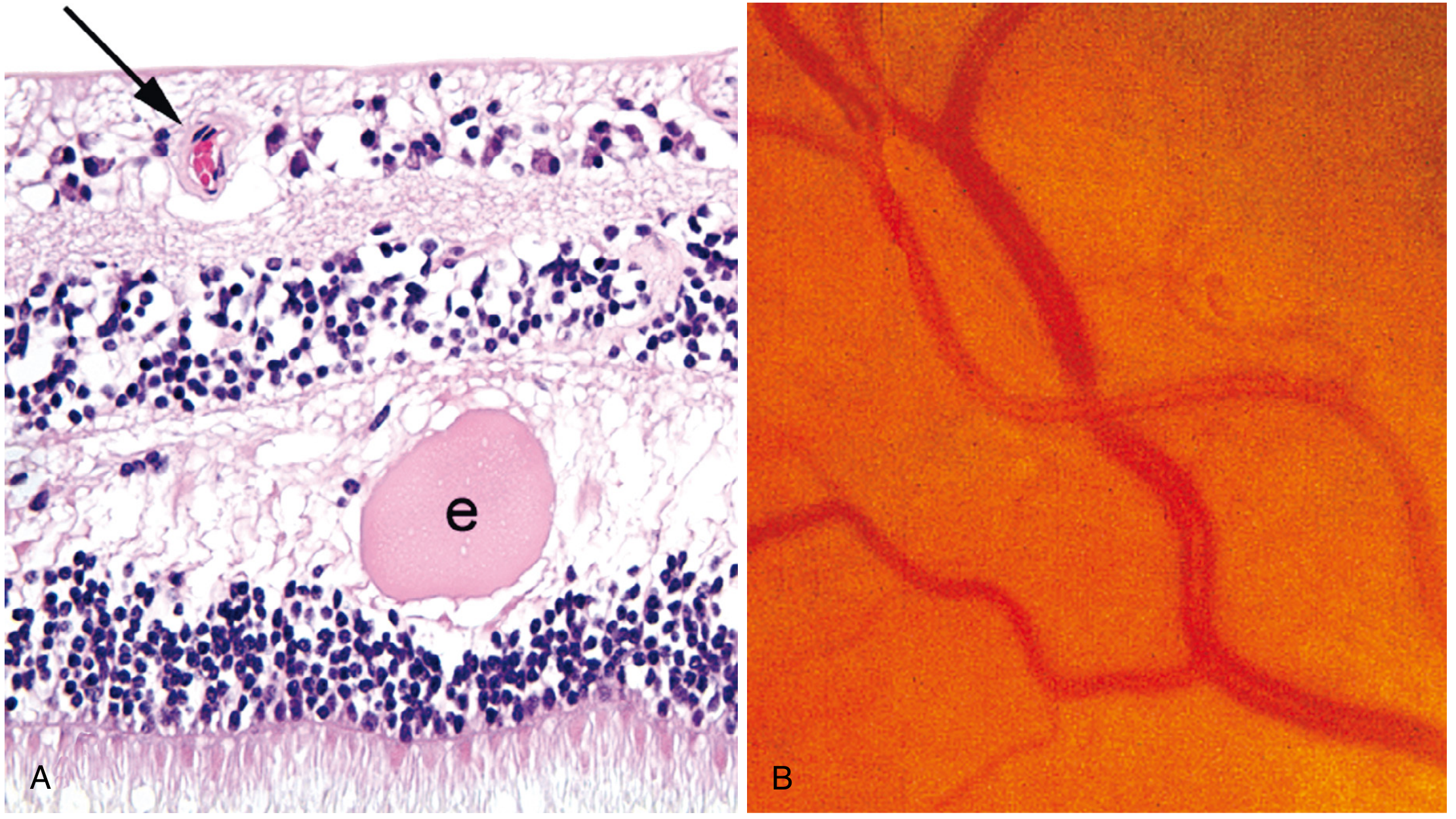
Fig: (A) Thickened retinal arteriolar wall with exudate (e) in outer plexiform layer. (B) Fundus showing copper-wire arterioles and vein compression at A-V crossing - Robbins Pathology
Why the colour changes:
- Normal: Transparent thin wall → bright red blood column visible
- Copper wire: Thickened wall reduces red saturation → copper/orange hue (blood still visible)
- Silver wire: Wall so thick the lumen appears obliterated → only a white/silver reflex visible
A-V nipping (Gunn's sign): Retinal arterioles and veins share a common adventitial sheath. When the arteriole thickens, it compresses the vein at crossing points. Venous stasis distal to these crossings can precipitate branch retinal vein occlusion.
Cotton-wool spots (Grade III): Infarcts of the retinal nerve fiber layer. Axoplasmic transport is interrupted at points of arteriolar occlusion, and accumulated mitochondria at swollen axonal ends create cytoid bodies - which appear as fluffy white patches on fundoscopy.
Macular star: In severe hypertension, exudate accumulating in the obliquely oriented outer plexiform layer of the macula forms a spoke-like star pattern around the fovea.
Clinical Significance
| Grade | BP Status | Action |
|---|---|---|
| I-II | Chronic mild-moderate HTN | Optimize BP control |
| III | Severe/uncontrolled HTN | Urgent BP reduction |
| IV (papilledema) | Hypertensive emergency | Immediate IV antihypertensive (nitroprusside/labetalol); target ~25% MAP reduction in first hour |
Sources: Textbook of Family Medicine, 9e; Robbins, Cotran & Kumar Pathologic Basis of Disease; Robbins & Kumar Basic Pathology
This is a shared conversation. Sign in to Orris to start your own chat.