
Basal ganglia physiology
I'll start by reading the medical library skill, then search for basal ganglia physiology content.
Reading File
Now I'll search for basal ganglia physiology in the library database and PubMed in parallel.
Finding Sources
Searching PubMed
"basal ganglia" AND physiology
Excellent sources found. Now I'll read the most authoritative physiology-focused sections in parallel - Ganong's, Costanzo, Neuroscience Exploring the Brain, and Kandel's Principles of Neural Science.
Reading File
Reading File
Reading File
Reading File
Good content. Now I'll read the detailed Ganong's section on circuitry, the Neuroscience Exploring the Brain section on direct/indirect pathways, and fetch the key diagrams.
Reading File
Reading File
Loading Image
Loading Image
Excellent - I have rich content from multiple authoritative sources. Let me read the direct/indirect pathway details from Neuroscience: Exploring the Brain and fetch the pathways diagram.
Reading File
Loading Image
Let me fetch the direct/indirect pathway diagram and read the dopamine modulation content.
Loading Image
Loading Image
Reading File
I now have comprehensive content from multiple authoritative sources. Let me compile the full response.
Basal Ganglia Physiology
1. Anatomy - Components and Nomenclature
The basal ganglia are a collection of deep nuclei in the telencephalon and closely associated subcortical structures. They include five major components on each side:
| Structure | Subdivision | Key Transmitter |
|---|---|---|
| Caudate nucleus | Part of striatum | GABA (medium spiny neurons) |
| Putamen | Part of striatum / lenticular nucleus | GABA |
| Globus pallidus (GPe + GPi) | Part of lenticular nucleus | GABA |
| Subthalamic nucleus (STN) | Diencephalon | Glutamate |
| Substantia nigra (SNpc + SNpr) | Midbrain | Dopamine (SNpc) / GABA (SNpr) |
Naming conventions:
- Striatum = caudate + putamen (main input structure)
- Lenticular nucleus = putamen + globus pallidus
- Corpus striatum = striatum + globus pallidus
The striatum contains ~95% medium spiny neurons (MSNs) using GABA, plus interneurons: large cholinergic, medium somatostatin, and small GABAergic cells.
Ganong's Review of Medical Physiology, 26th Ed.
Here is the anatomical layout:
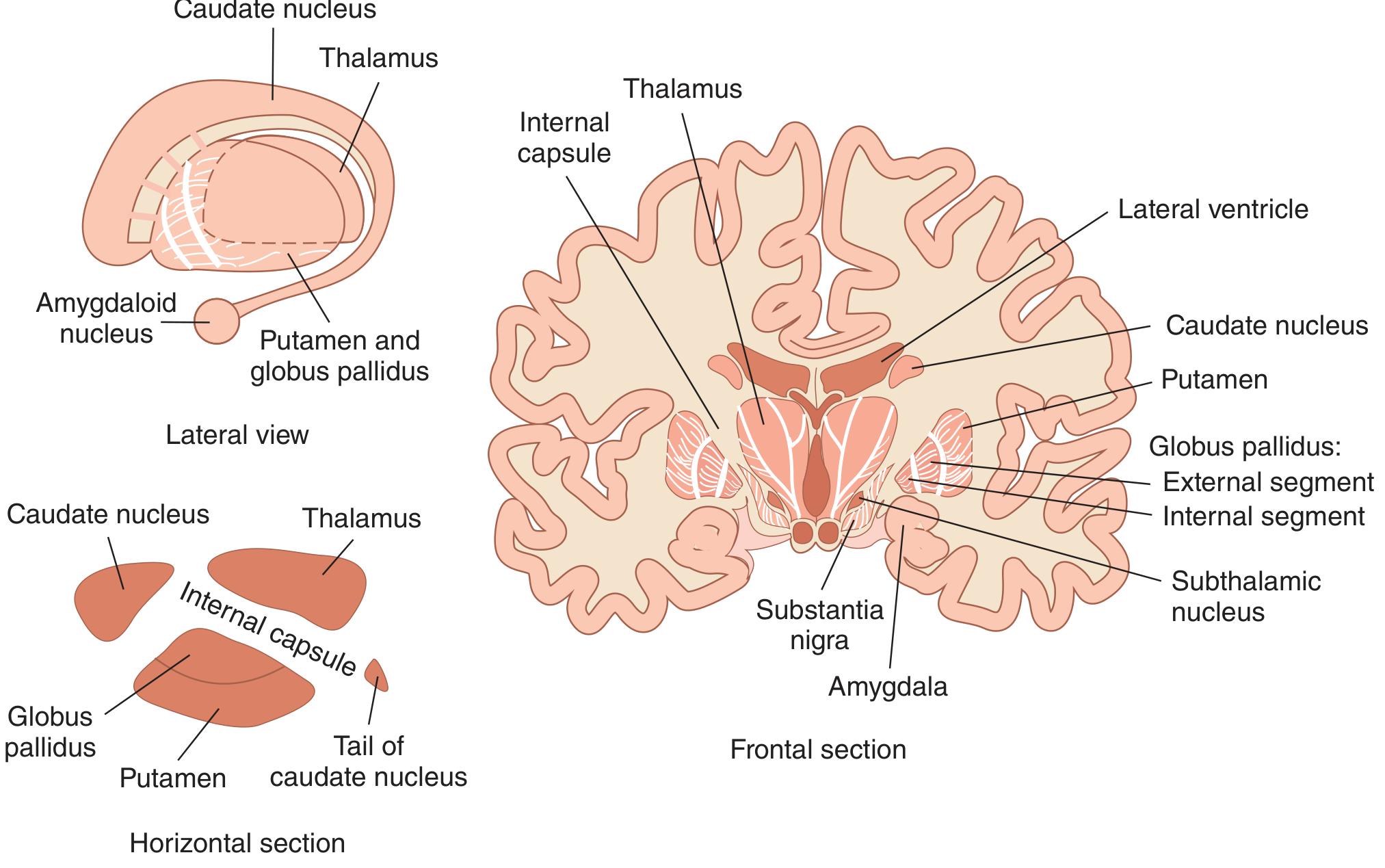
2. Inputs and Outputs
Inputs (both excitatory, glutamatergic, both to striatum):
- Corticostriatal pathway - from widespread cerebral cortex (especially frontal, prefrontal, parietal, and motor cortex)
- Thalamostriatal pathway - from intralaminar nuclei of the thalamus
Outputs (both inhibitory, GABAergic):
- GPi (internal segment of globus pallidus) → thalamus (VA/VL nuclei)
- SNpr (substantia nigra pars reticulata) → thalamus and brainstem
The thalamus then sends excitatory (glutamatergic) feedback to the motor cortex (especially the supplementary motor area, SMA).
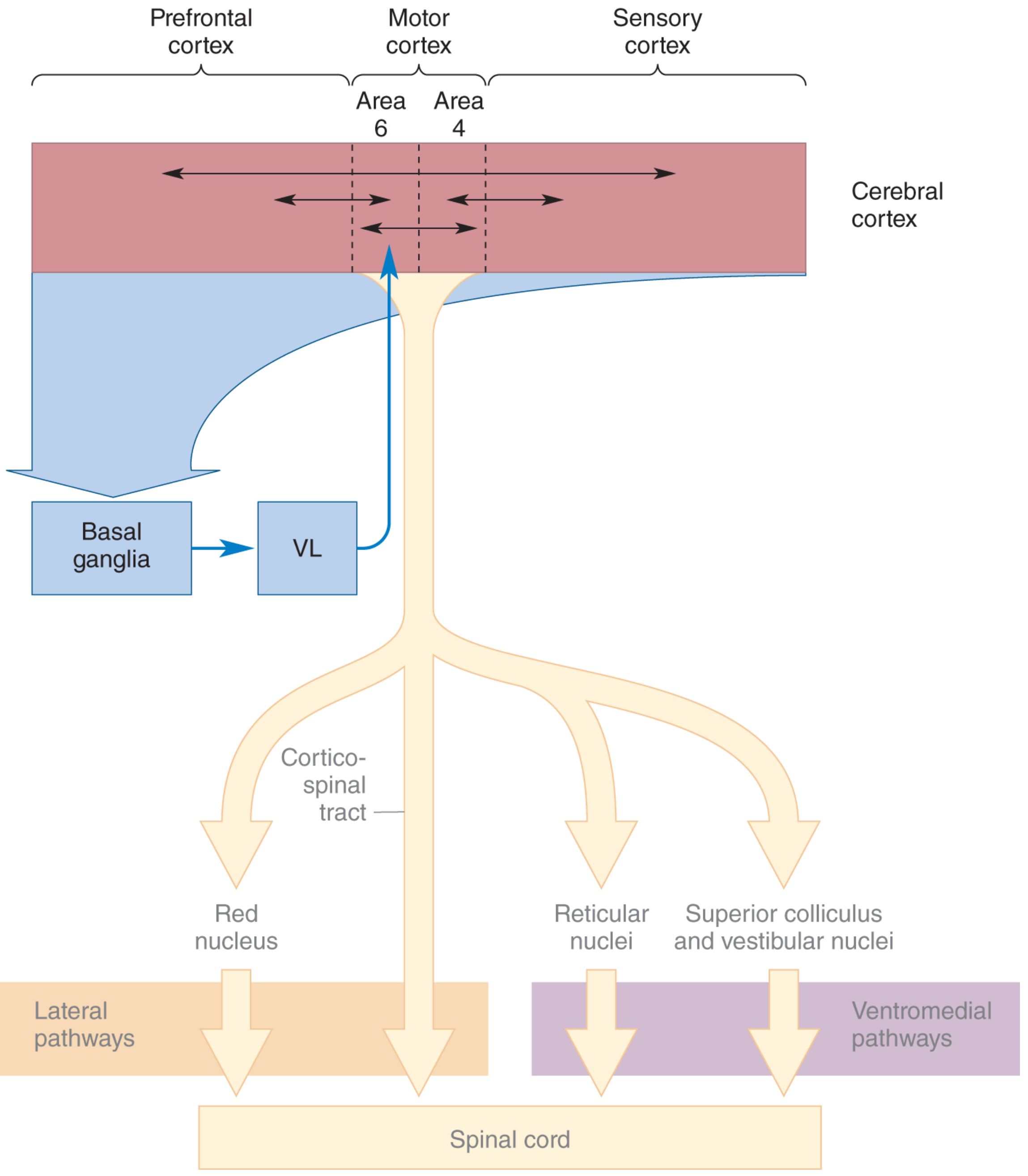
Overall architecture: A massive re-entrant loop: Cortex → Striatum → Basal ganglia output nuclei → Thalamus → Cortex.
3. Place in the Motor Hierarchy
The basal ganglia sit at the highest level of the motor hierarchy, concerned with strategy - the goal of movement and which movement best achieves that goal. In contrast:
- Motor cortex and cerebellum = tactics (sequences and timing)
- Brainstem and spinal cord = execution
Neuroscience: Exploring the Brain, 5th Ed.
4. The Two Pathways: Direct vs. Indirect
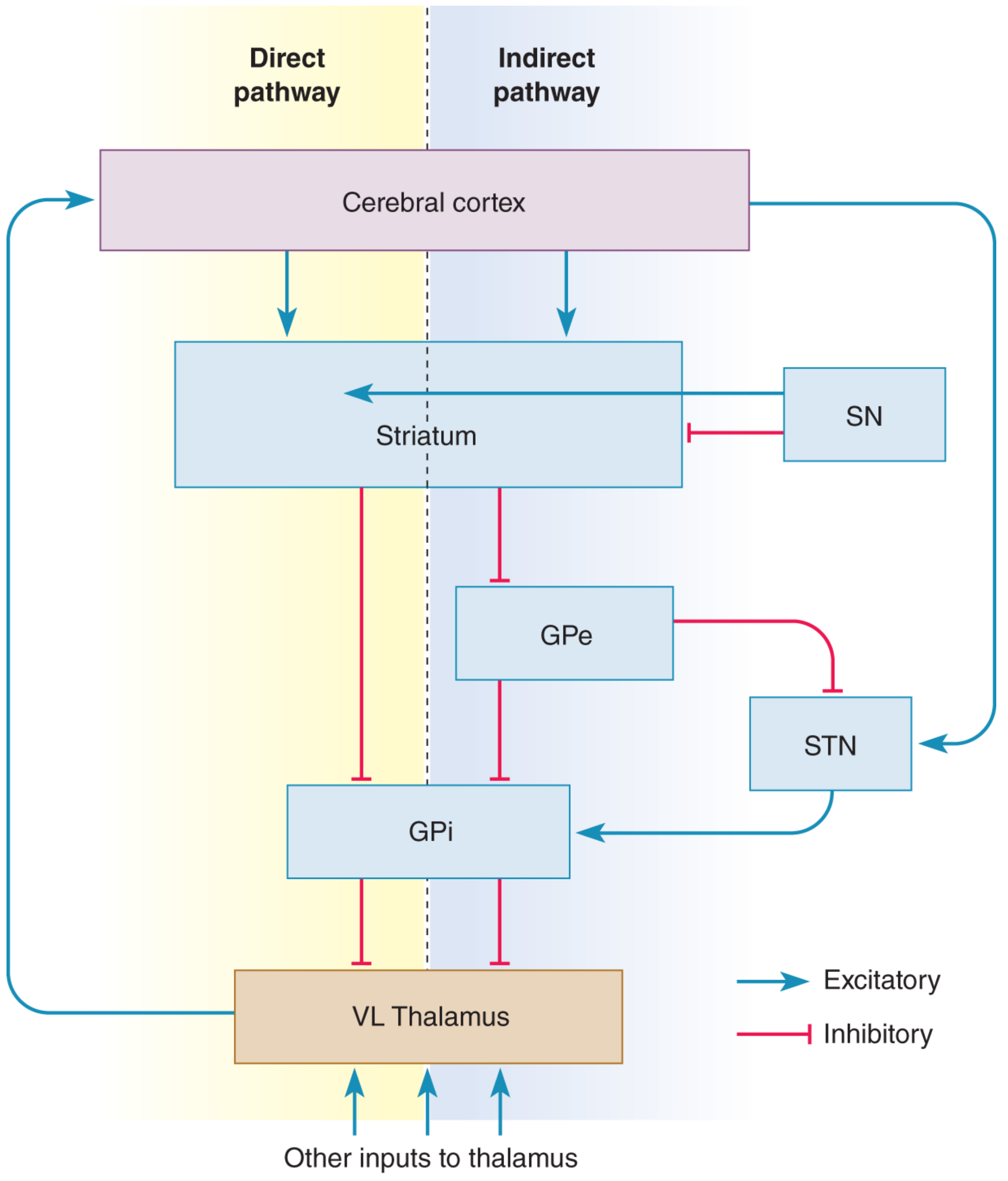
This is the central concept of basal ganglia physiology. Both pathways run in parallel from the cortex through the striatum to ultimately regulate the motor thalamus (VL).
Direct Pathway ("Go" signal - net excitatory)
Cortex (Glu+) → Striatum → GPi/SNpr (GABA-) → Thalamus → Cortex (SMA)
Step-by-step:
- Cortex excites striatal MSNs (glutamate)
- Striatal MSNs inhibit GPi (GABA)
- GPi neurons are tonically active at rest and normally suppress the thalamus
- Striatal inhibition of GPi releases the thalamus from inhibition ("disinhibition")
- Thalamus activates SMA - movement is facilitated
Net effect: Cortical activation → facilitation of movement (excitatory net output)
Indirect Pathway ("No-go" signal - net inhibitory)
Cortex (Glu+) → Striatum → GPe (GABA-) → STN (Glu+) → GPi/SNpr → Thalamus (suppressed)
Step-by-step:
- Cortex excites striatal MSNs
- Striatal MSNs inhibit GPe (GABA)
- GPe normally inhibits STN; striatal inhibition of GPe releases STN
- STN fires and excites GPi (glutamate)
- Excited GPi strongly inhibits thalamus
- Thalamus cannot activate SMA - movement is suppressed
Net effect: Cortical activation → inhibition of movement (inhibitory net output)
The two pathways operate together: direct pathway selects and facilitates desired motor programs, while the indirect pathway suppresses competing, unwanted motor programs - essentially a motor "spotlight" or "focusing" mechanism.
5. Dopaminergic Modulation - The Nigrostriatal System
The SNpc sends dopaminergic projections to the striatum. Dopamine has opposite effects on the two pathways via different receptor subtypes:
| Receptor | Pathway | Effect of Dopamine | Net Effect |
|---|---|---|---|
| D1 (on direct pathway MSNs) | Direct | Excitatory (facilitates) | Promotes movement |
| D2 (on indirect pathway MSNs) | Indirect | Inhibitory (suppresses) | Reduces brake on movement |
Result: Dopamine amplifies the direct pathway and dampens the indirect pathway - both effects favor movement facilitation.
There is reciprocal connectivity: striatum sends GABAergic projections back to SNpr, and there is a glutamatergic STN → SNpc projection as well.
Costanzo Physiology, 7th Ed.
Here is the complete connection diagram with neurotransmitters:
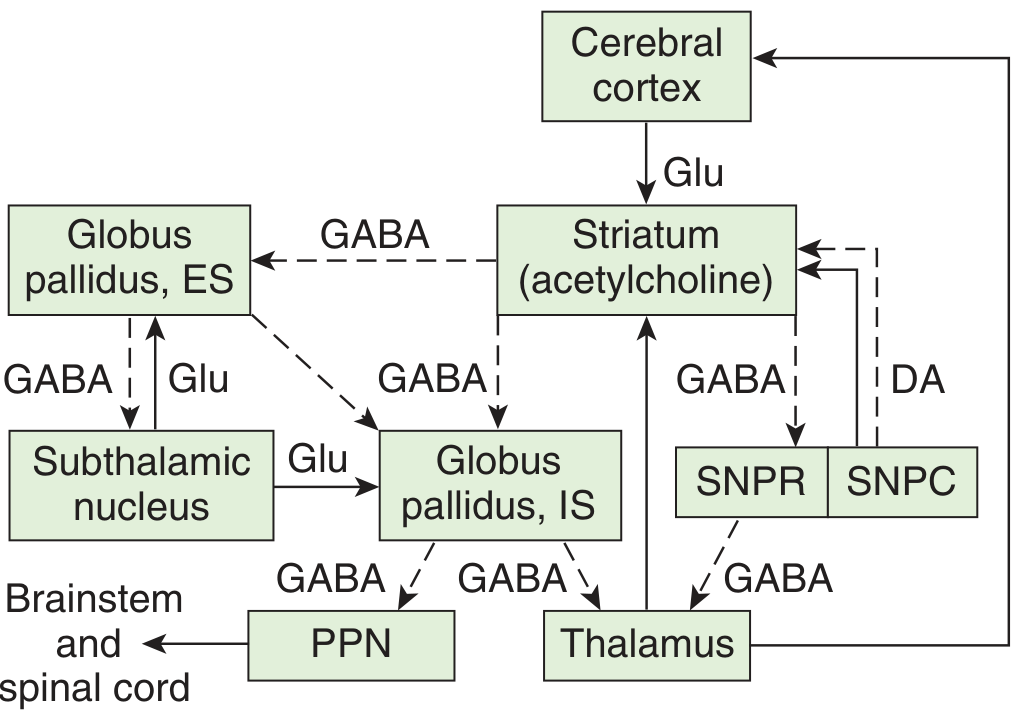
6. The "Hyperdirect" Pathway (Additional Circuit)
In addition to the two classic pathways, there is a hyperdirect pathway:
Cortex → STN (direct cortical glutamatergic input) → GPi
This bypasses the striatum entirely and provides the fastest cortical signal to the output nuclei. It is thought to mediate rapid global suppression of motor activity - a "global stop" signal that prevents premature responses.
7. Disinhibition - The Core Mechanism
A key physiological principle is disinhibition: the basal ganglia exert their net excitatory effect on the thalamus not by direct excitation but by removing tonic inhibition. At rest, the GPi/SNpr fire tonically and hold the thalamus under inhibition. When the direct pathway is activated, this tonic inhibition is lifted and the thalamus can fire.
8. Functional Territories (Beyond Motor)
The basal ganglia participate in multiple parallel circuits, not just motor:
| Circuit | Cortical Origin | Function |
|---|---|---|
| Sensorimotor | Motor/somatosensory cortex | Movement planning, execution |
| Associative/Cognitive | Prefrontal cortex, caudate | Working memory, executive function, decision-making |
| Limbic | Anterior cingulate, orbitofrontal | Motivation, emotion, reward |
The caudate nucleus in particular plays roles in cognitive processes; lesions disrupt object reversal and delayed alternation tasks. Left caudate lesions can cause a dysarthric aphasia resembling Wernicke aphasia.
9. Three Balanced Biochemical Systems
Normal basal ganglia function depends on balance among three systems (Ganong's):
- Nigrostriatal dopaminergic system (SNpc → striatum)
- Intrastriatal cholinergic system (large aspiny interneurons)
- GABAergic system (striatum → GPe, GPi, SNpr)
Disruption of any one system produces characteristic movement disorders.
10. Disorders and Their Physiological Basis
| Disease | Lesion | Pathway Effect | Clinical Features |
|---|---|---|---|
| Parkinson's disease | SNpc degeneration; dopamine loss | Direct pathway weakened + indirect pathway overactive → GPi hyperactive → thalamus over-inhibited | Bradykinesia, akinesia, rigidity, resting tremor (hypokinetic) |
| Huntington's disease | Striatal/cortical cholinergic + GABAergic neurons destroyed | Indirect pathway lost → GPe overactive → STN inhibited → GPi under-active → thalamus disinhibited | Choreiform movements, dementia (hyperkinetic) |
| Hemiballismus | STN lesion | STN no longer excites GPi → GPi under-active → thalamus disinhibited | Violent flailing movements of contralateral limbs (hyperkinetic) |
Hypokinetic disorders = too much GPi output (too much thalamic inhibition)
Hyperkinetic disorders = too little GPi output (thalamus insufficiently inhibited)
11. Action Selection - The Broader Concept
A unifying theory from Kandel's Principles of Neural Science proposes that the basal ganglia function as an action selection mechanism. All vertebrates face competition between multiple behavioral options. The architecture - widespread cortical input converging onto striatum, focused output from GPi/SNpr - is configured to pick one behavior from several competing candidates. Dopamine mediates reinforcement learning within this selection architecture via phasic signals encoding prediction errors.
Eric Kandel, Principles of Neural Science, 6th Ed.
Summary Table: Key Transmitters
| Pathway | Neurotransmitter | Effect |
|---|---|---|
| Cortex → Striatum | Glutamate | Excitatory |
| Cortex → STN (hyperdirect) | Glutamate | Excitatory |
| Striatum → GPe (indirect) | GABA | Inhibitory |
| Striatum → GPi/SNpr (direct) | GABA | Inhibitory |
| GPe → STN | GABA | Inhibitory |
| STN → GPi/SNpr | Glutamate | Excitatory |
| GPi/SNpr → Thalamus | GABA | Inhibitory (tonic) |
| Thalamus → Cortex | Glutamate | Excitatory |
| SNpc → Striatum (D1 MSNs) | Dopamine | Excitatory |
| SNpc → Striatum (D2 MSNs) | Dopamine | Inhibitory |
| Striatal interneurons | Acetylcholine | Local modulation |
Sources: Ganong's Review of Medical Physiology 26th Ed.; Costanzo Physiology 7th Ed.; Neuroscience: Exploring the Brain 5th Ed.; Kandel's Principles of Neural Science 6th Ed.; Adams and Victor's Principles of Neurology 12th Ed.
This is a shared conversation. Sign in to Orris to start your own chat.