
Lung zone and pneumonic
I'll start with a quick answer, then pull detailed content from the medical library.
The lung has distinct zones based on the relationship between arterial pressure (Pa), alveolar pressure (PA), and venous pressure (Pv). The classic mnemonic is the West Zones (1-4), describing blood flow distribution. Zone 1: PA > Pa > Pv (no flow), Zone 2: Pa > PA > Pv (intermittent flow), Zone 3: Pa > Pv > PA (continuous flow), Zone 4: Pa > Pv > PA but with extra-alveolar vessel compression (reduced flow).
Searching sources...
Reading File
Now searching the medical library and for relevant images in parallel:
Finding Sources
Finding Sources
Searching Images
West zones of lung blood flow distribution diagram
Good - I found textbook content with diagrams. Let me read the detailed sections and fetch the images:
Reading File
Reading File
Excellent content. Now let me fetch the key diagram and also read a bit more about Zone 4:
Loading Image
Reading File
I now have everything needed for a thorough answer. Here is the full breakdown:
West Zones of the Lung
The Classic Diagram
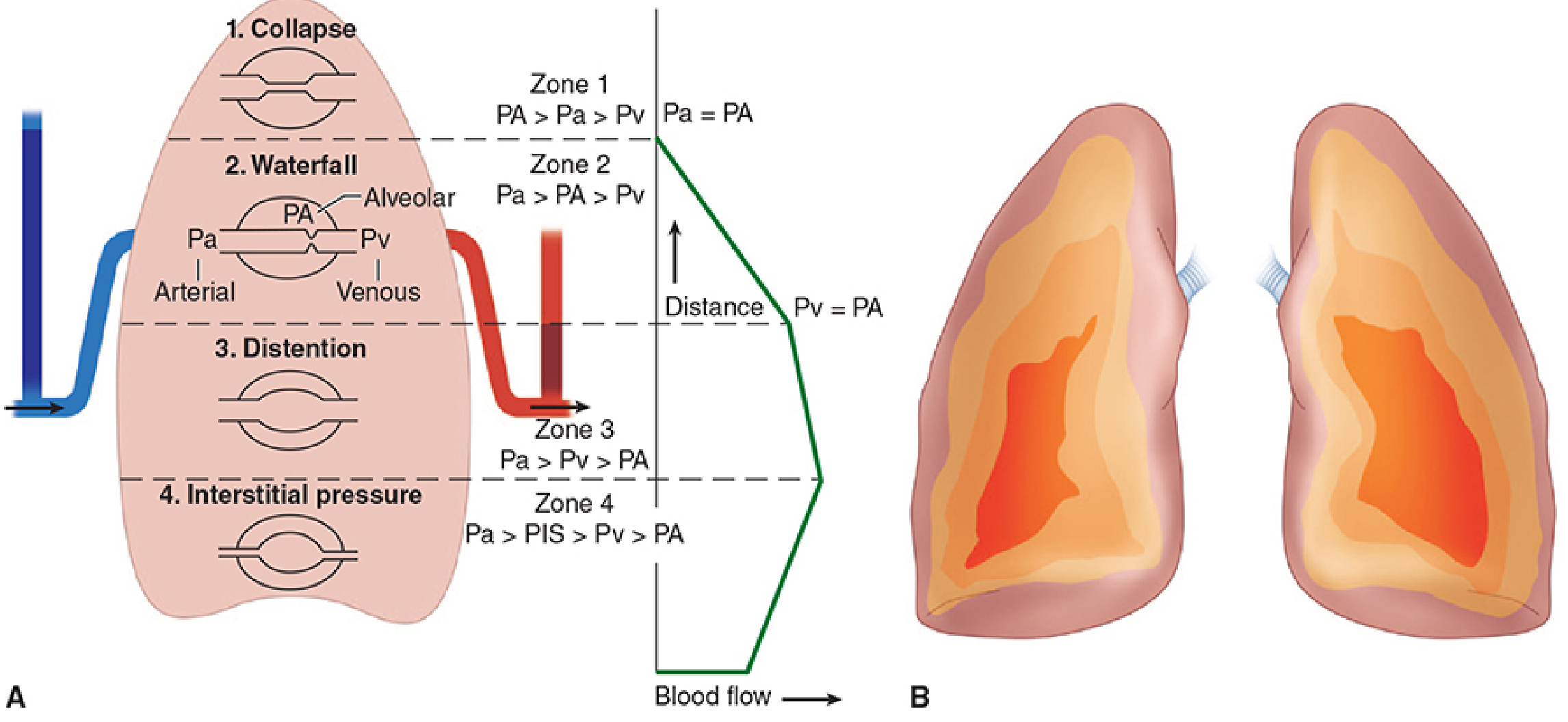
From Morgan & Mikhail's Clinical Anesthesiology, 7e - Figure 23-15. Left (A): Classic 4-zone model in upright lung. Right (B): "Onion-like" in vivo perfusion scanning showing central-to-peripheral distribution in addition to the gravitational gradient.
The Core Concept
Pulmonary blood flow is non-uniform. Dependent (lower) areas of the lung receive more blood flow than non-dependent (upper) areas, due to a gravitational gradient of ~1 cm H₂O per cm lung height. The low-pressure pulmonary circulation is very susceptible to this gravity effect. The interplay between three pressures determines flow in each region:
| Symbol | Meaning |
|---|---|
| Pa | Pulmonary arterial pressure |
| PA | Alveolar pressure |
| Pv | Pulmonary venous pressure |
| PIS | Pulmonary interstitial pressure (Zone 4) |
The 4 West Zones
Zone 1 - Apex (Top) - "Collapse" / Dead Space
Pressure relationship: PA > Pa > Pv
- Alveolar pressure exceeds arterial pressure - capillaries are compressed and collapsed
- No blood flow - creates alveolar dead space (ventilated but not perfused)
- In healthy people, Zone 1 is very small (Pa is just barely able to reach the apex)
- Enlarges with: positive pressure ventilation (raises PA), hypovolemia/hemorrhage (reduces Pa)
Mnemonic for Zone 1: "No flow at the TOP" - Dead zone, Dead space
Zone 2 - Middle - "Waterfall" / "Sluice"
Pressure relationship: Pa > PA > Pv
- Arterial pressure now exceeds alveolar, so capillaries open
- But PA > Pv, so the vessel behaves like a Starling resistor (collapsible tube in a pressure chamber)
- Flow is determined by Pa - PA (NOT Pa - Pv)
- Also called the "waterfall effect" - flow is independent of downstream (venous) pressure
- Blood flow increases going downward because Pa increases with gravity while PA stays constant
- Comprises most of the lung in upright position
Mnemonic for Zone 2: "Waterfall" - flow depends on Artery minus Alveolus
Zone 3 - Base - "Distention" / Continuous Flow
Pressure relationship: Pa > Pv > PA
- Both Pa and Pv exceed alveolar pressure - continuous blood flow
- Flow is now determined by Pa - Pv (the normal driving pressure)
- Blood flow still increases going downward, but now because of progressive capillary distension (and recruitment) as transmural pressure rises - not because of increased driving pressure
- Largest zone; most perfused; most efficient gas exchange
Mnemonic for Zone 3: "Distention" - flow depends on Artery minus Vein (normal)
Zone 4 - Most Dependent Base - "Interstitial pressure"
Pressure relationship: Pa > PIS > Pv > PA
- The extra-alveolar vessels (not alveolar capillaries) become narrow because alveoli at the very base are less expanded (due to the weight of the lung above)
- Increased contribution of extra-alveolar vascular resistance = reduced blood flow despite high Pa
- Flow depends on Pa - PIS (interstitial pressure, not alveolar)
- Worsened by: low lung volume, interstitial edema (cuffing of vessels), vasoconstrictors (serotonin)
- Improved by: vasodilators (isoproterenol), increased lung volume
Mnemonic for Zone 4: "Interstitial squeeze" - flow drops at the very Bottom
Master Mnemonic Table
| Zone | Location | Relationship | Flow | Key Feature |
|---|---|---|---|---|
| 1 | Apex | PA > Pa > Pv | None | Dead space |
| 2 | Mid | Pa > PA > Pv | Intermittent / "Waterfall" | Pa - PA drives flow |
| 3 | Base | Pa > Pv > PA | Continuous | Pa - Pv drives flow; distension |
| 4 | Most dependent | Pa > PIS > Pv > PA | Reduced | Extra-alveolar compression |
Useful Mnemonics
"1 has Nothing, 2 is Waterfall, 3 is Distended, 4 is Interstitial"
For pressure order memory (Zones 1 → 3):
- Zone 1: Alveolar biggest → "1 is the lone alveolus crushing everything"
- Zone 2: Artery > Alveolus > Vein → "AaV = Artery Alone Victorious (over alveolus and vein)"
- Zone 3: Artery > Vein > Alveolus → "AVA = Artery Vein Alveolus (both vascular > alveolar)"
"No Water Distends Interstitium" → Zone 1 (No flow), 2 (Waterfall), 3 (Distention), 4 (Interstitial pressure)
Clinical Relevance
| Clinical Scenario | West Zone Effect |
|---|---|
| Positive pressure ventilation (PPV) | Expands Zone 1 (raises PA) → more dead space |
| Hypovolemia / shock | Expands Zone 1 (reduces Pa) → dead space ↑ |
| PA catheter tip placement | Ideal position = Zone 3 (wedge pressure accurately reflects LAP only in Zone 3) |
| Interstitial pulmonary edema | Expands Zone 4 upward; may invert flow (apex > base) |
| Lateral decubitus position | Dependent lung = Zone 3-dominant (better perfused); useful for unilateral lung disease |
| Mitral stenosis (chronic) | Zone 4 expansion → blood flow inverted (apex > base on scan) |
Sources:
- Morgan & Mikhail's Clinical Anesthesiology, 7e, pp. 943-944
- Murray & Nadel's Textbook of Respiratory Medicine, pp. 226-228 (West JB, Dollery CT, Naimark A, J Appl Physiol 1964)
This is a shared conversation. Sign in to Orris to start your own chat.