
How to use minoxidil for women with significant hairless who is planning to get pregnant 2 years later
Reading File
Finding Sources
Finding Sources
Finding Sources
Searching PubMed
minoxidil pregnancy female pattern hair loss
Searching the Web
minoxidil women hair loss pregnancy planning safety stop before conception
Reading File
Reading File
Minoxidil for Female Pattern Hair Loss When Planning Pregnancy in ~2 Years
Since conception is a while off, this patient has a fairly wide window to actually treat the hair loss now, but the plan needs a built-in taper strategy well before she starts trying to conceive.
1. What minoxidil is approved/used for in women
- Topical: 2% solution and 5% foam are FDA-approved for female androgenetic alopecia (AGA); 5% solution is approved for men only but is often used off-label in women with more severe loss - Katzung's Basic and Clinical Pharmacology, p. 1926; Dermatology 2-Volume Set, p. 2197.
- Oral low-dose minoxidil: increasingly used off-label for AGA in women, typical doses 0.625-2.5 mg/day (lower than the 0.625-5 mg/day range used in men) - Dermatology 2-Volume Set, p. 2953.
- Mechanism: shortens telogen (resting) phase, prolongs anagen (growth) phase, and can increase follicle size. Expect a paradoxical shedding phase around 3-6 weeks after starting, which resolves with continued use - Dermatology 2-Volume Set, p. 2953.
2. The pregnancy issue - why this matters for her specifically
- Animal reproduction studies with oral minoxidil have shown adverse effects on the ability to conceive and on offspring survival, but there are no adequate controlled studies in pregnant women - Dermatology 2-Volume Set, "Use in pregnancy," p. 4347. This is the classic basis for minoxidil's older FDA Pregnancy Category C rating.
- Because human safety data are incomplete (not because harm has been clearly demonstrated), the standard of care is precautionary: avoid minoxidil during pregnancy, both oral and topical.
- Real-world/clinical guidance (consistent across dermatology sources): there is no good evidence that current, ordinary use of minoxidil impairs fertility or harms a pregnancy conceived while briefly overlapping with use - but it should not be continued once conception is being actively attempted or once pregnancy occurs.
3. Practical plan for the next 2 years
Now through the "actively trying" phase (most of the 2 years):
- She can use topical 2% or 5% minoxidil (or low-dose oral minoxidil if a dermatologist prescribes it) as normal treatment for her hair loss.
- Use reliable contraception throughout this period, since the drug is not meant to be used in pregnancy.
- If oral minoxidil is used, routine blood pressure/heart rate monitoring is reasonable given its vasodilator, antihypertensive mechanism - side effects include headache, hypertrichosis (unwanted facial/body hair, more noticeable in women), lightheadedness, periorbital edema, and rarely more significant cardiovascular effects - Katzung's, p. 3168; Dermatology 2-Volume Set, p. 2953.
Tapering off before conception attempts (roughly 1-3 months prior, per current dermatology practice):
- Topical minoxidil: most dermatologists recommend stopping at least a few weeks to about 1 month before actively trying to conceive.
- Oral minoxidil: because systemic exposure and effects on offspring were shown in animal data, a longer lead-out (commonly 2-3 months) before conception attempts is more conservative practice.
- There is no rigid, universally mandated washout period backed by controlled human trials - these intervals are precautionary consensus from clinical dermatology sources, not FDA-mandated windows.
Once actively trying / if pregnancy occurs:
- Discontinue minoxidil completely. If she conceives while still using it (e.g., before a missed period is noticed), stopping immediately once pregnancy is confirmed is the standard recommendation; there isn't clear evidence of harm from brief inadvertent early exposure, but continued use during pregnancy is not advised.
- Other common FPHL adjuncts also need to stop for pregnancy: spironolactone (antiandrogen) and oral finasteride/dutasteride are contraindicated in pregnancy (finasteride has teratogenic potential for a male fetus given its effect on DHT-dependent genital development) - Dermatology 2-Volume Set, p. 2955.
- Options that remain reasonably safe to continue through pregnancy/trying-to-conceive if she wants ongoing management: low-level laser therapy and general nutritional support (iron, vitamin D, biotin if deficient) - these don't carry the same reproductive-safety concerns.
4. Bottom line for her specifically
Because pregnancy is 2 years away, she does not need to avoid minoxidil now. A reasonable, commonly used approach:
- Start/continue topical (or dermatologist-guided oral low-dose) minoxidil now, with reliable contraception.
- Re-evaluate with her dermatologist roughly 1-3 months before she plans to start actively trying to conceive, and taper off at that point (topical needs a shorter lead-out than oral).
- Stop immediately if pregnancy is confirmed or suspected, and avoid restarting until she is done breastfeeding, since data during lactation are also insufficient.
- This plan should be confirmed with her treating dermatologist/OB, particularly if she's on oral minoxidil, since dosing and monitoring should be individualized.
Evidence check: A parallel PubMed search of recent trials/reviews on minoxidil in female pattern hair loss (2021-2025) confirms it remains a first-line/adjunct treatment (including growing use of low-dose oral minoxidil and combinations with spironolactone or topical estradiol), but none of these recent studies address pregnancy safety directly - human pregnancy safety data are still lacking, which is why the precautionary approach above stands. No systematic reviews or meta-analyses in the last 2 years contradict this.
Treatment for severe hair loss for girl aged 26years
Finding Sources
Finding Sources
Finding Sources
Finding Sources
Searching PubMed
female pattern hair loss treatment guideline
Finding Sources
Finding Sources
Finding Sources
Searching Images
Ludwig scale female pattern hair loss severity grading
Loading Image
Treatment for Severe Female Pattern Hair Loss (Age 26)
Since this continues the same clinical picture (26-year-old woman, significant/severe hair loss, planning pregnancy in ~2 years), here is the full treatment ladder used for severe androgenetic alopecia (female pattern hair loss, FPHL) in a young woman, with the pregnancy timeline factored in.
1. Confirm severity and rule out mimics first
Severe/rapidly progressive diffuse hair loss in a 26-year-old should not be assumed to be pure androgenetic alopecia without a basic work-up, because several conditions look similar or can be superimposed:
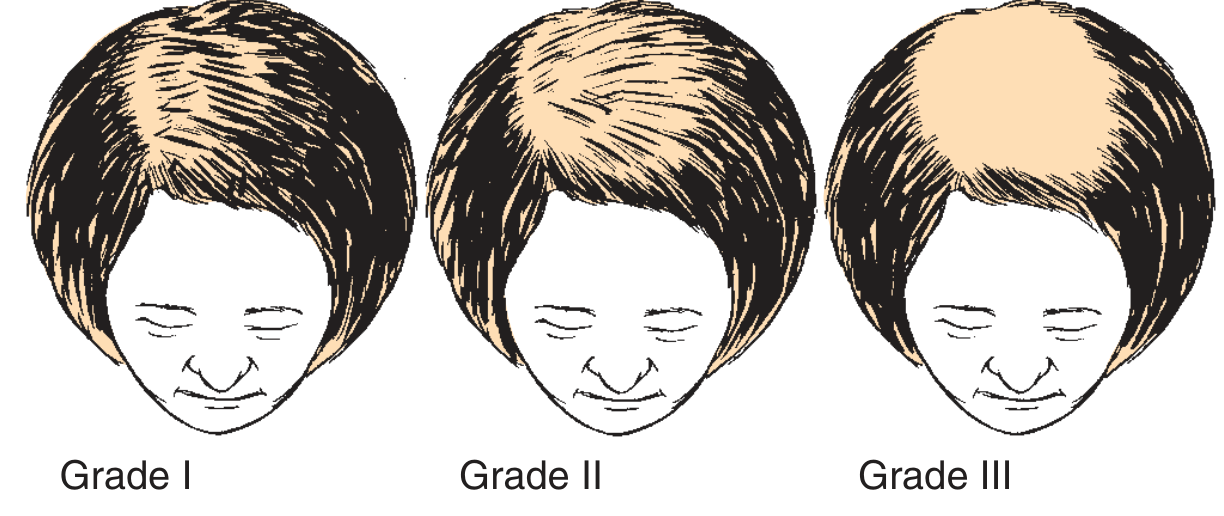
- Ludwig scale (3 grades) or Sinclair scale (5 grades) to grade the pattern - severe FPHL typically corresponds to Ludwig Grade III (diffuse thinning with a see-through crown) - Dermatology 2-Volume Set, p. 2870.
- Differentials/co-existing causes to exclude, especially since severity is significant: telogen effluvium (post-illness, postpartum, crash dieting), iron deficiency, thyroid dysfunction, and alopecia areata incognita/diffuse alopecia areata - these can mimic or worsen FPHL and need labs (ferritin, TSH ± free T4, sometimes androgen panel if hyperandrogenism signs like acne/hirsutism/irregular periods are present) - Fitzpatrick's Dermatology, p. 4611; Dermatology 2-Volume Set, p. 2175.
2. First-line: Topical minoxidil
- 5% foam (approved for both men and women) rather than 2% is generally preferred for more severe cases - Dermatology 2-Volume Set, p. 2197.
- Expect a shedding phase at 3-6 weeks, response visible by 4-6 months, and it must be continued indefinitely to maintain benefit.
3. Second-line, for severe/refractory cases: Oral therapy
- Low-dose oral minoxidil: 0.625-2.5 mg/day in women, increasingly used and often more effective than topical for severe disease - Dermatology 2-Volume Set, p. 2953.
- Anti-androgens - used especially if there's a hyperandrogenic component:
- Spironolactone 50-200 mg/day, off-label - Goodman & Gilman's, p. 2635.
- Cyproterone acetate - shown superior to minoxidil when hyperandrogenism signs (hyperseborrhea, other virilization features) are present - Andrews' Diseases of the Skin, p. 3542.
- Critical for her specifically: both spironolactone and cyproterone acetate require reliable contraception and must be stopped well before conception attempts (spironolactone can feminize a male fetus; anti-androgens carry teratogenic risk). Oral finasteride is generally not effective in women at standard doses and is contraindicated without strict contraception.
- Combination low-dose oral minoxidil + spironolactone has shown good results in trials and is a common regimen for moderate-severe FPHL - Cummings Otolaryngology, p. 2603.
4. Procedural/adjunct options (evidence updated recently)
- Platelet-rich plasma (PRP): a 2024 systematic review/meta-analysis of RCTs found PRP effective for female hair loss (PMID: 39177365) - consistent with textbook coverage of PRP as monotherapy or combined with microneedling/minoxidil - Andrews' Diseases of the Skin, p. 3545-3566.
- Microneedling + PRP + topical minoxidil combination outperforms minoxidil alone in some trials.
- Low-level laser therapy (LLLT): a 2024 systematic review supports efficacy for hair loss in general, including women (PMID: 34546105/2024) - a good non-hormonal option that's also safe to continue while trying to conceive or during pregnancy.
- Mesotherapy (intradermal minoxidil injections): a 2023 systematic review found it a reasonable adjunct but with less robust evidence than PRP or minoxidil (PMID: 37558233).
- Hair transplantation: possible in women but technically harder than in men because female thinning is usually diffuse rather than patterned, making donor-area selection difficult; it's reserved for stable, well-selected cases and often combined with medical therapy postoperatively - Goldman-Cecil Medicine, p. 1392; Dermatology 2-Volume Set, p. 2134-2142.
5. Practical treatment plan given her 2-year pregnancy timeline
| Timing | Reasonable approach |
|---|---|
| Now (severe FPHL, not yet trying) | Topical 5% minoxidil + consider low-dose oral minoxidil ± spironolactone if hyperandrogenic features present, plus PRP/microneedling if desired for faster/greater density gain. Reliable contraception mandatory while on spironolactone/oral minoxidil. |
| ~3-6 months before actively trying | Reassess with dermatologist; plan taper of spironolactone/anti-androgens and oral minoxidil. |
| Actively trying to conceive / pregnancy | Stop all systemic hormonal/vasodilator agents. Continue only LLLT and nutritional correction (iron, vitamin D, thyroid optimization) if deficient - these are safe throughout. |
This is a staged approach: treat aggressively now for 1.5+ years, then de-escalate to pregnancy-safe options (LLLT, nutrition) in the final months before conception. A dermatologist should individualize dosing and confirm there's no underlying hyperandrogenism (e.g., PCOS) that would also need addressing before pregnancy planning.
This is a shared conversation. Sign in to Orris to start your own chat.