
Etiology of buerger's disease
Buerger's disease (thromboangiitis obliterans) is strongly linked to tobacco use. The core etiology involves tobacco-induced endothelial injury and immune-mediated inflammation of small-to-medium vessels, leading to occlusive thrombi. Genetic susceptibility (HLA-A9, HLA-B5) and hypercoagulability also play roles.
Searching sources...
Reading File
Finding Sources
Finding Sources
Reading File
Reading File
Reading File
Reading File
Reading File
Loading Image
Here is a detailed account of the etiology of Buerger's disease (thromboangiitis obliterans), compiled from multiple authoritative textbooks:
Etiology of Buerger's Disease (Thromboangiitis Obliterans)
Overview
The exact etiology of TAO remains unknown, but it is one of the most clearly tobacco-associated vascular diseases in medicine. It is defined as a nonatherosclerotic, segmental, occlusive inflammatory disease of small- to medium-sized vessels.
1. Tobacco Use (Essential Factor)
Tobacco use is considered a prerequisite for the diagnosis of Buerger's disease. The association extends to all forms of tobacco:
- Cigarettes (most common)
- Cigars
- Smokeless/chewing tobacco
- Snuff
Although a direct causal relationship has not been formally established, tobacco use is indispensable for both diagnosis and disease progression. Complete cessation leads to disease remission; continued use drives progression toward gangrene and amputation. - Current Surgical Therapy, 14e
The incidence in women has risen to nearly 20%, paralleling increasing tobacco use among women.
2. Endothelial Dysfunction and Direct Toxicity
Tobacco causes endothelial cell (EC) dysfunction, manifesting as:
- Reduced endothelium-dependent vasodilation
- Release of prothrombotic substances
The prevailing hypothesis is direct EC toxicity caused by one or more components of tobacco. An alternative mechanism proposes that a reactive compound in tobacco modifies vessel wall components to trigger an immune response. - Robbins & Kumar Basic Pathology
3. Immune-Mediated Mechanism
- Most patients with Buerger's disease are hypersensitive to tobacco extracts on intradermal testing
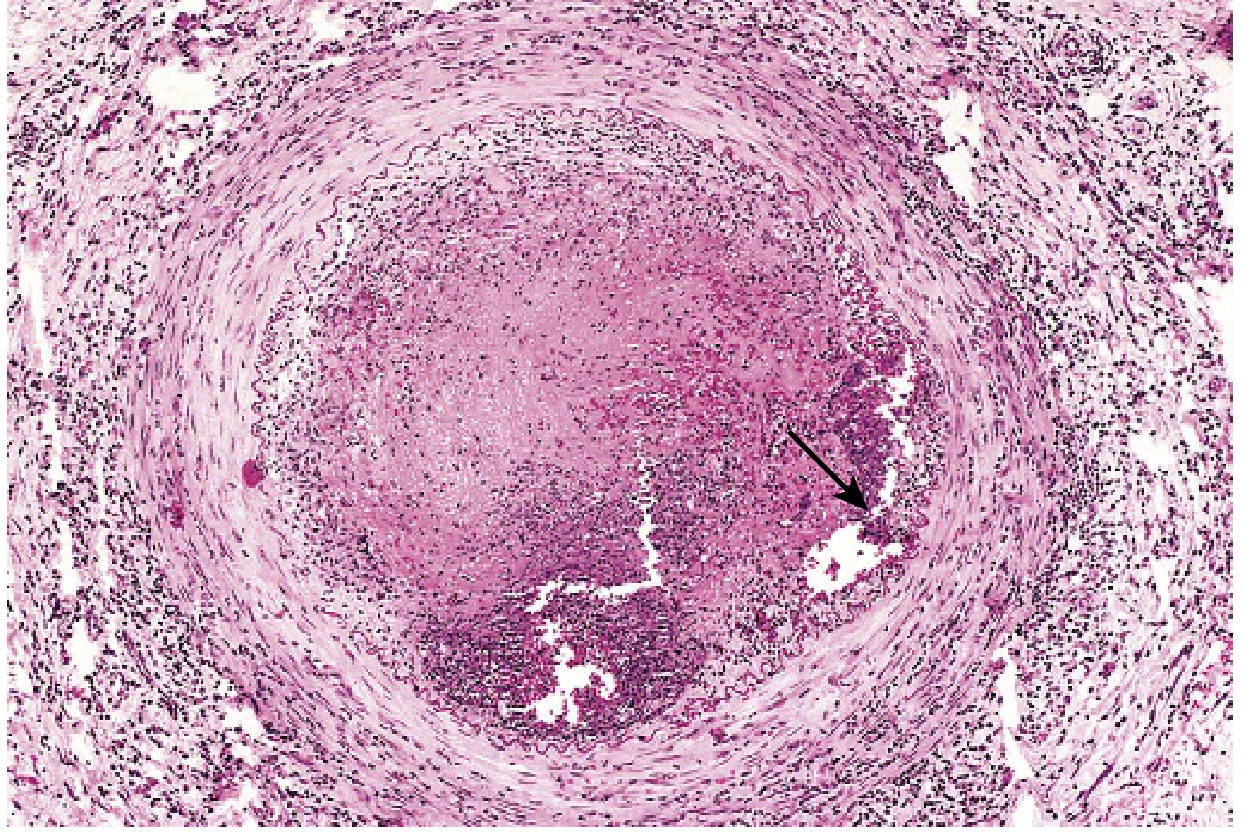
- The inflammatory infiltrate in the thrombus is characteristically cellular - with polymorphonuclear (PMN) leukocytes, microabscesses, and multinucleated giant cells
- This pattern suggests an immune-mediated hypersensitivity response to tobacco antigens rather than simple toxic injury
- The vessel wall is notably preserved (unlike in other vasculitides), with inflammation confined largely to the thrombus - which is distinctive
4. Genetic Predisposition
- An association has been noted with certain HLA haplotypes: particularly HLA-A9 and HLA-B5
- This genetic predisposition may explain why only a subset of smokers develop TAO
- Supports the hypothesis that genetically susceptible individuals mount an aberrant immune response to tobacco antigens - Robbins & Kumar Basic Pathology
5. Hypercoagulable State / Prothrombotic Tendency
- Endothelial injury leads to release of prothrombotic substances, promoting intraluminal thrombosis
- The thrombus is highly cellular (rather than bland), with microabscesses - a hallmark distinguishing TAO from simple thrombosis
- Over time, thrombi organize and recanalize, eventually resulting in fibrosis of the artery and adjacent structures
6. Pathological Features Supporting Etiology
The histopathology reflects the underlying immune-inflammatory etiology:
| Stage | Findings |
|---|---|
| Early/acute | Inflammatory thrombus with PMN aggregation, microabscesses, occasional granulomatous inflammation rimming abscesses |
| Subacute | Decreased hypercellularity, beginning recanalization |
| Late/chronic | Organized thrombus, vessel fibrosis, encasement of adjacent veins and nerves |
Key distinguishing point: Unlike most vasculitides, the vessel wall architecture is preserved - inflammation is primarily within the thrombus, not the wall itself. - Schwartz's Principles of Surgery, 11e
Histopathology of Buerger's disease - The image below (from Robbins & Kumar Basic Pathology) shows the lumen occluded by a thrombus containing a sterile microabscess (arrow), with leukocytic infiltration of the vessel wall:
Summary Table
| Etiological Factor | Role |
|---|---|
| Tobacco (all forms) | Essential; required for diagnosis; drives progression |
| Endothelial dysfunction | Reduced vasodilation; prothrombotic state |
| Direct tobacco toxicity | Damages endothelial cells; initiates inflammatory cascade |
| Immune hypersensitivity | Hypersensitivity to tobacco extracts; cellular thrombus with abscesses |
| Genetic (HLA-A9, HLA-B5) | Predisposes susceptible individuals |
| Prothrombotic state | Segmental intraluminal thrombosis of small/medium vessels |
Key clinical correlate: The strong link between tobacco cessation and disease remission - no progression with tissue loss in patients who stop smoking (Oregon Health Sciences Center data) - is the most compelling indirect evidence that tobacco is not merely associated but is the active driver of disease. - Schwartz's Principles of Surgery, 11e
This is a shared conversation. Sign in to Orris to start your own chat.