
PROTEIN IN URINE (PROTEINURIA) Normal Protein Excretion * Normal urinary protein excretion = ≤150 mg/day * Proteins with MW <50,000–60,000 Da pass through GBM and are reabsorbed by proximal tubules * Only very small amount of albumin (MW 69,000 Da) is filtered * Tamm-Horsfall glycoprotein (uromucoid) * Secreted by: * Distal tubular cells * Ascending loop of Henle * Forms ≥1/3 of normal urinary protein ⸻ Proteinuria Definition * Presence of detectable protein in urine * Indicates renal disease, especially glomerular injury * If urine is turbid → filter or centrifuge before testing ⸻ Methods for Detection of Proteinuria 1. Reagent Strip Method 2. Heat & Acetic Acid Test 3. Sulfosalicylic Acid Test 4. Heller’s Test Note * Reagent strip → mainly detects albumin * Acid precipitation methods → detect all proteins ⸻ 1. Reagent Strip Method Principle * Based on protein error of pH indicators * Proteins carry charge at physiologic pH → produce pH change * Color change of indicator indicates presence of protein Reagent * Tetrabromophenol blue OR * Tetrachlorophenol-tetrabromosulfophthalein * Buffered at pH 3.0 Reaction * No protein → strip remains yellow * Protein present → indicator-protein complex forms * Color changes to green/bluish-green * Shade depends on type & concentration of protein Result * Color develops in 30–60 seconds * Reported as: * Negative * Trace * 1+ * 2+ * 3+ * 4+ Sensitivity * Detects 5–20 mg albumin/dL ⸻ 2. Heat & Acetic Acid Test Principle * Heat causes protein coagulation & precipitation * Acetic acid enhances coagulation Procedure * Take 5 mL test tube * Fill 2/3 with urine * If urine alkaline → add few drops of 3% acetic acid * Boil upper portion for 2 minutes * Lower portion acts as control * If turbidity appears → add few drops of 3% acetic acid Interpretation * Turbidity disappears after acetic acid → Phosphates present * Turbidity persists after acetic acid → Proteins present Nature of Test * Semiquantitative * Graded from: * Trace * 1+ * 2+ * 3+ * 4+ ⸻ Acetic Acid Test for Bence-Jones Protein Procedure * 5 mL clear urine * Add 1 mL acetate buffer * Heat in water bath with thermometer Characteristic Finding * Starts precipitating at 40°C * Complete precipitation at 58°C * Dissolves when heated >60°C * Reappears on cooling to 40–60°C Best Detection Method * Protein electrophoresis ⸻ 3. Sulfosalicylic Acid Test Detects * Albumin * Globulin * Glycoproteins * Bence-Jones proteins Principle * Cold precipitation of proteins by strong acid Advantage * More sensitive & reliable than heat-acetic acid test Procedure * Take 2.5 mL urine * Add 2.5 mL of 3% sulfosalicylic acid slowly * Wait 10 minutes Interpretation * Cloudy precipitate → proteins present Limitation * Also precipitates: * Mucus * Bence-Jones proteins ⸻ 4. Heller’s Test Principle * Cold precipitation of proteins by strong acid Procedure * Take 5 mL urine * Add few drops of concentrated nitric acid Interpretation * White ring at urine-acid junction → Protein present Precaution * Filter turbid urine before testing ⸻ Quantitative Estimation of Urinary Protein Esbach’s Albuminometer Indications * Nephrotic syndrome * Protein >3.5 g/24 hr * Orthostatic/Postural proteinuria Principle * Cold precipitation of proteins by strong acid Procedure * Fill urine up to mark U * Add Esbach’s reagent up to mark R * Contains: * Picric acid * Citric acid * Stopper and mix * Keep for 24 hours * Read precipitate level * Divide reading by 10 Result * Gives percentage of total urinary proteins ⸻ Categories of Proteinuria According to Amount Heavy * 4 g/day Moderate * 1–4 g/day Mild * <1 g/day ⸻ According to Site/Cause 1. Renal * Glomerular * Tubular 2. Prerenal 3. Postrenal ⸻ Types of Glomerular Proteinuria Selective Proteinuria * Leakage of intermediate-sized proteins (<100 kDa) * Examples: * Albumin * Transferrin Nonselective Proteinuria * Leakage of proteins of different sizes * Includes larger proteins * Example: * Immunoglobulins ⸻ Bence-Jones Protein Definition * Light chains of immunoglobulins Seen In * Multiple myeloma * Macroglobulinemia * Lymphoma Characteristic Property * Precipitates at 40–60°C * Dissolves near 100°C * Reappears on cooling to 40–60°C ⸻ Microalbuminuria Definition Albumin in urine: * Above normal level * Below detection limit of routine tests Diagnostic Criteria Persistent urinary albumin excretion: * 20–200 mg/L OR * 20–200 µg/min * In early morning urine sample Significance * Indicates early and potentially reversible glomerular damage Detection Methods * Immunologic methods (antibodies) * Nephelometry * Immunoassay * Protein strip electrophoresis * HPLC ⸻ Causes of Microalbuminuria Diabetes Mellitus * Associated with ↑ cardiovascular mortality * Risk factor for renal mortality * Early predictor of diabetic nephropathy Essential Hypertension * Predicts cardiovascular morbidity * Predicts cardiovascular mortality ⸻ Causes of Proteinuria 1. Renal Causes A. Glomerular Damage Mechanism * Increased permeability of glomerular capillary wall Heavy Proteinuria * Nephrotic syndrome Moderate–Heavy Proteinuria * Rapidly progressive glomerulonephritis * Chronic glomerulonephritis * Malignant hypertension * SLE Mild–Moderate Proteinuria * Acute glomerulonephritis * Nephrosclerosis ⸻ B. Tubular Damage Mechanism * Failure of tubules to reabsorb low-MW proteins Moderate Proteinuria * Heavy metal intoxication * Vitamin D intoxication Mild Proteinuria * Acute pyelonephritis * Chronic pyelonephritis * Acute tubular necrosis * Polycystic kidney disease * Hypokalemia ⸻ 2. Prerenal Causes A. Overflow Proteinuria Mechanism * Excess protein in blood exceeds tubular reabsorptive capacity Causes Immunoglobulins * Plasma cell dyscrasias * Bence-Jones proteinuria Hemoglobin * Intravascular hemolysis Myoglobin * Skeletal muscle trauma Lysozyme * Acute myeloid leukemia (M4, M5) ⸻ B. Hemodynamic Proteinuria Mechanism * Altered glomerular blood flow Causes * Excessive exercise * Postural (orthostatic) albuminuria * Congestive cardiac failure * High fever * Exposure to cold * Dehydration Usually * Mild * Asymptomatic ⸻ 3. Postrenal Causes Due To Inflammatory or neoplastic lesions of: * Renal pelvis * Ureter * Bladder * Prostate * Urethra ⸻ Create one page image of masterchart of this topic proteinuria , including everything.
A comprehensive one-page medical masterchart/infographic about PROTEINURIA for medical students. Include all the following sections with clear headers, icons, and organized layout: TITLE: "PROTEINURIA - Complete Masterchart" at the top in bold SECTION 1 - NORMAL PROTEIN EXCRETION (top left): - Normal ≤150 mg/day - MW <50,000–60,000 Da filtered & reabsorbed by proximal tubules - Albumin MW 69,000 Da - only tiny amount filtered - Tamm-Horsfall glycoprotein: secreted by distal tubular cells & ascending loop of Henle = ≥1/3 of normal urinary protein SECTION 2 - DETECTION METHODS (top center, 4 boxes): Box 1: Reagent Strip - tetrabromophenol blue, pH 3.0, protein error principle, yellow→green, detects 5-20 mg albumin/dL Box 2: Heat & Acetic Acid - heat coagulates protein, turbidity persists with acetic acid = protein, dissolves = phosphates Box 3: Sulfosalicylic Acid - 2.5mL urine + 2.5mL 3% SSA, detects albumin/globulin/glycoproteins/BJP Box 4: Heller's Test - urine + conc. nitric acid, white ring at junction = protein SECTION 3 - BENCE-JONES PROTEIN (top right): - Light chains of immunoglobulins - Precipitates 40-60°C, dissolves >60°C, reappears on cooling - Seen in: Multiple myeloma, Macroglobulinemia, Lymphoma - Best detection: Protein electrophoresis SECTION 4 - QUANTITATIVE (Esbach's Albuminometer): - Fill to U, add picric+citric acid to R, wait 24hrs, divide reading by 10 - Nephrotic syndrome: >3.5 g/24hr SECTION 5 - CATEGORIES BY AMOUNT (small table): Heavy >4 g/day | Moderate 1-4 g/day | Mild <1 g/day SECTION 6 - CAUSES OF PROTEINURIA (large central flowchart/tree): Three main branches: 1. RENAL - Glomerular (↑permeability): Heavy=Nephrotic syndrome, Mod-Heavy=RPGN/CGN/Malignant HTN/SLE, Mild-Mod=Acute GN/Nephrosclerosis - Tubular (failure to reabsorb low MW proteins): Mod=Heavy metal/Vit D intox, Mild=Acute pyelonephritis/ATN/PKD/Hypokalemia 2. PRERENAL - Overflow (excess protein exceeds tubular capacity): Ig=plasma cell dyscrasias/BJP, Hb=intravascular hemolysis, Myoglobin=skeletal muscle trauma, Lysozyme=AML M4/M5 - Hemodynamic (altered glomerular flow): exercise/orthostatic/CCF/fever/cold/dehydration - mild & asymptomatic 3. POSTRENAL - Inflammatory/neoplastic: renal pelvis, ureter, bladder, prostate, urethra SECTION 7 - GLOMERULAR PROTEINURIA TYPES: Selective: <100 kDa proteins (albumin, transferrin) Nonselective: proteins of all sizes including immunoglobulins SECTION 8 - MICROALBUMINURIA (bottom right, highlighted box): Definition: albumin above normal but below routine test detection Criteria: 20-200 mg/L OR 20-200 µg/min (early morning sample) Significance: early reversible glomerular damage Causes: Diabetes Mellitus (↑CV mortality, predictor of diabetic nephropathy), Essential Hypertension (↑CV morbidity/mortality) Detection: immunologic methods, nephelometry, immunoassay, HPLC Use a clean medical textbook style with color-coded sections: blue for normal/detection, red/orange for causes, green for microalbuminuria, purple for Bence-Jones. Use arrows, small icons, clear typography. Dense but organized. White background. Professional medical infographic style.
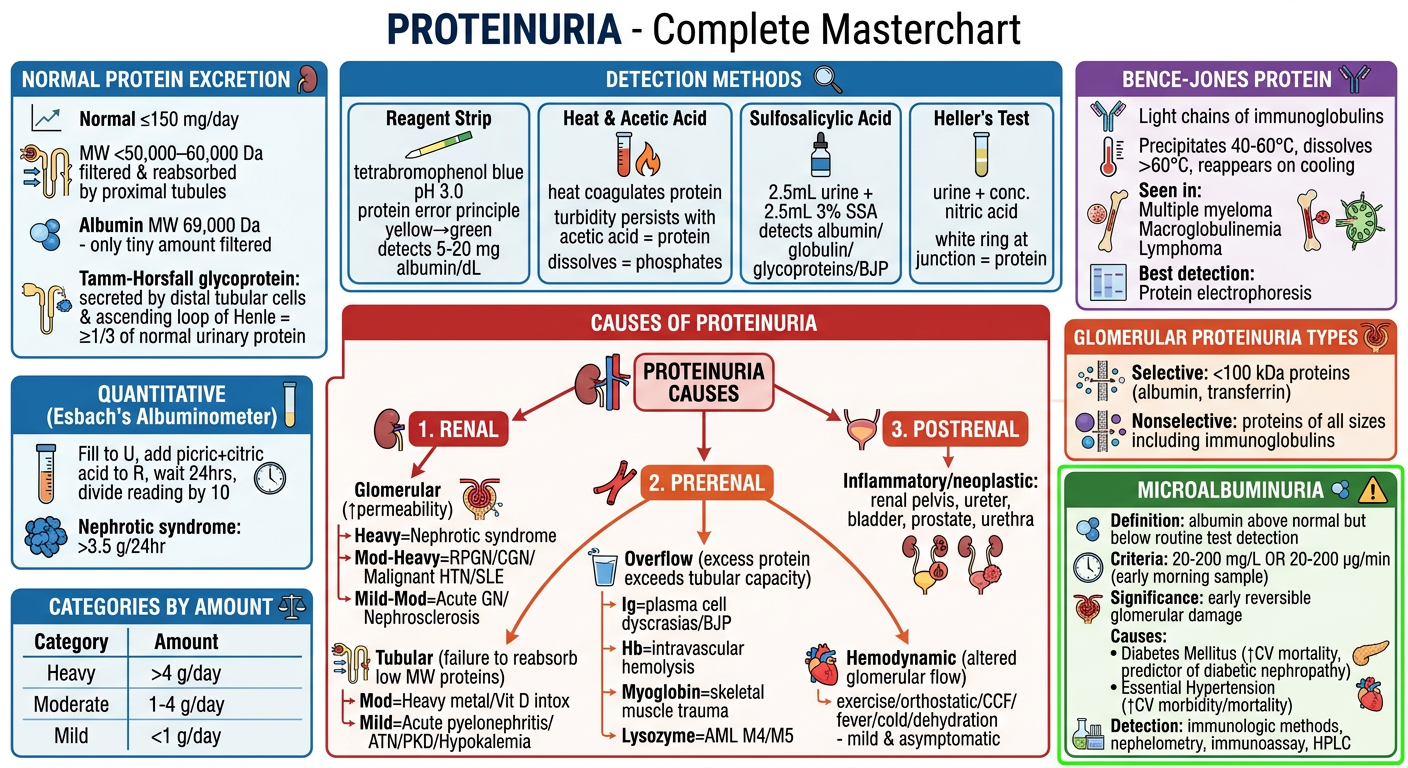
- Normal excretion - values, Tamm-Horsfall glycoprotein
- 4 Detection methods - Reagent Strip, Heat & Acetic Acid, Sulfosalicylic Acid, Heller's Test
- Bence-Jones Protein - thermal properties, diseases, best detection
- Esbach's Albuminometer - quantitative estimation procedure
- Categories by amount - Heavy / Moderate / Mild
- Causes tree - Renal (Glomerular + Tubular), Prerenal (Overflow + Hemodynamic), Postrenal
- Glomerular proteinuria types - Selective vs Nonselective
- Microalbuminuria - criteria, significance, causes (DM + HTN), detection methods
It doesn’t include everything from given text, features and advantage of reading from masterchart must be maintained and must be included everything. Do it right now.
ls -la /home/daytona/workspace/ 2>/dev/null || echo "workspace empty or not found"
mkdir -p /home/daytona/workspace/proteinuria && echo "created"
~/proteinuria/masterchart.html
<!DOCTYPE html>
<html>
<head>
<meta charset="UTF-8">
<style>
* { margin: 0; padding: 0; box-sizing: border-box; }
body {
font-family: 'Arial', sans-serif;
background: #fff;
width: 1400px;
padding: 10px;
}
.main-title {
background: linear-gradient(135deg, #1a237e, #283593);
color: white;
text-align: center;
padding: 10px 6px;
font-size: 22px;
font-weight: bold;
letter-spacing: 2px;
border-radius: 8px;
margin-bottom: 8px;
text-transform: uppercase;
}
.main-title span { font-size: 13px; font-weight: normal; display: block; margin-top: 2px; letter-spacing: 1px; color: #b3c6ff; }
.grid-top {
display: grid;
grid-template-columns: 1fr 1fr 1fr;
gap: 7px;
margin-bottom: 7px;
}
.grid-middle {
display: grid;
grid-template-columns: 1.1fr 1.9fr;
gap: 7px;
margin-bottom: 7px;
}
.grid-bottom {
display: grid;
grid-template-columns: 1fr 1fr 1fr;
gap: 7px;
margin-bottom: 7px;
}
.card {
border-radius: 7px;
padding: 7px 9px;
border: 1.5px solid;
}
.card-title {
font-size: 11.5px;
font-weight: bold;
text-transform: uppercase;
letter-spacing: 0.8px;
padding: 3px 7px;
border-radius: 4px;
margin-bottom: 6px;
display: block;
text-align: center;
}
.sec-normal { border-color: #1565c0; background: #e8f0fe; }
.sec-normal .card-title { background: #1565c0; color: white; }
.sec-detect { border-color: #6a1b9a; background: #f3e5f5; }
.sec-detect .card-title { background: #6a1b9a; color: white; }
.sec-bence { border-color: #ad1457; background: #fce4ec; }
.sec-bence .card-title { background: #ad1457; color: white; }
.sec-quant { border-color: #e65100; background: #fff3e0; }
.sec-quant .card-title { background: #e65100; color: white; }
.sec-causes { border-color: #b71c1c; background: #fff8f8; }
.sec-causes .card-title { background: #b71c1c; color: white; }
.sec-glom { border-color: #00695c; background: #e0f2f1; }
.sec-glom .card-title { background: #00695c; color: white; }
.sec-micro { border-color: #2e7d32; background: #e8f5e9; }
.sec-micro .card-title { background: #2e7d32; color: white; }
.sec-cat { border-color: #f57f17; background: #fffde7; }
.sec-cat .card-title { background: #f57f17; color: white; }
ul { padding-left: 14px; margin: 0; }
li { font-size: 10.5px; line-height: 1.55; }
p { font-size: 10.5px; line-height: 1.55; margin-bottom: 2px; }
.sub-head { font-size: 10.5px; font-weight: bold; color: #333; margin: 4px 0 1px; }
.tag {
display: inline-block;
font-size: 9px;
font-weight: bold;
padding: 1px 5px;
border-radius: 3px;
margin: 1px 2px 1px 0;
color: white;
}
.tag-red { background: #c62828; }
.tag-orange { background: #e65100; }
.tag-blue { background: #1565c0; }
.tag-green { background: #2e7d32; }
.tag-purple { background: #6a1b9a; }
.tag-teal { background: #00695c; }
.tag-pink { background: #ad1457; }
/* Detection 4-grid */
.detect-grid {
display: grid;
grid-template-columns: 1fr 1fr;
gap: 5px;
}
.detect-box {
border: 1.2px solid #9c27b0;
border-radius: 5px;
padding: 5px 6px;
background: white;
}
.detect-box .db-title {
font-size: 10px;
font-weight: bold;
color: #6a1b9a;
margin-bottom: 3px;
text-decoration: underline;
}
/* Causes layout */
.causes-grid {
display: grid;
grid-template-columns: 1fr 1fr 1fr;
gap: 6px;
}
.cause-col {
border-radius: 5px;
padding: 5px 6px;
}
.cause-col-renal { background: #ffebee; border: 1.2px solid #ef9a9a; }
.cause-col-pre { background: #e8f5e9; border: 1.2px solid #a5d6a7; }
.cause-col-post { background: #e3f2fd; border: 1.2px solid #90caf9; }
.cause-col-title {
font-size: 11px;
font-weight: bold;
text-align: center;
padding: 2px 4px;
border-radius: 3px;
margin-bottom: 5px;
color: white;
}
.col-renal-t { background: #c62828; }
.col-pre-t { background: #2e7d32; }
.col-post-t { background: #1565c0; }
.sub-cause {
background: white;
border-radius: 4px;
padding: 4px 5px;
margin-bottom: 4px;
border-left: 3px solid;
}
.sub-cause-glom { border-color: #c62828; }
.sub-cause-tub { border-color: #ff7043; }
.sub-cause-over { border-color: #43a047; }
.sub-cause-hemo { border-color: #81c784; }
.sub-cause-post { border-color: #42a5f5; }
.mech-label {
font-size: 9px;
color: #555;
font-style: italic;
margin-bottom: 2px;
}
.severity-row {
display: flex;
align-items: baseline;
margin: 1px 0;
gap: 3px;
}
.sev-tag {
font-size: 8.5px;
font-weight: bold;
padding: 0px 4px;
border-radius: 2px;
white-space: nowrap;
color: white;
}
.sev-heavy { background: #b71c1c; }
.sev-mod { background: #e65100; }
.sev-mild { background: #f9a825; color: #333; }
.sev-text { font-size: 10px; line-height: 1.4; }
/* Micro */
.micro-row {
display: grid;
grid-template-columns: 1fr 1fr;
gap: 5px;
margin-top: 3px;
}
.micro-box {
background: white;
border: 1px solid #a5d6a7;
border-radius: 4px;
padding: 4px 5px;
}
.micro-box .mb-title { font-size: 9.5px; font-weight: bold; color: #2e7d32; margin-bottom: 2px; }
/* Category table */
.cat-table { width: 100%; border-collapse: collapse; font-size: 10.5px; }
.cat-table th { padding: 4px 6px; color: white; font-size: 10px; }
.cat-table td { padding: 3px 6px; text-align: center; font-size: 10.5px; border-bottom: 1px solid #ddd; }
.th-heavy { background: #c62828; }
.th-mod { background: #e65100; }
.th-mild { background: #f9a825; color: #333; }
/* Selective/Nonselective */
.glom-grid {
display: grid;
grid-template-columns: 1fr 1fr;
gap: 5px;
margin-top: 3px;
}
.glom-box {
background: white;
border-radius: 4px;
padding: 5px 6px;
border: 1.2px solid #4db6ac;
}
.glom-box .gb-title { font-size: 10px; font-weight: bold; color: #00695c; margin-bottom: 3px; }
/* Note box */
.note-box {
background: #fff9c4;
border: 1.5px solid #f9a825;
border-radius: 5px;
padding: 4px 8px;
font-size: 10px;
margin-top: 5px;
text-align: center;
}
.divider { font-size: 10px; color: #888; margin: 3px 0; text-align: center; }
/* Esbach */
.esbach-steps {
display: flex;
gap: 3px;
margin-top: 4px;
align-items: center;
}
.esbach-step {
background: white;
border: 1px solid #ffb74d;
border-radius: 4px;
padding: 3px 5px;
font-size: 9.5px;
text-align: center;
flex: 1;
}
.arrow-step { color: #e65100; font-weight: bold; font-size: 13px; }
</style>
</head>
<body>
<!-- MAIN TITLE -->
<div class="main-title">
PROTEINURIA — Complete Masterchart
<span>Pathophysiology · Detection Methods · Classification · Causes · Microalbuminuria</span>
</div>
<!-- ROW 1: Normal + Detection + Bence-Jones -->
<div class="grid-top">
<!-- NORMAL PROTEIN EXCRETION -->
<div class="card sec-normal">
<span class="card-title">Normal Protein Excretion</span>
<p>🔵 Normal urinary protein: <strong>≤150 mg/day</strong></p>
<ul>
<li>Proteins with MW <strong><50,000–60,000 Da</strong> → pass through GBM → reabsorbed by <strong>proximal tubules</strong></li>
<li>Albumin (MW <strong>69,000 Da</strong>) → very small amount filtered (large size = protection)</li>
</ul>
<div class="sub-head">🧪 Tamm-Horsfall Glycoprotein (Uromucoid)</div>
<ul>
<li>Secreted by: <strong>distal tubular cells</strong> + <strong>ascending loop of Henle</strong></li>
<li>Forms <strong>≥⅓ of normal urinary protein</strong></li>
</ul>
<div class="note-box">Proteinuria = detectable protein in urine → indicates <strong>renal disease</strong>, especially glomerular injury<br>Turbid urine → filter/centrifuge before testing</div>
<div class="note-box" style="margin-top:4px; background:#e8f0fe; border-color:#1565c0;">
<strong>Reagent strip</strong> → mainly detects <strong>albumin</strong><br>
<strong>Acid precipitation</strong> → detects <strong>all proteins</strong>
</div>
</div>
<!-- DETECTION METHODS -->
<div class="card sec-detect">
<span class="card-title">Methods for Detection of Proteinuria</span>
<div class="detect-grid">
<!-- 1 -->
<div class="detect-box">
<div class="db-title">① Reagent Strip Method</div>
<p><em>Principle:</em> Protein error of pH indicators; proteins carry charge → pH change</p>
<p><em>Reagent:</em> Tetrabromophenol blue OR Tetrachlorophenol-tetrabromosulfophthalein, buffered at <strong>pH 3.0</strong></p>
<p><em>Reaction:</em> No protein → <strong style="color:#e65100">Yellow</strong>; Protein → indicator-protein complex → <strong style="color:#2e7d32">Green/Bluish-green</strong></p>
<p><em>Result:</em> 30–60 sec → Neg / Trace / 1+ / 2+ / 3+ / 4+</p>
<p><em>Sensitivity:</em> Detects <strong>5–20 mg albumin/dL</strong></p>
</div>
<!-- 2 -->
<div class="detect-box">
<div class="db-title">② Heat & Acetic Acid Test</div>
<p><em>Principle:</em> Heat → protein coagulation; acetic acid enhances coagulation</p>
<p><em>Procedure:</em> 5 mL tube, fill ⅔ urine; alkaline urine → add few drops 3% acetic acid; boil <strong>upper portion 2 min</strong> (lower = control)</p>
<p>If turbidity → add few drops 3% acetic acid</p>
<p>✅ Turbidity <strong>persists</strong> → <strong>Proteins</strong></p>
<p>❌ Turbidity <strong>disappears</strong> → <strong>Phosphates</strong></p>
<p><em>Nature:</em> Semiquantitative → Trace / 1+ / 2+ / 3+ / 4+</p>
</div>
<!-- 3 -->
<div class="detect-box">
<div class="db-title">③ Sulfosalicylic Acid (SSA) Test</div>
<p><em>Detects:</em> Albumin, Globulin, Glycoproteins, Bence-Jones proteins</p>
<p><em>Principle:</em> Cold precipitation by strong acid</p>
<p><em>Advantage:</em> More sensitive & reliable than heat-acetic acid test</p>
<p><em>Procedure:</em> 2.5 mL urine + 2.5 mL of <strong>3% SSA</strong> slowly → wait 10 min</p>
<p>Cloudy precipitate → proteins present</p>
<p><em>Limitation:</em> Also precipitates mucus & Bence-Jones proteins</p>
</div>
<!-- 4 -->
<div class="detect-box">
<div class="db-title">④ Heller's Test</div>
<p><em>Principle:</em> Cold precipitation by strong acid</p>
<p><em>Procedure:</em> 5 mL urine + few drops <strong>concentrated nitric acid</strong></p>
<p>⚪ <strong>White ring</strong> at urine-acid junction → Protein present</p>
<p><em>Precaution:</em> Filter turbid urine before testing</p>
<br>
<div style="background:#fce4ec; border-radius:4px; padding:4px; font-size:9.5px;">
<strong>Acetic Acid Test for BJP:</strong><br>
5 mL urine + 1 mL acetate buffer → heat in water bath<br>
↓ Precipitates at <strong>40°C</strong>, complete at <strong>58°C</strong><br>
↓ Dissolves <strong>>60°C</strong>, reappears on cooling 40–60°C
</div>
</div>
</div>
</div>
<!-- BENCE-JONES PROTEIN -->
<div class="card sec-bence">
<span class="card-title">Bence-Jones Protein (BJP)</span>
<p><strong>Definition:</strong> Light chains of immunoglobulins</p>
<div class="sub-head">🔴 Seen In:</div>
<ul>
<li><strong>Multiple myeloma</strong></li>
<li>Macroglobulinemia</li>
<li>Lymphoma</li>
</ul>
<div class="sub-head">🌡️ Characteristic Thermal Properties:</div>
<div style="background:white; border:1px solid #f48fb1; border-radius:4px; padding:5px 7px; margin-top:3px;">
<div style="display:flex; align-items:center; margin-bottom:3px;">
<span style="background:#ff8a65; color:white; font-size:9px; font-weight:bold; padding:1px 5px; border-radius:2px; margin-right:4px;">40°C</span>
<span style="font-size:10px;">Starts precipitating</span>
</div>
<div style="display:flex; align-items:center; margin-bottom:3px;">
<span style="background:#f44336; color:white; font-size:9px; font-weight:bold; padding:1px 5px; border-radius:2px; margin-right:4px;">58°C</span>
<span style="font-size:10px;">Complete precipitation</span>
</div>
<div style="display:flex; align-items:center; margin-bottom:3px;">
<span style="background:#b71c1c; color:white; font-size:9px; font-weight:bold; padding:1px 5px; border-radius:2px; margin-right:4px;">>60°C</span>
<span style="font-size:10px;">Dissolves (re-solubilizes)</span>
</div>
<div style="display:flex; align-items:center;">
<span style="background:#7b1fa2; color:white; font-size:9px; font-weight:bold; padding:1px 5px; border-radius:2px; margin-right:4px;">↓cool</span>
<span style="font-size:10px;">Reappears at 40–60°C on cooling</span>
</div>
</div>
<div class="note-box" style="margin-top:5px;">
⭐ <strong>Best Detection Method:</strong><br>Protein Electrophoresis
</div>
<div style="margin-top:5px; background:white; border:1px solid #f48fb1; border-radius:4px; padding:4px 6px;">
<div class="sub-head" style="margin-bottom:2px;">SSA Test Limitation:</div>
<p style="font-size:10px;">SSA also precipitates BJP (not specific)</p>
</div>
</div>
</div>
<!-- ROW 2: Quantitative + Causes (big) -->
<div class="grid-middle">
<!-- LEFT: Quantitative + Categories + Glomerular types -->
<div style="display:flex; flex-direction:column; gap:7px;">
<!-- Quantitative -->
<div class="card sec-quant">
<span class="card-title">Quantitative Estimation — Esbach's Albuminometer</span>
<p style="margin-bottom:3px;"><strong>Indications:</strong> Nephrotic syndrome (>3.5 g/24 hr), Orthostatic/Postural proteinuria</p>
<p style="margin-bottom:4px;"><strong>Principle:</strong> Cold precipitation of proteins by strong acid</p>
<div class="esbach-steps">
<div class="esbach-step">Fill urine<br>up to mark <strong>U</strong></div>
<div class="arrow-step">→</div>
<div class="esbach-step">Add Esbach's reagent<br>(Picric acid + Citric acid)<br>up to mark <strong>R</strong></div>
<div class="arrow-step">→</div>
<div class="esbach-step">Stopper<br>& mix</div>
<div class="arrow-step">→</div>
<div class="esbach-step">Keep<br><strong>24 hours</strong></div>
<div class="arrow-step">→</div>
<div class="esbach-step">Read precipitate<br>÷ 10<br>= <strong>% protein</strong></div>
</div>
</div>
<!-- Categories -->
<div class="card sec-cat">
<span class="card-title">Categories of Proteinuria by Amount</span>
<table class="cat-table">
<tr>
<th class="th-heavy">HEAVY</th>
<th class="th-mod">MODERATE</th>
<th class="th-mild">MILD</th>
</tr>
<tr>
<td><strong>>4 g/day</strong></td>
<td><strong>1–4 g/day</strong></td>
<td><strong><1 g/day</strong></td>
</tr>
</table>
</div>
<!-- Glomerular types -->
<div class="card sec-glom">
<span class="card-title">Types of Glomerular Proteinuria</span>
<div class="glom-grid">
<div class="glom-box">
<div class="gb-title">🔵 Selective Proteinuria</div>
<p>Leakage of <strong>intermediate-sized proteins (<100 kDa)</strong></p>
<ul>
<li>Albumin</li>
<li>Transferrin</li>
</ul>
</div>
<div class="glom-box">
<div class="gb-title">🔴 Nonselective Proteinuria</div>
<p>Leakage of <strong>proteins of different sizes</strong> (including large proteins)</p>
<ul>
<li>Immunoglobulins</li>
<li>Mixed protein spectrum</li>
</ul>
</div>
</div>
</div>
</div>
<!-- RIGHT: Causes — big -->
<div class="card sec-causes">
<span class="card-title">Causes of Proteinuria — Classification by Site / Mechanism</span>
<div class="causes-grid">
<!-- RENAL -->
<div class="cause-col cause-col-renal">
<div class="cause-col-title col-renal-t">🩺 RENAL</div>
<div class="sub-cause sub-cause-glom">
<div class="db-title" style="color:#c62828; font-size:10px; font-weight:bold; margin-bottom:2px;">A. GLOMERULAR DAMAGE</div>
<div class="mech-label">Mechanism: ↑ permeability of glomerular capillary wall</div>
<div class="severity-row">
<span class="sev-tag sev-heavy">HEAVY</span>
<span class="sev-text">Nephrotic syndrome</span>
</div>
<div class="severity-row">
<span class="sev-tag sev-mod">MOD–HEAVY</span>
<span class="sev-text" style="font-size:9.5px;">Rapidly progressive GN, Chronic GN, Malignant hypertension, SLE</span>
</div>
<div class="severity-row">
<span class="sev-tag sev-mild">MILD–MOD</span>
<span class="sev-text" style="font-size:9.5px;">Acute glomerulonephritis, Nephrosclerosis</span>
</div>
</div>
<div class="sub-cause sub-cause-tub">
<div class="db-title" style="color:#e64a19; font-size:10px; font-weight:bold; margin-bottom:2px;">B. TUBULAR DAMAGE</div>
<div class="mech-label">Mechanism: Failure of tubules to reabsorb low-MW proteins</div>
<div class="severity-row">
<span class="sev-tag sev-mod">MODERATE</span>
<span class="sev-text" style="font-size:9.5px;">Heavy metal intoxication, Vitamin D intoxication</span>
</div>
<div class="severity-row">
<span class="sev-tag sev-mild">MILD</span>
<span class="sev-text" style="font-size:9.5px;">Acute pyelonephritis, Chronic pyelonephritis, Acute tubular necrosis (ATN), Polycystic kidney disease, Hypokalemia</span>
</div>
</div>
</div>
<!-- PRERENAL -->
<div class="cause-col cause-col-pre">
<div class="cause-col-title col-pre-t">⬆️ PRERENAL</div>
<div class="sub-cause sub-cause-over">
<div class="db-title" style="color:#2e7d32; font-size:10px; font-weight:bold; margin-bottom:2px;">A. OVERFLOW PROTEINURIA</div>
<div class="mech-label">Mechanism: Excess protein in blood exceeds tubular reabsorptive capacity</div>
<div style="margin-top:3px;">
<div style="display:flex; gap:3px; flex-wrap:wrap; margin-bottom:3px;">
<span class="tag tag-purple">Immunoglobulins</span>
<span style="font-size:10px;">→ Plasma cell dyscrasias, Bence-Jones proteinuria</span>
</div>
<div style="display:flex; gap:3px; flex-wrap:wrap; margin-bottom:3px;">
<span class="tag tag-red">Hemoglobin</span>
<span style="font-size:10px;">→ Intravascular hemolysis</span>
</div>
<div style="display:flex; gap:3px; flex-wrap:wrap; margin-bottom:3px;">
<span class="tag tag-orange">Myoglobin</span>
<span style="font-size:10px;">→ Skeletal muscle trauma</span>
</div>
<div style="display:flex; gap:3px; flex-wrap:wrap;">
<span class="tag tag-teal">Lysozyme</span>
<span style="font-size:10px;">→ Acute myeloid leukemia (M4, M5)</span>
</div>
</div>
</div>
<div class="sub-cause sub-cause-hemo">
<div class="db-title" style="color:#388e3c; font-size:10px; font-weight:bold; margin-bottom:2px;">B. HEMODYNAMIC PROTEINURIA</div>
<div class="mech-label">Mechanism: Altered glomerular blood flow</div>
<ul style="margin-top:2px;">
<li>Excessive exercise</li>
<li>Postural (orthostatic) albuminuria</li>
<li>Congestive cardiac failure</li>
<li>High fever</li>
<li>Exposure to cold</li>
<li>Dehydration</li>
</ul>
<div style="margin-top:4px; background:#c8e6c9; border-radius:3px; padding:3px 5px; font-size:10px;">
✅ Usually <strong>mild</strong> & <strong>asymptomatic</strong>
</div>
</div>
</div>
<!-- POSTRENAL -->
<div class="cause-col cause-col-post">
<div class="cause-col-title col-post-t">⬇️ POSTRENAL</div>
<div class="sub-cause sub-cause-post" style="height:calc(100% - 35px);">
<div class="mech-label" style="margin-bottom:4px;">Due to inflammatory or neoplastic lesions of urinary tract below kidney</div>
<div style="margin-top:5px;">
<div style="background:white; border:1px solid #90caf9; border-radius:4px; padding:4px 6px; margin-bottom:4px;">
<span style="font-size:10px; font-weight:bold; color:#1565c0;">Sites affected:</span>
<ul>
<li>Renal pelvis</li>
<li>Ureter</li>
<li>Bladder</li>
<li>Prostate</li>
<li>Urethra</li>
</ul>
</div>
</div>
</div>
</div>
</div>
</div>
</div>
<!-- ROW 3: Microalbuminuria (full width) -->
<div class="card sec-micro" style="margin-bottom:7px;">
<span class="card-title">Microalbuminuria</span>
<div style="display:grid; grid-template-columns: 1fr 1fr 1fr 1fr; gap:6px;">
<div style="background:white; border:1px solid #a5d6a7; border-radius:5px; padding:6px 8px;">
<div class="micro-box mb-title" style="background:none; border:none; padding:0;">📌 Definition & Criteria</div>
<p>Albumin in urine:</p>
<ul>
<li>Above <strong>normal level</strong></li>
<li>Below <strong>detection limit</strong> of routine tests</li>
</ul>
<div style="margin-top:5px; background:#e8f5e9; border-radius:3px; padding:4px;">
<p><strong>Diagnostic Criteria</strong> (persistent excretion):</p>
<ul>
<li><strong>20–200 mg/L</strong> OR</li>
<li><strong>20–200 µg/min</strong></li>
<li>In <strong>early morning</strong> urine sample</li>
</ul>
</div>
</div>
<div style="background:white; border:1px solid #a5d6a7; border-radius:5px; padding:6px 8px;">
<div class="micro-box mb-title" style="background:none; border:none; padding:0;">🔬 Detection Methods</div>
<ul>
<li>Immunologic methods (antibodies)</li>
<li>Nephelometry</li>
<li>Immunoassay</li>
<li>Protein strip electrophoresis</li>
<li>HPLC</li>
</ul>
<div style="margin-top:5px; background:#e8f5e9; border-radius:3px; padding:4px; font-size:10px;">
<strong>Significance:</strong><br>
Indicates <strong>early and potentially reversible glomerular damage</strong>
</div>
</div>
<div style="background:white; border:1px solid #a5d6a7; border-radius:5px; padding:6px 8px;">
<div class="micro-box mb-title" style="background:none; border:none; padding:0;">🩺 Diabetes Mellitus</div>
<ul>
<li>Associated with <strong>↑ cardiovascular mortality</strong></li>
<li>Risk factor for <strong>renal mortality</strong></li>
<li><strong>Early predictor</strong> of diabetic nephropathy</li>
</ul>
<div style="margin-top:4px; background:#ffecb3; border-radius:3px; padding:3px 5px; font-size:10px;">
⚠️ Monitor microalbuminuria in <strong>all diabetics</strong> for early nephropathy detection
</div>
</div>
<div style="background:white; border:1px solid #a5d6a7; border-radius:5px; padding:6px 8px;">
<div class="micro-box mb-title" style="background:none; border:none; padding:0;">❤️ Essential Hypertension</div>
<ul>
<li>Predicts <strong>cardiovascular morbidity</strong></li>
<li>Predicts <strong>cardiovascular mortality</strong></li>
</ul>
<div style="margin-top:4px; background:#ffecb3; border-radius:3px; padding:3px 5px; font-size:10px;">
⚠️ Microalbuminuria in hypertension = marker of <strong>target organ damage</strong>
</div>
</div>
</div>
</div>
<!-- FOOTER NOTE -->
<div style="background:#1a237e; color:white; border-radius:6px; padding:5px 12px; font-size:9.5px; text-align:center; display:flex; justify-content:space-between;">
<span>🔵 Normal ≤150 mg/day | Reagent strip → albumin only | Acid precipitation → all proteins</span>
<span>🔴 Nephrotic syndrome: >3.5 g/24h | Bence-Jones: 40–60°C precipitate, dissolves >60°C</span>
<span>🟢 Microalbuminuria: 20–200 mg/L = early reversible glomerular damage</span>
</div>
</body>
</html>
cd /home/daytona/workspace/proteinuria && which chromium-browser || which chromium || which google-chrome || which google-chrome-stable || which puppeteer 2>/dev/null; echo "---"; ls /usr/bin/chrom* 2>/dev/null; ls /usr/bin/google* 2>/dev/null; which wkhtmltoimage 2>/dev/null; which cutycapt 2>/dev/null; python3 -c "import playwright" 2>/dev/null && echo "playwright ok"; node -e "require('puppeteer')" 2>/dev/null && echo "puppeteer ok"
/usr/bin/chromium --headless --disable-gpu --no-sandbox --screenshot=/home/daytona/workspace/proteinuria/masterchart.png --window-size=1400,2200 file:///home/daytona/workspace/proteinuria/masterchart.html 2>&1 | tail -5; ls -lh /home/daytona/workspace/proteinuria/masterchart.png 2>/dev/null
# Check full page height via chromium --print-to-pdf first, then re-screenshot with correct height # First let's get the full page screenshot with auto height using a JS trick /usr/bin/chromium --headless --disable-gpu --no-sandbox --run-all-compositor-stages-before-draw \ --virtual-time-budget=5000 \ --screenshot=/home/daytona/workspace/proteinuria/masterchart_full.png \ --window-size=1400,3000 \ file:///home/daytona/workspace/proteinuria/masterchart.html 2>&1 | tail -3 ls -lh /home/daytona/workspace/proteinuria/masterchart_full.png
# Use Python to get actual rendered page height and then take proper screenshot python3 << 'EOF' from PIL import Image img = Image.open('/home/daytona/workspace/proteinuria/masterchart_full.png') print(f"Size: {img.size}, Mode: {img.mode}") # Check bottom pixels to see if content is cut off import numpy as np arr = np.array(img) # Find last non-white row non_white = np.any(arr < 250, axis=(1,2)) last_content = np.where(non_white)[0][-1] if non_white.any() else img.size[1] print(f"Last content row: {last_content}") EOF
# Crop to actual content + small margin python3 << 'EOF' from PIL import Image img = Image.open('/home/daytona/workspace/proteinuria/masterchart_full.png') cropped = img.crop((0, 0, 1400, 1230)) cropped.save('/home/daytona/workspace/proteinuria/proteinuria_masterchart.png', optimize=True) print(f"Saved: {cropped.size}") EOF ls -lh /home/daytona/workspace/proteinuria/proteinuria_masterchart.png

proteinuria masterchart
Image · PNG
| Section | Covered |
|---|---|
| Normal protein excretion | ✅ MW cutoffs, Tamm-Horsfall, albumin |
| Reagent Strip | ✅ Principle, reagent, reaction, colors, sensitivity, grading |
| Heat & Acetic Acid | ✅ Procedure, interpretation, phosphates vs protein |
| Acetic Acid Test for BJP | ✅ 40°C/58°C/60°C temps |
| SSA Test | ✅ Principle, advantage, limitation, procedure |
| Heller's Test | ✅ Nitric acid, white ring, precaution |
| Bence-Jones Protein | ✅ Definition, diseases, thermal properties, best detection |
| Esbach's Albuminometer | ✅ Full step-by-step with arrow flow |
| Categories by amount | ✅ Heavy/Moderate/Mild table |
| Glomerular causes | ✅ Heavy/Mod-Heavy/Mild-Mod with specific diseases |
| Tubular causes | ✅ Moderate/Mild with specific diseases |
| Prerenal - Overflow | ✅ All 4 proteins (Ig, Hb, Myoglobin, Lysozyme) with causes |
| Prerenal - Hemodynamic | ✅ All 6 causes, mild & asymptomatic note |
| Postrenal | ✅ All 5 sites |
| Selective vs Nonselective | ✅ kDa cutoffs, examples |
| Microalbuminuria | ✅ Definition, criteria, both detection methods, DM & HTN significance |
| Footer summary bar | ✅ Key facts at a glance |
It’s blank and not opening
A dense, complete, professional one-page medical study masterchart titled "PROTEINURIA — COMPLETE MASTERCHART" on white background. The chart is organized into clearly labeled colored sections with borders, headers, bullet points, and structured sub-sections. All text must be clearly readable. Include every detail below: TITLE BAR (dark navy blue, white text, top): "PROTEINURIA — COMPLETE MASTERCHART" with subtitle "Pathophysiology · Detection Methods · Classification · Causes · Microalbuminuria" ROW 1 — THREE COLUMNS: LEFT COLUMN (blue border, light blue bg) "NORMAL PROTEIN EXCRETION": • Normal urinary protein: ≤150 mg/day • Proteins MW <50,000–60,000 Da → pass through GBM → reabsorbed by proximal tubules • Albumin (MW 69,000 Da) → only very small amount filtered • Tamm-Horsfall Glycoprotein (Uromucoid): - Secreted by: distal tubular cells + ascending loop of Henle - Forms ≥1/3 of normal urinary protein • NOTE BOX: Proteinuria = detectable protein in urine → indicates renal disease, especially glomerular injury. Turbid urine → filter/centrifuge before testing • NOTE BOX: Reagent strip → mainly detects ALBUMIN | Acid precipitation → detects ALL proteins MIDDLE COLUMN (purple border, light purple bg) "METHODS FOR DETECTION OF PROTEINURIA" — 2x2 grid of 4 boxes: Box 1 "① Reagent Strip Method": - Principle: Protein error of pH indicators; proteins carry charge → pH change - Reagent: Tetrabromophenol blue OR Tetrachlorophenol-tetrabromosulfophthalein, buffered at pH 3.0 - Reaction: No protein → YELLOW; Protein present → indicator-protein complex → GREEN/BLUISH-GREEN - Result: 30–60 sec → Negative / Trace / 1+ / 2+ / 3+ / 4+ - Sensitivity: Detects 5–20 mg albumin/dL Box 2 "② Heat & Acetic Acid Test": - Principle: Heat causes protein coagulation; acetic acid enhances coagulation - Procedure: 5 mL tube, fill 2/3 urine; if alkaline → add few drops 3% acetic acid; boil UPPER PORTION 2 min (lower = control); if turbidity → add few drops 3% acetic acid - Turbidity PERSISTS after acetic acid → PROTEINS present - Turbidity DISAPPEARS after acetic acid → PHOSPHATES present - Nature: Semiquantitative → Trace / 1+ / 2+ / 3+ / 4+ Box 3 "③ Sulfosalicylic Acid (SSA) Test": - Detects: Albumin, Globulin, Glycoproteins, Bence-Jones proteins - Principle: Cold precipitation by strong acid - Advantage: More sensitive & reliable than heat-acetic acid test - Procedure: 2.5 mL urine + 2.5 mL of 3% SSA slowly → wait 10 min - Cloudy precipitate → proteins present - Limitation: Also precipitates mucus & Bence-Jones proteins Box 4 "④ Heller's Test + Acetic Acid Test for BJP": - Principle: Cold precipitation by strong acid - Procedure: 5 mL urine + few drops concentrated nitric acid - WHITE RING at urine-acid junction → Protein present - Precaution: Filter turbid urine before testing - ACETIC ACID TEST FOR BJP: 5 mL urine + 1 mL acetate buffer → heat in water bath; Precipitates at 40°C, complete at 58°C; Dissolves >60°C; Reappears on cooling 40–60°C RIGHT COLUMN (pink/crimson border, light pink bg) "BENCE-JONES PROTEIN (BJP)": - Definition: Light chains of immunoglobulins - Seen in: Multiple myeloma, Macroglobulinemia, Lymphoma - THERMAL PROPERTIES (colored temperature badges): [40°C] Starts precipitating [58°C] Complete precipitation [>60°C] Dissolves (re-solubilizes) [↓cool] Reappears at 40–60°C on cooling - BEST DETECTION METHOD: Protein Electrophoresis (highlighted box) - SSA Test Limitation: SSA also precipitates BJP (not specific) ROW 2 — TWO COLUMNS (left narrow, right wide): LEFT COLUMN — stacked 3 cards: Card A (orange border) "QUANTITATIVE ESTIMATION — ESBACH'S ALBUMINOMETER": - Indications: Nephrotic syndrome (>3.5 g/24 hr), Orthostatic/Postural proteinuria - Principle: Cold precipitation of proteins by strong acid - Step flow with arrows: [Fill urine to mark U] → [Add Esbach's reagent (Picric acid + Citric acid) to mark R] → [Stopper & mix] → [Keep 24 hours] → [Read precipitate ÷ 10 = % total urinary protein] Card B (amber border) "CATEGORIES OF PROTEINURIA BY AMOUNT": - Table with 3 columns: HEAVY (red) | MODERATE (orange) | MILD (yellow) >4 g/day | 1–4 g/day | <1 g/day Card C (teal/green border) "TYPES OF GLOMERULAR PROTEINURIA": - SELECTIVE PROTEINURIA: Leakage of intermediate-sized proteins (<100 kDa) — Albumin, Transferrin - NONSELECTIVE PROTEINURIA: Leakage of proteins of different sizes including large proteins — Immunoglobulins, Mixed protein spectrum RIGHT COLUMN (dark red border, very light pink bg) "CAUSES OF PROTEINURIA — CLASSIFICATION BY SITE / MECHANISM" — 3 sub-columns: Sub-column 1 "🩺 RENAL" (red header): A. GLOMERULAR DAMAGE - Mechanism: ↑ permeability of glomerular capillary wall - [HEAVY] Nephrotic syndrome - [MOD–HEAVY] Rapidly progressive GN, Chronic GN, Malignant hypertension, SLE - [MILD–MOD] Acute glomerulonephritis, Nephrosclerosis B. TUBULAR DAMAGE - Mechanism: Failure of tubules to reabsorb low-MW proteins - [MODERATE] Heavy metal intoxication, Vitamin D intoxication - [MILD] Acute pyelonephritis, Chronic pyelonephritis, Acute tubular necrosis (ATN), Polycystic kidney disease, Hypokalemia Sub-column 2 "⬆ PRERENAL" (green header): A. OVERFLOW PROTEINURIA - Mechanism: Excess protein in blood exceeds tubular reabsorptive capacity - [Immunoglobulins] → Plasma cell dyscrasias, Bence-Jones proteinuria - [Hemoglobin] → Intravascular hemolysis - [Myoglobin] → Skeletal muscle trauma - [Lysozyme] → Acute myeloid leukemia (M4, M5) B. HEMODYNAMIC PROTEINURIA - Mechanism: Altered glomerular blood flow - Excessive exercise - Postural (orthostatic) albuminuria - Congestive cardiac failure - High fever - Exposure to cold - Dehydration - Usually MILD & ASYMPTOMATIC Sub-column 3 "⬇ POSTRENAL" (blue header): - Due to inflammatory or neoplastic lesions of urinary tract below kidney - Sites affected: • Renal pelvis • Ureter • Bladder • Prostate • Urethra ROW 3 — FULL WIDTH (green border, light green bg) "MICROALBUMINURIA": 4 equal boxes side by side: Box 1 "Definition & Criteria": - Albumin in urine: Above normal level, Below detection limit of routine tests - Diagnostic Criteria (persistent excretion): 20–200 mg/L OR 20–200 µg/min, In early morning urine sample Box 2 "Detection Methods": - Immunologic methods (antibodies) - Nephelometry - Immunoassay - Protein strip electrophoresis - HPLC - Significance: Indicates EARLY and potentially REVERSIBLE glomerular damage Box 3 "Diabetes Mellitus": - Associated with ↑ cardiovascular mortality - Risk factor for renal mortality - Early predictor of diabetic nephropathy - Monitor microalbuminuria in all diabetics for early nephropathy detection Box 4 "Essential Hypertension": - Predicts cardiovascular morbidity - Predicts cardiovascular mortality - Microalbuminuria in hypertension = marker of target organ damage FOOTER BAR (dark navy, white text): "Normal ≤150 mg/day | Reagent strip → albumin only | Acid precipitation → all proteins | Nephrotic syndrome: >3.5 g/24h | Bence-Jones: 40–60°C precipitate, dissolves >60°C | Microalbuminuria: 20–200 mg/L = early reversible glomerular damage" Style: clean medical textbook infographic, color-coded sections, small readable fonts, dense but organized, all content visible, white background, professional appearance suitable for medical exam revision
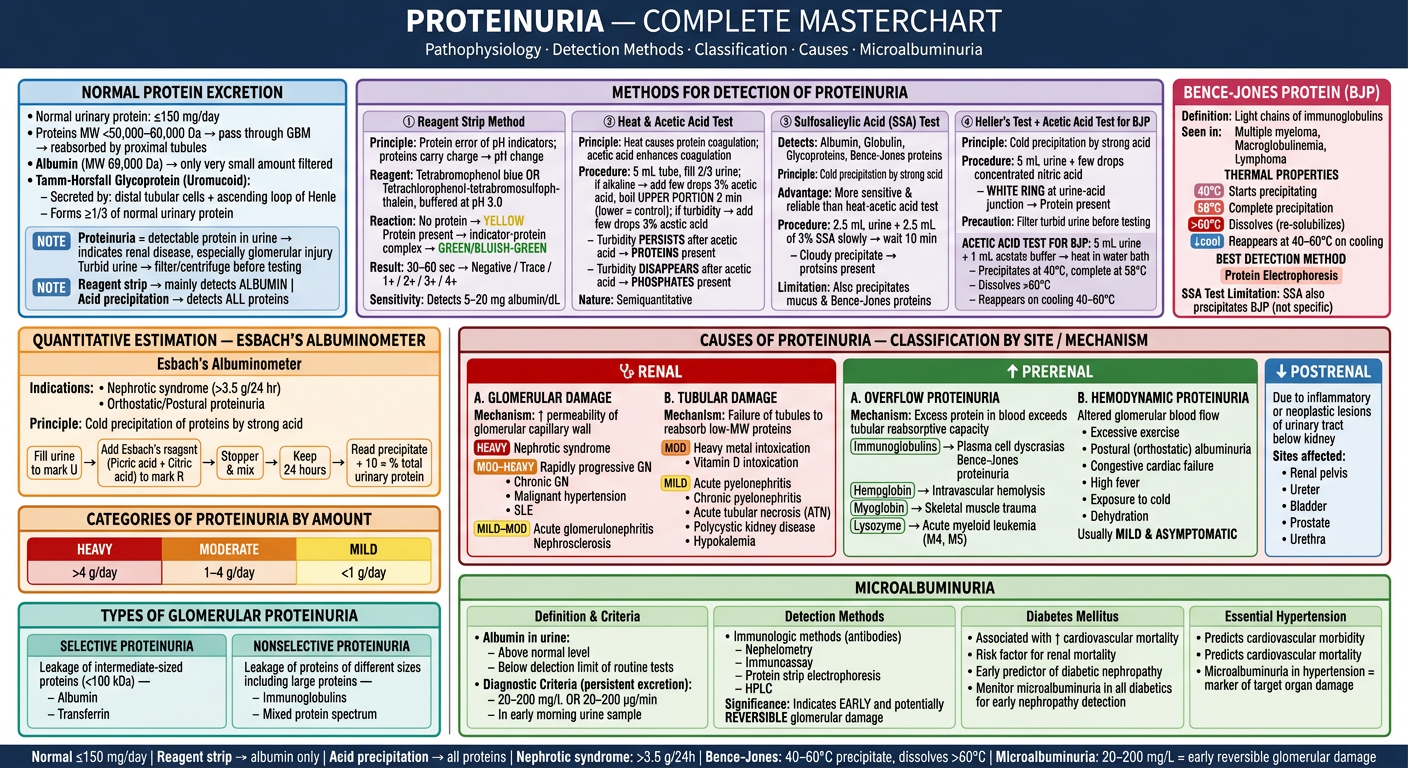
- Normal Protein Excretion - MW values, Tamm-Horsfall, albumin facts
- All 4 Detection Methods - Reagent Strip, Heat & Acetic Acid, SSA Test, Heller's Test (with full procedures, principles, interpretations)
- Acetic Acid Test for BJP - complete temperature sequence (40°C → 58°C → >60°C → cooling)
- Bence-Jones Protein - thermal properties with color-coded temperature badges, best detection method
- Esbach's Albuminometer - step-by-step arrow flow
- Categories by Amount - Heavy/Moderate/Mild table
- Glomerular types - Selective vs Nonselective with kDa cutoffs
- Full Causes - Renal (Glomerular + Tubular), Prerenal (Overflow with all 4 proteins + Hemodynamic with all 6 causes), Postrenal (all 5 sites)
- Microalbuminuria - criteria, detection methods, DM, HTN significance
मूत्र में प्रोटीन (Proteinuria) सामान्य प्रोटीन उत्सर्जन * सामान्य मूत्र प्रोटीन उत्सर्जन = ≤150 mg/दिन * MW <50,000–60,000 Da वाले प्रोटीन GBM (Glomerular Basement Membrane) से गुजर जाते हैं और Proximal Tubules द्वारा पुनः अवशोषित (reabsorb) हो जाते हैं। * केवल बहुत कम मात्रा में Albumin (MW 69,000 Da) फ़िल्टर होता है। * Tamm-Horsfall Glycoprotein (Uromucoid) * स्रावित होता है: * Distal Tubular Cells * Ascending Loop of Henle * सामान्य मूत्र प्रोटीन का ≥1/3 भाग बनाता है। ⸻ Proteinuria (प्रोटीनूरिया) परिभाषा * मूत्र में प्रोटीन की पहचान योग्य मात्रा की उपस्थिति। * विशेषकर Glomerular Injury सहित Renal Disease का महत्वपूर्ण संकेत। * यदि मूत्र धुंधला (turbid) हो → परीक्षण से पहले Filter या Centrifuge करें। ⸻ Proteinuria की जाँच की विधियाँ 1. Reagent Strip Method 2. Heat & Acetic Acid Test 3. Sulfosalicylic Acid Test 4. Heller’s Test नोट * Reagent Strip → मुख्यतः Albumin पहचानती है। * Acid Precipitation Methods → सभी प्रकार के प्रोटीन पहचानती हैं। ⸻ 1. Reagent Strip Method सिद्धांत * pH Indicators की Protein Error पर आधारित। * Physiological pH पर प्रोटीन आवेश (charge) रखते हैं → pH परिवर्तन उत्पन्न करते हैं। * Indicator का रंग बदलना = प्रोटीन की उपस्थिति। अभिकर्मक (Reagent) * Tetrabromophenol Blue या * Tetrachlorophenol-Tetrabromosulfophthalein * pH 3.0 पर Buffer किया गया। प्रतिक्रिया * प्रोटीन नहीं → Strip पीली रहती है। * प्रोटीन उपस्थित → Protein-Indicator Complex बनता है। * रंग हरा / नीला-हरा हो जाता है। * रंग की तीव्रता प्रोटीन के प्रकार और मात्रा पर निर्भर करती है। परिणाम * 30–60 सेकंड में रंग विकसित। * रिपोर्ट: * Negative * Trace * 1+ * 2+ * 3+ * 4+ संवेदनशीलता * 5–20 mg Albumin/dL पहचान सकती है। ⸻ 2. Heat & Acetic Acid Test सिद्धांत * गर्मी से प्रोटीन Coagulate व Precipitate होते हैं। * Acetic Acid जमाव (coagulation) बढ़ाता है। प्रक्रिया * 5 mL टेस्ट ट्यूब लें। * 2/3 भाग मूत्र भरें। * यदि मूत्र क्षारीय (alkaline) हो → 3% Acetic Acid की कुछ बूंदें डालें। * ऊपरी भाग को 2 मिनट उबालें। * निचला भाग Control का कार्य करता है। * यदि धुंधलापन आए → पुनः 3% Acetic Acid डालें। व्याख्या * धुंधलापन Acetic Acid डालने पर गायब हो जाए → Phosphates उपस्थित। * धुंधलापन बना रहे → Proteins उपस्थित। परीक्षण का प्रकार * Semiquantitative * Grade: * Trace * 1+ * 2+ * 3+ * 4+ ⸻ Bence-Jones Protein हेतु Acetic Acid Test प्रक्रिया * 5 mL साफ मूत्र लें। * 1 mL Acetate Buffer मिलाएँ। * Thermometer के साथ Water Bath में गर्म करें। विशिष्ट निष्कर्ष * 40°C पर Precipitation शुरू। * 58°C पर पूर्ण Precipitation। * 60°C पर घुल जाता है। * 40–60°C तक ठंडा करने पर पुनः दिखाई देता है। सर्वोत्तम जाँच * Protein Electrophoresis ⸻ 3. Sulfosalicylic Acid Test क्या पहचानता है? * Albumin * Globulin * Glycoproteins * Bence-Jones Proteins सिद्धांत * Strong Acid द्वारा Cold Precipitation। लाभ * Heat & Acetic Acid Test से अधिक Sensitive और Reliable। प्रक्रिया * 2.5 mL मूत्र लें। * धीरे-धीरे 2.5 mL 3% Sulfosalicylic Acid मिलाएँ। * 10 मिनट प्रतीक्षा करें। व्याख्या * Cloudy Precipitate → Protein उपस्थित। सीमा (Limitation) * Mucus भी Precipitate कर सकता है। * Bence-Jones Protein भी Precipitate करता है। ⸻ 4. Heller’s Test सिद्धांत * Strong Acid द्वारा Cold Precipitation। प्रक्रिया * 5 mL मूत्र लें। * Concentrated Nitric Acid की कुछ बूंदें डालें। व्याख्या * Urine-Acid Junction पर White Ring → Protein उपस्थित। सावधानी * धुंधले मूत्र को पहले Filter करें। ⸻ मूत्र प्रोटीन का मात्रात्मक अनुमान Esbach’s Albuminometer संकेत (Indications) * Nephrotic Syndrome * Protein >3.5 g/24 hr * Orthostatic/Postural Proteinuria सिद्धांत * Strong Acid द्वारा Cold Precipitation। प्रक्रिया * Urine को Mark U तक भरें। * Esbach’s Reagent को Mark R तक भरें। * इसमें: * Picric Acid * Citric Acid * Stopper लगाकर मिश्रण करें। * 24 घंटे रखें। * Precipitate Level पढ़ें। * Reading को 10 से भाग दें। परिणाम * Total Urinary Protein का प्रतिशत प्राप्त होता है। ⸻ Proteinuria की श्रेणियाँ मात्रा के अनुसार Heavy * 4 g/day Moderate * 1–4 g/day Mild * <1 g/day ⸻ स्थान/कारण के अनुसार 1. Renal * Glomerular * Tubular 2. Prerenal 3. Postrenal ⸻ Glomerular Proteinuria के प्रकार Selective Proteinuria * केवल Intermediate-Sized Proteins (<100 kDa) का रिसाव। उदाहरण * Albumin * Transferrin ⸻ Nonselective Proteinuria * विभिन्न आकार के प्रोटीनों का रिसाव। * बड़े प्रोटीन भी निकलते हैं। उदाहरण * Immunoglobulins ⸻ Bence-Jones Protein परिभाषा * Immunoglobulin की Light Chains। किन रोगों में? * Multiple Myeloma * Macroglobulinemia * Lymphoma विशिष्ट गुण * 40–60°C पर Precipitate। * लगभग 100°C पर घुल जाता है। * 40–60°C तक ठंडा करने पर पुनः दिखाई देता है। ⸻ Microalbuminuria परिभाषा मूत्र में Albumin: * सामान्य से अधिक * परंतु Routine Tests की Detection Limit से कम Diagnostic Criteria लगातार Albumin Excretion: * 20–200 mg/L या * 20–200 µg/min Early Morning Urine Sample में। महत्व * प्रारंभिक एवं संभावित रूप से Reversible Glomerular Damage का संकेत। Detection Methods * Immunologic Methods (Antibodies) * Nephelometry * Immunoassay * Protein Strip Electrophoresis * HPLC ⸻ Microalbuminuria के कारण Diabetes Mellitus * ↑ Cardiovascular Mortality से संबंधित। * Renal Mortality का Risk Factor। * Diabetic Nephropathy का प्रारंभिक Predictor। Essential Hypertension * Cardiovascular Morbidity का Predictor। * Cardiovascular Mortality का Predictor। ⸻ Proteinuria के कारण 1. Renal Causes A. Glomerular Damage Mechanism * Glomerular Capillary Wall की Permeability बढ़ना। Heavy Proteinuria * Nephrotic Syndrome Moderate–Heavy Proteinuria * Rapidly Progressive Glomerulonephritis * Chronic Glomerulonephritis * Malignant Hypertension * SLE Mild–Moderate Proteinuria * Acute Glomerulonephritis * Nephrosclerosis ⸻ B. Tubular Damage Mechanism * Tubules द्वारा Low-MW Proteins का Reabsorption न होना। Moderate Proteinuria * Heavy Metal Intoxication * Vitamin D Intoxication Mild Proteinuria * Acute Pyelonephritis * Chronic Pyelonephritis * Acute Tubular Necrosis * Polycystic Kidney Disease * Hypokalemia ⸻ 2. Prerenal Causes A. Overflow Proteinuria Mechanism * रक्त में प्रोटीन की अत्यधिक मात्रा Tubular Reabsorptive Capacity से अधिक हो जाती है। कारण Immunoglobulins * Plasma Cell Dyscrasias * Bence-Jones Proteinuria Hemoglobin * Intravascular Hemolysis Myoglobin * Skeletal Muscle Trauma Lysozyme * Acute Myeloid Leukemia (M4, M5) ⸻ B. Hemodynamic Proteinuria Mechanism * Glomerular Blood Flow में परिवर्तन। कारण * अत्यधिक व्यायाम * Postural (Orthostatic) Albuminuria * Congestive Cardiac Failure * उच्च बुखार * ठंड का संपर्क * Dehydration विशेषता * सामान्यतः Mild * Asymptomatic ⸻ 3. Postrenal Causes कारण Renal Pelvis, Ureter, Bladder, Prostate या Urethra की Inflammatory या Neoplastic Lesions। ⸻ Generate one page image of masterchart of this topic proteinuria. Including everything, nothing must be skipped.
~/proteinuria/hindi_masterchart.html
<!DOCTYPE html>
<html lang="hi">
<head>
<meta charset="UTF-8">
<style>
@import url('https://fonts.googleapis.com/css2?family=Noto+Sans+Devanagari:wght@400;600;700&family=Roboto:wght@400;700&display=swap');
* { margin:0; padding:0; box-sizing:border-box; }
body {
font-family: 'Noto Sans Devanagari', 'Roboto', Arial, sans-serif;
background: #f0f4f8;
width: 1500px;
padding: 10px;
font-size: 11px;
line-height: 1.5;
}
/* ── TITLE ── */
.main-title {
background: linear-gradient(135deg, #0d1b5e 0%, #1a3a8c 100%);
color: #fff;
text-align: center;
padding: 10px 8px 8px;
border-radius: 10px;
margin-bottom: 8px;
}
.main-title h1 { font-size: 20px; font-weight: 700; letter-spacing: 2px; text-transform: uppercase; }
.main-title p { font-size: 11px; color: #aac4ff; margin-top: 2px; letter-spacing: 0.5px; }
/* ── LAYOUT ── */
.row { display: flex; gap: 8px; margin-bottom: 8px; }
.col-1-3 { flex: 1; }
.col-2-3 { flex: 2; }
.col-full { flex: 1; }
/* ── CARD ── */
.card {
border-radius: 8px;
border: 2px solid;
background: #fff;
padding: 7px 9px;
height: 100%;
}
.card-title {
display: block;
text-align: center;
font-weight: 700;
font-size: 11px;
text-transform: uppercase;
letter-spacing: 0.6px;
color: #fff;
padding: 4px 6px;
border-radius: 5px;
margin-bottom: 6px;
}
/* colour themes */
.blue { border-color: #1565c0; } .blue .card-title { background: #1565c0; }
.purple { border-color: #6a1b9a; } .purple .card-title { background: #6a1b9a; }
.pink { border-color: #ad1457; } .pink .card-title { background: #ad1457; }
.orange { border-color: #e65100; } .orange .card-title { background: #e65100; }
.amber { border-color: #f57f17; } .amber .card-title { background: #f57f17; }
.teal { border-color: #00695c; } .teal .card-title { background: #00695c; }
.red { border-color: #b71c1c; } .red .card-title { background: #b71c1c; }
.green { border-color: #2e7d32; } .green .card-title { background: #2e7d32; }
/* backgrounds */
.blue { background: #e8f0fe; }
.purple { background: #f3e5f5; }
.pink { background: #fce4ec; }
.orange { background: #fff3e0; }
.amber { background: #fffde7; }
.teal { background: #e0f2f1; }
.red { background: #fff5f5; }
.green { background: #e8f5e9; }
/* ── TYPOGRAPHY ── */
ul { padding-left: 14px; margin: 2px 0; }
li { font-size: 10.5px; line-height: 1.55; }
p { font-size: 10.5px; line-height: 1.55; margin: 1px 0; }
b { font-weight: 700; }
.sh { /* sub-heading */
font-size: 10.5px; font-weight: 700;
margin: 4px 0 2px;
color: #222;
}
/* ── NOTE BOX ── */
.note {
border-radius: 5px;
padding: 4px 7px;
font-size: 10px;
margin-top: 5px;
text-align: center;
line-height: 1.5;
}
.note-yellow { background: #fff9c4; border: 1.5px solid #f9a825; }
.note-blue { background: #dbeafe; border: 1.5px solid #1565c0; }
/* ── 4-GRID for detection ── */
.det-grid { display: grid; grid-template-columns: 1fr 1fr; gap: 5px; }
.det-box {
background: #fff;
border: 1.5px solid #9c27b0;
border-radius: 6px;
padding: 5px 7px;
}
.det-title { font-size: 10.5px; font-weight: 700; color: #6a1b9a; margin-bottom: 3px; text-decoration: underline; }
/* ── TEMP BADGES ── */
.tbadge {
display: inline-block;
font-size: 9.5px; font-weight: 700;
color: #fff; padding: 1px 6px;
border-radius: 3px; margin-right: 4px;
}
.t40 { background:#ff8a65; }
.t58 { background:#e53935; }
.t60 { background:#b71c1c; }
.tcool{ background:#7b1fa2; }
/* ── ESBACH STEPS ── */
.steps { display: flex; align-items: center; gap: 3px; margin-top: 5px; }
.step {
flex: 1;
background: #fff;
border: 1.5px solid #ffb74d;
border-radius: 5px;
padding: 4px 4px;
font-size: 9.5px;
text-align: center;
}
.arr { color: #e65100; font-weight: 700; font-size: 14px; }
/* ── AMOUNT TABLE ── */
.amt-table { width: 100%; border-collapse: collapse; margin-top: 4px; font-size: 11px; }
.amt-table th { padding: 4px 6px; color: #fff; text-align: center; }
.amt-table td { padding: 4px 6px; text-align: center; font-weight: 700; border-bottom: 1px solid #ddd; }
.th-h { background:#b71c1c; } .th-m { background:#e65100; } .th-mi { background:#f9a825; color:#333; }
/* ── CAUSES 3-COL ── */
.causes-wrap { display: grid; grid-template-columns: 1fr 1fr 1fr; gap: 6px; }
.cc {
border-radius: 6px;
padding: 5px 6px;
}
.cc-renal { background:#ffebee; border:1.5px solid #ef9a9a; }
.cc-pre { background:#e8f5e9; border:1.5px solid #a5d6a7; }
.cc-post { background:#e3f2fd; border:1.5px solid #90caf9; }
.cc-hdr {
text-align: center; font-size: 11.5px; font-weight: 700;
color: #fff; border-radius: 4px; padding: 3px 6px; margin-bottom: 5px;
}
.hdr-r { background:#b71c1c; }
.hdr-p { background:#2e7d32; }
.hdr-po{ background:#1565c0; }
.sub-box {
background: #fff;
border-radius: 5px;
padding: 4px 6px;
margin-bottom: 5px;
border-left: 3px solid;
}
.sb-glom { border-color: #c62828; }
.sb-tub { border-color: #ff7043; }
.sb-ov { border-color: #43a047; }
.sb-hemo { border-color: #81c784; }
.sb-post { border-color: #42a5f5; }
.mech { font-size: 9.5px; color: #666; font-style: italic; margin-bottom: 3px; }
/* severity badges */
.sv {
display: inline-block; font-size: 8.5px; font-weight: 700;
color: #fff; padding: 1px 5px; border-radius: 2px; margin-right: 3px; white-space: nowrap;
}
.sv-h { background:#b71c1c; }
.sv-mh { background:#e65100; }
.sv-m { background:#e65100; }
.sv-mi { background:#f9a825; color:#333; }
.sv-row { display: flex; align-items: baseline; margin: 2px 0; gap: 3px; }
.sv-txt { font-size: 10px; }
/* protein tags */
.ptag {
display: inline-block; font-size: 9px; font-weight: 700;
color: #fff; padding: 1px 5px; border-radius: 3px; margin: 1px 2px 2px 0;
}
.pt-pur { background:#6a1b9a; }
.pt-red { background:#c62828; }
.pt-ora { background:#e65100; }
.pt-tea { background:#00695c; }
/* ── MICRO 4-col ── */
.micro-grid { display: grid; grid-template-columns: 1fr 1fr 1fr 1fr; gap: 6px; margin-top: 4px; }
.mb {
background: #fff;
border: 1.5px solid #81c784;
border-radius: 6px;
padding: 6px 8px;
}
.mb-title { font-size: 10.5px; font-weight: 700; color: #2e7d32; margin-bottom: 4px; }
.mb-warn {
background: #fffde7; border: 1px solid #f9a825;
border-radius: 4px; padding: 3px 5px;
font-size: 9.5px; margin-top: 4px;
}
.mb-sig {
background: #e8f5e9; border: 1px solid #a5d6a7;
border-radius: 4px; padding: 3px 5px;
font-size: 9.5px; margin-top: 4px;
}
/* glom types */
.glom-grid { display: grid; grid-template-columns: 1fr 1fr; gap: 5px; margin-top: 4px; }
.gb {
background: #fff;
border: 1.5px solid #4db6ac;
border-radius: 5px;
padding: 5px 7px;
}
.gb-title { font-size: 10.5px; font-weight: 700; color: #00695c; margin-bottom: 3px; }
/* ── FOOTER ── */
.footer {
background: #0d1b5e; color: #fff;
border-radius: 6px; padding: 6px 14px;
font-size: 9.5px; text-align: center;
display: flex; justify-content: space-between;
margin-top: 0;
}
</style>
</head>
<body>
<!-- ══════════ TITLE ══════════ -->
<div class="main-title">
<h1>मूत्र में प्रोटीन (Proteinuria) — सम्पूर्ण Masterchart</h1>
<p>Pathophysiology · जाँच विधियाँ · वर्गीकरण · कारण · Microalbuminuria</p>
</div>
<!-- ══════════ ROW 1: Normal | Detection (4-box) | BJP ══════════ -->
<div class="row">
<!-- NORMAL -->
<div class="col-1-3">
<div class="card blue">
<span class="card-title">सामान्य प्रोटीन उत्सर्जन</span>
<p>🔵 सामान्य मूत्र प्रोटीन: <b>≤150 mg/दिन</b></p>
<ul>
<li>MW <b><50,000–60,000 Da</b> → GBM से गुज़रते हैं → <b>Proximal Tubules</b> द्वारा Reabsorb</li>
<li>Albumin (MW <b>69,000 Da</b>) → बहुत कम मात्रा में Filter होता है</li>
</ul>
<div class="sh">🧪 Tamm-Horsfall Glycoprotein (Uromucoid)</div>
<ul>
<li>स्रावित: <b>Distal Tubular Cells</b> + <b>Ascending Loop of Henle</b></li>
<li>सामान्य मूत्र प्रोटीन का <b>≥1/3 भाग</b> बनाता है</li>
</ul>
<div class="note note-yellow" style="margin-top:5px;">
<b>Proteinuria</b> = मूत्र में प्रोटीन की पहचान योग्य उपस्थिति<br>
→ विशेषतः <b>Glomerular Injury</b> सहित Renal Disease का संकेत<br>
Turbid मूत्र → परीक्षण से पहले <b>Filter / Centrifuge</b> करें
</div>
<div class="note note-blue" style="margin-top:4px;">
<b>Reagent Strip</b> → मुख्यतः <b>Albumin</b> पहचानती है<br>
<b>Acid Precipitation</b> → <b>सभी प्रकार के प्रोटीन</b> पहचानती है
</div>
</div>
</div>
<!-- DETECTION 4-box -->
<div class="col-2-3">
<div class="card purple">
<span class="card-title">Proteinuria की जाँच विधियाँ (Detection Methods)</span>
<div class="det-grid">
<!-- 1 Reagent Strip -->
<div class="det-box">
<div class="det-title">① Reagent Strip Method</div>
<p><b>सिद्धांत:</b> pH Indicators की Protein Error; प्रोटीन आवेश → pH परिवर्तन → रंग बदलना</p>
<p><b>Reagent:</b> Tetrabromophenol Blue <i>या</i> Tetrachlorophenol-Tetrabromosulfophthalein, <b>pH 3.0</b> पर Buffer</p>
<p><b>प्रतिक्रिया:</b> प्रोटीन नहीं → <b style="color:#e65100">पीला (Yellow)</b>; प्रोटीन उपस्थित → Complex → <b style="color:#2e7d32">हरा / नीला-हरा (Green/Bluish-Green)</b></p>
<p><b>परिणाम:</b> 30–60 sec → Negative / Trace / 1+ / 2+ / 3+ / 4+</p>
<p><b>संवेदनशीलता:</b> <b>5–20 mg Albumin/dL</b> पहचान सकती है</p>
</div>
<!-- 2 Heat Acetic Acid -->
<div class="det-box">
<div class="det-title">② Heat & Acetic Acid Test</div>
<p><b>सिद्धांत:</b> गर्मी → Protein Coagulation + Precipitation; Acetic Acid जमाव बढ़ाता है</p>
<p><b>प्रक्रिया:</b> 5 mL ट्यूब, 2/3 मूत्र भरें; Alkaline हो → 3% Acetic Acid; <b>ऊपरी भाग 2 मिनट उबालें</b> (निचला = Control); धुंधलापन → 3% Acetic Acid डालें</p>
<p>✅ धुंधलापन <b>बना रहे</b> → <b>Proteins</b> उपस्थित</p>
<p>❌ धुंधलापन <b>गायब</b> → <b>Phosphates</b> उपस्थित</p>
<p><b>प्रकार:</b> Semiquantitative → Trace / 1+ / 2+ / 3+ / 4+</p>
</div>
<!-- 3 SSA -->
<div class="det-box">
<div class="det-title">③ Sulfosalicylic Acid (SSA) Test</div>
<p><b>पहचानता है:</b> Albumin, Globulin, Glycoproteins, Bence-Jones Proteins</p>
<p><b>सिद्धांत:</b> Strong Acid द्वारा Cold Precipitation</p>
<p><b>लाभ:</b> Heat & Acetic Acid Test से अधिक <b>Sensitive & Reliable</b></p>
<p><b>प्रक्रिया:</b> 2.5 mL मूत्र + धीरे-धीरे 2.5 mL <b>3% SSA</b> → 10 मिनट प्रतीक्षा</p>
<p>Cloudy Precipitate → <b>Protein उपस्थित</b></p>
<p><b>सीमा:</b> Mucus भी Precipitate; Bence-Jones Protein भी Precipitate होता है</p>
</div>
<!-- 4 Heller + BJP -->
<div class="det-box">
<div class="det-title">④ Heller's Test</div>
<p><b>सिद्धांत:</b> Strong Acid द्वारा Cold Precipitation</p>
<p><b>प्रक्रिया:</b> 5 mL मूत्र + <b>Concentrated Nitric Acid</b> की कुछ बूंदें</p>
<p>⚪ <b>White Ring</b> at Urine-Acid Junction → <b>Protein उपस्थित</b></p>
<p><b>सावधानी:</b> Turbid मूत्र पहले Filter करें</p>
<div style="background:#fce4ec; border-radius:4px; padding:4px 5px; margin-top:5px; font-size:10px; border:1px solid #f48fb1;">
<b>Bence-Jones Protein हेतु Acetic Acid Test:</b><br>
5 mL मूत्र + 1 mL Acetate Buffer → Water Bath (Thermometer सहित)<br>
<b>40°C</b> पर Precipitation शुरू → <b>58°C</b> पूर्ण Precipitation<br>
<b>60°C</b> पर घुल जाता है → <b>40–60°C</b> ठंडा करने पर पुनः दिखाई देता है
</div>
</div>
</div>
</div>
</div>
<!-- BJP -->
<div class="col-1-3">
<div class="card pink">
<span class="card-title">Bence-Jones Protein (BJP)</span>
<p><b>परिभाषा:</b> Immunoglobulin की <b>Light Chains</b></p>
<div class="sh">🔴 किन रोगों में:</div>
<ul>
<li><b>Multiple Myeloma</b></li>
<li>Macroglobulinemia</li>
<li>Lymphoma</li>
</ul>
<div class="sh">🌡️ विशिष्ट ताप गुण (Thermal Properties):</div>
<div style="background:#fff; border:1.5px solid #f48fb1; border-radius:5px; padding:5px 7px; margin-top:3px;">
<div style="margin-bottom:3px;"><span class="tbadge t40">40°C</span> Precipitation शुरू होती है</div>
<div style="margin-bottom:3px;"><span class="tbadge t58">58°C</span> पूर्ण Precipitation</div>
<div style="margin-bottom:3px;"><span class="tbadge t60">>60°C</span> घुल जाता है (Re-solubilizes)</div>
<div><span class="tbadge tcool">↓ ठंडा</span> 40–60°C पर पुनः दिखाई देता है</div>
</div>
<div style="background:#fff; border:1.5px solid #f48fb1; border-radius:5px; padding:5px 7px; margin-top:5px;">
<p style="font-size:10px; color:#555; margin-bottom:2px;"><b>सर्वोत्तम जाँच विधि:</b></p>
<p style="font-size:11px; font-weight:700; color:#ad1457; text-align:center;">Protein Electrophoresis</p>
</div>
<div style="background:#fff; border:1px solid #f48fb1; border-radius:4px; padding:4px 6px; margin-top:4px;">
<p style="font-size:10px;"><b>SSA Test सीमा:</b> SSA, BJP को भी Precipitate करती है (Specific नहीं)</p>
</div>
</div>
</div>
</div>
<!-- ══════════ ROW 2: Left (Esbach + Amount + Glom) | Causes ══════════ -->
<div class="row">
<!-- LEFT STACK -->
<div style="flex:1.1; display:flex; flex-direction:column; gap:8px;">
<!-- Esbach -->
<div class="card orange">
<span class="card-title">मात्रात्मक अनुमान — Esbach's Albuminometer</span>
<p><b>संकेत:</b> Nephrotic Syndrome (>3.5 g/24 hr), Orthostatic/Postural Proteinuria</p>
<p style="margin-top:2px;"><b>सिद्धांत:</b> Strong Acid द्वारा Cold Precipitation</p>
<div class="steps">
<div class="step">मूत्र को<br>Mark <b>U</b> तक भरें</div>
<div class="arr">→</div>
<div class="step">Esbach's Reagent<br>(<b>Picric Acid</b> + <b>Citric Acid</b>)<br>Mark <b>R</b> तक भरें</div>
<div class="arr">→</div>
<div class="step">Stopper<br>लगाकर<br>मिलाएँ</div>
<div class="arr">→</div>
<div class="step"><b>24 घंटे</b><br>रखें</div>
<div class="arr">→</div>
<div class="step">Precipitate<br>Level पढ़ें<br>÷ 10 =<br><b>% प्रोटीन</b></div>
</div>
</div>
<!-- Amount Categories -->
<div class="card amber">
<span class="card-title">Proteinuria — मात्रा के अनुसार श्रेणियाँ</span>
<table class="amt-table">
<tr>
<th class="th-h">HEAVY (अधिक)</th>
<th class="th-m">MODERATE (मध्यम)</th>
<th class="th-mi">MILD (हल्का)</th>
</tr>
<tr>
<td><b>>4 g/दिन</b></td>
<td><b>1–4 g/दिन</b></td>
<td><b><1 g/दिन</b></td>
</tr>
</table>
<div style="margin-top:6px;">
<p style="font-size:10px; color:#555; margin-bottom:3px;"><b>स्थान/कारण के अनुसार:</b></p>
<div style="display:flex; gap:6px;">
<div style="background:#ffebee; border:1px solid #ef9a9a; border-radius:4px; padding:3px 8px; font-size:10px; flex:1; text-align:center;"><b>1. Renal</b><br>Glomerular / Tubular</div>
<div style="background:#e8f5e9; border:1px solid #a5d6a7; border-radius:4px; padding:3px 8px; font-size:10px; flex:1; text-align:center;"><b>2. Prerenal</b></div>
<div style="background:#e3f2fd; border:1px solid #90caf9; border-radius:4px; padding:3px 8px; font-size:10px; flex:1; text-align:center;"><b>3. Postrenal</b></div>
</div>
</div>
</div>
<!-- Glomerular Types -->
<div class="card teal">
<span class="card-title">Glomerular Proteinuria के प्रकार</span>
<div class="glom-grid">
<div class="gb">
<div class="gb-title">🔵 Selective Proteinuria</div>
<p>केवल <b>Intermediate-Sized Proteins (<100 kDa)</b> का रिसाव</p>
<ul>
<li>Albumin</li>
<li>Transferrin</li>
</ul>
</div>
<div class="gb">
<div class="gb-title">🔴 Nonselective Proteinuria</div>
<p><b>विभिन्न आकार के प्रोटीन</b> का रिसाव (बड़े प्रोटीन भी)</p>
<ul>
<li>Immunoglobulins</li>
<li>Mixed Protein Spectrum</li>
</ul>
</div>
</div>
</div>
</div>
<!-- CAUSES -->
<div style="flex:1.9;">
<div class="card red" style="height:100%;">
<span class="card-title">Proteinuria के कारण — स्थान / Mechanism के अनुसार वर्गीकरण</span>
<div class="causes-wrap">
<!-- RENAL -->
<div class="cc cc-renal">
<div class="cc-hdr hdr-r">🩺 RENAL (गुर्दे सम्बंधी)</div>
<div class="sub-box sb-glom">
<div style="font-size:10.5px; font-weight:700; color:#c62828; margin-bottom:3px;">A. GLOMERULAR DAMAGE</div>
<div class="mech">Mechanism: Glomerular Capillary Wall की Permeability ↑</div>
<div class="sv-row"><span class="sv sv-h">HEAVY</span><span class="sv-txt">Nephrotic Syndrome</span></div>
<div class="sv-row"><span class="sv sv-mh">MOD–HEAVY</span><span class="sv-txt" style="font-size:9.5px;">Rapidly Progressive GN, Chronic GN, Malignant Hypertension, SLE</span></div>
<div class="sv-row"><span class="sv sv-mi">MILD–MOD</span><span class="sv-txt" style="font-size:9.5px;">Acute Glomerulonephritis, Nephrosclerosis</span></div>
</div>
<div class="sub-box sb-tub">
<div style="font-size:10.5px; font-weight:700; color:#e64a19; margin-bottom:3px;">B. TUBULAR DAMAGE</div>
<div class="mech">Mechanism: Tubules द्वारा Low-MW Proteins का Reabsorption न होना</div>
<div class="sv-row"><span class="sv sv-m">MODERATE</span><span class="sv-txt" style="font-size:9.5px;">Heavy Metal Intoxication, Vitamin D Intoxication</span></div>
<div class="sv-row"><span class="sv sv-mi">MILD</span><span class="sv-txt" style="font-size:9.5px;">Acute Pyelonephritis, Chronic Pyelonephritis, Acute Tubular Necrosis (ATN), Polycystic Kidney Disease, Hypokalemia</span></div>
</div>
</div>
<!-- PRERENAL -->
<div class="cc cc-pre">
<div class="cc-hdr hdr-p">⬆ PRERENAL (गुर्दे से पहले)</div>
<div class="sub-box sb-ov">
<div style="font-size:10.5px; font-weight:700; color:#2e7d32; margin-bottom:3px;">A. OVERFLOW PROTEINURIA</div>
<div class="mech">Mechanism: Blood में प्रोटीन की अधिक मात्रा → Tubular Capacity से अधिक</div>
<div style="margin-top:4px;">
<div style="margin-bottom:3px;"><span class="ptag pt-pur">Immunoglobulins</span><span style="font-size:10px;">→ Plasma Cell Dyscrasias, BJP</span></div>
<div style="margin-bottom:3px;"><span class="ptag pt-red">Hemoglobin</span><span style="font-size:10px;">→ Intravascular Hemolysis</span></div>
<div style="margin-bottom:3px;"><span class="ptag pt-ora">Myoglobin</span><span style="font-size:10px;">→ Skeletal Muscle Trauma</span></div>
<div><span class="ptag pt-tea">Lysozyme</span><span style="font-size:10px;">→ Acute Myeloid Leukemia (M4, M5)</span></div>
</div>
</div>
<div class="sub-box sb-hemo">
<div style="font-size:10.5px; font-weight:700; color:#388e3c; margin-bottom:3px;">B. HEMODYNAMIC PROTEINURIA</div>
<div class="mech">Mechanism: Glomerular Blood Flow में परिवर्तन</div>
<ul>
<li>अत्यधिक व्यायाम (Excessive Exercise)</li>
<li>Postural (Orthostatic) Albuminuria</li>
<li>Congestive Cardiac Failure</li>
<li>उच्च बुखार (High Fever)</li>
<li>ठंड का संपर्क (Exposure to Cold)</li>
<li>Dehydration</li>
</ul>
<div style="background:#c8e6c9; border-radius:3px; padding:3px 6px; font-size:10px; margin-top:4px;">
✅ सामान्यतः <b>Mild</b> और <b>Asymptomatic</b>
</div>
</div>
</div>
<!-- POSTRENAL -->
<div class="cc cc-post">
<div class="cc-hdr hdr-po">⬇ POSTRENAL (गुर्दे के बाद)</div>
<div class="sub-box sb-post" style="height:calc(100% - 40px);">
<div class="mech" style="margin-bottom:5px;">Renal Pelvis से Urethra तक मूत्र मार्ग की Inflammatory या Neoplastic Lesions</div>
<div style="background:#fff; border:1px solid #90caf9; border-radius:4px; padding:5px 7px;">
<p style="font-weight:700; color:#1565c0; margin-bottom:3px; font-size:10.5px;">प्रभावित स्थान (Sites):</p>
<ul>
<li><b>Renal Pelvis</b></li>
<li><b>Ureter</b></li>
<li><b>Bladder</b></li>
<li><b>Prostate</b></li>
<li><b>Urethra</b></li>
</ul>
</div>
</div>
</div>
</div>
</div>
</div>
</div>
<!-- ══════════ ROW 3: MICROALBUMINURIA ══════════ -->
<div class="card green" style="margin-bottom:8px;">
<span class="card-title">Microalbuminuria — सूक्ष्म Albuminuria</span>
<div class="micro-grid">
<div class="mb">
<div class="mb-title">📌 परिभाषा एवं Diagnostic Criteria</div>
<p>मूत्र में Albumin:</p>
<ul>
<li>सामान्य से <b>अधिक</b></li>
<li>Routine Tests की <b>Detection Limit से कम</b></li>
</ul>
<div class="mb-sig" style="margin-top:5px;">
<b>Diagnostic Criteria</b> (लगातार Albumin Excretion):<br>
• <b>20–200 mg/L</b> या<br>
• <b>20–200 µg/min</b><br>
• <b>Early Morning</b> Urine Sample में
</div>
</div>
<div class="mb">
<div class="mb-title">🔬 Detection Methods</div>
<ul>
<li>Immunologic Methods (Antibodies)</li>
<li>Nephelometry</li>
<li>Immunoassay</li>
<li>Protein Strip Electrophoresis</li>
<li>HPLC</li>
</ul>
<div class="mb-sig">
<b>महत्व (Significance):</b><br>
<b>प्रारंभिक एवं Reversible</b> Glomerular Damage का संकेत
</div>
</div>
<div class="mb">
<div class="mb-title">🩺 Diabetes Mellitus में</div>
<ul>
<li>↑ <b>Cardiovascular Mortality</b> से संबंधित</li>
<li><b>Renal Mortality</b> का Risk Factor</li>
<li>Diabetic Nephropathy का <b>प्रारंभिक Predictor</b></li>
</ul>
<div class="mb-warn">
⚠️ सभी Diabetics में Microalbuminuria की जाँच → Nephropathy की <b>प्रारंभिक पहचान</b>
</div>
</div>
<div class="mb">
<div class="mb-title">❤️ Essential Hypertension में</div>
<ul>
<li><b>Cardiovascular Morbidity</b> का Predictor</li>
<li><b>Cardiovascular Mortality</b> का Predictor</li>
</ul>
<div class="mb-warn">
⚠️ Hypertension में Microalbuminuria = <b>Target Organ Damage</b> का marker
</div>
</div>
</div>
</div>
<!-- ══════════ FOOTER ══════════ -->
<div class="footer">
<span>🔵 सामान्य ≤150 mg/दिन | Reagent Strip → केवल Albumin | Acid Precipitation → सभी Proteins</span>
<span>🔴 Nephrotic Syndrome: >3.5 g/24h | BJP: 40–60°C Precipitate, >60°C घुलता है</span>
<span>🟢 Microalbuminuria: 20–200 mg/L = प्रारंभिक Reversible Glomerular Damage</span>
</div>
</body>
</html>
/usr/bin/chromium --headless --disable-gpu --no-sandbox \ --window-size=1520,3500 \ --screenshot=/home/daytona/workspace/proteinuria/hindi_raw.png \ file:///home/daytona/workspace/proteinuria/hindi_masterchart.html 2>&1 | tail -3 ls -lh /home/daytona/workspace/proteinuria/hindi_raw.png
python3 << 'EOF' from PIL import Image import numpy as np img = Image.open('/home/daytona/workspace/proteinuria/hindi_raw.png') print(f"Size: {img.size}") arr = np.array(img) # find last non-white/non-bg row non_bg = np.any(arr < 240, axis=(1,2)) rows = np.where(non_bg)[0] if len(rows): last = rows[-1] print(f"Last content row: {last}") cropped = img.crop((0, 0, img.width, last + 20)) cropped.save('/home/daytona/workspace/proteinuria/proteinuria_hindi_masterchart.png', optimize=True) print(f"Saved: {cropped.size}") else: print("No content found!") EOF
proteinuria hindi masterchart
Image · PNG
| Section | ✅ |
|---|---|
| सामान्य प्रोटीन उत्सर्जन — MW values, Tamm-Horsfall, Albumin | ✅ |
| Reagent Strip — Principle, Reagent (दोनों), Reaction, Colors, Sensitivity, Grading | ✅ |
| Heat & Acetic Acid — Procedure, Phosphates vs Protein interpretation, Semiquantitative | ✅ |
| BJP हेतु Acetic Acid Test — 40°C/58°C/60°C/ठंडा complete sequence | ✅ |
| SSA Test — Principle, Advantage, Limitation, Procedure | ✅ |
| Heller's Test — Nitric Acid, White Ring, Precaution | ✅ |
| Bence-Jones Protein — Diseases, Thermal Properties (colored badges), Best detection | ✅ |
| Esbach's Albuminometer — Step-by-step arrow flow, Picric + Citric Acid, ÷10 | ✅ |
| मात्रा वर्गीकरण — Heavy/Moderate/Mild table + Renal/Prerenal/Postrenal | ✅ |
| Glomerular Types — Selective (<100 kDa) vs Nonselective | ✅ |
| Glomerular Causes — Heavy/Mod-Heavy/Mild-Mod with diseases | ✅ |
| Tubular Causes — Moderate/Mild with all diseases | ✅ |
| Overflow Proteinuria — Ig/Hb/Myoglobin/Lysozyme + causes | ✅ |
| Hemodynamic Proteinuria — सभी 6 causes, Mild & Asymptomatic | ✅ |
| Postrenal — सभी 5 sites | ✅ |
| Microalbuminuria — Criteria, Detection methods, DM significance, HTN significance | ✅ |
| Footer summary bar | ✅ |