
Describe and discuss in depth about isoflurane sevoflurane and desflurane 20 mark answer for anesthesia exam
Reading File
Now I'll search the medical library for all three volatile agents simultaneously.
Finding Sources
Finding Sources
Finding Sources
Excellent - I have the key file paths. Now let me read the most comprehensive sources in parallel.
Reading File
Reading File
Reading File
Good. Now let me read the detailed clinical content from Morgan & Mikhail (the key anesthesia textbook) for all three agents.
Reading File
Reading File
Reading File
Now let me get the desflurane section and the physical properties/MAC table from Morgan & Mikhail, plus the Barash content on physical properties.
Reading File
Reading File
Finding Sources
Now let me get the physical properties table from Goodman & Gilman and the Barash clinical overview content, plus the cerebral metabolism section from Morgan & Mikhail block 4.
Reading File
Reading File
Reading File
I now have comprehensive data from multiple authoritative textbooks. Let me also get the desflurane section in Barash and the neuromuscular/malignant hyperthermia content, plus fetch the chemical structure image.
Reading File
Finding Sources
Loading Image
I now have all the information needed for a comprehensive 20-mark exam answer. Let me compile the complete answer.
Isoflurane, Sevoflurane, and Desflurane: A Comprehensive Discussion
Chemical Structures of Inhalational Anesthetics
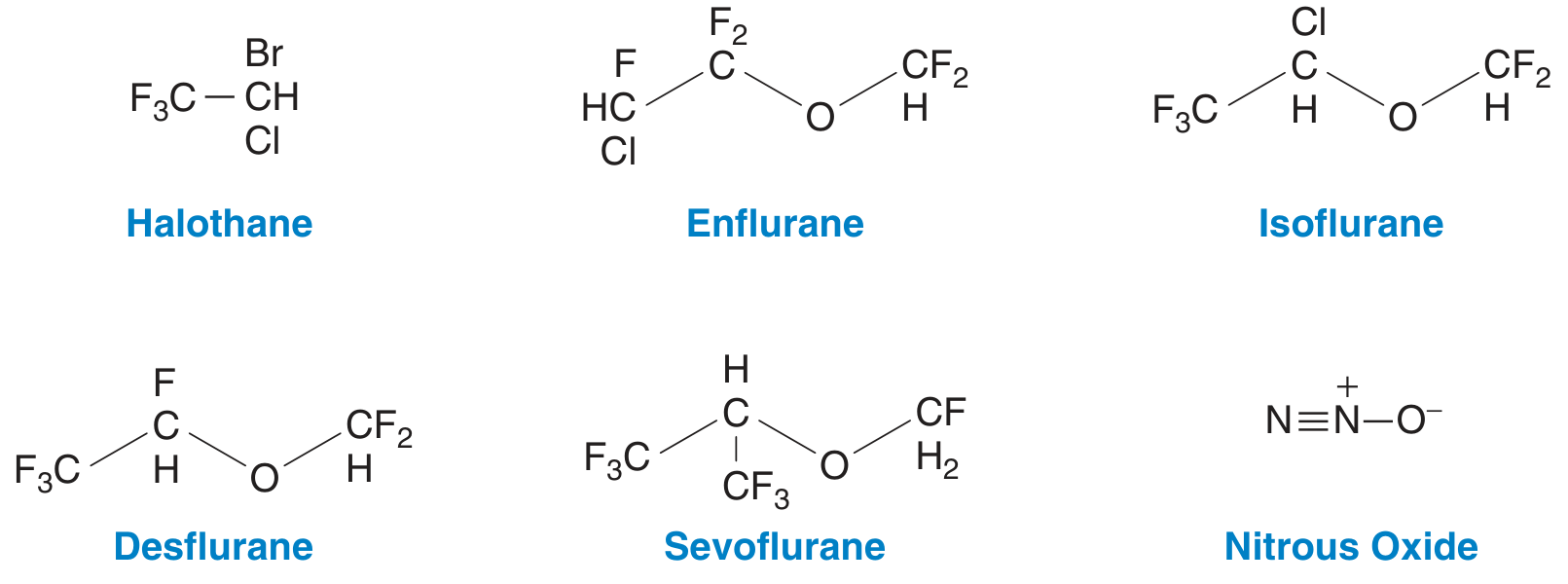
Fig. 24-4 from Goodman & Gilman's Pharmacological Basis of Therapeutics - note that desflurane is identical to isoflurane except fluorine replaces chlorine on the alpha-ethyl component
1. Introduction and Classification
Isoflurane, sevoflurane, and desflurane are the three currently used potent volatile halogenated inhalational anesthetics. All three are fluorinated methyl ethyl ethers that produce general anesthesia through enhancement of inhibitory neurotransmission (principally GABA-A and glycine receptors) and inhibition of excitatory NMDA receptors. They superseded halothane and enflurane due to superior safety profiles and more predictable pharmacokinetics.
2. Physical Properties and Pharmacokinetic Comparison
| Property | Isoflurane | Sevoflurane | Desflurane |
|---|---|---|---|
| MAC (%) | 1.05-1.28 | 1.4-3.3 (age-dependent) | 5.2-9.2 |
| MAC-awake (%) | 0.4 | 0.6 | 2.4 |
| Blood/gas partition coefficient | 1.43 | 0.63-0.69 | 0.42 |
| Vapor pressure at 20°C (mmHg) | 238 | 157 | 669 |
| % Metabolism | 0.17% | 3.5-5% | <0.02% |
| Odor | Pungent, ethereal | Non-pungent, sweet | Very pungent |
| Vaporizer | Conventional | Conventional | Special heated, pressurized |
(Sources: Goodman & Gilman's, p.497; Morgan & Mikhail's Clinical Anesthesiology 7e)
Key Points on Physical Properties
Isoflurane is the most potent of the three (lowest MAC among halogenated ethers), is chemically very stable, and has a high vapor pressure allowing use in conventional variable-bypass vaporizers. Its higher blood/gas coefficient (1.43) makes it the slowest of the three for induction and emergence. It is the historical "gold standard" volatile anesthetic since its introduction in the 1970s.
Sevoflurane has a much lower blood solubility (0.65) than isoflurane, enabling a moderately rapid induction. Its non-pungent, sweet odor makes it the agent of choice for inhalational induction - both in children and adults. A conventional vaporizer can be used because of its modest vapor pressure (157 mmHg).
Desflurane is structurally identical to isoflurane with one substitution: fluorine replaces the chlorine atom on the alpha-ethyl component. This seemingly "minor" change profoundly alters its physical properties. It has:
- The lowest blood/gas partition coefficient of any potent volatile anesthetic (0.42), even lower than nitrous oxide (0.47), making it the fastest agent for induction and emergence
- An extremely high vapor pressure (669 mmHg) - at high altitudes it boils at room temperature - necessitating a special electrically-heated, pressurized vaporizer (the Tec 6 vaporizer)
- The lowest fat solubility (roughly half that of other volatile agents), an advantage in obese patients who require less downward titration at the end of long procedures
- The lowest potency (MAC 5.2-9.2%) requiring approximately 4-5 times more volume than isoflurane
(Morgan & Mikhail's, p.308-312; Barash Clinical Anesthesia 9e, p.1403)
3. Mechanism of Action
All three agents produce anesthesia primarily by:
- Potentiating GABA-A receptors - increasing chloride channel open time, producing hyperpolarization and neuronal inhibition
- Inhibiting NMDA-type glutamate receptors - reducing excitatory neurotransmission
- Inhibiting two-pore domain (TREK) potassium channels - modulating resting membrane potential
- Inhibiting store-operated calcium entry (SOCE) in airway smooth muscle - isoflurane more than sevoflurane - contributing to bronchodilation
(Miller's Anesthesia 10e)
4. Effects on Organ Systems
A. Cardiovascular System
Isoflurane:
- Causes minimal left ventricular depression in vivo. Cardiac output is maintained through an increase in heart rate (via partial preservation of carotid baroreflexes)
- Mild beta-adrenergic stimulation increases skeletal muscle blood flow, decreases SVR, and lowers arterial blood pressure
- Rapid concentration increases produce transient elevations in heart rate, BP, and norepinephrine levels
- Dilates coronary arteries (though less potently than nitroglycerine/adenosine) - the historical concern about coronary "steal" has largely been abandoned in clinical practice
Sevoflurane:
- Mildly depresses myocardial contractility
- SVR and arterial BP decline slightly less than with isoflurane or desflurane
- Causes little or no rise in heart rate, so cardiac output is not maintained as well as with the other two
- May prolong the QT interval (clinical significance uncertain; QT prolongation may persist 60 minutes after emergence, particularly in infants)
- Does not sensitize the myocardium to catecholamine-induced arrhythmias
Desflurane:
- Cardiovascular effects similar to isoflurane overall
- Decline in SVR leads to a fall in arterial pressure
- Rapid increases in concentration produce marked, transient sympathetic stimulation (tachycardia, hypertension, elevated catecholamines) - more pronounced than with isoflurane, especially in patients with cardiovascular disease. This can be attenuated by fentanyl, esmolol, or clonidine
All three agents produce dose-dependent reductions in systemic blood pressure proportional to alveolar concentration.
(Morgan & Mikhail's, pp.307-313)
B. Respiratory System
All three agents:
- Produce dose-dependent respiratory depression (decreased tidal volume, decreased minute ventilation, elevated PaCO2)
- Blunt the normal ventilatory responses to hypoxia and hypercapnia (even at 0.1 MAC for isoflurane)
- Produce bronchodilation (useful in reactive airway disease, asthma)
Isoflurane: Despite tendency to irritate upper airway reflexes, is a good bronchodilator. Tachypnea is less pronounced, so the fall in minute ventilation is more marked.
Sevoflurane: Non-pungent; depresses respiration and reverses bronchospasm to an extent similar to isoflurane. Preferred for inhalational induction due to absence of airway irritation. Agent of choice in children and those with difficult IV access.
Desflurane: Most pungent volatile agent; highly irritating to the airway during induction. Causes salivation, breath-holding, coughing, and laryngospasm. Absolutely contraindicated for inhalational induction (not suitable for mask induction). Airway resistance may increase in children with reactive airway disease.
(Morgan & Mikhail's, pp.307-312)
C. Cerebral Effects
All three agents:
- Produce concentration-dependent decreases in cerebral metabolic rate (CMRO2) - isoflurane produces the greatest maximal depression (up to 50%), with desflurane and sevoflurane producing nearly equivalent depression
- Dilate cerebral vessels, increasing CBF, cerebral blood volume, and ICP in a dose-dependent fashion at normocarbia
- Impair cerebrovascular autoregulation in a concentration-dependent manner
- Maintain responsiveness to CO2 (hyperventilation can blunt or abolish increases in CBF and ICP)
Isoflurane: At >1 MAC, increases CBF and ICP. Increases CBF by approximately 20% at 1 MAC (less than halothane's 200%). At 2 MAC produces an electrically silent EEG (isoelectric). Considered relatively neuroprotective; no seizure activity. Simultaneous hyperventilation (unlike halothane) can prevent ICP rises.
Sevoflurane: Produces the least cerebral vasodilation of the volatile agents. High concentrations (>1.5 MAC) may impair CBF autoregulation, causing CBF to fall during hemorrhagic hypotension. No seizure activity has been reported in adults, but at high concentrations in children, epileptiform EEG changes occur and are associated with emergence delirium.
Desflurane: Directly vasodilates cerebral vasculature, increasing CBF, CBV, and ICP. However, the concomitant decline in CMRO2 causes reactive vasoconstriction that moderates the CBF increase. EEG effects similar to isoflurane - initial frequency increase followed by progressive slowing. Maintains CO2 reactivity.
For all agents in patients with intracranial pathology: use with caution; pre-treat with hyperventilation; maintain normocarbia.
(Morgan & Mikhail's Clinical Anesthesiology 7e, pp.307-313; Chapter 26)
D. Neuromuscular System
All three volatile agents:
- Produce skeletal muscle relaxation
- Potentiate non-depolarizing neuromuscular blocking agents (NMBAs) - reducing dose requirements by approximately 30-50%
- Are all triggers for malignant hyperthermia (MH) in susceptible individuals (RYR1 mutation carriers). All three must be avoided if MH susceptibility is suspected.
Isoflurane, desflurane, and sevoflurane potentiate NMBAs to roughly equal extents.
(Katzung's Basic and Clinical Pharmacology; Goldman-Cecil Medicine)
E. Renal Effects
Isoflurane: Decreases renal blood flow, GFR, and urinary output in proportion to reduction in blood pressure; effects reversible.
Sevoflurane: The major renal concern is the production of Compound A (fluoromethyl-2,2-difluoro-1-[trifluoromethyl]vinyl ether) when sevoflurane is degraded by CO2 absorbers (soda lime, especially Baralyme). Compound A is dose-dependent nephrotoxic in rats but has no demonstrated adverse renal effects in humans at any flow rate. Some clinicians recommend fresh gas flow ≥2 L/min for prolonged anesthetics as a precaution. The elevated inorganic fluoride levels after sevoflurane metabolism (>50 µmol/L in ~7% of patients) have not been associated with clinically significant renal dysfunction.
Desflurane: Negligible renal concern due to <0.02% metabolism.
(Morgan & Mikhail's, pp.308-313; Barash Clinical Anesthesia 9e)
F. Hepatic Effects
Isoflurane: Total hepatic blood flow may be reduced, but hepatic artery perfusion is preserved (unlike halothane). Liver function tests generally unaffected. Undergoes limited oxidative metabolism to trifluoroacetic acid (0.17%), minimizing risk of immune-mediated hepatitis (which requires trifluoroacetylated protein adducts as antigens). Risk of hepatitis is extremely low.
Sevoflurane: Metabolized at 5% rate (10× more than isoflurane). Notably, it does not form trifluoroacetate; instead metabolized to hexafluoroisopropanol (an acyl halide). Therefore, does not stimulate the antibody formation responsible for halothane-like hepatitis.
Desflurane: Resistant to metabolism to trifluoroacetate due to strong C-F bonds (<0.02% metabolized). Immune-mediated hepatitis is therefore an extremely rare occurrence.
(Morgan & Mikhail's, pp.307-313; Barash Clinical Anesthesia 9e)
5. Biotransformation and Toxicity
Isoflurane: Metabolized (0.17%) by CYP2E1 to trifluoroacetic acid. Fluoride levels may rise but nephrotoxicity is extremely unlikely even with enzyme inducers or prolonged ICU use.
Sevoflurane: Metabolized by CYP2E1 (5%) - 10× rate of isoflurane. Produces:
- Inorganic fluoride (F-) - levels can exceed 50 µmol/L but without clinical nephrotoxicity
- Compound A from CO2 absorber degradation (nephrotoxic in rats, not in humans)
- No trifluoroacetylated hepatotoxic adducts
- Induced by ethanol or phenobarbital pretreatment
Desflurane: Nearly no metabolism (<0.02%). The strong C-F bond makes it environmentally resistant - it has a long atmospheric lifetime and is a potent greenhouse gas (global warming potential approximately 2,540 times that of CO2 over 100 years - far greater than sevoflurane at 130× CO2). This environmental concern has led to restrictions/withdrawal from clinical use in several European countries.
(Morgan & Mikhail's, p.312-313; Barash Clinical Anesthesia 9e, p.1403-1404)
6. Induction and Emergence Characteristics
The blood/gas partition coefficient is the single most important determinant of speed of induction and emergence:
| Agent | Speed of Induction/Emergence |
|---|---|
| Desflurane | Fastest - approaches N2O kinetics; wakeup ~50% faster than isoflurane |
| Sevoflurane | Intermediate - rapid induction possible; faster emergence than isoflurane |
| Isoflurane | Slowest - most prolonged emergence among the three |
- The low fat solubility of desflurane means tissue saturation is minimal even during long procedures, giving predictable rapid emergence regardless of case duration. Particularly advantageous in morbidly obese patients and long surgical procedures
- Sevoflurane's non-pungency and favorable kinetics make it the agent of choice for gaseous induction in children
- Emergence delirium is more common with desflurane (in pediatric patients) and sevoflurane compared to other agents
(Barash Clinical Anesthesia 9e; Morgan & Mikhail's, pp.308-309)
7. MAC Values and Age Dependence
MAC is the minimum alveolar concentration at 1 atmosphere that prevents movement in 50% of patients in response to surgical incision. Key MAC adjustments:
- MAC decreases with age (highest in infants, declines progressively)
- MAC decreases with hypothermia, hypotension, pregnancy, premedication with opioids/benzodiazepines
- MAC increases with hyperthermia, chronic alcohol use, and early infancy
Sevoflurane has a uniquely age-dependent MAC: 3.3% in neonates, 3.2% for infants 1-6 months, declining to 2.5% in children >6 months, and approximately 2.0% in adults - with relatively little difference between neonates and infants (unlike other agents).
(Miller's Anesthesia 10e; Morgan & Mikhail's)
8. Special Clinical Considerations
Malignant Hyperthermia
All three agents are potential triggers for MH in susceptible individuals. If MH susceptibility is known or suspected, all volatile agents must be avoided; total intravenous anesthesia (TIVA) is indicated.
Coronary Steal (Isoflurane)
The historical concern that isoflurane-induced coronary vasodilation could divert blood away from fixed stenotic lesions (coronary steal) has been largely abandoned. Clinical outcomes data do not support this as a clinically significant concern.
Obstetrics
All volatile agents cause dose-dependent uterine relaxation (tocolysis), which can be useful during certain obstetric procedures (e.g., manual removal of placenta) but may contribute to uterine atony and hemorrhage if used at high concentrations.
Desflurane Use Restrictions
Due to its high global warming potential, desflurane has been withdrawn from clinical use in several countries (UK, Nordic countries) and its use is increasingly restricted on environmental grounds. Many institutions have moved toward TIVA or sevoflurane-based anesthesia.
Epinephrine Administration
Isoflurane, sevoflurane, and desflurane do NOT sensitize the myocardium to catecholamine-induced arrhythmias (unlike halothane). Epinephrine can be safely administered at doses up to 4.5 µg/kg during desflurane anesthesia.
9. Contraindications
| Contraindication | Isoflurane | Sevoflurane | Desflurane |
|---|---|---|---|
| Malignant hyperthermia susceptibility | ✗ | ✗ | ✗ |
| Severe hypovolemia | Caution | ✗ | Caution |
| Intracranial hypertension (elevated ICP) | Caution* | Caution* | Caution* |
| Inhalational induction (pediatric/difficult airway) | Avoid (pungent) | Safe | Avoid (most pungent) |
| Morbidly obese (long cases) | Less preferred | Acceptable | Preferred |
*Use with moderate hyperventilation; simultaneous hyperventilation can prevent ICP rise
10. Comparison Summary Table
| Feature | Isoflurane | Sevoflurane | Desflurane |
|---|---|---|---|
| Potency (MAC) | Highest (1.15%) | Intermediate (2.0%) | Lowest (6-7%) |
| Blood/gas coeff | 1.43 (slowest) | 0.65 (intermediate) | 0.42 (fastest) |
| Induction suitability | Pungent - poor for mask | Non-pungent - excellent | Highly pungent - contraindicated for mask |
| Vaporizer required | Conventional | Conventional | Special heated/pressurized |
| Cardiac output | Maintained (HR rise) | Less well maintained | Maintained (HR rise) |
| Coronary steal concern | Historical - not clinically significant | None | None |
| QT prolongation | No | Yes | No |
| Sympathetic stimulation on rapid ↑ | Mild | Minimal | Marked - clinical problem |
| Hepatotoxicity | Extremely rare | Not reported | Extremely rare |
| Nephrotoxicity | Minimal | Compound A (theoretical in humans) | Negligible |
| Malignant hyperthermia | Trigger | Trigger | Trigger |
| Cerebral vasodilation | Moderate | Least | Moderate |
| CMRO2 depression | Up to 50% | Up to 50% | Up to 50% |
| % Metabolized | 0.17% | 3.5-5% | <0.02% |
| Environmental impact | Moderate | Lower (130× CO2) | Highest (2,540× CO2) |
| Pediatric use | IV induction preferred | Agent of choice for mask induction | Not recommended in non-intubated children |
| Best for long/obese cases | Less preferred | Acceptable | Preferred (least tissue saturation) |
| Emergence delirium | Low | Higher (children) | Higher (children) |
11. Clinical Selection Guide
- Sevoflurane is the first choice for inhalational induction, pediatric anesthesia, patients with reactive airway disease, and situations requiring smooth mask induction
- Desflurane is preferred for long surgical cases, morbidly obese patients, and situations where very rapid predictable emergence is paramount (though environmental concerns are limiting its use)
- Isoflurane remains widely used, especially in resource-limited settings; it is the historical gold standard and offers excellent stability and reliability at low cost
- All three are equally appropriate for maintenance of anesthesia when given via endotracheal tube or LMA
References
- Morgan and Mikhail's Clinical Anesthesiology, 7th Edition, Chapter 8 (Inhalational Anesthetics), pp. 306-314
- Barash, Cullen, and Stoelting's Clinical Anesthesia, 9th Edition, Chapter 18 (Clinical Overview of Inhaled Anesthetics), pp. 1403-1404
- Goodman & Gilman's The Pharmacological Basis of Therapeutics, Chapter 24, Table 24-3, p. 497
- Miller's Anesthesia, 10th Edition, Block 6 & 29 - Mechanisms and Pediatric Applications
- Katzung's Basic and Clinical Pharmacology, 16th Edition, Chapter on General Anesthetics
This is a shared conversation. Sign in to Orris to start your own chat.