
why DPT should not given after 7 years old
Reading File
Finding Sources
Finding Sources
Searching the Web
why DPT vaccine not given after 7 years of age pertussis component
Reading File
Why DPT (the pertussis-containing vaccine) is not given after 7 years of age
1. Pertussis becomes less severe with increasing age
Whooping cough is most dangerous in infants and young children, who have the highest rates of severe disease, complications (pneumonia, apnea, seizures) and death. As per Park's Textbook of Preventive and Social Medicine, "since the severity of pertussis infection decreases with age, the pertussis component in DPT vaccine is not usually recommended after the age of 6 years" - the disease burden simply doesn't justify a reactogenic vaccine in this age group (Park's Textbook of Preventive and Social Medicine, p. 664 equivalent section).
2. Reactogenicity increases with age/repeated exposure
The pertussis component (especially whole-cell pertussis in the older DPT formulation) is the part of the vaccine most associated with adverse reactions - local swelling, pain, high fever, and rare but serious neurological events such as encephalopathy, prolonged convulsions, and infantile spasms (estimated risk ~1:170,000 doses). As children get older and have had repeated exposure to the antigens (through prior doses or natural exposure), local and systemic reactions to another pertussis-containing dose tend to be more pronounced - large local swelling/Arthus-type reactions become more common with repeat boosting in this age group.
3. Practical/administrative shift to adult-type formulations
By age 7, children have generally either completed their primary DPT series or need a different antigen dose. So instead of full-strength DPT:
- Children who missed doses and are older than 5-7 years should receive DT (diphtheria-tetanus) without pertussis, not DPT.
- From age 7 (US ACIP) / 12 years (Park's/WHO) onward, the vaccine of choice becomes Td or Tdap - "d" and "p" in lowercase indicating markedly reduced diphtheria and pertussis antigen content, designed specifically to be less reactogenic in older children and adults while still providing a pertussis booster where indicated.
In short: DPT (or DTaP) after age 7 is avoided because (a) pertussis disease is much less severe/dangerous at that age, and (b) the vaccine, particularly its pertussis component, causes disproportionately more local and systemic side effects in older children/adults. This is why the reduced-antigen Td/Tdap formulations replace DPT beyond this age cutoff.
This is consistent with current CDC guidance: "CDC recommends DTaP for all infants and children younger than 7 years of age... If the pertussis component is contraindicated, use Td to complete the primary series in this age group," with Tdap/Td used for those 7 years and older.
No recent systematic reviews or meta-analyses in the last 2 years contradict this - the age cutoff and rationale remain part of standard immunization practice (WHO EPI schedule and ACIP/CDC recommendations).
Explain it shortly
DPT is not given after 7 years of age mainly because:
- Pertussis is milder in older children/adults - the disease is most dangerous in infants and young children, so there's less need for the reactogenic vaccine later.
- More side effects with age - the pertussis component causes stronger local and systemic reactions (swelling, fever, rare neurological events) when given to older children, due to repeated antigen exposure.
- Switch to low-dose formulations - after this age, children/adults instead receive Td or Tdap, which have reduced diphtheria and pertussis antigen content, giving protection with far fewer side effects.
So the vaccine formula changes with age, not the need for protection itself.
X ray readings
Could you clarify what you're looking for?
Asking for Preferences
What do you need about X-ray readings?
Why DPT (the pertussis-containing vaccine) is not given after 7 years of age
1. Pertussis becomes less severe with increasing age
Whooping cough is most dangerous in infants and young children, who have the highest rates of severe disease, complications (pneumonia, apnea, seizures) and death. As per Park's Textbook of Preventive and Social Medicine, "since the severity of pertussis infection decreases with age, the pertussis component in DPT vaccine is not usually recommended after the age of 6 years" - the disease burden simply doesn't justify a reactogenic vaccine in this age group (Park's Textbook of Preventive and Social Medicine, p. 664 equivalent section).
2. Reactogenicity increases with age/repeated exposure
The pertussis component (especially whole-cell pertussis in the older DPT formulation) is the part of the vaccine most associated with adverse reactions - local swelling, pain, high fever, and rare but serious neurological events such as encephalopathy, prolonged convulsions, and infantile spasms (estimated risk ~1:170,000 doses). As children get older and have had repeated exposure to the antigens (through prior doses or natural exposure), local and systemic reactions to another pertussis-containing dose tend to be more pronounced - large local swelling/Arthus-type reactions become more common with repeat boosting in this age group.
3. Practical/administrative shift to adult-type formulations
By age 7, children have generally either completed their primary DPT series or need a different antigen dose. So instead of full-strength DPT:
- Children who missed doses and are older than 5-7 years should receive DT (diphtheria-tetanus) without pertussis, not DPT.
- From age 7 (US ACIP) / 12 years (Park's/WHO) onward, the vaccine of choice becomes Td or Tdap - "d" and "p" in lowercase indicating markedly reduced diphtheria and pertussis antigen content, designed specifically to be less reactogenic in older children and adults while still providing a pertussis booster where indicated.
In short: DPT (or DTaP) after age 7 is avoided because (a) pertussis disease is much less severe/dangerous at that age, and (b) the vaccine, particularly its pertussis component, causes disproportionately more local and systemic side effects in older children/adults. This is why the reduced-antigen Td/Tdap formulations replace DPT beyond this age cutoff.
This is consistent with current CDC guidance: "CDC recommends DTaP for all infants and children younger than 7 years of age... If the pertussis component is contraindicated, use Td to complete the primary series in this age group," with Tdap/Td used for those 7 years and older.
No recent systematic reviews or meta-analyses in the last 2 years contradict this - the age cutoff and rationale remain part of standard immunization practice (WHO EPI schedule and ACIP/CDC recommendations).DPT is not given after 7 years of age mainly because:
- Pertussis is milder in older children/adults - the disease is most dangerous in infants and young children, so there's less need for the reactogenic vaccine later.
- More side effects with age - the pertussis component causes stronger local and systemic reactions (swelling, fever, rare neurological events) when given to older children, due to repeated antigen exposure.
- Switch to low-dose formulations - after this age, children/adults instead receive Td or Tdap, which have reduced diphtheria and pertussis antigen content, giving protection with far fewer side effects.
So the vaccine formula changes with age, not the need for protection itself.Could you clarify what you're looking for?
All but for Pediatrics
Finding Sources
Finding Sources
Finding Sources
Searching the Web
systematic approach to reading pediatric chest x-ray differences from adult
Reading File
Reading X-rays in Pediatrics
Interpreting a pediatric X-ray follows the same basic systematic approach as in adults (check technique/rotation/inspiration first, then a structured scan), but the normal anatomy changes dramatically with age, so what looks abnormal on an adult film can be completely normal in a child - and vice versa.
1. Check technique first
- Rotation: assess by symmetry of clavicles/ribs to the spine - kids move a lot, so rotation is the most common cause of a "weird-looking" film.
- Inspiration: adequate if you can count ~8-9 posterior ribs above the diaphragm; poor inspiration falsely makes the heart look enlarged and lungs look hazy.
- Positioning: many infants/young children are imaged supine (AP) rather than erect PA, which changes apparent heart size and diaphragm position.
2. Key pediatric-specific normal findings (don't mistake these for pathology)
- Thymus: a large, soft, triangular "sail sign" density in the anterior superior mediastinum, very prominent in neonates and infants, shrinking with age and usually inconspicuous by age 6. It can mimic a mediastinal mass, lobar pneumonia, or hilar adenopathy - a lateral view confirms its anterior location.
- Cardiac silhouette: can normally occupy up to 60-65% of chest width in neonates (vs ~50% "cardiothoracic ratio" cutoff in older children/adults).
- Chest shape: more pyramidal/trapezoidal in neonates vs the long rectangular adult chest.
- Bronchovascular markings: bronchial branching may be visible further out than in adults, which can falsely look like abnormal air bronchograms.
- Diaphragm: sits relatively higher; trachea/bronchi are more central and shift position with growth.
3. Systematic scan (adapted for kids)
Lung parenchyma → pulmonary vasculature → heart/mediastinum (including thymus) → airway → bones (ribs, clavicles, spine - watch for metaphyseal/costochondral changes, e.g. rickets, or occult fractures suggestive of non-accidental trauma) → soft tissues/foreign bodies (children commonly aspirate foreign bodies - look for asymmetric air trapping or lobar collapse if the object is radiolucent).
4. Age-based disease patterns
- Neonates: transient tachypnea of the newborn ("wet lung") and meconium aspiration are top differentials for respiratory distress.
- Infants/toddlers: foreign body aspiration, bronchiolitis (hyperinflation, peribronchial cuffing).
- School-age children: pneumonia patterns start resembling adult lobar/patchy consolidation.
5. Bone age reading (skeletal maturity)
Bone age X-rays (usually left hand-wrist) are read against standard atlases (e.g. Greulich-Pyle) by evaluating ossification centers and epiphyseal fusion, which follow a predictable sequence and timing through childhood - used to assess growth disorders, precocious/delayed puberty, and in forensic age estimation.
Below is an example of a normal neonatal chest X-ray showing the thymic "sail sign," a classic normal variant that's important not to over-call as pathology:
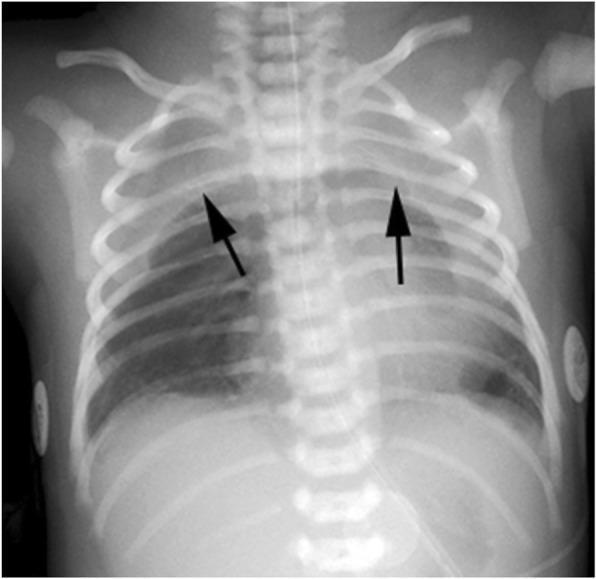
Sources: Tintinalli's Emergency Medicine, "The Pediatric Chest Radiograph" - p. 3059-3090 (block10); general pediatric radiology references (SFLRad, BorderRadiology, AJR pictorial review on pediatric chest radiograph pitfalls).
If you have a specific film (chest, bone age, abdomen, skull) or a particular clinical question (e.g. pneumonia vs foreign body, rickets, fracture dating for NAT), let me know and I can go into that specific reading in more depth.
This is a shared conversation. Sign in to Orris to start your own chat.