
Sevoflurane 5 mark answer
Reading File
Sevoflurane is a fluorinated volatile inhalational anaesthetic. Let me pull the authoritative textbook content.
Searching sources...
Finding Sources
Finding Sources
Good results. Let me read the most relevant textbook sections now.
Reading File
Reading File
Reading File
Reading File
Reading File
I now have comprehensive information from multiple authoritative sources. Let me fetch the inhalation anesthetic comparison image too.
Loading Image
I now have all the information needed for a well-structured 5-mark answer. Here it is:
Sevoflurane
1. Basic Properties
Sevoflurane is a sweet-smelling, completely fluorinated methyl isopropyl ether - a clear, colorless volatile liquid at room temperature. Key physicochemical properties:
| Property | Value |
|---|---|
| Blood:gas partition coefficient | 0.65 (low - second only to desflurane) |
| MAC (adults) | ~2% |
| Vapour pressure | ~160 mmHg at 20°C |
| Metabolism | ~5% by hepatic CYP2E1 |
| Solubility | Low blood/tissue solubility |
It is non-flammable and non-explosive in air or O2 mixtures. It can be used in a conventional variable-bypass vaporizer.
2. Mechanism of Action
Like all volatile anaesthetics, sevoflurane produces unconsciousness primarily by:
- Potentiating GABA-A receptors (hyperpolarization via increased Cl- influx)
- Inhibiting NMDA receptors and neuronal Na+/K+ channels
- Modulating two-pore domain K+ channels (K2P), increasing background leak conductance to hyperpolarize neurons
3. Clinical Pharmacology / ADME
- Induction: Rapidly achieved using 2-4% inhaled concentration. The preferred volatile agent for inhalational (mask) induction in both children and adults due to its pleasant odour and lack of airway irritation - has largely replaced halothane for this purpose.
- Rapid onset and offset: Due to low blood:gas solubility, induction and recovery are quick; anesthetic depth can be changed rapidly.
- Maintenance: Widely used post-IV induction; also used as the sole agent via VIMA (Volatile Induction and Maintenance of Anaesthesia).
- Metabolism: ~5% metabolized by hepatic CYP2E1 to hexafluoroisopropanol + inorganic fluoride. NOT metabolized to trifluoroacetate (unlike halothane), so it does not cause halothane-type immune hepatitis.
4. Organ System Effects (Side Effects)
Cardiovascular
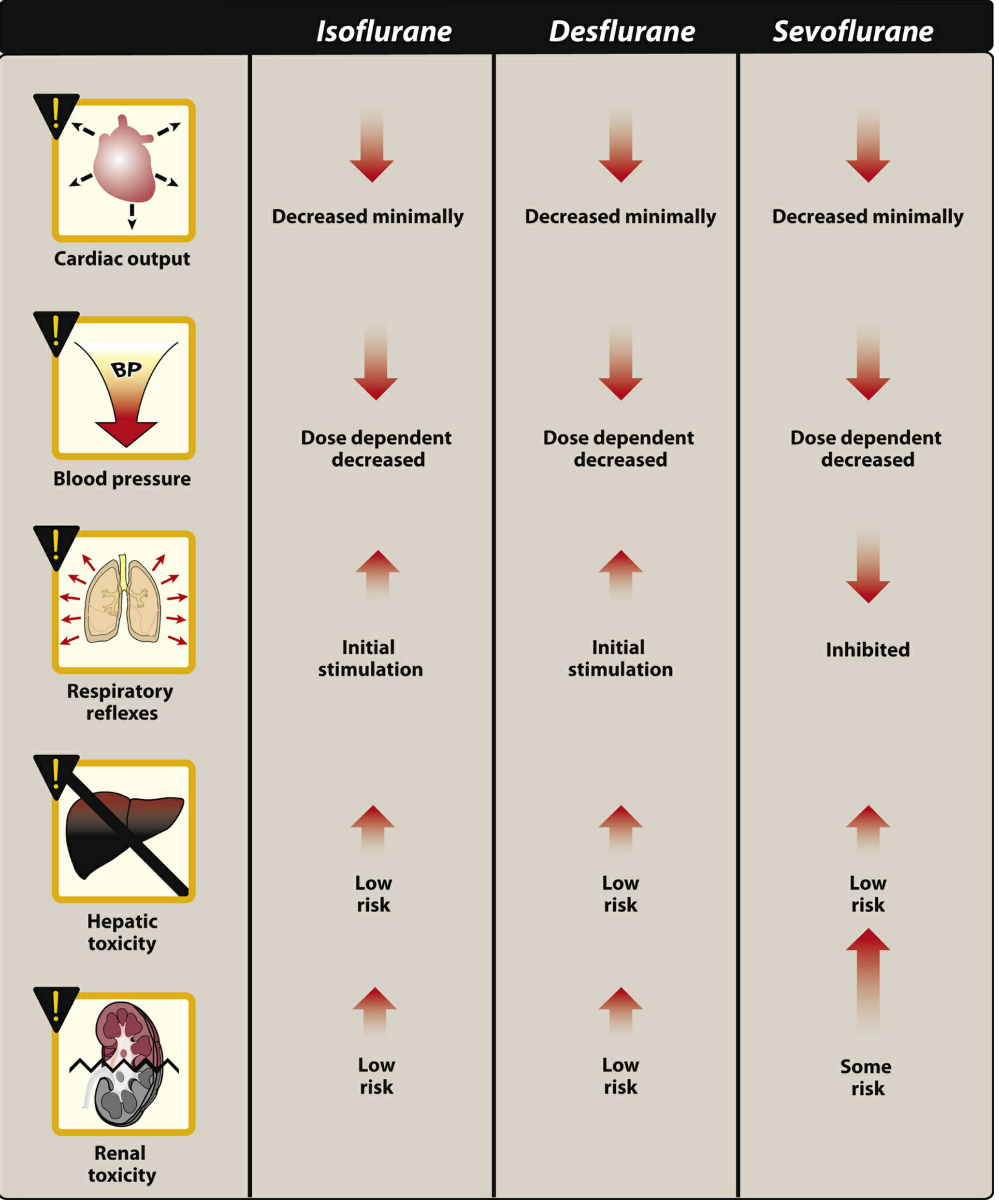
- Concentration-dependent decrease in arterial blood pressure (due to systemic vasodilation) and decrease in cardiac output
- Does NOT cause tachycardia - preferable in patients prone to myocardial ischaemia
- Half as potent a coronary vasodilator as isoflurane
Respiratory
- Concentration-dependent reduction in tidal volume + increase in respiratory rate
- Net effect: reduced minute ventilation and increased PaCO2
- NOT irritating to airway - most potent clinical bronchodilator among inhalational anaesthetics (useful in asthma)
- Respiratory reflexes are inhibited (unlike isoflurane/desflurane which initially stimulate)
Central Nervous System
- Increases cerebral blood flow (CBF) and ICP (similar to isoflurane/desflurane), but the response to hypocapnia is preserved - ICP increases can be prevented by hyperventilation
- Reduces CMRO2 (cerebral metabolic rate of O2)
- Emergence delirium in children - short-lived, no long-term sequelae; managed with fentanyl, propofol, ketamine, or alpha-2 agonists (midazolam premedication is ineffective)
Neuromuscular
- Produces skeletal muscle relaxation and enhances the effects of non-depolarizing neuromuscular blocking agents
Hepatic
- Low hepatotoxic potential - not metabolized to trifluoroacetate, so antibody-mediated hepatitis does not occur
5. Toxicity - Compound A and Renal Concerns
- Sevoflurane reacts with CO2 absorbents (soda lime/Baralyme) containing strong bases (NaOH, KOH) to form Compound A (fluoromethyl-2,2-difluoro-1-(trifluoromethyl) vinyl ether - a vinyl halide/haloalkene)
- Compound A is a dose-dependent nephrotoxin in rats (proximal tubular necrosis at >150 ppm-hours)
- In humans: No clinically significant nephrotoxicity has been demonstrated, even with >200 ppm-hour exposures. This is because human kidneys have far lower beta-lyase activity than rat kidneys (the enzyme that converts the cysteine conjugate of Compound A to a toxic reactive intermediate)
- Practical precaution: Maintain fresh gas flows above 2 L/min when using soda lime to minimize Compound A accumulation
- Sevoflurane also produces inorganic fluoride on metabolism (as does methoxyflurane at toxic levels), but renal-concentrating defects have NOT been associated with sevoflurane at clinical doses
- Malignant hyperthermia trigger - like all halogenated volatile agents, sevoflurane is a trigger for MH in susceptible individuals (must avoid in MH-susceptible patients)
Key Advantages (Summary)
| Feature | Clinical Benefit |
|---|---|
| Low blood:gas solubility (0.65) | Rapid induction, recovery, and depth control |
| Pleasant sweet smell, non-pungent | Ideal for mask induction (children, needle-phobia) |
| Best bronchodilator among volatiles | Safe in asthma/COPD |
| No tachycardia | Safe in ischaemic heart disease |
| No trifluoroacetate metabolite | No immune hepatitis |
| Rapid emergence | Suitable for day-case/ambulatory surgery |
Sources: Goodman & Gilman's Pharmacological Basis of Therapeutics; Miller's Anesthesia 10e; Barash Clinical Anesthesia 9e; Lippincott Illustrated Reviews Pharmacology
This is a shared conversation. Sign in to Orris to start your own chat.