
explain in same way demonstartion everthing in sensory integration in deatil
Reading File
Finding Sources
Finding Sources
Finding Sources
Finding Sources
Reading File
Reading File
Reading File
Reading File
Reading File
Loading Image
Loading Image
Reading File
Now I have enough rich textbook content to deliver a comprehensive, well-structured explanation. Let me compile everything.
Sensory Integration — A Complete Explanation
Sensory integration is the process by which the nervous system receives, organizes, and interprets information from the body and the environment to produce coordinated perception, movement, and behavior. Think of it as the brain's "traffic management system" — raw sensory data arrives from multiple channels simultaneously, and the brain must merge them into a single, meaningful experience.
1. The Starting Point: Sensory Receptors
Before integration can occur, the outside world must be transduced (converted) into electrical signals the brain can use.
Mechanoreceptors (Touch & Position)
These are the most relevant to sensory integration. They are found in skin, muscles, and joints.
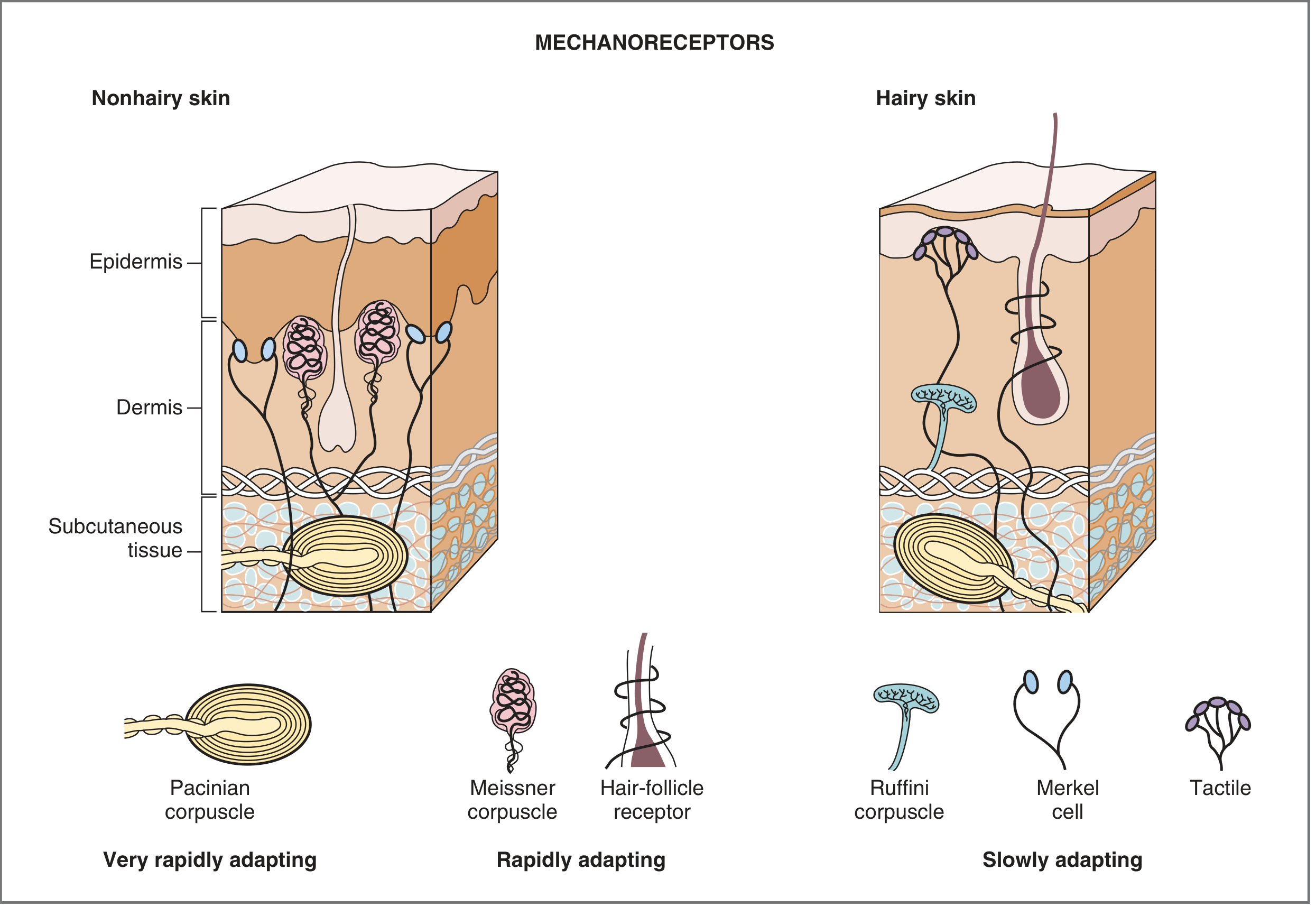
| Receptor | Location | Adaptation | What it detects |
|---|---|---|---|
| Pacinian corpuscle | Deep subcutaneous tissue | Very rapidly | Vibration, tapping |
| Meissner corpuscle | Nonhairy skin dermis | Rapidly | Point discrimination, flutter |
| Hair follicle receptor | Around hair shafts | Rapidly | Velocity & direction of movement |
| Ruffini corpuscle | Hairy skin | Slowly | Stretch, joint rotation |
| Merkel receptor | Nonhairy skin | Slowly | Vertical skin indentation |
| Tactile discs | Hairy skin | Slowly | Vertical skin indentation |
Key concept — Adaptation: Rapidly adapting receptors fire at the onset and offset of a stimulus (detecting change). Slowly adapting receptors fire continuously while the stimulus persists (detecting intensity and duration). This distinction is the first level of sensory filtering. — Costanzo Physiology, 7th Ed.
The Three Systems Central to Sensory Integration
- Tactile system — touch, pressure, pain, temperature (skin receptors)
- Vestibular system — balance, gravity, movement (inner ear)
- Proprioceptive system — body position and limb awareness (muscles, joints, tendons)
These three, along with vision and audition, feed data simultaneously into the CNS for integration.
2. Two Pathways to the Brain
Somatosensory information travels to the cortex via two distinct spinal cord pathways:
| Pathway | Modalities Carried | Key Features |
|---|---|---|
| Dorsal column–medial lemniscal | Fine touch, pressure, vibration, two-point discrimination, proprioception | Fast, precise, highly organized |
| Anterolateral (spinothalamic) | Pain, temperature, crude light touch | Crosses early (in spinal cord), less spatially precise |
Both pathways relay in the thalamus before projecting to the primary somatosensory cortex (S1, postcentral gyrus, Brodmann areas 3, 1, 2).
— Costanzo Physiology, 7th Ed.
3. The First Integration Station: Relay Nuclei
Before reaching the cortex, sensory signals pass through relay nuclei in the brainstem and thalamus. This is where the first true integration begins.
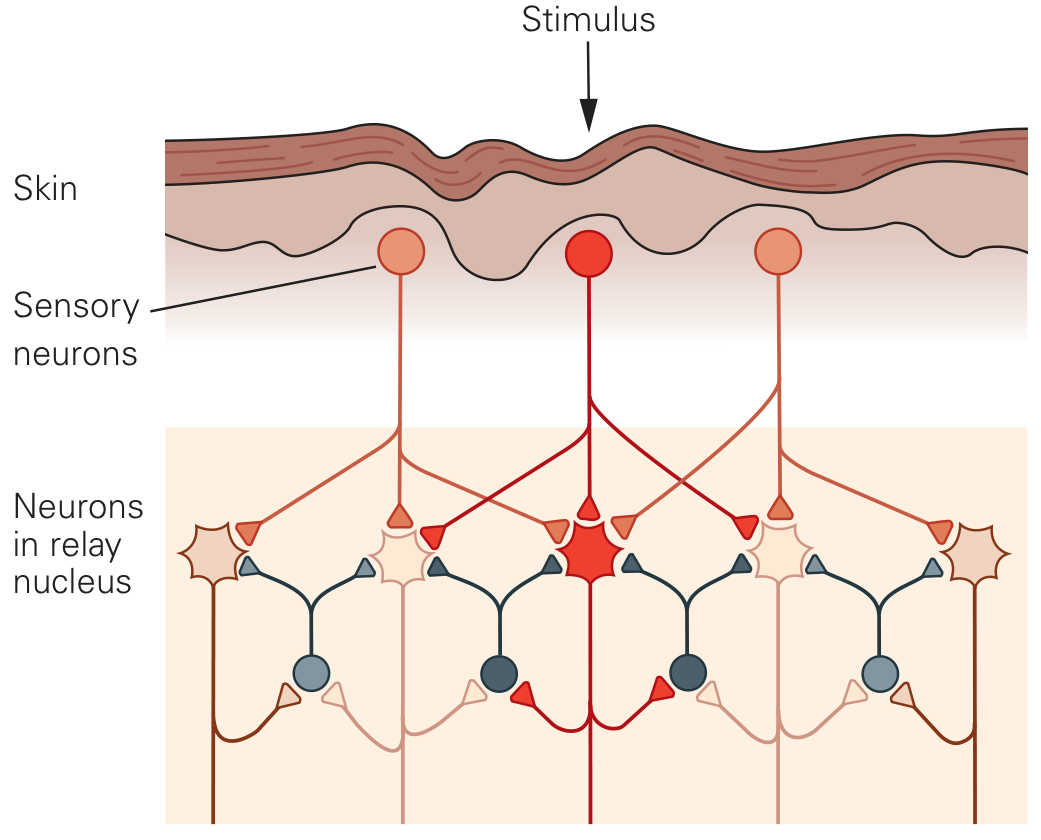
What happens in a relay nucleus:
- A stimulus to the skin activates the most strongly stimulated relay neuron at the center of the array (shown in red above)
- Lateral inhibition via local inhibitory interneurons suppresses surrounding neurons
- This sharpens contrast between strong and weak signals — allowing the brain to precisely localize the stimulus
Three types of inhibition operate here:
- Feed-forward inhibition — afferent fibers activate inhibitory interneurons directly
- Feedback inhibition — output neurons project back to inhibit neighboring neurons via recurrent collaterals
- This creates sharply defined zones of excitation and inhibition
"Inhibition confines excitation to the central zone where stimulation is strongest, enhancing contrast between strongly and weakly stimulated relay neurons." — Principles of Neural Science (Kandel), 6th Ed.
4. The Thalamus: The Integration Gateway
The thalamus is the master relay station for all sensory information (except olfaction). Different thalamic nuclei serve different functions in sensory integration:
| Thalamic Nucleus | Inputs | Function |
|---|---|---|
| Ventroposterolateral (VPL) | Body somatosensory | Relay touch/proprioception |
| Ventroposteromedial (VPM) | Face (trigeminal) | Relay facial sensation |
| Lateral geniculate | Retina | Visual relay |
| Medial geniculate | Inferior colliculus | Auditory relay |
| Lateral posterior | Superior colliculus, parietal cortex | Sensory integration |
| Pulvinar | Superior colliculus, temporal/parietal/occipital cortices, cerebellum | Integration of visual information |
The lateral posterior nucleus and pulvinar are explicitly identified as thalamic nuclei dedicated to sensory integration — they receive convergent input from multiple sensory modalities and cortical areas. — Kaplan & Sadock's Comprehensive Textbook of Psychiatry
5. Topographic Maps in the Cortex
When sensory signals arrive in the cortex, they are organized as maps — adjacent neurons represent adjacent body regions:
- Somatotopic map — body surface (the "sensory homunculus" in S1)
- Retinotopic map — visual field (in V1, occipital cortex)
- Tonotopic map — sound frequency (in A1, auditory cortex)
These topographic maps are preserved from the receptor surface all the way to the primary cortical areas. The hands and lips have disproportionately large cortical representations because of their high receptor density and fine discriminative ability. — Principles of Neural Science (Kandel), 6th Ed.
6. Hierarchical & Parallel Processing in the Cortex
This is the core of sensory integration. The cortex does not process sensory input in a single linear chain — it uses both hierarchical (serial) and parallel pathways simultaneously.
Hierarchical Processing
Information flows through multiple cortical levels:
- Primary sensory cortex (e.g., S1, V1, A1) — detects basic features (location, intensity, frequency)
- Secondary sensory cortex (e.g., S2, V2) — detects more complex features
- Association cortex — integrates across modalities; produces meaning
At each higher level:
- Receptive fields get larger (neurons respond to larger areas of the body/world)
- Responses become less topographic and more feature-specific
- Neurons respond to combinations of stimuli (e.g., direction of movement + color)
Parallel Processing
Information flows in two major streams simultaneously:
| Stream | Direction | What it computes | Connects to |
|---|---|---|---|
| Ventral ("What") stream | V1 → temporal lobe | Shape, identity, object recognition | Hippocampus, prefrontal cortex |
| Dorsal ("Where/How") stream | V1 → parietal lobe | Location, motion, spatial guidance of action | Motor cortex, frontal eye fields |
This ventral/dorsal division exists not only in vision but also in somatosensory and auditory systems:
- Somatosensory: object shape/texture → temporal areas; grip planning → parietal/frontal areas
- Auditory: speech comprehension → Wernicke's area (temporal); speech production → Broca's area (frontal)
"Forming percepts requires integration of lower-level inputs. Neurons in the cerebral cortex are specialized to integrate and detect specific features of stimuli... In each successive stage of cortical processing, spatial organization is progressively lost as neurons become less concerned with descriptive features and more concerned with properties of behavioral importance." — Principles of Neural Science (Kandel), 6th Ed.
7. Multisensory Convergence
The brain does not keep sensory modalities isolated — it actively merges them:
- Parietal association cortex receives input from touch, vision, and proprioception → creates a unified body schema and space map
- Superior colliculus receives visual, auditory, and somatosensory input → guides orienting movements
- Cerebellum receives proprioceptive, vestibular, and motor efference copies → fine-tunes movement coordination
- Insular cortex integrates interoceptive, vestibular, and tactile signals → bodily awareness
The pulvinar of the thalamus plays a key coordination role — it receives from the superior colliculus and connects temporal, parietal, and occipital cortices to synchronize visual integration with somatosensory and vestibular context.
8. Modulation by Attention and Feedback
Sensory integration is not passive — it is dynamically shaped by top-down signals:
- When you attend to a stimulus, neural activity in the relevant sensory cortex increases — even when the physical stimulus is unchanged
- This was shown directly by fMRI: attending to a stimulus in the right visual field increased activity in the left V1; attending to the left field switched activity to the right V1
- Feedback connections from higher areas back to earlier sensory areas allow context, expectation, and attention to shape what is perceived
"Sensory systems are not simply automated assembly lines. The variability of evoked central responses results from the subject's state of alertness, whether attention is engaged, previous experience, and the context of stimulus presentation." — Principles of Neural Science (Kandel), 6th Ed.
9. Balance — A Prime Example of Sensory Integration in Action
Balance requires real-time integration of three systems:
| System | Contribution |
|---|---|
| Visual | External reference frame (horizon, objects) |
| Vestibular | Head position and acceleration (semicircular canals + otoliths) |
| Proprioceptive | Foot pressure, joint angles, muscle tension |
The cerebellum and brainstem constantly compare and weight these signals. When one system gives conflicting information (e.g., motion sickness when the inner ear senses motion but eyes do not), integration fails temporarily and symptoms arise.
"Balance is an important sensory integration task using visual, vestibular, and proprioception input from cortical networks that is frequently disturbed after mild traumatic brain injury." — Tintinalli's Emergency Medicine
10. Clinical Relevance: When Sensory Integration Fails
Sensory Integration Disorder
- Children with sensory integration dysfunction may struggle with body awareness and coordination
- Activities of daily living, motor planning, and behavioral regulation are all affected
- Sensory integration (SI) therapy, usually administered by occupational therapists, uses physical activities targeting the tactile, vestibular, and proprioceptive systems to remediate these deficits
"SI programs consist of physical activities that increase awareness of motor and sensory function — e.g., brushing the skin, swinging, bouncing on a trampoline — targeting tactile, vestibular, and proprioceptive systems." — Kaplan & Sadock's Synopsis of Psychiatry
Neurologic Soft Signs (NSS)
- Observable deficits in sensory integration, motor coordination, and developmental reflexes
- Seen in schizophrenia, suggesting developmental abnormalities in sensory processing circuits
Developmental Coordination Disorder
- Treated with sensory integration programs and modified physical education
Summary Diagram of the Full Flow
STIMULUS (touch/sound/light/movement)
        ↓
PERIPHERAL RECEPTORS
(mechanoreceptors, photoreceptors, hair cells, nociceptors)
        ↓
PERIPHERAL NERVE (afferent fibers — Aβ, Aδ, C fibers)
        ↓
RELAY NUCLEUS (brainstem / spinal cord)
— lateral inhibition sharpens signal
        ↓
THALAMUS (VPL, LGN, MGN, Pulvinar)
— gateway integration; modality-specific routing
        ↓
PRIMARY SENSORY CORTEX (S1 / V1 / A1)
— topographic maps; basic feature detection
        ↓
SECONDARY & ASSOCIATION CORTEX
— feature combinations; modality convergence
        ↓
VENTRAL STREAM ←→ DORSAL STREAM
(WHAT: identification)  (WHERE/HOW: action)
        ↓
MULTIMODAL INTEGRATION
(parietal, prefrontal, insular cortex)
— attention, memory, perception, action
Key Takeaways
| Concept | Core Idea |
|---|---|
| Transduction | Receptors convert physical stimuli into action potentials |
| Lateral inhibition | Relay nuclei sharpen signal contrast via inhibitory interneurons |
| Topographic maps | Spatial order of receptor sheets is preserved in the cortex |
| Hierarchical processing | Each level extracts more complex features |
| Parallel streams | Ventral (what) and dorsal (where/how) process simultaneously |
| Top-down modulation | Attention and feedback reshape sensory processing dynamically |
| Multimodal convergence | Parietal cortex, thalamus, cerebellum merge signals from all senses |
| Clinical failure | Coordination disorders, NSS, balance problems, sensory processing disorder |
Sources: Principles of Neural Science (Kandel) 6th Ed.; Costanzo Physiology 7th Ed.; Kaplan & Sadock's Comprehensive Textbook of Psychiatry; Kaplan & Sadock's Synopsis of Psychiatry; Tintinalli's Emergency Medicine
This is a shared conversation. Sign in to Orris to start your own chat.