
Where do we use median Incubation Period
The median incubation period is used in several key areas of epidemiology and public health:
- Quarantine duration - Setting the length of quarantine periods (e.g., 14 days for COVID-19 was based on the ~97th percentile of its incubation distribution, but the median informs the midpoint expectation).
- Source tracing - Working backwards from symptom onset to identify the likely time and source of exposure.
- Epidemic curve analysis - Estimating when an outbreak began and projecting its progression.
- Public health policy - Deciding isolation/observation windows for exposed individuals.
The median is preferred over the mean because incubation periods are often right-skewed (a few cases have very long incubation periods that would inflate the mean).
Searching sources...
Reading File
Searching the Web
median incubation period uses epidemiology quarantine public health
Finding Sources
Reading File
Reading File
Let me also fetch the epidemic curve figure referenced in that section.
Loading Image
Loading Image
Here is a complete, textbook-grounded answer on where the median incubation period is used:
Median Incubation Period - Definition and Uses
Definition: The median incubation period is the time required for 50% of the cases to occur following exposure to a pathogen.
(Park's Textbook of Preventive and Social Medicine)
Primary Uses
1. Point-Source (Common-Source) Epidemic Analysis
This is the most classic and exam-important use. In a point-source epidemic (e.g., food poisoning), all cases develop within one incubation period of a single brief exposure. The epidemic curve has a single bell-shaped peak. The median incubation period is read directly off this curve - it is the time from the known exposure event to the peak of the epidemic curve (where 50% of cases have occurred).
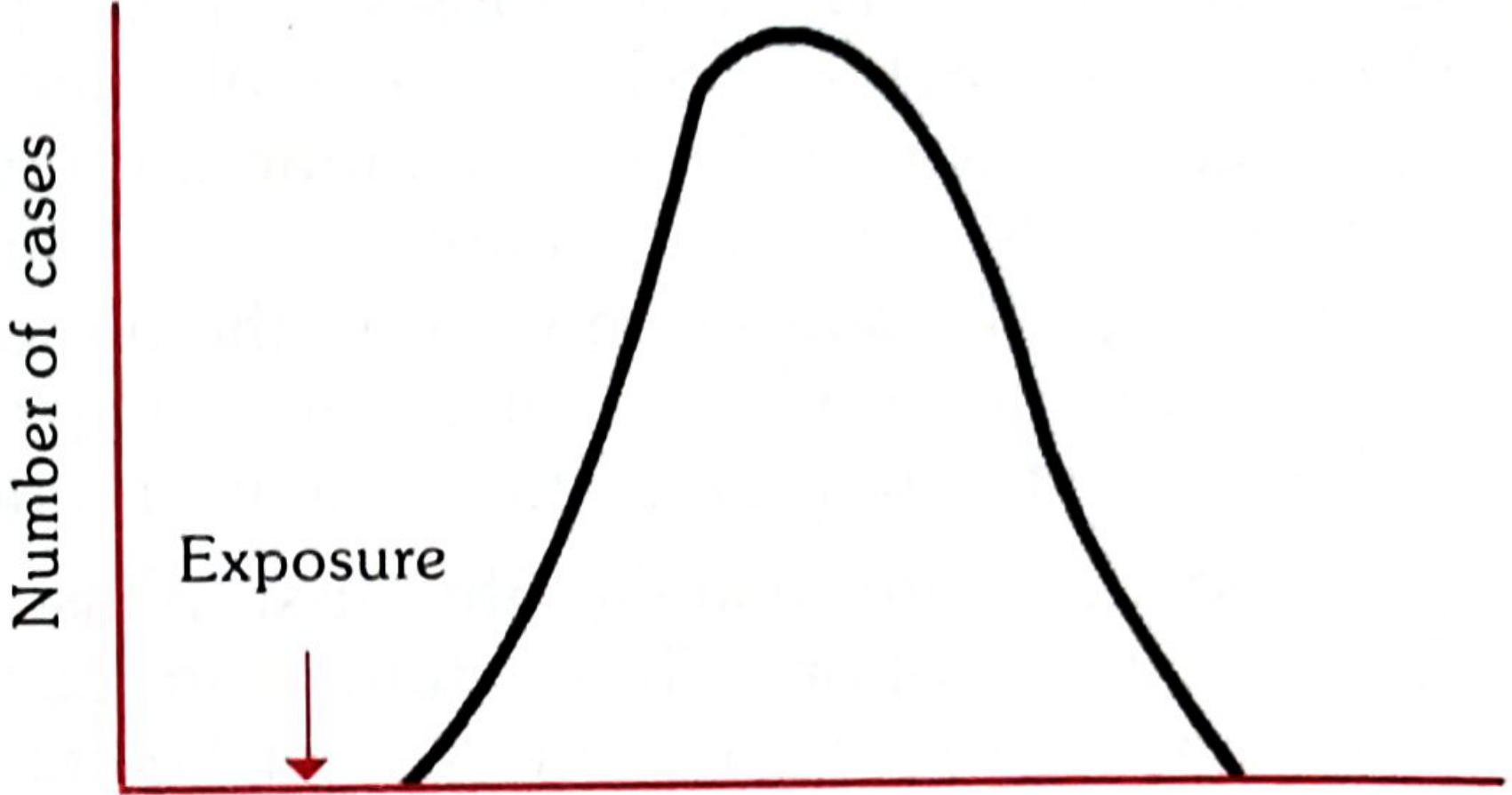
This helps identify:
- The causative agent - by matching the computed median to known incubation periods of diseases
- The time and source of exposure - by working backward from the epidemic peak
2. Distinguishing Primary from Secondary Cases
In propagated epidemics, the epidemic curve shows two humps - one for primary cases and one for secondary cases. The gap between the two peaks estimates the average incubation period. The median incubation period (B in the diagram below) marks from the initial exposure to the midpoint of the primary case curve.
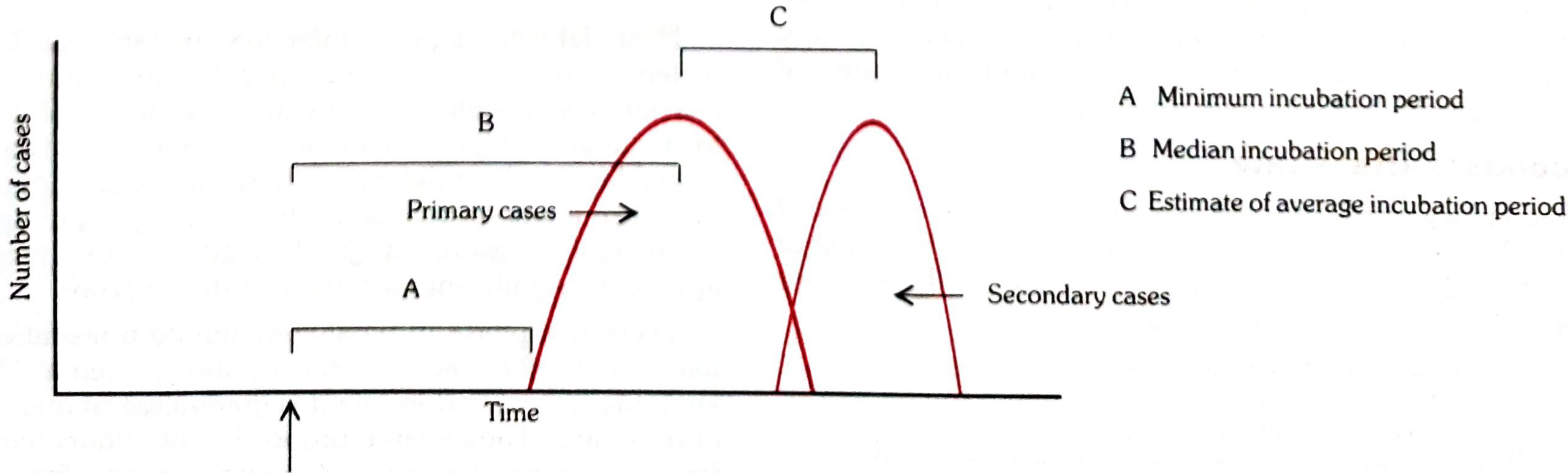
From the diagram:
- A = Minimum incubation period
- B = Median incubation period
- C = Estimate of average incubation period (from primary to secondary peak)
3. Tracing the Source of Infection
By knowing when symptoms appeared in the majority of cases (50th percentile = median), epidemiologists can back-calculate to find the likely time window of exposure and trace the contaminated food, water, or contact source.
4. Estimating Period of Surveillance / Quarantine
The incubation period guides quarantine length - typically set equal to the maximum incubation period. However, the median informs the realistic midpoint expectation for when most exposed individuals will show symptoms.
5. Characterising Disease Agents
Incubation periods are broadly classified by length:
| Category | Duration | Examples |
|---|---|---|
| Short | Hours to 2-3 days | Staphylococcal food poisoning, cholera, influenza |
| Median length | 10 days to 3 weeks | Typhoid, chickenpox, measles, mumps, COVID-19 |
| Long | Weeks to years | Hepatitis A/B, rabies, leprosy, HIV |
(Park's Textbook of Preventive and Social Medicine)
Why Median, Not Mean?
Incubation period distributions are typically right-skewed - a small number of cases may have unusually long incubation periods. The mean would be pulled upward by these outliers, making it a less accurate representation of when most cases appear. The median is more robust and epidemiologically meaningful.
In summary: The median incubation period is primarily used in point-source epidemic analysis to identify the causative agent and trace the exposure source - this is its most tested application in public health and epidemiology.
Median Incubation Period of measels
The median incubation period of measles is 14 days (range: 7-21 days).
Searching sources...
Finding Sources
Reading File
Here is the complete textbook answer:
Median Incubation Period of Measles
The incubation period of measles has two reference points, both important:
| Endpoint | Duration |
|---|---|
| Exposure → Onset of fever | 10 days |
| Exposure → Appearance of rash | 14 days |
The median incubation period commonly cited is 14 days (to rash onset), with a range of 7-21 days.
(Park's Textbook of Preventive and Social Medicine, p. 167)
Key Points to Remember
- 10 days = from exposure to fever (start of prodromal stage)
- 14 days = from exposure to rash - this is the classic median used in epidemiology
- When measles vaccine (live virus) is injected bypassing the respiratory tract, the incubation period shortens to an average of 7 days
- Adults may have a longer incubation period, up to 3 weeks (Harrison's Principles of Internal Medicine, 22E)
- Measles is one of the exceptions to the rule that diseases are not communicable during the incubation period - it is infectious during the later part of the incubation period (from 4 days before rash to 4 days after)
Why This Matters Epidemiologically
Since measles falls in the "median length" incubation category (10 days to 3 weeks), tracing the source of infection is more complex than short-incubation diseases (like food poisoning), because many possible contacts and exposures will have occurred in the 10-14 day window before symptoms appear.
What is median Incubation Period of mumps
The median incubation period of mumps is 18 days (range: 14-21 days).
Searching sources...
Finding Sources
Your credits are exhausted. Your daily credits reset tomorrow, or you can purchase a top-up for more.
This is a shared conversation. Sign in to Orris to start your own chat.