


+4 more
Tell me the diagnosis and treatment plan
Reading File
Now let me analyze all the images and search the medical library in parallel.
analyse_media
analyse_media
Finding Sources
Finding Sources
Now let me search the medical library specifically for cervical cancer staging and treatment, and also run a PubMed search in parallel.
Finding Sources
Finding Sources
Searching PubMed
"cervical cancer" AND "chemoradiation" AND "FIGO stage"
Finding Sources
Searching PubMed
"cervical cancer" AND "concurrent chemoradiotherapy"
Searching the Web
cervical cancer FIGO 2023 staging IIB treatment chemoradiation guidelines cisplatin brachytherapy
Now let me get the detailed cervical cancer management section from Berek & Novak's Gynecology and the radiology textbook findings.
Reading File
Reading File
I now have all the information needed. Let me compile the comprehensive analysis.
Loading Image
I now have all the data needed for a comprehensive response.
Patient Summary
Patient: Ms. Mithu Devi | Female, 48 years 6 months | Referred by Dr. Alok Narang
Study: Whole Body FDG PET-CT (Pretreatment evaluation for known carcinoma cervix)
Date: 20 July 2026
PET-CT Findings (Key Points)
| Region | Finding |
|---|---|
| Cervix / Pelvis | FDG-avid heterogeneously enhancing soft tissue lesion involving uterine cervix, extending into adjacent upper vagina - size: 2.8 (AP) x 4.2 (TR) x 3.4 (CC) cm, SUVmax 13.3 |
| Adjacent structures | Closely abutting posterior urinary bladder wall and rectum - no obvious infiltration; bilateral lower ureters uninvolved |
| Lymph nodes | Metabolically active left external iliac lymph node (~1.5 x 1.0 cm, SUVmax 14.3) - likely metastatic; other nodes in aortocaval/paraaortic/bilateral iliac regions are subcentimetric and FDG-negative (likely reactive) |
| Distant metastasis | None. No FDG-avid lesions in lung, bone, liver, or distant nodes |
| Liver | Enlarged (~17.1 cm craniocaudal), diffuse fatty changes - no focal FDG uptake; no metastatic disease |
| Brain / Thorax / Bone | No abnormal FDG uptake |
Diagnosis
Primary Malignant Pathology: Carcinoma of the Uterine Cervix
FIGO Staging (2018 system):
Based on the PET-CT findings:
- Cervical tumor extending into the upper vagina = at minimum Stage II
- Parametrial involvement - not explicitly stated; the tumor is large (>4 cm) and abutting rectum/bladder without clear infiltration
- Pelvic lymph node metastasis (left external iliac) = under FIGO 2018, pelvic LN positivity upstages to Stage IIIC1
Most likely stage: FIGO Stage IIIC1r (pelvic lymph node metastasis confirmed on imaging - 'r' suffix denotes radiological staging)
This corresponds to the diagram shown below (IIIC1 = pelvic LN involvement):
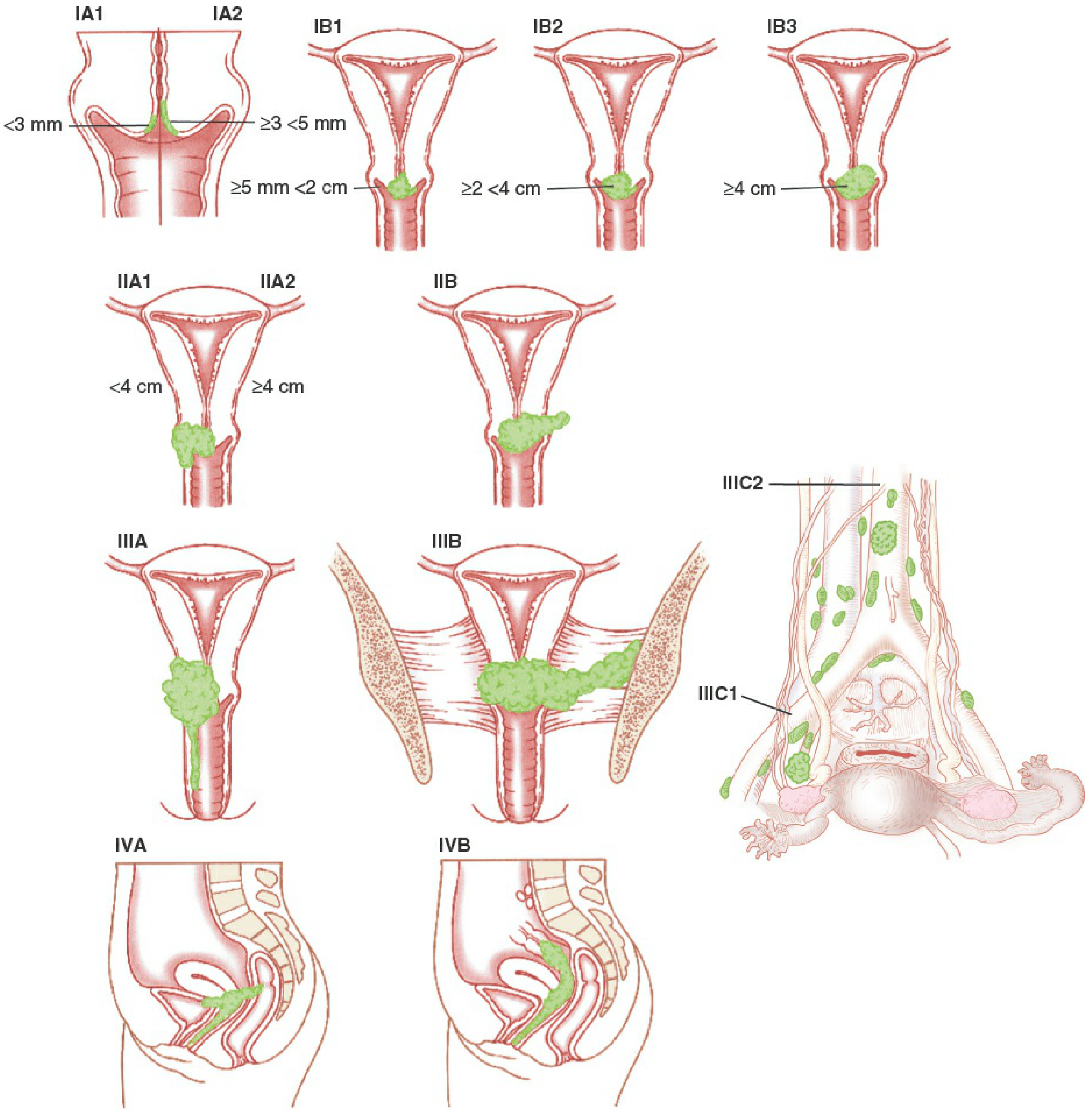
Berek & Novak's Gynecology - FIGO Cervical Cancer Staging 2018
Note: The FIGO 2018 staging system - which is incorporated into this report - uses imaging and pathologic measurements to determine pelvic/para-aortic nodal involvement. The left external iliac node (SUVmax 14.3) strongly indicates metastatic disease, placing this patient in Stage IIIC1.
Treatment Plan
As per NCCN Guidelines (v1.2024) and ESGO/SEOM Guidelines (2023) for Stage IIIC1 Locally Advanced Cervical Cancer:
1. Primary Treatment: Concurrent Chemoradiotherapy (CCRT)
This is the standard of care for Stage IIB and above (including IIIC1), supported by multiple RCTs showing a 30-50% reduction in risk of death compared to radiation alone.
Radiotherapy
- External Beam Radiation Therapy (EBRT): 45-50 Gy to the pelvis in 25-28 fractions
- Field should cover the primary tumor, parametria, upper vagina, and pelvic lymph nodes (including the left external iliac node)
- Extended-field RT to para-aortic nodes may be considered if para-aortic nodes are suspicious (they are not significantly enlarged here, but close monitoring is warranted)
- Brachytherapy (intracavitary/interstitial): Given after EBRT - this is an essential component. Total EQD2 to point A: typically ≥85 Gy. Omission of brachytherapy significantly worsens outcomes.
Concurrent Chemotherapy (Radiosensitizer)
- Cisplatin 40 mg/m² IV weekly (max 70 mg/week) x 5-6 cycles - preferred agent
- Alternative if cisplatin-intolerant: Carboplatin (AUC 2 weekly)
2. Additional Systemic Therapy (Consider)
Based on the KEYNOTE-A18 trial (2023), the NCCN guidelines now allow pembrolizumab (anti-PD-1) in combination with chemoradiation for locally advanced cervical cancer (Stage IIIC1). This should be discussed and considered in fit patients:
- Pembrolizumab 200 mg every 3 weeks x 5 cycles concurrent with CCRT, then 400 mg every 6 weeks maintenance x 15 cycles
3. Pre-treatment Work-Up Required
Before initiating treatment:
- Histopathology/biopsy confirmation (squamous cell carcinoma vs adenocarcinoma vs other - guides PD-L1 testing)
- MRI pelvis (preferred for local staging and treatment planning - better soft tissue delineation than PET-CT alone; Grainger & Allison's Diagnostic Radiology)
- PD-L1 testing (CPS score) if pembrolizumab is being considered
- Renal function tests (creatinine, GFR) before cisplatin - note serum creatinine is 0.70 mg/dL (normal here)
- Complete blood count, LFTs (fatty liver noted - monitor hepatotoxicity)
- USG abdomen - for gallbladder/biliary system evaluation (liver is enlarged with fatty changes)
- Fertility counseling - patient is 48 years, likely perimenopausal; ovarian function/hormone status discussion
- Consider para-aortic lymph node dissection/biopsy for pathological staging if upstaging would change field borders
4. Response Assessment
- PET-CT reassessment 3 months after completion of CCRT
- If complete metabolic response: surveillance
- If residual disease: assess for salvage (exenteration in selected cases; additional systemic therapy)
Summary Table
| Parameter | Detail |
|---|---|
| Diagnosis | Carcinoma cervix, likely squamous cell (confirm on biopsy) |
| FIGO Stage | IIIC1r (pelvic LN metastasis on imaging) |
| Primary treatment | Concurrent Chemoradiotherapy (CCRT) |
| Radiation | EBRT 45-50 Gy + Brachytherapy boost (intracavitary) |
| Chemotherapy | Cisplatin 40 mg/m² weekly x 5-6 cycles |
| Add-on (consider) | Pembrolizumab (KEYNOTE-A18 regimen) |
| Prognosis | Stage IIIC1 5-year survival ~40-50% with CCRT; improved with immunotherapy in PD-L1+ disease |
Sources: Berek & Novak's Gynecology (FIGO 2018 staging) | Grainger & Allison's Diagnostic Radiology (cervical cancer imaging) | NCCN Guidelines Cervical Cancer v1.2024 | SEOM-GEICO Clinical Guidelines 2023 | PubMed PMID 39351236 (chemoradiation + immune checkpoint inhibitors in locally advanced cervical cancer, 2024)
Disclaimer: This analysis is based on imaging findings only. Final clinical staging, treatment decisions, and all therapeutic interventions must be made by the treating oncologist/gynecologic oncologist in conjunction with a multidisciplinary tumor board, following clinical examination, histopathological confirmation, and institutional protocols.
This is a shared conversation. Sign in to Orris to start your own chat.