
Introduction of human body
The human body is a remarkable biological system. Here is a quick overview before I pull detailed content from the medical library:
- The body is organized into levels: atoms -> molecules -> cells -> tissues -> organs -> organ systems -> the whole organism.
- There are 11 major organ systems: integumentary, skeletal, muscular, nervous, endocrine, cardiovascular, lymphatic, respiratory, digestive, urinary, and reproductive.
- The body maintains a stable internal environment through homeostasis, regulated by feedback mechanisms.
- It is composed of roughly 37 trillion cells, all arising from a single fertilized egg.
Searching sources...
Reading File
Finding Sources
Finding Sources
Finding Sources
Finding Sources
Finding Sources
Reading File
Reading File
Finding Sources
Reading File
I now have rich content from Guyton and Hall's Textbook of Medical Physiology. Let me also fetch the diagram image for visual clarity.
Loading Image
Finding Sources
I now have comprehensive content to write a thorough introduction to the human body. Here is the full answer:
Introduction to the Human Body
Source: Guyton and Hall Textbook of Medical Physiology, 14th Ed.
1. What is Human Physiology?
Physiology is the branch of biology that explains how living organisms function - the physical and chemical mechanisms responsible for the origin, development, and progression of life. Human physiology specifically explains the characteristics and mechanisms of the human body that make it a living being.
The key idea is that the human body remains alive through complex, interlocking control systems: hunger drives us to seek food, fear drives us to seek safety, cold drives us toward warmth, and hormonal signals drive reproduction. These are not random reactions - they are precisely coordinated automatic sequences of life.
Human physiology links the basic life sciences with clinical medicine by integrating the functions of cells, tissues, and organs into the function of a whole living person. Crucially, the coordinated functions of the body are greater than the sum of its parts - life depends on total integration, not isolated parts working alone.
2. Levels of Organization
The body is organized in a hierarchy, from simplest to most complex:
| Level | Description |
|---|---|
| Atoms / Molecules | Chemical building blocks (oxygen, carbon, hydrogen, proteins, lipids, DNA) |
| Cells | The basic living units of the body |
| Tissues | Aggregates of similar cells (muscle, epithelial, connective, nervous) |
| Organs | Structures made of multiple tissue types performing specific functions |
| Organ Systems | Groups of organs working together for a common purpose |
| Organism | The entire human body as one integrated unit |
3. The Cell - Basic Living Unit of the Body
Each tissue or organ is an aggregate of many different cells held together by intercellular supporting structures. Key facts about cells:
- Each cell type is specially adapted to perform one or a few particular functions. Red blood cells, for example, transport oxygen from the lungs to the tissues.
- The human body contains approximately 35 to 40 trillion cells.
- Cells share basic commonalities: all use oxygen to burn carbohydrates, fats, and proteins for energy; all deliver chemical products into surrounding fluids; most can reproduce themselves when destroyed.
The Microbiome
Beyond human cells, the body hosts trillions of microorganisms - bacteria, fungi, and viruses - particularly in the gastrointestinal tract, which harbors 400 to 1,000 species. These microbiota communities live in harmony with their human host and perform vital functions essential for survival.
4. The Major Organ Systems
The body's organ systems work in concert to maintain life. Here is how each contributes:
Circulatory System
Blood carries nutrients and oxygen to every cell and removes waste products. The heart pumps approximately 5 liters of blood per minute at rest, and this output can increase many times during exercise. The circulation has two components:
- Systemic circulation - delivers oxygenated blood to body tissues
- Pulmonary circulation - passes blood through the lungs for gas exchange
Respiratory System
Each time blood passes through the lungs, it picks up oxygen across the alveolar membrane (only 0.4 to 2.0 micrometers thick) and releases carbon dioxide. Carbon dioxide is the most abundant metabolic waste product and must be continuously expelled.
Gastrointestinal Tract
Digests food and absorbs nutrients - carbohydrates, fatty acids, and amino acids - into the extracellular fluid. Undigested material and some metabolic wastes are eliminated as feces.
Liver
Transforms absorbed nutrients into more usable chemical forms, detoxifies ingested drugs and chemicals, secretes wastes into bile, and eliminates toxic substances.
Kidneys
Filter large volumes of plasma through the glomerular capillaries, reabsorb needed substances (glucose, amino acids, water, ions), and excrete metabolic wastes (urea, creatinine) as urine.
Nervous System
Composed of three parts:
- Sensory input - receptors detect internal and external changes
- Central nervous system (brain + spinal cord) - integrates information and determines appropriate responses
- Motor output - sends signals to muscles and glands to act
Endocrine System
Secretes hormones directly into the bloodstream to regulate metabolism, growth, reproduction, and stress responses. Works closely with the nervous system for long-term regulation.
Musculoskeletal System
Provides the body's structural framework and the ability to move. Without muscles, the body could not obtain food or escape danger - making this system essential to homeostasis.
5. The Internal Environment and Homeostasis
Claude Bernard, the 19th-century physiologist, proposed that the "milieu intérieur" (internal environment) of the body must remain stable for life to continue. Walter Cannon later called this stability homeostasis.
The internal environment consists of extracellular fluid - the fluid surrounding all cells - which must maintain precise concentrations of oxygen, nutrients, ions, and other substances.
Key Normal Values of Extracellular Fluid
| Constituent | Normal Value | Unit |
|---|---|---|
| Oxygen (venous) | 40 | mm Hg |
| Carbon dioxide | 45 | mm Hg |
| Sodium (Na⁺) | 142 | mmol/L |
| Potassium (K⁺) | 4.2 | mmol/L |
| Calcium (Ca²⁺) | 1.2 | mmol/L |
| Glucose | 90 | mg/dL |
| Body temperature | 37.0 | °C |
| Blood pH | 7.4 | pH units |
These values are kept remarkably stable despite constant internal and external fluctuations.
6. How the Body Maintains Homeostasis: Negative Feedback
Most control systems in the body operate by negative feedback - when a parameter deviates from normal, the system triggers a response that brings it back toward normal (opposing the change).
Example - Carbon Dioxide Regulation:
- CO₂ rises → pulmonary ventilation increases → more CO₂ is expelled → CO₂ falls back toward normal
- CO₂ falls → ventilation slows → CO₂ rises back toward normal
Example - Blood Pressure Regulation:
- Pressure rises → baroreceptors signal heart to slow and vessels to dilate → pressure falls
- Pressure drops → reflexes increase heart rate and constriction → pressure rises
The gain of a feedback system measures how effectively it corrects a disturbance. A high-gain system returns a variable very close to its set point; a low-gain system allows larger deviations.
7. Capillary Exchange - The Bridge Between Blood and Cells
The diagram below illustrates a fundamental process of body function: how fluid and dissolved substances (nutrients, oxygen, ions) move across capillary walls to reach the cells, and how waste products move back into the bloodstream.
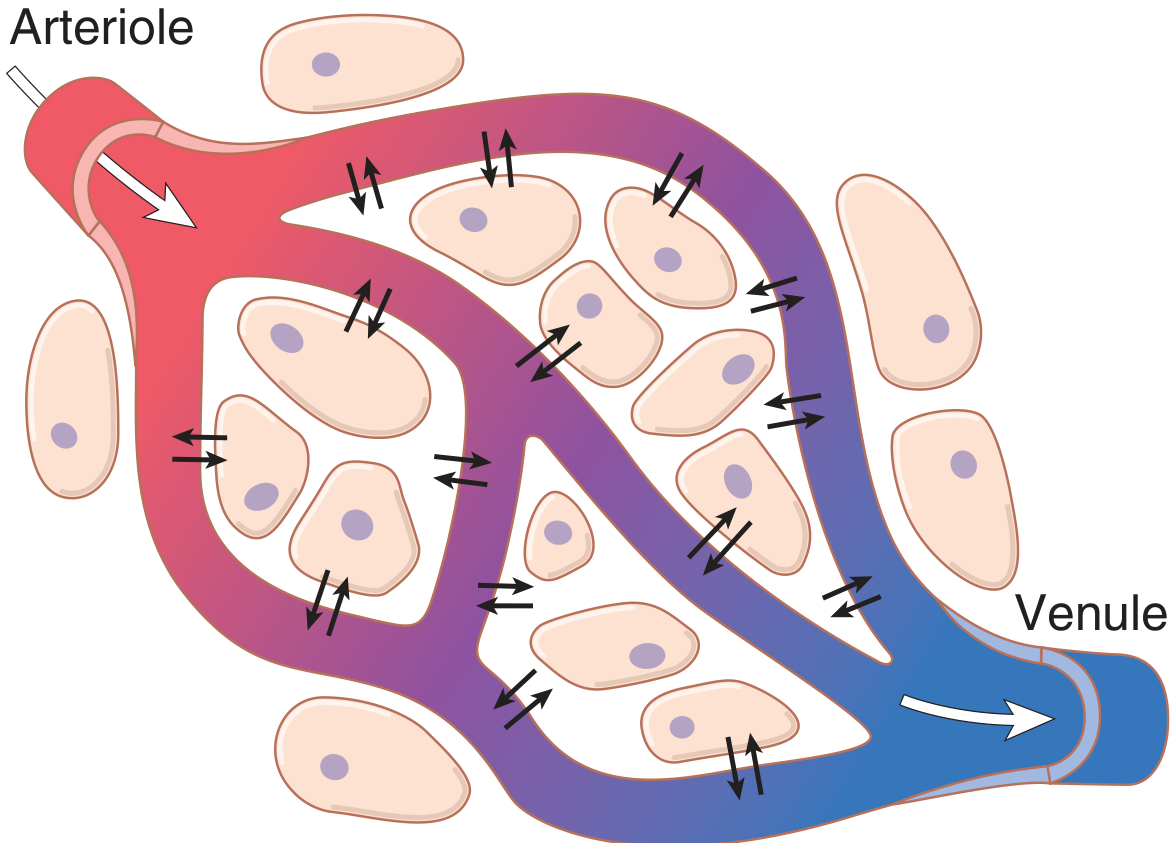
Figure: An arteriole (red) delivers oxygenated blood into a capillary network. Nutrients and oxygen diffuse outward to surrounding cells (arrows pointing outward). Waste products diffuse back in. The capillary drains into a venule (blue). This bidirectional exchange is the core mechanism of cellular nutrition.
8. Summary
| Concept | Key Idea |
|---|---|
| Human physiology | Explains how the body works as an integrated living system |
| Cell | Basic unit of life; ~35-40 trillion cells in the human body |
| Organ systems | 11 systems, all interlinked and mutually dependent |
| Internal environment | Extracellular fluid bathing every cell |
| Homeostasis | Keeping the internal environment stable |
| Negative feedback | Primary mechanism restoring balance when disrupted |
| Microbiome | Trillions of microorganisms coexisting with human cells |
The human body is not a collection of independent systems - it is one tightly integrated organism where every organ, cell, and molecule works in coordination. Disruption of any part of this integration is, at its core, the definition of disease.
Source: Guyton and Hall Textbook of Medical Physiology, 14th Edition - Chapter 1: Functional Organization of the Human Body and Control of the "Internal Environment"
Definition of human body
The human body is the entire physical structure of a human being - a complex, self-regulating biological organism composed of cells, tissues, organs, and systems working together to sustain life.
Searching sources...
Finding Sources
Finding Sources
Finding Sources
Finding Sources
Reading File
Finding Sources
Reading File
Finding Sources
I have all the content needed. Here is a thorough, textbook-grounded answer.
Definition of the Human Body
Core Definition
The human body is the complete physical structure of a human being - a living organism composed of approximately 35 to 40 trillion cells, organized into tissues, organs, and systems, all working in coordinated integration to sustain life.
From the perspective of physiology, the human body is defined not merely by its structure but by its function: it is a self-regulating biological system whose survival depends on maintaining a stable internal environment (homeostasis) through a vast network of control mechanisms operating at every level - from genes and molecules, all the way up to whole-organ systems.
"The science of human physiology attempts to explain the specific characteristics and mechanisms of the human body that make it a living being. The fact that we remain alive is the result of complex control systems."
- Guyton and Hall Textbook of Medical Physiology, 14th Ed.
The Body Defined at Each Level
| Level | Definition |
|---|---|
| Chemical level | Atoms (carbon, hydrogen, oxygen, nitrogen) bonded into molecules (water, proteins, DNA, lipids) |
| Cellular level | Cells are the basic living units; each is adapted to one or a few specific functions |
| Tissue level | Aggregates of similar cells held together by intercellular supporting structures |
| Organ level | Multiple tissue types forming a structure with a specific function (e.g., heart, kidney) |
| System level | Groups of organs working together (e.g., circulatory, nervous, digestive) |
| Organism level | The total integrated human being - the sum of all systems functioning as one |
Composition of the Human Body
About 50% to 70% of the adult human body is fluid - mainly a water solution of ions and other substances:
- Intracellular fluid (~two-thirds of total): fluid inside the cells, rich in potassium (K⁺), magnesium (Mg²⁺), and phosphate ions.
- Extracellular fluid (~one-third of total): fluid surrounding the cells, rich in sodium (Na⁺), chloride (Cl⁻), and bicarbonate (HCO₃⁻), plus oxygen, glucose, amino acids, and fatty acids.
The extracellular fluid is the "internal environment" of the body - a term introduced by the French physiologist Claude Bernard (1813-1878). All cells essentially live in this same fluid environment, and maintaining its precise composition is the central task of every organ system.
The Body as a Living System
What distinguishes the human body from a non-living structure is its capacity for:
| Property | Description |
|---|---|
| Metabolism | Converting nutrients and oxygen into energy to power all cellular functions |
| Responsiveness | Detecting and reacting to internal and external stimuli (hunger, fear, cold, pain) |
| Movement | Voluntary and involuntary movement through the musculoskeletal system |
| Growth | Increasing cell number and size through controlled reproduction |
| Reproduction | Producing new cells to replace damaged or old ones; producing offspring |
| Homeostasis | Continuously adjusting internal conditions to maintain stability |
Homeostasis - The Defining Operating Principle
In 1929, the American physiologist Walter Cannon (1871-1945) coined the term homeostasis to describe the maintenance of stable conditions in the internal environment. Homeostasis is a dynamic, not static, process - the body is constantly making adjustments to maintain stability despite the challenges of daily life.
Homeostasis operates at every level of organization:
- At the molecular level - DNA replication assembles ~3 to 6 billion nucleotides in correct order to form 20,000-25,000 genes controlling ~100,000 proteins
- At the cellular level - each cell has separate control mechanisms regulating its own function
- At the organ level - organs communicate via hormones, the nervous system, and extracellular vesicles
- At the whole-body level - the integrated coordination of all systems to sustain life
"The coordinated functions of the human body are much more than the sum of its parts, and life relies on this total function."
- Guyton and Hall Textbook of Medical Physiology, 14th Ed.
The Body and Its Microbiome
The human body does not exist as a purely "human" entity. It hosts 25 to 30 trillion microorganisms - bacteria, fungi, and viruses - living in symbiosis with the body's own cells, particularly in the gut (400-1,000 species). These microbiota perform vital functions in digestion, immunity, and nutrition. In this sense, the human body is more accurately described as a superorganism - a community of human cells and microbial partners functioning together.
Summary Definition
The human body is a complex, self-regulating, living biological organism composed of ~35-40 trillion human cells (plus trillions of microbial partners), organized hierarchically from atoms to organ systems, sustained by continuous homeostatic control mechanisms, and defined as much by its dynamic functions - metabolism, responsiveness, growth, and reproduction - as by its physical structure.
Source: Guyton and Hall Textbook of Medical Physiology, 14th Edition
This is a shared conversation. Sign in to Orris to start your own chat.