
Cell wall synthesis inhibitors antimicrobial drug name
Cell wall synthesis inhibitors include the following major drug classes:
Beta-Lactams - penicillins (amoxicillin, ampicillin, piperacillin), cephalosporins (cephalexin, cefazolin, ceftriaxone, cefepime), carbapenems (meropenem, imipenem, ertapenem), and monobactams (aztreonam). They inhibit penicillin-binding proteins (PBPs), blocking transpeptidation of peptidoglycan.
Glycopeptides - vancomycin, teicoplanin. They bind D-Ala-D-Ala terminus of peptidoglycan precursors, blocking transglycosylation and transpeptidation.
Others - bacitracin (inhibits lipid carrier recycling), fosfomycin (inhibits MurA, an early peptidoglycan synthesis enzyme), cycloserine (inhibits D-Ala-D-Ala ligase).
Searching sources...
Reading File
Finding Sources
Finding Sources
Reading File
Reading File
Reading File
Loading Image
Here is a thorough breakdown of all cell wall synthesis inhibitor antimicrobial drugs, sourced from the Tietz Textbook of Laboratory Medicine and the Textbook of Family Medicine.
Cell Wall Synthesis Inhibitors
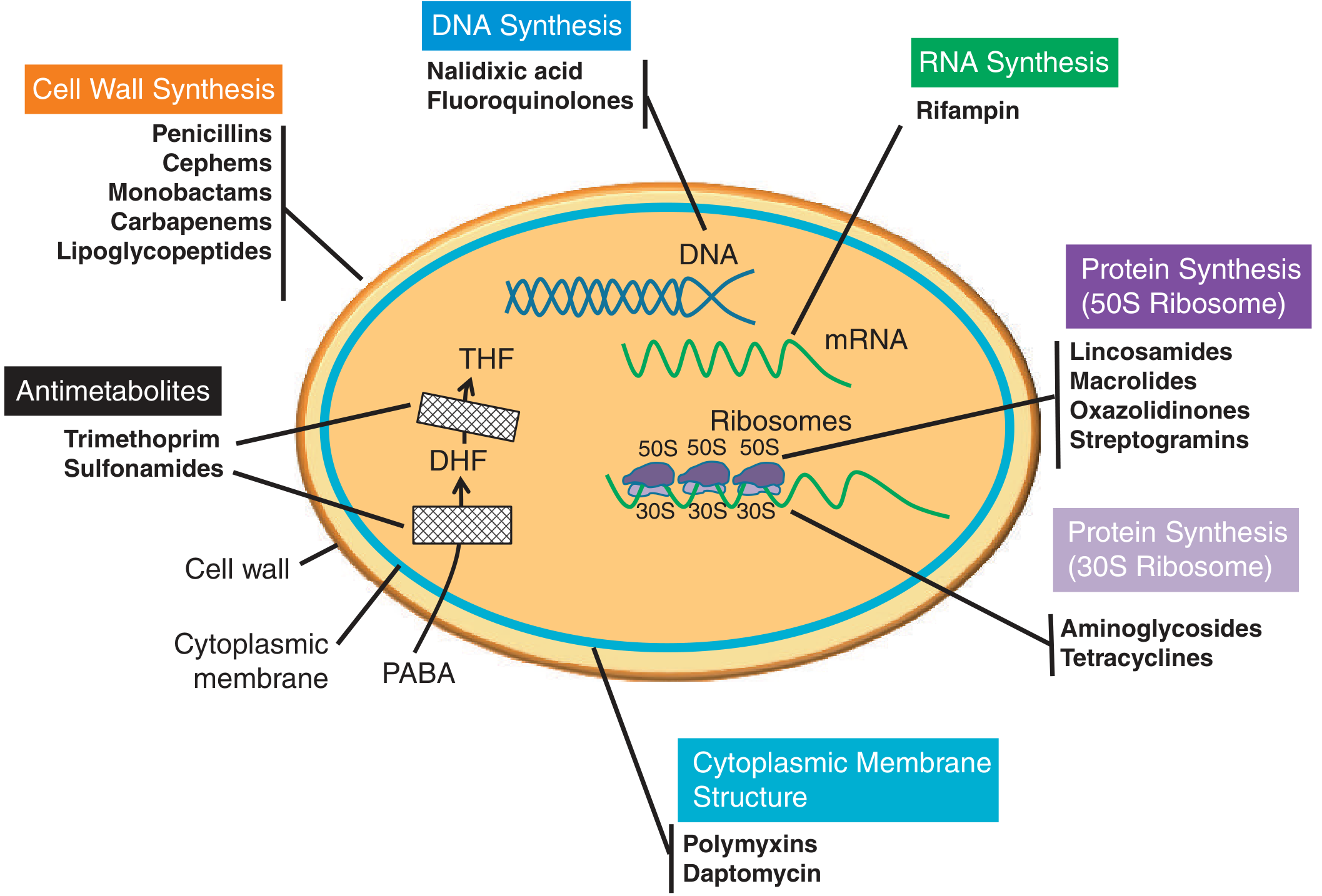
Figure: Mode of action for antimicrobials - cell wall synthesis inhibitors are shown in orange (top left)
1. Beta-Lactams (B-Lactams)
The most widely used cell wall synthesis inhibitors. They share the beta-lactam ring structure and inhibit penicillin-binding proteins (PBPs), blocking transpeptidation/cross-linking of peptidoglycan strands, leading to cell lysis.
Penicillins
| Subclass | Drugs |
|---|---|
| Penicillinase-labile | Penicillin G, Penicillin V, Ampicillin, Amoxicillin |
| Penicillinase-stable (anti-staphylococcal) | Oxacillin, Nafcillin, Methicillin, Dicloxacillin, Cloxacillin |
| Extended-spectrum | Ticarcillin, Piperacillin |
Beta-Lactam / Beta-Lactamase Inhibitor Combinations
These pair a penicillin/cephalosporin with an inhibitor that neutralizes beta-lactamase enzymes:
- Amoxicillin-clavulanate
- Ampicillin-sulbactam
- Piperacillin-tazobactam
- Ceftazidime-avibactam
- Ceftolozane-tazobactam
- Imipenem-relebactam
- Meropenem-vaborbactam
Cephalosporins (Cephems)
Divided by generation; spectrum broadens with each generation (more gram-negative coverage):
| Generation | Drugs |
|---|---|
| 1st | Cefazolin, Cephalexin, Cefadroxil |
| 2nd | Cefuroxime, Cefoxitin, Cefaclor |
| 3rd | Ceftriaxone, Cefotaxime, Ceftazidime, Cefixime, Cefpodoxime |
| 4th | Cefepime |
| 5th (anti-MRSA) | Ceftaroline, Ceftobiprole |
| Siderophore (iron-chelating) | Cefiderocol |
Carbapenems
Broadest-spectrum beta-lactams; active against most aerobic gram-positive and gram-negative organisms:
- Imipenem-cilastatin
- Meropenem
- Ertapenem
- Doripenem
Monobactams
Active only against aerobic gram-negative bacilli:
- Aztreonam (safe in penicillin-allergic patients)
2. Glycopeptides / Lipoglycopeptides
These large molecules inhibit cell wall synthesis by binding to the D-Ala-D-Ala terminus of peptidoglycan pentapeptide precursors, blocking transglycosylation and transpeptidation. Active against gram-positive bacteria (including MRSA, VRE in some cases).
| Subclass | Drugs |
|---|---|
| Glycopeptides | Vancomycin, Teicoplanin |
| Lipoglycopeptides (also depolarize membrane) | Telavancin, Dalbavancin, Oritavancin |
3. Other Cell Wall Synthesis Inhibitors
| Drug | Mechanism |
|---|---|
| Fosfomycin | Inhibits MurA (enolpyruvyl transferase) - blocks first step of peptidoglycan synthesis |
| Bacitracin | Inhibits recycling of lipid carrier (bactoprenol/undecaprenyl pyrophosphate) that transports peptidoglycan subunits across the membrane |
| Cycloserine | Inhibits D-alanine racemase and D-Ala-D-Ala ligase - blocks early cytoplasmic steps; used in TB |
Resistance Mechanisms (Key Points)
- Beta-lactamase production - enzymatic degradation of the beta-lactam ring (most common)
- PBP alteration - e.g., MRSA produces altered PBP2a (encoded by mecA) with low affinity for beta-lactams
- Reduced outer membrane permeability - porin loss in gram-negative bacteria
- Glycopeptide resistance - van gene cluster alters D-Ala-D-Ala to D-Ala-D-Lac (seen in VRE)
- Thickened cell wall - seen in vancomycin-intermediate S. aureus (VISA)
Sources: Tietz Textbook of Laboratory Medicine, 7th Edition, p. 3278-3279; Textbook of Family Medicine 9e, Table 15-2
This is a shared conversation. Sign in to Orris to start your own chat.