
Theories of accomodation
The term "accommodation" appears in multiple fields. Let me clarify what you're looking for before diving in.
Asking for Preferences
Which field are you asking about?
The classic theories of ocular accommodation include Helmholtz's lens-based theory (the dominant accepted model), Tscherning's opposing theory, and Schachar's newer equatorial zonule theory. Let me pull the full detail from the medical library.
Searching sources...
Reading File
Finding Sources
Finding Sources
Good - I can see ophthalmology content. Let me search more specifically for theories of accommodation in ophthalmology textbooks.
Finding Sources
Finding Sources
Finding Sources
Finding Sources
Reading File
Reading File
Let me read the actual accommodation section from the neuroscience book and search for the specific theories in ophthalmology texts.
Reading File
Finding Sources
Finding Sources
Searching the Web
theories of accommodation ophthalmology Helmholtz Tscherning Schachar Catenary
Reading Web Page
https://entokey.com/physiology-of-accommodation-and-presbyop…
I now have comprehensive information to give a detailed answer. Let me also fetch the accommodation diagram image.
Loading Image
Here is a thorough breakdown of the theories of accommodation in ophthalmology:
Theories of Accommodation
Accommodation is the ability of the eye to change its refractive power to focus clearly on objects at varying distances. The process primarily involves changes in the crystalline lens, though several competing theories differ on exactly how this is achieved.
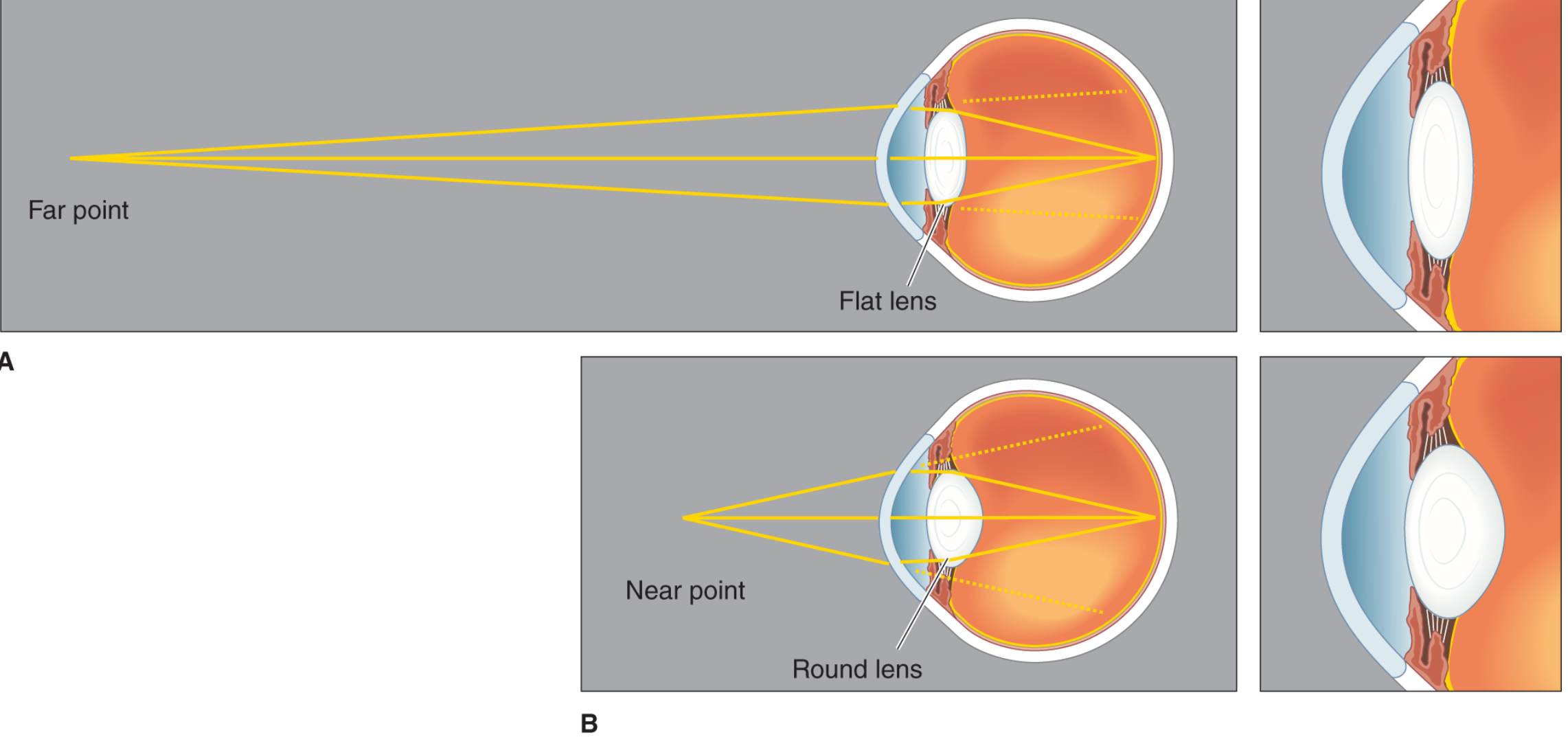
1. Helmholtz Theory (1855) - The Accepted Standard
Proposed by Hermann von Helmholtz, this remains the most widely accepted theory of accommodation.
Key tenets:
- At rest (distance vision): the ciliary muscle is relaxed, the zonular fibers are taut, pulling the lens equator outward and keeping the lens flat.
- During accommodation (near vision): the ciliary muscle contracts, moving anteriorly and inward, which releases tension on the zonular fibers.
- With reduced zonular tension, the elastic lens capsule causes the lens to assume a more spherical shape - the anterior surface steepens more than the posterior, increasing the lens's refractive power.
- The lens becomes thicker centrally, its diameter decreases, and its anterior surface moves forward.
This is supported by the observation that during accommodation, the anterior chamber depth decreases, the lens becomes more convex, and the pupil constricts (miosis - part of the near triad along with convergence).
2. Tscherning Theory (1894)
Proposed by Marius Tscherning (building on Cramer's 1851 work), this theory opposes Helmholtz in one critical respect.
Key tenets:
- Contraction of the ciliary muscle increases (not decreases) zonular tension at the lens equator.
- The equatorial compression causes the central part of the anterior lens surface to bulge forward while the peripheral lens flattens.
- Accommodation is produced by compression of the lens, not passive elastic recoil.
This theory was largely set aside but was revived in the 1990s by Schachar.
3. Schachar Theory (1992)
Proposed by Ronald Schachar, this is the most prominent modern challenger to Helmholtz.
Key tenets:
- The zonule is divided into three distinct parts: anterior zonule, equatorial zonule, and posterior zonule.
- When the ciliary muscle contracts, it pulls outward and posteriorly (radial fiber action), which increases tension on the equatorial zonules while the anterior and posterior zonules relax.
- Increased equatorial zonular tension causes:
- Central lens surfaces to steepen (increase curvature)
- Central lens thickness to increase (anterior-posterior diameter)
- Peripheral lens surfaces to flatten
- This is consistent with Tscherning's observation of central bulging with peripheral flattening.
Critical limitation: No independent laboratory has been able to reproduce Schachar's experimental results. This lack of reproducibility is a major obstacle to acceptance.
4. Coleman's Catenary Theory (1970, 1986)
Proposed by D. Jackson Coleman, this introduces an extralenticular, hydraulic mechanism.
Key tenets:
- The lens, lens capsule, zonules, and anterior vitreous face form a hammock-like diaphragm separating the aqueous and vitreous compartments.
- Ciliary muscle contraction creates a pressure gradient between the vitreous and aqueous chambers - vitreous pressure rises.
- This hydraulic pressure acts on the posterior lens surface, pushing the diaphragm anteriorly and deforming the lens into a steep central curvature with slight peripheral flattening.
- The resulting lens cross-section resembles a catenary - the curve formed by a freely hanging cable suspended from two endpoints (not a simple parabola).
- Coleman confirmed Johnson's earlier hydraulic observations.
5. Johnson's Hydraulic Theory (earlier)
Johnson proposed that aqueous humor under increased pressure is forced into the spaces of Fontana during accommodation, producing lens bulging. The increased curvature was attributed to hydraulic pressure rather than zonular relaxation. Coleman later confirmed and expanded this idea.
Summary Comparison
| Feature | Helmholtz | Tscherning / Schachar | Coleman |
|---|---|---|---|
| Ciliary muscle action | Contracts | Contracts | Contracts |
| Zonule tension on accommodation | Decreases | Increases (equatorial) | Shifts pressure gradient |
| Lens shape change | Becomes more spherical, thicker | Central bulging, peripheral flattening | Anterior displacement, catenary shape |
| Mechanism | Elastic recoil of lens capsule | Equatorial compression | Hydraulic pressure from vitreous |
| Acceptance | Widely accepted | Largely disputed (not reproducible) | Supplementary / partial support |
Presbyopia in Context
All theories have implications for presbyopia. In the Helmholtz framework, the aging lens loses elasticity and cannot round up despite full ciliary contraction - hence progressive loss of near focus from age ~40 onwards. The near point of accommodation (NPA) recedes with age: approximately 8 cm at age 20, receding to ~46 cm by age 50 (Kanski's Clinical Ophthalmology).
The Schachar theory alternatively attributes presbyopia to equatorial growth of the lens over time, reducing the space available for the equatorial zonules to act - a claim that has driven experimental scleral expansion surgery, though results have been mixed.
Sources: Neuroscience: Exploring the Brain (5th ed.) | Kanski's Clinical Ophthalmology (10th ed.) | ESCRS EuroTimes - Theories of Accommodation | EntoKey - Physiology of Accommodation and Presbyopia
This is a shared conversation. Sign in to Orris to start your own chat.