
Headache medicine
Reading File
The query "headache medicine" is broad and could mean several things. Let me clarify before diving in.
Asking for Preferences
What would you like to know about headache medicine?
Headaches are broadly classified into primary (no structural cause) and secondary (due to an underlying condition). The big primary types are migraine, tension-type, and cluster headache. Key diagnostic clues include onset speed, location, quality, associated symptoms, and red flags.
Searching sources...
Finding Sources
Finding Sources
Reading File
Finding Sources
Reading File
Reading File
Reading File
Loading Image
Loading Image
Here is a thorough overview of headache types and diagnosis, drawn from multiple medical textbooks.
Overview of Headache: Types & Diagnosis
Classification: Primary vs. Secondary
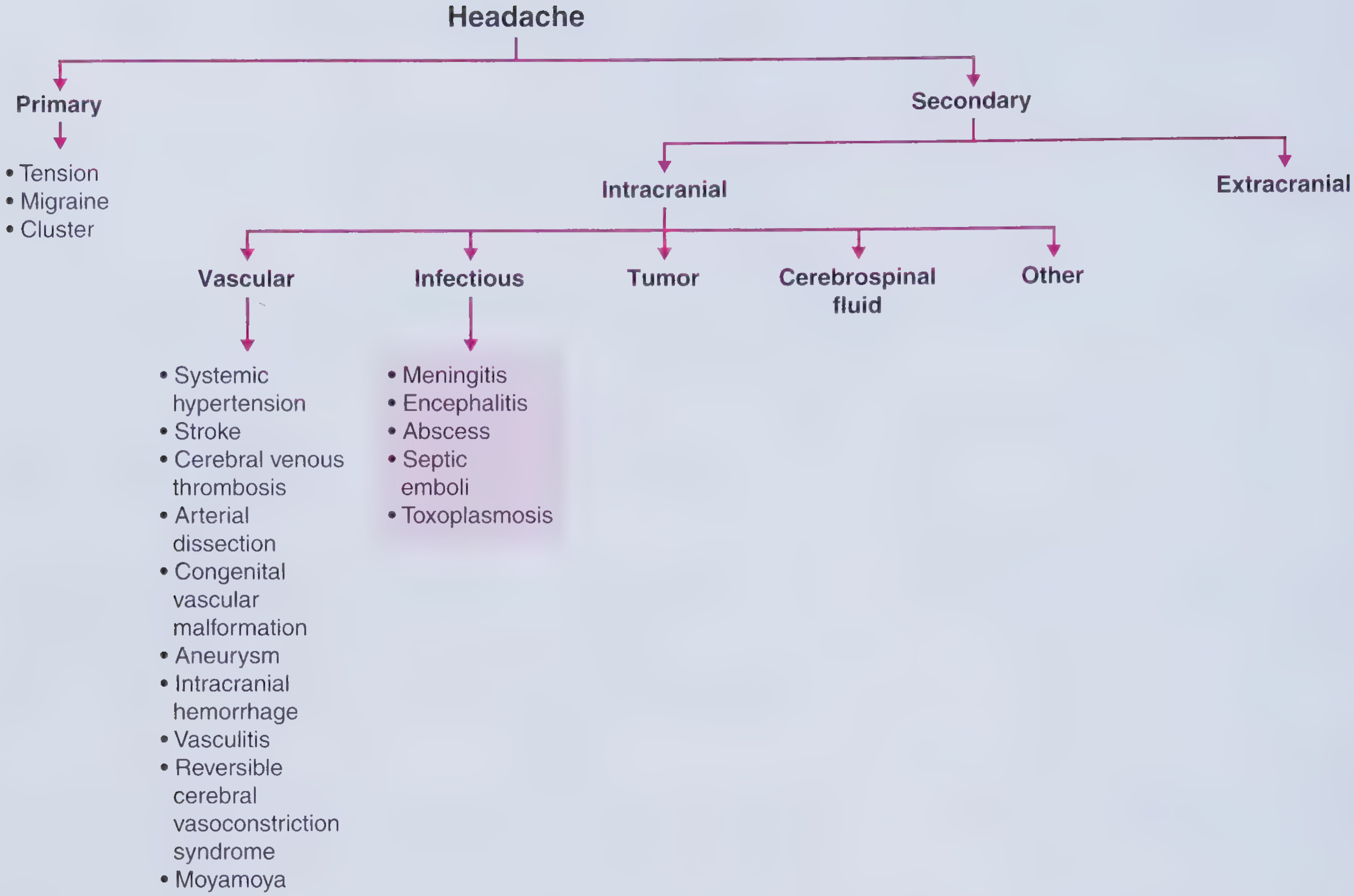
All headaches divide into two broad categories:
- Primary - the headache IS the disorder; no structural cause. Includes migraine, tension-type, and cluster headache.
- Secondary - the headache is a symptom of something else (vascular, infectious, tumor, CSF pressure disorders, extracranial causes).
Primary Headache Types
1. Migraine
| Feature | Details |
|---|---|
| Epidemiology | More common in women; strong genetic component |
| Pain quality | Unilateral or bilateral; throbbing; moderate to severe |
| Duration | Hours to days |
| Worsens with | Physical activity |
| Associated symptoms | Photophobia, phonophobia, nausea/vomiting |
| Aura | ~30% of patients - visual, sensory, motor, or language disturbances preceding the headache |
Migraine with complicated features ("complicated migraine") can produce transient focal deficits from cortical spreading depression - including hemiplegia, aphasia, visual loss. These should be diagnoses of exclusion after ruling out stroke or epilepsy.
2. Tension-Type Headache
| Feature | Details |
|---|---|
| Epidemiology | Equal in men and women |
| Pain quality | Dull, band-like pressure; bilateral; mild to moderate |
| Duration | Hours to days |
| Worsens/improves | Improves with activity (opposite of migraine) |
| Associated symptoms | No nausea/vomiting; at most mild light OR sound sensitivity, not both |
The name was changed from "tension headache" to reflect that muscle tension is NOT the primary mechanism.
3. Cluster Headache (Trigeminal Autonomic Cephalgia)
| Feature | Details |
|---|---|
| Epidemiology | 4x more common in men |
| Pain quality | Extremely severe, unilateral, "boring" pain behind one eye |
| Duration | 30-90 minutes per attack; recurs in clusters over weeks |
| Associated symptoms | Ipsilateral: tearing, eye redness, ptosis, miosis (partial Horner's), nasal congestion, flushing |
| Neurobiology | Posterior hypothalamic activation during attacks |
Other trigeminal autonomic cephalgias (TACs) include paroxysmal hemicrania (shorter, responds specifically to indomethacin) and SUNCT/SUNA (very brief attacks, male-predominant, more frequent).
4. Medication Overuse Headache (MOH)
A common secondary/complication pattern - headache occurring >15 days/month in the setting of frequent analgesic or triptan use. Often coexists with chronic migraine.
Secondary Headache - When to Suspect It
The following are red flags ("SNOOP" features) that should prompt workup for secondary causes (Goldman-Cecil Medicine):
- New headache beginning at older age, without prior history or family history
- Unexplained worsening of previously existing migraine
- "Worst headache of my life" - sudden onset (thunderclap)
- Headaches awakening patient from sleep (except cluster)
- Worse when recumbent, upright, or with Valsalva maneuver
- Focal neurologic deficits that persist after headache resolves
- New headache in setting of HIV, malignancy, or pregnancy
- Abnormal neurologic or new psychiatric findings on exam
Thunderclap Headache
Defined as sudden-onset severe headache reaching maximum intensity immediately or within 1 minute. Key causes include:
- Subarachnoid hemorrhage (most feared)
- Intracerebral hemorrhage
- Cerebral venous thrombosis
- Arterial dissection
- Reversible cerebral vasoconstriction syndrome (RCVS)
- Pituitary apoplexy
- Meningitis
Diagnostic Approach
History - five key elements:
- Family history - genetic predisposition
- Life history - new vs. longstanding headache pattern
- Attack history - quality, location, timing, triggers
- Medical/psychiatric history - comorbidities that worsen headache
- Medication history - drug-induced or overuse headache
Imaging:
- CT scan - first choice for acute severe headache (rules out hemorrhage quickly)
- MRI - better for persistent headaches; detects mass lesions, hemosiderin, Chiari malformation, ICP changes
- CT angiography or MR angiography - if RCVS or vascular malformation is suspected
Lab work:
- ESR and/or CRP in patients >60 years with new/unusual headache - to rule out giant cell arteritis
- CSF (lumbar puncture) - if intracranial hypertension, meningitis, or subarachnoid hemorrhage suspected (especially if CT is negative but thunderclap headache)
Frequency-Based Classification
| Category | Frequency |
|---|---|
| Episodic headache | <15 days/month |
| Chronic headache | ≥15 days/month |
Risk factors for progression to chronic headache: female sex, migraine type, high baseline frequency, obesity, low education level, and analgesic overuse.
Sources: Neuroanatomy through Clinical Cases, 3rd ed.; Goldman-Cecil Medicine, International Edition; Frameworks for Internal Medicine
Would you like to go deeper into any specific type - such as migraine diagnosis, cluster headache management, or secondary headache workup? I can also cover acute treatment medications or preventive therapies if helpful.
This is a shared conversation. Sign in to Orris to start your own chat.