
Can I see spine in xray
Yes! The spine is visible on X-ray. Different regions (cervical, thoracic, lumbar, sacrum, coccyx) can all be imaged, and X-ray shows the bony structures well - vertebral bodies, spinous processes, disc spaces, and alignment.
Searching sources...
Reading File
Searching the Web
spine X-ray views anatomy what can be seen
Finding Sources
Loading Image
Loading Image
Yes, absolutely! The spine is very well visible on X-ray. Here are annotated real X-ray images showing exactly what you can see:
Cervical Spine (Neck) - Lateral View
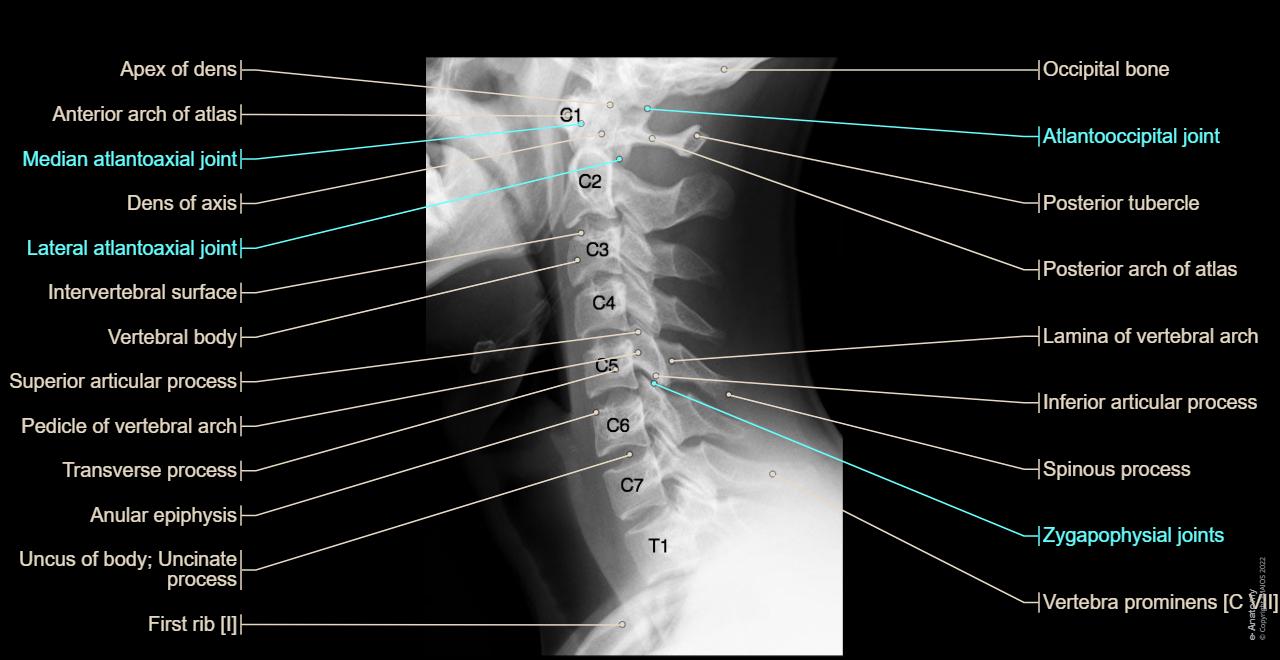
On this lateral X-ray of the cervical spine (neck), you can clearly see:
- Vertebral bodies of C1 through C7 (and the top of T1)
- Spinous processes projecting backwards
- Intervertebral disc spaces (the gaps between vertebral bodies)
- Articular processes and zygapophysial (facet) joints
- Pedicles and laminae of the vertebral arches
- The dens (odontoid process) of C2
- Atlantooccipital and atlantoaxial joints at the top
Lumbar Spine (Lower Back) - AP View
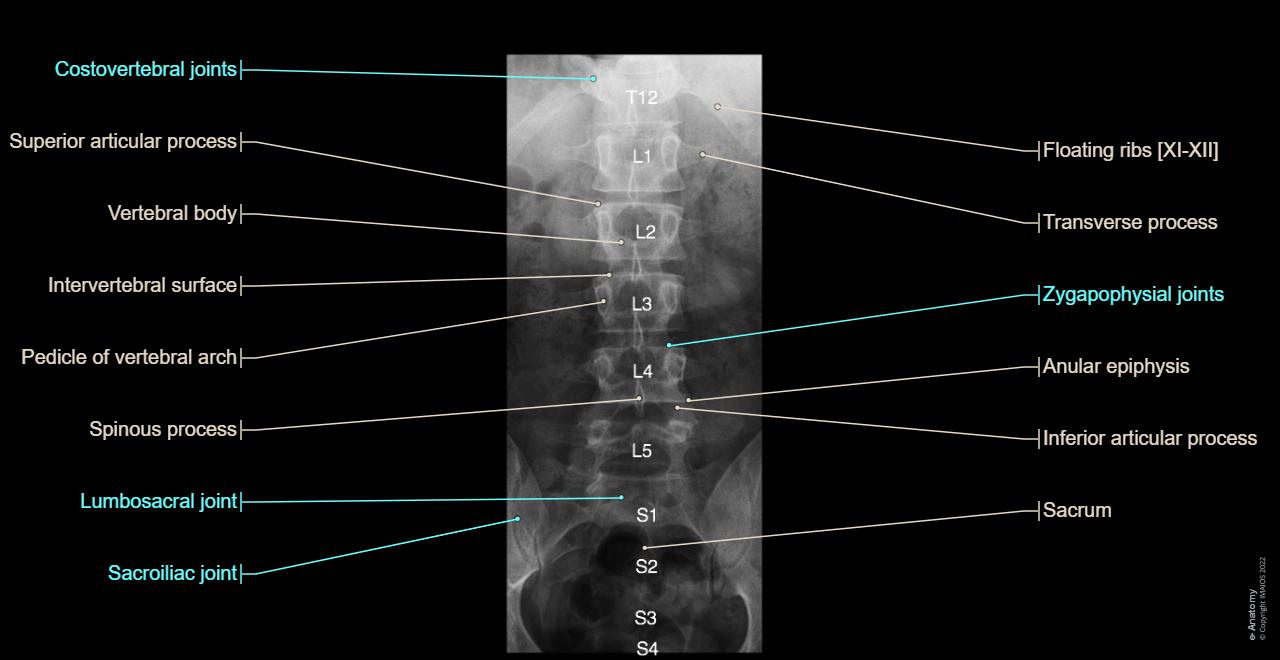
On this AP (front-to-back) X-ray of the lumbar spine, you can see:
- Vertebral bodies L1-L5 and T12 above
- Transverse processes spreading to the sides
- Spinous processes visible as dense midline shadows
- Pedicles appearing as oval rings on either side of the vertebral body
- Zygapophysial (facet) joints
- The sacrum (S1-S4) and sacroiliac joints below
- The lumbosacral joint (L5/S1)
What X-ray Can and Cannot Show in the Spine
| Visible on X-ray | NOT well seen on X-ray |
|---|---|
| Vertebral bodies (shape, alignment) | Spinal cord |
| Disc spaces (indirectly) | Intervertebral disc material (soft tissue) |
| Fractures | Nerve roots |
| Bone spurs (osteophytes) | Ligaments |
| Scoliosis/kyphosis curves | Early tumors in soft tissue |
| Pedicles, spinous/transverse processes | Muscle |
| Vertebral alignment (listhesis) | Herniated discs |
Standard X-ray Views for Each Spinal Region
- Cervical spine: Lateral, AP, and open-mouth (odontoid peg) views
- Thoracic spine: Lateral and AP views
- Lumbar spine: Lateral and AP views (flexion/extension views for instability)
- Sacrum/coccyx: AP and lateral views
X-ray is the standard first-line imaging for back/neck pain, fractures, scoliosis, and degenerative changes. For soft tissues, disc herniations, or spinal cord issues, MRI is the preferred modality.
This is a shared conversation. Sign in to Orris to start your own chat.